Today, 10th March, marks 6 years since I heard the words, “I’m sorry you have Breast Cancer.” My head did a 360 turn & then my life became ‘Before B.C. & After B.C.’ So what’s happening now?
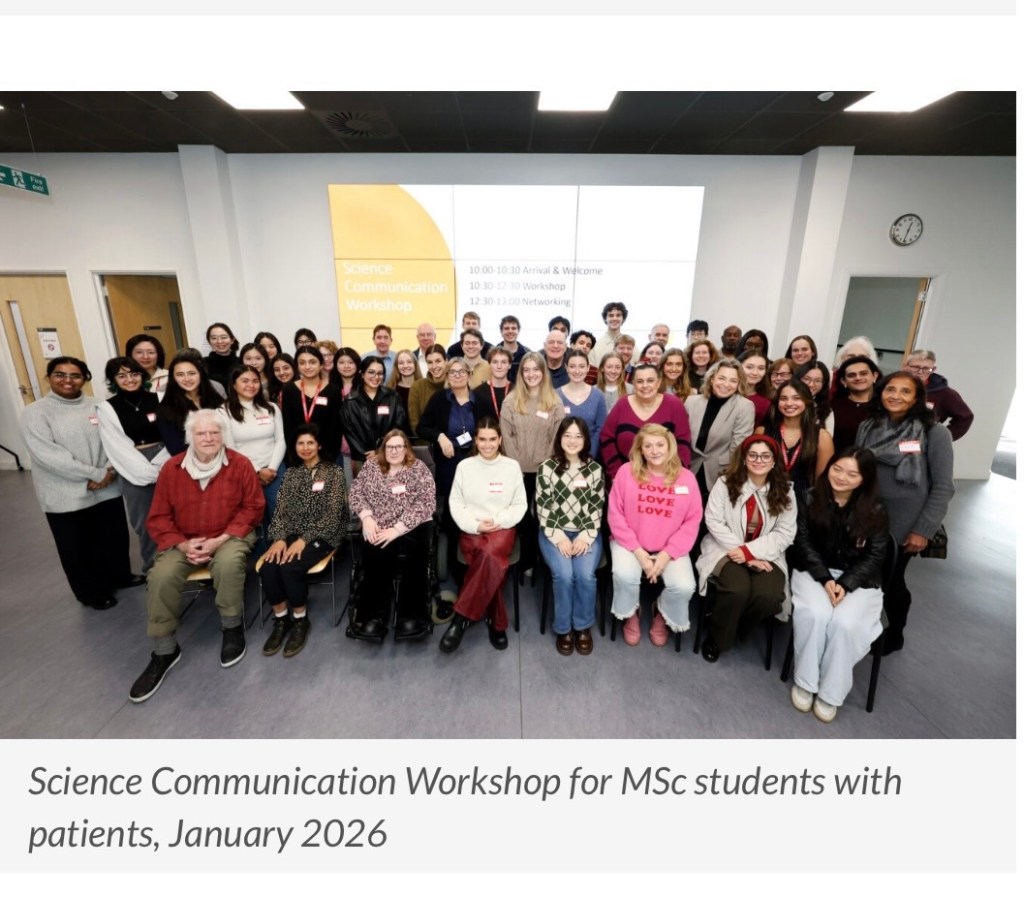
Alt Text: A large group of diverse people, posing for a photograph in a lecture hall.
Six years on & the world is still in great turmoil. When I was being diagnosed in Charing Cross Hospital during the morning of the 10th March, we were at the start of a worldwide pandemic spreading fear & panic across the world. Today we’re at the edge of war which is escalating by the day. That’s pretty scary for any cancer patient, or anyone in receipt of regular, life-saving treatment. Any unplanned interruption or break in treatment cycle is terrifying for the patient, their families & friends.
I can’t let my mind go to the places that it went to when I was diagnosed & then my operation was cancelled three days later. I’m not going to think about war potentially interrupting my treatment. Instead I’m going to think about the here & now.
In a couple of weeks time I’m catching up with my oncologist at Charing Cross Hospital, London. I haven’t seen her for just over two years (I haven’t needed to), but depending on how I’m doing, I may have reached the end of one of my treatments. I’ve got to the target age of 55 & I’ve had the total number of treatments required. This is the first big treatment change I’ve had since finishing radiotherapy in September 2020. It’s quite a milestone. You know that I have a needle phobia? (I’ve mentioned it in most of my blogs, lol!) Since March 2021, I’ve been on a monthly injection of Gossamer (brand name Zoladex) which shuts down my ovaries, so the cancer can’t feed off my Oestrogen. It’s brutal. The injection is in fact a pellet that gets injected into your tummy & it slowly dissolves in the lining of your stomach. When the GP presses the syringe, it clicks really loudly & it never fails to make me jump! I use numbing cream on the site which I put on an hour before the injection. That really helps control the pain & my nerves.
I’ve always had awful side effects with this injection although most people don’t get any at all. After the injection is given, my body temperature soars, my brain turns to mush & I’m sleepy for the rest of the day. If I’m lucky I won’t get a bruise from the injection but I always bleed after it because my stomach is squashed up when I’m sitting in my wheelchair. I’ve got neat little red pin pricks all over the left side of my stomach (I don’t have them on my right because of my body shape – that’s too complicated to explain!) I wonder if these pin pricks will ever disappear?
I’ve asked what side effects there could be when I come off Zoladex. All the medics I’ve spoken to so far seem a bit non-plussed by my question because apparently this drug has no side effects. So I guess like everything else on this cancer journey, I’ll just have to find out for myself. I do wish there was research on the side effects of ER positive cancer treatments on people with Breast Cancer.
And talking of cancer research, this brings me on to what I’ve been doing for the last year & a half.
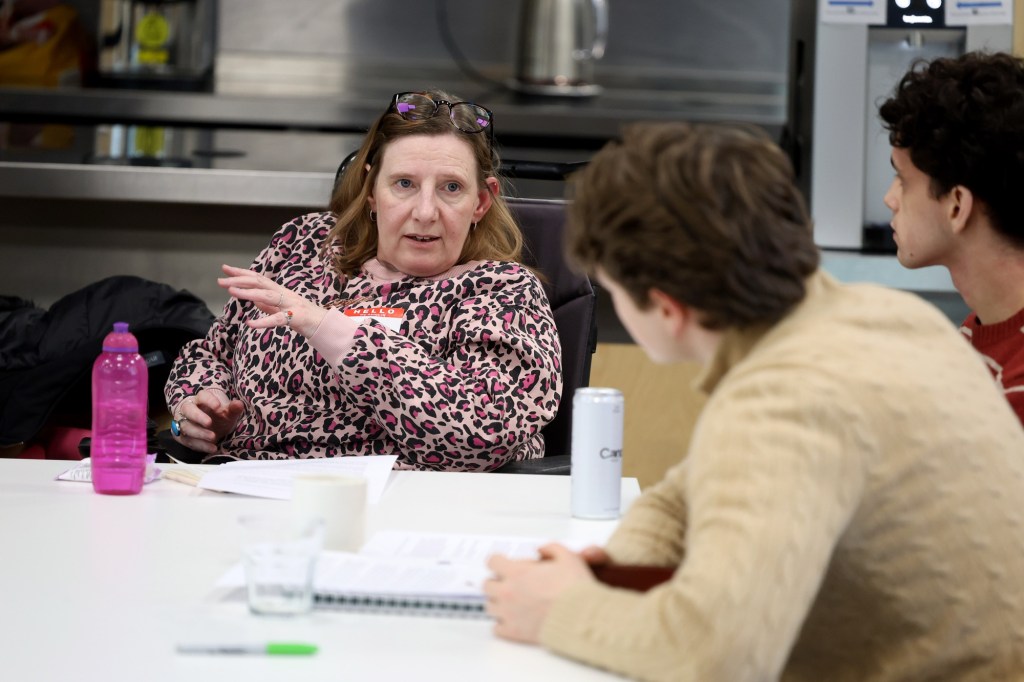
Alt Text: A middle-aged woman, sitting in an electric wheelchair, is at a table with two young, diverse students in a room. They are deep in discussion. There are notebooks, pens, papers, cups, glasses & water bottles strewn across the table. The background is blurred but there is an area for preparing food & drinks. The surfaces are all stainless steel.
About 18 months ago I bumped into a neighbour at my local Maggie’s Centre who was there supporting her sister. We got talking & knowing my activism background, she told me about how I could get involved with some Imperial College / Imperial NHS Trust programmes for cancer patients. I contacted the Lead Nurse for Imperial CRUK, Kelly Gleeson, explaining who I was & my lived experience, & I got a really positive response back. I went to a meeting & that was the start of my involvement with PPIE – Patient Public Involvement and Engagement – with Imperial.
Since then, I’ve co-produced an EDI (Equality Diversity Inclusion) measurement tool with other patients & one of the professors that makes sure that researchers are including a diversity of patients in their work, worked with an artist who is designing peaceful environments for hospital rooms, co-designed an exercise programme with an O.T. & other patients for people who have mobility impairments, I’ve attended a London hospitals trust conference as a Patient Advocate where new treatments & research were discussed & I’ve been in a film about the importance of early detection in cancer (& why diverse people are likely to miss out on that early crucial stage of screening & testing).
It was during the filming that I met the Head of PPIE at the Royal Marsden Foundation NHS Trust, Markella Boudioni. Because the hospital hasn’t identified any disabled cancer patients being treated there, she asked me to join their PPIE programme too. So far, I’ve done some training to prepare me for the role which has been really helpful, I’ve joined the Equality, Diversity & Inclusion Patient & Public Contributors (EDI PPC) Group & taken part in an inaugural meeting of patients & the PPIE to identify what’s most urgently needed in support for diverse patients.
However, my most favourite task is to work with the student researchers at the ‘Science Communication Workshops.’ It’s always so interesting. Their projects bring light & hope into the world when it’s easy to become so despondent. And ultimately, their research will save lives, perhaps not in my lifetime, but in the future. The students are fiercely bright & eager to learn. The patients are more than happy to support them. We all learn a lot about cancer this way, & we all want to contribute to this bigger picture. More & better treatments are being developed, alongside treatments which are kinder to cancer patients. Early detection & testing becomes better & more reliable. Treatments can be personalised even more than they are now.
During the ‘Science Communication Workshops,’ the students have to read their ‘lay summaries’ (a 300 word summary of their project & what they’re trying to achieve) to the patient advocates. Then we have to tell them if we’ve understood them. Patients are always part of the boards who decide on what gets funded & also patient involvement is a much bigger part of the research process than ever before, so giving this support is really important.
Last month, Kelly asked me to write an article about my experience working with MSc students (Masters) & I’ve included links to a couple of places where it appeared.
From the Convergence Science Centre’s website –
And from Imperial’s website –
Thanks to Kelly for commissioning me & to all the students and patient advocates who contributed.
Cancer anniversaries are never, ever easy but I’m thankful that I have a community around me who I can lean on.
 The Musings of Spu