Over the last few months I’ve been reading lots of self-help books and lots of books by people who have lived experience of breast cancer. It’s not such a horrific read as you may think!
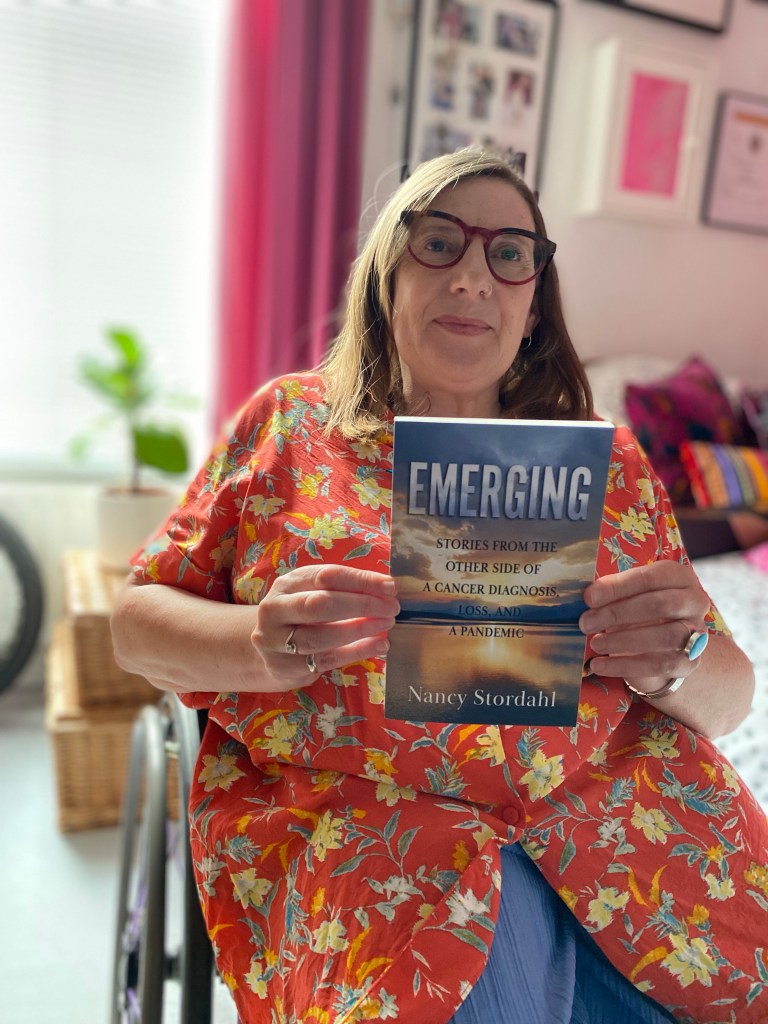
Alt Text: A middle-aged white woman with long, straightened brown/blond hair sits in her wheelchair, in her bedroom. She is smiling & holding a book entitled ‘Emerging – Stories from the other side of a cancer diagnosis, loss and a pandemic’ by Nancy Stordahl. She is wearing round, pink/brown glasses, small, silver hoop earrings, a small silver nose ring, a silver watch, 3 silver rings (one with a large turquoise stone) on her fingers, blue plisse trousers & an oversized orange blouse with yellow, blue & white flowers, & green foliage printed on it.
I’ve spent the last few months delving into self-help books and reading autobiographies of people who have a breast cancer diagnosis. I wasn’t ready to read any books like this before now, although I was a regular reader of blogs from the start of my treatment.
Reading them has been difficult for all the obvious reasons; it’s brought up some feelings & thoughts which I’d rather have buried. And, of course, none of them detail anything on the disability experience with breast cancer. However, they were really good in helping me understand my emotions. They gave really great practical advice & a couple were really good at explaining the medical science behind breast cancer treatments.
During this period I read:
● ‘Emerging – Stories from the other side of a cancer diagnosis, loss and a pandemic’ by Nancy Stordhal
● ‘The Cancer Survivors’ Companion’ by Dr Frances Goodheart & Lucy Atkins
● ‘Glittering A Turd’ by Kris Hallenga
● ‘The Complete Guide To Breast Cancer – How To Feel Empowered & Take Control’ –
Professor Trisha Greenhalgh & Dr Liz O’Riordan
● ‘Under The Knife’ – Dr Liz O’Riordan
And then I also read two books which aren’t about breast cancer at all but I can really relate to them because of my disability experience – I’ll come back to why I added them in later in the blog:
● ‘Reasons Why You Should(n’t) Love Me’ (playscript) – Amy Trigg
● ‘First In the World Somewhere’ (autobiography) – Penny Pepper (I actually contributed to
its crowdfunder for Unbound & I read this years ago but it’s a book that’ll stay with me forever)
I’m not going to review them because I want people to discover them for themselves & I think it’s important for people to take what they need from the books. Instead, I’m just going to say why they stood out for me, even if it’s just one phrase that helped me, an experience that I could relate to, a piece of advice, or something that helped me get some perspective.
‘Emerging’ by Nancy Stordahl:
So in the interests of transparency, I’ve been a big fan of Nancy since coming across her blog, ‘Nancy’s Point’ on ‘X’ (formerly known as Twitter). Nancy has been equally supportive to my blog, retweeting & sharing each one. I bought her book & after leaving a short review, Nancy approached me to help her get her book & blog into wider circles. I agreed because I was excited at being part of a ‘gang’ of self-published, independent writers across the world that offer support to one another.
I enjoyed ‘Emerging’ because I was getting the perspective from a US citizen. Through Nancy, I learnt about the US way of life, the way in which the US handled the pandemic, & how Nancy experienced all of this as a breast cancer patient. Nancy also gave an intimate insight into how she coped with grief & family loss. This was helpful to me after losing my Mum to cancer, & seeing both my Dad & my sister go through their own cancer diagnosis.
But what I related to the most was Nancy’s concept of ‘Moving Forward’ after a cancer diagnosis. Did you know that the most annoying thing to me is when people say that it’s time that I moved on from cancer & start to put my life back together & to start enjoying life again? All with the notion that doing this will help me feel much better. Oh do f*k off! Like many cancer patients, I can’t actually move on from cancer. For a start, I have a LOT more scars & a large dent in my boob. Then I have to take daily medication to prevent the cancer from recurring, & then a whole lot of other medication to try to stop the side effects of the cancer drugs. A large needle punctures my stomach every month to suppress my ovaries & every six months I get an infusion to stop my bones from breaking. And then there’s the menopause & I can’t remember sh!t. So excuse me if I can’t move on! But Nancy talks about the concept of ‘Moving Forward.’ You can’t move on from a huge trauma. However, she encourages you to move forward in your life, carrying all this ‘stuff’ with you, & she encourages you to embrace your life with a cancer diagnosis in it. I found this idea more helpful than any CBT (Cognitive Behavioural Therapy) techniques & Mindfulness. Nancy is a star for highlighting the difference between ‘Moving On’ & ‘Moving Forward.’
‘The Cancer Survivors’ Companion’ by Dr Frances Goodheart and Lucy Atkins:
This book was helpful in some areas, but it was too general for me in its advice & support. Some of its advice was really obvious, but that could be because I’ve had a lot of therapy in my life (before your minds start whirling – I didn’t seek treatment because I was depressed about being disabled!) & I had a course of CBT from my local Maggie’s Centre whilst I was waiting for my surgery (which was delayed because of the pandemic). I think the difference between this book & other books was that the lived experience wasn’t there from the authors; it felt more like theory, although there were featured case studies from patients peppered throughout the book as real-life illustrations.
‘Glittering A Turd’ by Kris Hallenga: I love the title!
This autobiography is a beautiful, life-affirming, brutally honest book & I loved it. If you don’t know Kris, she founded the charity ‘CoppaFeel.’ As a charity-founder myself, I could relate very well to starting something yourself to help a community that isn’t being supported. In Kris’ case, it was because younger people were often being dismissed as being ‘too young to have breast cancer.’ (To be frank, young women are still being dismissed in the same way today). Kris was diagnosed with breast cancer at 23 & very quickly it was diagnosed as secondary.(i.e. It has spread to other parts of her body).
What stood out to me was Kris’ lust for life. I’m someone who has a lot of challenges but I love life too so it was easy for me to relate to Kris. But the most important affirmation was when Kris said that she wasn’t afraid to challenge medical teams & to make sure she fully understood the implications of treatments before making any decisions. I was relieved to read that in print. If you’ve been reading my blog for a long time, then you’ll know how much I’ve had to challenge, but at the same time, I’ve expressed guilt for ‘acting like a Diva’ (at the end of my radiotherapy, I apologised to the Breast Cancer nurse for my demanding ways, my angry outbursts & my temper. She replied that there was no need for me to apologise & she said that it was important that I’d done this – it was the way that the medical team knew I would be able to get through everything that was thrown at me).
‘The Complete Guide to Breast Cancer’ by Professor Trisha Greenhalgh & Dr Liz O’Riordan:
I really, really should have read this book three & a half years ago, at the point when I was diagnosed. There’s no better way of giving a 360 degree of the breast cancer experience by two breast consultants who then got diagnosed with breast cancer. It’s so generous of them to share their experience to help other women. I couldn’t imagine knowing what was going to happen to me because I’d been treating so many women with breast cancer. I find that so terrifying.
But because the two consultants have treated so many different types of breast cancer & they’re updated on all the research & medications, it means that they can give so much detail (it’s important to add that their guide is currently being updated). They include case studies about themselves that serve as a comparison (because their types of breast cancer were different & their treatment options were different) & there are case studies from other patients too. I liked the comparisons of how they dealt with their diagnosis in different ways. It was so helpful to have a guide on how you might want to tell people about your diagnosis (& if you don’t) & giving some details about practical help that you might need both throughout your treatment & support after it when you’re not seeing your medical team anymore. This book also acknowledges your family & friends – they could equally pick up this book & it would help them to understand what they could do to support. I loved this book & I can see that I’ll be dipping into it for the rest of my life.
‘Under The Knife’ by Dr Liz O’Riordan:
Liz’s autobiography was published this year by Unbound & it details her life in medicine, her battles with depression & when her life gets turned upside down by a breast cancer diagnosis – twice. Like Kris’, it is uplifting (especially when Liz finds her passion in running & cycling) but it’s also brutally honest. It made me think much more about the emotions that medical teams go through & how hard it hits them when they can’t save a patient. How hard surgeons & consultants work to give you the best possible chances. That they don’t always have the answers but they so often have to figure a way through in a split second & in the most challenging environments (thinking about A & E here). And the relentless march of patients who are going through their worst moments & then the medical teams have to put them back together again – but who puts the medical teams back together again? Liz describes the camaraderie of medical teams & her own coping mechanisms.
As Liz was reacting to her diagnosis, it brought me sharply back to my own & how absolutely terrifying it was. I’m so grateful for the kindness & dedication of the breast cancer team at Charing Cross.
Some of the books cover different communities & diversities of people, & how diagnosis can impact differently, but none of the books covered the disability experience. The difficult, sad part of this is that sometimes the books highlighted my isolation.
The books didn’t cover poverty either. There were lots of references to treating yourself, having massages, sleeping in a separate bedroom if your menopause symptoms were disturbing your partner, making use of a downstairs bathroom if stairs were too much at the beginning, etc. It took me back to the pandemic where a family might have had one computer between them, if they had one at all, kids completing their homeworks on a family mobile, people in shared houses having to share bathrooms & kitchens, etc. I thought back to when I’d graduated from university. I wouldn’t have coped with cancer treatment then. My first home was a single room in a housing co-op where a bed & a chest of drawers just about fitted in. The house was meant to be for ten single people but we had twenty in ours as a family of five were in the room next door to me. In later years, I lived in an old people’s home (this often happens to disabled people as these are often the only local homes that are accessible) because it had a semi-wheelchair accessible bedsit. My kitchen was a cupboard off a main space that was my bedroom/sitting room – I slept in the same room as my fridge & freezer! At least I’d upgraded to having my own bathroom by then.
I know someone who was going to their biopsy & they were 20p short for their bus fare. Despite explaining their situation, the bus driver refused to let them onto the bus so they walked to their appointment. They arrived two hours late – they had rung ahead & luckily they were still seen. Their breast cancer team were appalled at what had happened.
Whilst some services are free to access & some people might be eligible for help with transport & other living costs, this is absolutely a postcode lottery & help isn’t consistent across the country. I’d like to see books that speak honestly & openly about how poverty impacts on the cancer experience.
Returning to the subject of lived experience of disability, I’m going to reference two books that haven’t got anything to do with cancer, but they kept me sane whilst I was reading the books about cancer. These two books aren’t self-help books at all, they are autobiographical & written by disabled people.
I read Penny Peppy’s ‘First In the World Somewhere’ & because Penny is a dear friend of mine & I love the bones of her! I had so much in common with Penny’s lived experience, not just disability, but she’s post-punk as well, was in bands, writes, & into the DIY scene. She talks openly about her sexual experiences & being comfortable with her body which is important. Penny is an activist & she’s been campaigning her whole life for disability equality & equity for the disabled community.
In 2022 I went to see Amy Trigg’s one woman show ‘Reasons Why You Should (n’t) Love Me’ & it blew me away. It was like my life on the stage – growing up in Essex, trying to avoid the religious groups that would pray for my miracle cure & many hours spent at the Spina Bifida Clinic in Chelwest (big shout out to their team as they’re amazing as well). I spoke to Amy afterwards, mainly about growing up in Essex. I bought the play script which she signed (I’m very proud of this!) I read the script in between all the self-help books & it reminded me that my lived experience of disability is probably the strongest thing that I have in this world & although it complicates my cancer treatment, it has helped me self-advocate in the most desperate of situations & helped me navigate the NHS.
So, to conclude – the best self-help books are ones written by those who have lived experience, & we need more about cancer & disability, & cancer & poverty.
Boom!
 The Musings of Spu
Thank you so much for this wonderful review. I’m honored to be included with the other fine folks. And, thank for raising those two very important issues regarding breast cancer disparities. Whenever we are advocating, we need to be more inclusive of those with disabilities and those who struggle financially.
LikeLiked by 1 person
It was my pleasure to include Emerging.
LikeLiked by 1 person
Thanks for another down to earth, say it as it is blog Suzanne – always educational and very often emotional!
LikeLiked by 1 person
Thanks Geoff!
LikeLike