This month’s blog I’m handing over to the brilliant Kate Fox. As with most of us who are disabled and then get diagnosed with Breast Cancer, they have quite a story to tell!
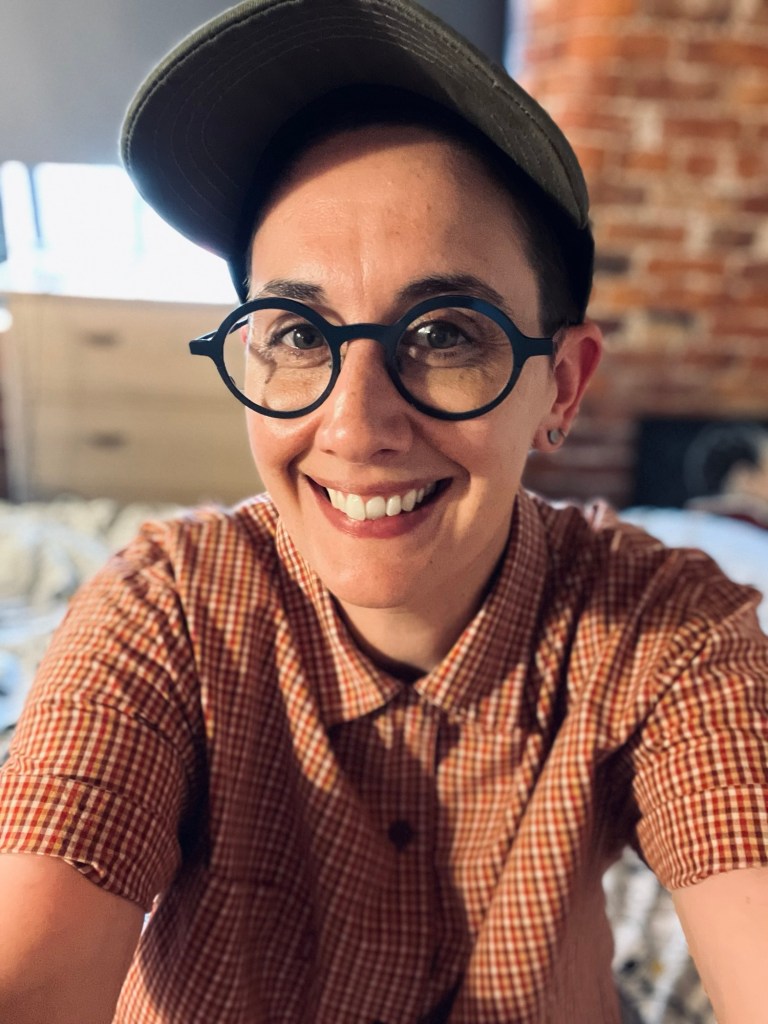
Alt Text: Kate, a white non-binary person with round, black-framed glasses is taking a selfie and smiling at the camera. They’re wearing a checked shirt and a black baseball cap.
I’m Kate, and I’m jumping into write a guest post thanks to a very kind invitation from Suzanne.
I was somewhat unexpectedly diagnosed with breast cancer in April 2022, and this is a reflection on my experience.
I live in Manchester, and my family and I had moved house the year before my diagnosis – when our city was still under a lot of COVID restrictions. I worked for a large arts organisation, and things were very busy, so by early 2022 I was definitely feeling tired and emotional!
I had some nagging aches and pains in my chest. When they didn’t go away, I decided to take advantage of our new GP surgery where it was much easier to get an appointment than the one in our old neighbourhood.
The GP was reassuring – she was pretty sure this was nothing to worry about, but she referred me to the hospital just to check.
It’s important to note here that I’m nonbinary and disabled, so my first trip to the breast clinic was bound to be an adventure. I’m too young to have encountered a mammogram before through national screening, so I traipsed off with considerable trepidation.
My sister, who’s a wheelchair user, had had a breast cancer scare the year before and ended up having an ultrasound scan straight away because the mammogram machine wasn’t accessible for her…this made me nervous about what contortions were going to be needed!
Being totally honest, on the day itself, I was less worried about the possibility of cancer than about the machine and the fact that I was clearly going to be expected to put on a pink robe, sit in a corridor for several hours and focus on a part of my body that I had some really complicated feelings about!
I got through it – again, the doctor that examined me first was reassuring. She even said, ‘I don’t think this is cancer’. There was a lot of sitting in corridors, and my wonky stance didn’t make the mammographer’s job any simpler, but we got it done. I went home, went back to work and tried to forget about the whole saga.
Cut to three weeks later, the middle of the school Easter holidays. I was with my partner and 7-year-old, walking back from a morning of enforced holiday fun / organised childcare. My phone rang and the hospital if I could be there in 45 minutes to get my results. My partner and I looked at each other over our kid’s head…we knew this couldn’t be a GOOD sign.
I left the family at our flat and rushed to get to the hospital. I found myself in a small room with a consultant and a Macmillan nurse (again, I didn’t take this to be a good sign). The doctor told me that they were all SO surprised when there had turned out to be a small lump and even more surprised it had turned out to be cancer.
He also asked why I’d come on my own, to which I thought ‘because you rang me 45 minutes ago in the middle of the school holidays, so the person I’d have brought needed to stay with my kid…’
The upshot was that my surprising cancer was eminently treatable, so the consultant soon trotted off, leaving me with the Macmillan nurse. She was great. She managed to move me to another consultant who had some experience working with trans and non-binary folks, which was brilliant (at least, it was brilliant while I was in her clinic – whenever I ventured into other bits of the hospital, people tended to forget about my gender identity, just as they tended to forget about my disability).
I was offered a slot for surgery soon after my diagnosis, which came as quite a surprise to my workplace. It was a huge scramble to tie up loose ends and get ready.
Once again, on the day of surgery, I was again more distracted by how/whether I would be asked to climb onto the operating table (I was, and it wasn’t easy) than about what was actually about to happen. I had a weird reaction to the anaesthetic that I think was disability-related, and it was only when this happened afterwards that I realised no-one had really talked to me about my access needs before the operation (and I, as we know, was quite distracted and not best placed to advocate for myself).
When I had my second surgery the following year, I had to have a psychological appointment beforehand. There was an opportunity then to note anything else you wanted the surgeons to know – so I used that to talk about my access needs.
It’s annoying that this wasn’t offered by default the first time round – especially because I was so knocked sideways by the speed of everything at that stage that all my professional knowledge (I’m an access consultant) went totally out of the window!
Recovering from surgery was slow. At first, I was cautious to set foot outside or walk anywhere – I was terrified of falling (which I normally do regularly) and landing with my elbows in the brand-new scars. I’ve cracked many a rib in this way before thanks to my close relationship with gravity, and I didn’t want to add that to my recovery! I acquired a new stick to reassure myself and eventually managed to go step by step round the block.
During my recovery, it felt like there was a lot of pressure to get involved with exercise. This was quite difficult for me – as a disabled person in a mainstream school I had terrible experiences with P.E. and I wasn’t keen to revisit it. I found Yoga for Cancer was a lifeline because I could do the sessions at home on Zoom, and skip or adapt anything that didn’t work for me.
Later, I joined a weight training group run by the lovely Carolyn Garritt. This was online again, so I could go at my own pace – and Carolyn was brilliant at suggesting adaptations for me. She even managed to connect me with some other folks in her community with neurological disabilities so we could compare notes.
I’ve managed to continue with weight training since having my second surgery and continuing hormone treatment, and while it’s sometimes been a struggle, it’s benefited my strength and challenged my (lack of) balance.
The other thing that cancer has done is improve my ability to advocate for my own access needs. I think this was in part because it felt like things I needed due to cancer were taken somewhat more seriously or urgently than other needs – which is daft, but did increase my confidence to ask for other adjustments.
I feel like I’m now in about my 4th different body in 5 years as I journey through hormone treatment, but it’s a body I know better than I did before.


This was incredibly moving and at the same time thought provoking- what an amazing person.
LikeLike
Thank you Helen, I’m going to forward your comment to Kate x
LikeLike