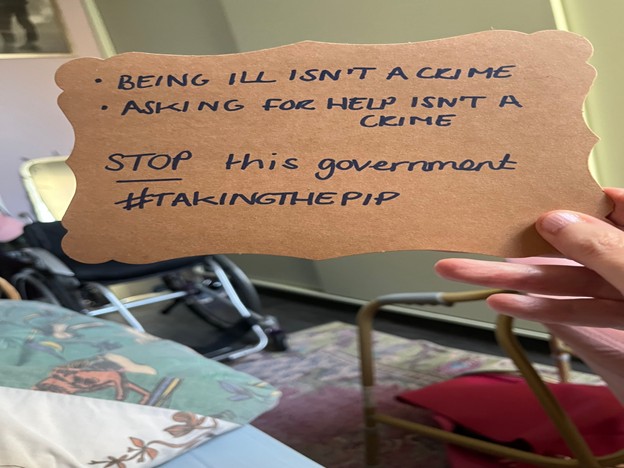
Being ill isn’t a crime & neither is asking for help. But with the UK government’s proposed Welfare Reform Bill, it’s getting harder and harder to be disabled, become ill & grow old in this country!
#TriggerWarning – this blog discusses some subjects which readers might find upsetting, including extreme poverty, hardship & death.
Alt text: A brown, cardboard sign being held up with one hand. The text written in blue felt tip pen says ‘Being ill isn’t a crime. Asking for help isn’t a crime. Stop this government from #TakingThePip. The photo was taken from a lying down position, in a bedroom decorated a little bit like Art Deco-style. Amongst other possessions in the background are a child-sized, gold-coloured walking frame & a chrome & purple-coloured manual wheelchair.
July might be ‘Disability Pride Month’ across the world, but it’s difficult to celebrate here in the UK when the disabled community are having their rights and dignity stripped away. I think what’s baffling to people is that it’s a Labour government that is proposing these wide-reaching Welfare Reforms because it’s not really a ‘Labour thing’ to do. Labour were sworn in with a huge majority. Lots of voters were disabled people & their family, friends & allies because people felt that they were voting for fundamental changes to the way that disabled people would be treated in the future & an end to the austerity measures of the Conservative government.
But it’s not the first time that a Labour government has discriminated against disabled people. When Labour was voted in on a landslide victory in 1997, & Tony Blair became Prime Minister, the first thing he did was propose cuts to disability benefits. I know this to be true because I was at one of the big demos throwing red paint on the gates of Downing Street. I was also quoted on the front of a couple of broadsheet papers about how the cuts would devastate disabled people, & my dad said that this was one of his proudest moments!
In the 25 years that I was at Attitude is Everything, I was demonstrating less publicly & more carefully because I knew how important it was as a charity leader to be seen as a-political. Nevertheless, I was a fully paid up member of the Labour party for many years. Now that I’ve left the charity, I can be much more obviously political – oh & I’ve recently resigned from the Labour party, citing the Welfare Reforms as my reason for ditching Labour. I sent a scathing letter to the party membership!
For this round of demos, I’ve been supporting the online campaigns led by @Taking The Pip, @Fight4Life, @Access To Work Collective & @Not Dead Yet UK (more later about the two last campaigning groups on my list. There have been many demos in cities, towns & outside the UK Parliament but I haven’t been well enough to get there in person (I’m saving the explanation about this when I know more about what’s happening with me). But there’s also another consideration for me – will the DWP (that’s the UK’s Department of Work & Pensions) be taking note of who’s taking part in the demos, & then will they use this to claim that if I can get to a demo & protest all day, then surely I don’t need my disability benefit? You might think that this is serious paranoia on my part. It isn’t because the DWP do look through people’s social media accounts, etc, to see what claimants say & do. For instance, one time they contacted me because of a feature that I’d written on my charity website & I’d called my assistant my PA. They demanded that the charity change the description to ‘Support Worker funded by Access To Work!’
However, disabled people need to show up on demos because otherwise it’s ‘out of sight, out of mind!’ It was down to the rigorous campaigning & lobbying of ministers that last-minute changes were made to the Bill before the first vote. There were also 50 ministers who rebelled against the Bill & forced some changes to it. I have to say that the changes are still detrimental to the disabled community, but seemingly the government has agreed to consult & co-produce the Welfare Reforms with disabled people & their supporters.
I also met with my local (Labour) MP to talk through how damaging these reforms are going to be & we’re still in correspondence over the matter. I put a compelling case across but he still voted for the reforms.
So what’s the Labour government doing that’s hurting disabled people so much? It’s claiming that there are too many people on benefits, especially young people, that don’t need to be on benefits, & they want to cut down on benefit spending. They’ve also said that they want to get more disabled people into work. I have some perspectives on this. We’re only 5 years since we had a world pandemic in which some people became more disabled after contracting The Virus, & people still need a lot of support with their mental health (such as social anxiety & social interaction, agoraphobia, isolation). Young people missed out on their education & some could never return to it. Disabled people do want to work – if they can work. There’s a certain amount of dividing the disabled community up into the ‘undeserving poor’ & the ‘deserving poor.’ Because of the way that disability is portrayed, the ‘undeserving poor’ might be the people who don’t work, to whom it may seem that they could work if they wanted to. The ‘deserving poor’ might be disabled people for whom it’s obvious that they can’t work, or they do work so the public think “well at least they’re giving it a go!” or how they view Paralympians or other such great achievers. I should add a footnote here that the UK Prime Minister thought that PIP (the Disability Benefit) was an out of work benefit. That’s wrong, you can receive PIP if you’re working too.
This is why I started the blog stating that being ill & asking for help isn’t a crime. We all need help from time to time. You might become disabled. Everyone grows older.
The majority of disabled people do want to work, it’s just that no one wants to employ us! I make no secret of saying that I built my career in disabled-led companies. I had no interest in joining a mainstream organisation or company because I didn’t want to be THAT disabled employee, cutting a lonely figure in the workplace, trying to cope with microaggressions & being expected to answer every single question about disability, illness & access from my non-disabled colleagues. The majority of employers don’t want to make reasonable adjustments for their disabled employees, they’ve decided that a disabled colleague won’t fit the workplace culture, they doubt disabled colleagues’ ability & they feel that disabled people will need more sick leave than other colleagues. I’ll return to more of what prevents disabled people getting into, and staying in work later in the blog, but I just wanted to outline the UK Welfare Reforms & what the damaging impact is likely to be.
Government’s proposed Welfare Reforms:
MP’s voted on Tuesday 1st July 2025 to allow the UK Government’s Universal Credit and PIP (Personal Independence Payment) Bill to advance to the next stage in becoming law. About 126 Labour backbenchers had previously threatened to vote against the legislation, enough to block its passage through the UK House of Commons, but in the end only 49 did so. But ministers were forced to offer a series of concessions to persuade the rebels to back the Government. The Work and Pensions Secretary Liz Kendall announced a partial U-turn aimed at heading off the rebellion that included three key points:
- Changes to PIP eligibility would only come into effect in November 2026, and anyone claiming the benefit before that date would not be subject to the new rules, instead of imposing the changes on everyone (the disabled community are furious about this because it means that younger &/or newly disabled people are penalised, & it doesn’t account for impairments that get progressively worse).
- People claiming the health element of universal credit, and new claimants with the most severe conditions, would see their incomes protected in real terms.
- Thirdly, minister for Disability Sir Stephen Timms would conduct a review of the PIP assessment, “co-produced” with disabled people.
However during the debate on 1st July, Sir Stephen offered a further concession – any changes to PIP eligibility would only be introduced after his review had concluded. This delays the changes; pushing back PIP changes to an unspecified date, leaves uncertain the details of what those changes will be, & thus removes a major part of the Government’s reform plans. The proposed changes to universal credit remain, raising the standard allowance while halving the health element for most new claimants from April 2026.
This is likely the effect on disabled people – source – Taking the PIP – Home – Taking The PIP #TakingthePIP
700,000 families already living in poverty will face further devastation. Over 3.2 million disabled people and their families will be affected.
Under the government’s proposals, people will no longer qualify for the daily living element of PIP unless they score a minimum of four points in a single daily living activity. In the current system, points are accumulated across areas of need. As a result, someone who cannot wash below the waist or needs support to eat may be deemed “fit” & cut off from lifeline benefits.
The health component of Universal Credit will be cut by nearly half, from £97 to £50 per month for new claimants, & payments will be frozen below inflation for existing recipients. Losing PIP will automatically strip people of the health element of Universal Credit – causing a domino effect of financial ruin.
The proposed cuts will:
- Strip financial support from those who need it most
- Push hundreds of thousands of families deeper into poverty
- Reduce access to care, equipment, transport, & basic needs
- Overwhelm councils, which rely on PIP assessments for social care
- Remove eligibility for Carer’s Allowance from thousands of unpaid carers
- Deepen social exclusion & increase disability-related deaths
Scope – Home | Disability charity Scope UK – has calculated that disabled households face an average of £1,010 extra costs per month – even after existing benefits. The Joseph Rowntree Foundation Home | Joseph Rowntree Foundation – warns that by 2029/30, individuals could lose 16–58% of their income. Some will be unable to cover food, bills, or housing. Many will lose their homes. Homelessness amongst disabled households has risen by 75% since 2019.
Already, 69% of people referred to food banks are disabled. These numbers will surge. The Trussell Trust – Ending hunger together | Trussell – Carers UK UK | Carers UK – and multiple disability organisations have raised the alarm. Every £1 removed from PIP will cost local councils £1.50 (I’ll say this, it’s hardly any savings for councils!!!!)
There are over 16 million disabled people in the UK, yet not even a quarter of those receive PIP. Those who do are the most in need. PIP is not a benefit for disabled people – it is access to life. Without it, people are left housebound & isolated.
Aside from having cancer, I think this is one of the most serious situations that I’ve faced in my life. My PIP goes towards my care (I have a care package awarded by my local authority) & hiring my car through the Motability scheme – Motability Scheme | Lease a car, WAV, scooter or wheelchair – I need care to get me up & going about my daily business, & I need my car so I can work, see family & friends, & socialise. All the normal daily activities that most people do & take for granted. If I lose it, then I’ll be stuck at home, with really bad B.O. (Body Odour).
There appears to be a trend across social media of ‘influencers’ who are boasting about the benefits that they’re getting, how much they’re getting from the state instead of working, & how much they’re getting. So for example, someone with ‘tennis elbow’ winds up with a Mobility car & proudly shows his new car off. A woman who flaunted a benefits-funded luxury lifestyle in Thailand on social media. These people make me absolutely sick because this is why the general public has the impression that life is easy on benefits. I also think that when it comes to reform, the government doesn’t need to do anything else but pursue & prosecute these influencers for making a mockery of our welfare system. Why are disabled people getting penalised instead of these people?
I said I’d return to disabled people getting into, & staying in work. In all the places that I’ve worked, the workforce has been majority disabled people & disabled interns / trainees. In my 30+ years career, I’ve never met a single disabled person who can work & doesn’t want to. I just don’t know who these work-shy people are that the government refers to! What I’ve experienced are trainees, interns & colleagues who are eager to learn, excited about working towards a shared purpose & supportive of the community that they represent. They’ve been excellent problem-solvers (comes from navigating an inaccessible world), supported other colleagues in the team when needed & often gone beyond & above the requirements of the role because they’re hungry for more responsibility & promotion. And because of this, all the organisations that I’ve worked for have strived hard to prioritise best practice adjustments to enable all colleagues to work at their best & enable them to thrive at work.
One scheme that I have benefited from, & many other disabled colleagues have too, is the Access To Work scheme – Access to Work: get support if you have a disability or health condition: What Access to Work is – GOV.UK
In the past, Access To Work has supported me with equipment that I need to carry out my role (e.g. a new wheelchair & an electric power assisted trike, voice-assisted software, a Support Worker, covering my fares when I travel to work). Access To Work is far from perfect – I’ve had a sudden review with some of my support cut at short notice, & been kept waiting until the 11th hour to find out if my support Package will be renewed for the next three years. When it works, it’s brilliant. I’ve had some lovely Support Workers over the time & it’s made work really enjoyable.
But guess what, the government, who have said that their aim is to get disabled people into work, is also cutting back on their Access To Work scheme. Yep! It really makes no sense at all.
This is the likely impact of the cuts to the Access To Work scheme taken from The Access To Work Collective’s #AccessToNowhere campaign (you can find them on Linked In):
As of February 2025, 62,000 applications were still waiting, and 33,000 people were waiting in a backlog to be paid. Behind every number is someone at risk of losing their job or someone who already has.
The Access to Work Collective surveyed over 250 disabled workers, employers, & suppliers.
- 7 in 10 said they probably would not have or absolutely couldn’t have got into work, attended interviews, or stayed employed without Access to Work.
- 86% said it has a major impact on their ability to stay in work or run a business.
- 100% of employers said their disabled staff would struggle to do their jobs without it.
- 78% of employers said it enabled them to hire disabled people by covering workplace adjustment costs.
Yet instead of fixing and expanding the scheme, the government is cutting it back without consulting disabled people. The effects are devastating:
- People are waiting months, even years, for support.
- Some are forced into debt or onto benefits because Access to Work payments don’t arrive, despite being given an award for support.
- Unpaid invoices & unworkable processes are pushing employers & suppliers to the brink. Many have now closed down.
- Support workers & sign language interpreters are leaving due to illegal below-minimum rates and late payments.
- The stress is damaging people’s mental health, causing burnout & forcing many out of work altogether.
So the scheme which was designed to remove barriers to work has become the biggest barrier! Yet there’s something even more sinister lurking behind all of these cuts & reforms. I’m not the only one making this link to the Assisted Dying Bill, other disabled people are too. If the government can’t take away our lives & our dignity, & if they can’t starve us to death because we’ve no money to get food, then they can get disabled people with the Assisted Dying Bill. Many disabled people, like me, have grave concerns about how this proposed Bill doesn’t have enough safeguards to protect vulnerable & disabled people. You know the narrative that some people like to parrot – ‘you don’t want to be a burden to your family,’ ‘your life is hard, why not ease the pain,’ ‘people like you cost us taxpayers so much money,’ etc. Given the right (totally wrong!) circumstances, people can be manipulated. The Assisted Dying Bill terrifies me. I realise that some of you might find that strange because I live with a cancer diagnosis. But I love life & I want to live it as I choose.
I want to finish up by saying that the disabled community has a lot of allies & this is the time to show up for us all by questioning, scrutinising, supporting both the online & in-person demos. This social media post is from the veteran DJ Tony Blackburn, proving that reforms not only hurt disabled people, but it deeply hurts our families & friends too.
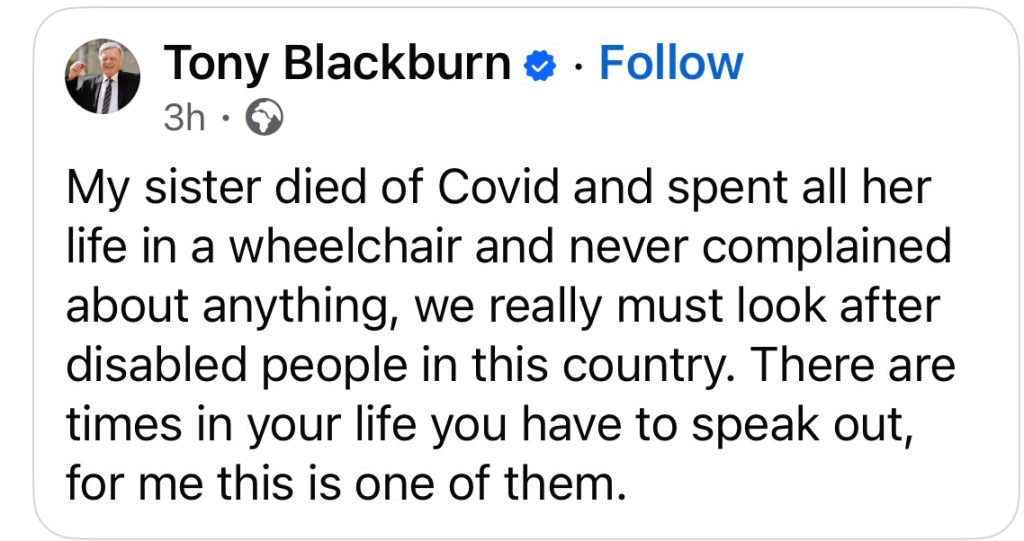
Alt text: A screenshot of a social media post from Tony Blackburn. There is a small, round photo of him in the left hand corner. He is an old man with grey hair, wearing a black suit jacket & tie, & a white shirt. He is holding up a medal & he is smiling. His post says ‘My sister died of [The Virus] & spent all her life in a wheelchair & she never complained about anything, we really must look after disabled people in this country. There are times in your life you have to speak out, for me this is one of them.’
 The Musings of Spu
Thanks for sharing all your observations and concerns Suzanne.
Much to be taken in and much to do.
The awareness you create is so valuable, particularly when action comes from your sharing.
Thanks
LikeLiked by 1 person
Thanks so much Geoff. Honestly, I can’t believe things are so bad for disabled people in the UK at the moment! There was so much hope for Labour to change things for the better!
LikeLike