Today, 10th March, marks 6 years since I heard the words, “I’m sorry you have Breast Cancer.” My head did a 360 turn & then my life became ‘Before B.C. & After B.C.’ So what’s happening now?
Alt Text: A large group of diverse people, posing for a photograph in a lecture hall.
Six years on & the world is still in great turmoil. When I was being diagnosed in Charing Cross Hospital during the morning of the 10th March, we were at the start of a worldwide pandemic spreading fear & panic across the world. Today we’re at the edge of war which is escalating by the day. That’s pretty scary for any cancer patient, or anyone in receipt of regular, life-saving treatment. Any unplanned interruption or break in treatment cycle is terrifying for the patient, their families & friends.
I can’t let my mind go to the places that it went to when I was diagnosed & then my operation was cancelled three days later. I’m not going to think about war potentially interrupting my treatment. Instead I’m going to think about the here & now.
In a couple of weeks time I’m catching up with my oncologist at Charing Cross Hospital, London. I haven’t seen her for just over two years (I haven’t needed to), but depending on how I’m doing, I may have reached the end of one of my treatments. I’ve got to the target age of 55 & I’ve had the total number of treatments required. This is the first big treatment change I’ve had since finishing radiotherapy in September 2020. It’s quite a milestone. You know that I have a needle phobia? (I’ve mentioned it in most of my blogs, lol!) Since March 2021, I’ve been on a monthly injection of Gossamer (brand name Zoladex) which shuts down my ovaries, so the cancer can’t feed off my Oestrogen. It’s brutal. The injection is in fact a pellet that gets injected into your tummy & it slowly dissolves in the lining of your stomach. When the GP presses the syringe, it clicks really loudly & it never fails to make me jump! I use numbing cream on the site which I put on an hour before the injection. That really helps control the pain & my nerves.
I’ve always had awful side effects with this injection although most people don’t get any at all. After the injection is given, my body temperature soars, my brain turns to mush & I’m sleepy for the rest of the day. If I’m lucky I won’t get a bruise from the injection but I always bleed after it because my stomach is squashed up when I’m sitting in my wheelchair. I’ve got neat little red pin pricks all over the left side of my stomach (I don’t have them on my right because of my body shape – that’s too complicated to explain!) I wonder if these pin pricks will ever disappear?
I’ve asked what side effects there could be when I come off Zoladex. All the medics I’ve spoken to so far seem a bit non-plussed by my question because apparently this drug has no side effects. So I guess like everything else on this cancer journey, I’ll just have to find out for myself. I do wish there was research on the side effects of ER positive cancer treatments on people with Breast Cancer.
And talking of cancer research, this brings me on to what I’ve been doing for the last year & a half.
Alt Text: A middle-aged woman, sitting in an electric wheelchair, is at a table with two young, diverse students in a room. They are deep in discussion. There are notebooks, pens, papers, cups, glasses & water bottles strewn across the table. The background is blurred but there is an area for preparing food & drinks. The surfaces are all stainless steel.
About 18 months ago I bumped into a neighbour at my local Maggie’s Centre who was there supporting her sister. We got talking & knowing my activism background, she told me about how I could get involved with some Imperial College / Imperial NHS Trust programmes for cancer patients. I contacted the Lead Nurse for Imperial CRUK, Kelly Gleeson, explaining who I was & my lived experience, & I got a really positive response back. I went to a meeting & that was the start of my involvement with PPIE – Patient Public Involvement and Engagement – with Imperial.
Since then, I’ve co-produced an EDI (Equality Diversity Inclusion) measurement tool with other patients & one of the professors that makes sure that researchers are including a diversity of patients in their work, worked with an artist who is designing peaceful environments for hospital rooms, co-designed an exercise programme with an O.T. & other patients for people who have mobility impairments, I’ve attended a London hospitals trust conference as a Patient Advocate where new treatments & research were discussed & I’ve been in a film about the importance of early detection in cancer (& why diverse people are likely to miss out on that early crucial stage of screening & testing).
It was during the filming that I met the Head of PPIE at the Royal Marsden Foundation NHS Trust, Markella Boudioni. Because the hospital hasn’t identified any disabled cancer patients being treated there, she asked me to join their PPIE programme too. So far, I’ve done some training to prepare me for the role which has been really helpful, I’ve joined the Equality, Diversity & Inclusion Patient & Public Contributors (EDI PPC) Group & taken part in an inaugural meeting of patients & the PPIE to identify what’s most urgently needed in support for diverse patients.
However, my most favourite task is to work with the student researchers at the ‘Science Communication Workshops.’ It’s always so interesting. Their projects bring light & hope into the world when it’s easy to become so despondent. And ultimately, their research will save lives, perhaps not in my lifetime, but in the future. The students are fiercely bright & eager to learn. The patients are more than happy to support them. We all learn a lot about cancer this way, & we all want to contribute to this bigger picture. More & better treatments are being developed, alongside treatments which are kinder to cancer patients. Early detection & testing becomes better & more reliable. Treatments can be personalised even more than they are now.
During the ‘Science Communication Workshops,’ the students have to read their ‘lay summaries’ (a 300 word summary of their project & what they’re trying to achieve) to the patient advocates. Then we have to tell them if we’ve understood them. Patients are always part of the boards who decide on what gets funded & also patient involvement is a much bigger part of the research process than ever before, so giving this support is really important.
Last month, Kelly asked me to write an article about my experience working with MSc students (Masters) & I’ve included links to a couple of places where it appeared.
For the past few months, I’ve been submitting my ideas to the UK Government’s National Cancer Plan from the perspective of being disabled and then getting diagnosed with cancer via MacMillan Cancer, Breast Cancer Now and the Department of Health & Social Care. To my surprise I received an invitation from Number 10 Downing Street to join the Minister of Health and Social Care, Wes Streeting, for a presentation on the new National Cancer Plan, ahead of World Cancer Day.
Alt text: a headshot of a white-skinned disabled woman sitting in her wheelchair in front of a black door. She is wearing a long, black puffa jacket, a gold slide in her hair & pink / brown round glasses. She is smiling. Behind her, the black door is open & a small group of diverse people are milling around. It’s night time.
For the past 18 months I’ve been heavily involved with Imperial College and Imperial NHS Trust as I’ve joined their EDI (Equity, Diversity & Inclusion) & PPE (Public & Patient Involvement) programmes. And two weeks ago I was invited to join the Royal Marsden’s PPIE (Public and Patient Involvement & Engagement) group because they don’t have anyone who identifies as disabled to support their activity. I’m going to write a future blog dedicated to the topic of PPIE at a later date, but first, I wanted to talk about how I contributed to the National Cancer Plan.
Here’s what the UK Government’s Department of Health & Social Care say about the new plan:
Three in four cancer patients will survive long term under radical new cancer plan
75% of patients diagnosed from 2035 will be cancer-free or living well after five years, following record investment in the NHS
NHS to meet all cancer waiting time standards by 2029, with hundreds of thousands more patients treated within 62 days
Major expansion of robot-assisted surgery and faster diagnostics to slash delays
Patients will receive faster diagnosis, quicker treatment, and the support to live well with cancer under the government’s landmark National Cancer Plan, unveiled today.
For the first time, the NHS will commit to ensuring three in four people diagnosed with cancer from 2035 onwards are cancer-free or living well after five years.
This represents the fastest rate of improvement in cancer outcomes this century and will translate to 320,000 more lives saved over the lifetime of the plan.
The NHS has not met its central cancer performance target - that 85% of patients start treatment within 62 days of referral - since 2014. Survival rates are below Romania and Poland for some cancer types.
Under this plan, that will change – by March 2029, the NHS will meet all three cancer waiting time standards, meaning hundreds of thousands more patients will receive timely treatment. This demonstrates the real change being delivered by the government’s record investment as we rebuild the NHS.
60% of patients currently survive for 5 years or more and around 2.4m people are currently living after a cancer diagnosis.
The plan sets out sweeping reforms to how cancer is diagnosed and treated:
Faster diagnostics: A £2.3 billion investment will deliver 9.5 million additional tests by 2029 -investing in more scanners, digital technology and automated testing. Where possible, Community Diagnostic Centres will operate 12 hours a day, seven days a week, bringing testing closer to where people live.
Robot-assisted surgery: From hip replacements to heart surgery and cancer operations, the number of robot-assisted procedures will increase from 70,000 to half a million by 2035, reducing complications and freeing up hospital beds.
Treatment at specialist centres: More patients with rarer cancers will have their care reviewed and treated at specialist cancer centres, where they can benefit from the expertise of the best cancer doctors. These centres bring together surgeons, oncologists, specialist nurses and radiologists to agree the best treatment plan for each case.
Genomic testing: Every patient who could benefit will be offered a test that analyses the DNA of their cancer. This helps doctors understand exactly the type of cancer someone has and choose treatments most likely to work for them.
Waiting lists: New technology is being developed to give patients better access to tests for cancer by offering them the earliest available appointment from a range of NHS organisations in their local area.
The government has also announced a new AI pilot to help detect hard-to-reach lung cancers sooner with fewer invasive tests as well as a new employer partnership to support England’s 830,000 working-age cancer patients to remain in employment during and after treatment.
While more people survive cancer than ever before, progress has slowed over the last decade, and England remains behind other comparable countries including Australia and Denmark. For some cancers, such as brain cancer, survival rates in England trail behind countries like Croatia and Romania.
The cancer plan comes as the government continues to make strides on cancer waiting lists, diagnosing or ruling out cancer on time for 213,000 extra cases since July last year.
One hundred and seventy community diagnostic centres are now open – with over 100 of them available at evenings and weekends – bringing checks, scans and tests closer to where people live and at times that work around them. The government is also taking tough action on the causes of cancer: introducing a generational ban on smoking and a ban on junk food ads before 9pm.
I know it’s quite a lengthy piece to digest, but I want to make sure that everyone who lands on this page gets the chance to read the press release in full.
I must admit, I got really excited when the consultation for the National Cancer Plan was announced. I saw it as my opportunity to talk about my experiences as a disabled person living with a cancer diagnosis & what needs to change in screening, detection, treatment & survival support for disabled people to have an equitable experience in cancer care. I gave my feedback at a conference organised by MacMillan Cancer & the Department of Health & Social Care, as well as submitting detailed, written notes after the event. I submitted notes directly to the Department of Health & Social Care, as well as completing public surveys hosted by Breast Cancer Now and MacMillan Cancer.
You never know where your perspective, your hopes, dreams, fears and ideas will take you. On this occasion, they took me to the heart of the UK Government – to a reception hosted by the Minister for Health and Social Welfare, Wes Streeting, at Number 10 Downing Street. (Downing Street is wheelchair accessible. There are temporary ramps to enter through Number 10, then there is a passenger lift to take you to the first floor. There’s one final lift for wheelchair users – it’s very posh, it turns the carpeted steps into a platform lift with the aid of a small key & takes you to the reception rooms. Yes, you miss out on climbing the staircase where all the UK Prime Ministers’ portraits are, but you can go out on the landing to view this area).
I have been to 10 Downing Street before. It was for the launch of the Edinburgh Fringe Festival. In my capacity as a senior leader within music, live events and access for disabled people, I’ve attended meetings, receptions & events in the House of Lords & the House of Commons. I also hosted an event in the Atlee Suite, Portcullis House. However, this time it felt even more special because I was invited because I’d shared my personal lived experience. It felt like my perspective had been taken on board amongst the thousands of responses.
Let me share some statistics with you which galvanized me to work on the National Cancer Plan. (This from a conference for medics that I was invited to last year. I attended as a PPI patient):
Pre-existing comorbidity rates were higher in the cancer population (13%) compared to their peers; and those with more comorbidities were likely to have an extended referral interval.
Pain, multiple symptoms and less typical symptoms were all associated with longer treatment referral.
There was increased primary care attendance history in the 2 years prior to diagnosis – even when peer-matched.
People with severe & enduring (the presenter’s words, not my own) mental illness had the most clinical contact, but they were diagnosed at a later stage. (I enquired as to their definition of mental illness & the presenter said it included people with anxiety and/or depression).
Minister Wes Streeting made a compelling speech. I’m not saying anything that’s not in the public domain by sharing that he lives with a cancer diagnosis himself. He was diagnosed with Stage 1 kidney cancer a few years back. He talked about his fears as a kidney cancer patient & also the experiences of his close friends & constituents, some of whom didn’t receive the timely diagnosis, treatment & kindness that we all should expect.
At the end of his speech, we had the opportunity to speak with the Minister on a 1-2-1 basis. As you can imagine, I was one of the first in the queue! It wouldn’t be right for me to repeat our conversation word for word, but we did talk about this myth that disabled people can’t possibly get cancer or any other general health condition if they’re already disabled, access to health information in different formats, inaccessible mammograms & radiotherapy tables, & what cancer treatment might do to bodies and/or the health of people with underlying conditions. Currently there is no clinical trial data or research data on disabled people who have been / are being treated for cancer. He then directed me to his team & we had a really positive conversation about how to change attitudes on cancer care & disabled people, & how to ensure equity of experience for disabled cancer patients. I didn’t shy away from the more difficult parts of my experience – like the time my surgery was cancelled because it was March 2020 & the times that I was devalued in conversations like “are you sure you want to go ahead with cancer treatment?” & “if we take you into hospital in March 2020 & you caught the other ‘c’, then you’re not likely to survive – oh & you wouldn’t be offered a ventilator either, (i.e. implying that the ventilator would go to someone younger & healthier than me). There were a lot of shocked faces but for me, that’s all the more reason I need to speak out. And in that moment with the Minister, I felt ‘heard.’
When World Cancer Day arrived a few days later, I shared some photos of my partner & I outside Number 10 (you’re not allowed to take photographs inside the building) on social media & I shared different pieces on the National Cancer Plan as well as the statistics that had been previously shared with me. I’m sure World Cancer Day was triggering for a lot of people, their families & friends – me included. I made sure that I didn’t share anything more personal on this day.
But the real work on the National Cancer Plan starts now. We’ve all got to hold the UK Government’s feet to the fire on targets, & we’ve got to get the hospitals & other healthcare settings to abide by the plan. We’ve got to get improved care and survival rates for those most marginalised – by poverty, deprivation, diversity including disability & learning disability, age & the area where they live.
A bit longer down the line, I’ll return to the National Cancer Plan because I haven’t had the chance to review the final edition through the eyes of the disabled perspective. I wanted to give it time to sink in.
Finally, I want to remember Graham Findlay who passed in the early hours of World Cancer Day. Graham got in touch with me because he was a disabled person who was also living with a cancer diagnosis. Like me & many of my guest bloggers, he wanted to improve the cancer experience for other disabled people. We’d planned to work together on a collaborative blog, but this wasn’t to be. I’m sad that we never got to meet in person & I’ll miss our email exchanges. He was a kind, generous & funny man. I’m sending love to his family, friends & colleagues.
My annual mammogram seems to come around quicker with each year that passes, but there’s always something different to report! Let’s see how I got on this January.
Alt Text: A photo of a residential street taken from the ground floor front window. Outside there is a light blanket of snow on the pavement & on the street as it continues to snow. In the foreground through the window, there is a terracotta pot, resting on a sill. There are two cyclamen plants, not in great shape, in the pot. The flowers are pink or red. They have green leaves with white veins. Looking beyond the flowerpot, there is a concrete wheelchair ramp with black handrails leading to the pavement. Cars are parked on both sides of the street. There is a traditional black London lamppost. The houses opposite are red-brick Victorian houses with sash windows & small balconies.
I braved the early January weather to go to hospital for my mammogram. It was a few days after my birthday. It was freezing outside & also in the scan room. This is never great when you’re about go topless & put your breasts on two very cold scanning plates! But here we are, those in charge still not entirely thinking about the comfort of people going through mammograms!
I had a very supportive radiographer who was doing my scan, but I could see her face drop a little when she realised that I was her patient. This nearly always happens & I’m very used to it. I have to take a deep breath & get into ‘battle mode.’ This means remaining as calm as possible. I also attempt to get the radiographer not to panic: I remind her that it’s easy if she follows my direction & that I’ve been having mammograms for many years. My attempts don’t always work & the procedure really tests my patience, but I try to give it a fair go!
This year there was something new offered – a chair for me to sit on. It went up & down, a bit like an office chair. It might have been permanently in the room but it could have been put there for me. Someone spotted that I was a wheelchair user from my notes. I had asked for a wheelchair accessible mammogram at 2025’s scan. I’m not entirely sure if this is how accessible mammograms have been set up, but I was very wary of this chair. The radiographer insisted that I should use it because it would be ‘better for both of us.’ It’s because the chair was able to go up and down. But I declined because I was worried about the chair giving me enough support for my back & even if it went down low, would it still be able to accommodate my left hip which protrudes & makes left-side scanning a little trickier (& sometimes painful)? After a bit of gentle to & fro, I suggested that we should try me with standing again, as time was ticking (not that there were any other patients in the waiting room with me). I was trying to hurry the start of the process because I was getting really nervous!
The mammogram went ahead in the usual way – I stood on one leg & positioned myself just about long enough for the image to be taken. The radiographer was pleased at the effort that I was making & at the same time surprised that this was even working at all. As usual, I became breathless when the plates had to push hard against my protruding sternum. One of the left side scans had to be repeated because the radiographer couldn’t get a good enough image. But we persevered & bingo, the scan was completed in about 10 minutes. About halfway through the radiographer started to rush – running back from taking the image, to re-position me for the next scan. I had to ask her for a mini-break to take in some water. She was kind & supportive, apologising for the room’s freezing temperature.
Quite a lot of you will know the drill by now, but I have to wait 15 days for my result. Scanxiety is riding high & I’m trying to keep myself occupied. It’s particularly bad at the moment because I’ve been experiencing extreme fatigue & stomach upset which could be ‘something & nothing’ (as British people say). I start to shake when the postman arrives.
A few days after the scan, a notification popped into my NHS app (a medical app for UK patients which gives us our appointment dates, letters & test results. We can also order our prescriptions through it). On closer inspection, there were some results. I opened it up & it said that there was a notification for a mammogram, but the accompanying text said “able to view from 5th February 2026.” I hate these messages. What’s the point of alerting you that the scan is in, but the patient isn’t able to view it yet? It just makes the whole scanxiety thing a whole lot worse!
I don’t have any outcome to give you. I’m hoping I get the all-clear again. It’s been six years since my diagnosis. I’m still in treatment for potentially another 10 years so it has been quite difficult watching most of my peers who are now reaching five years since diagnosis, & able to come off their medication. I try not to think about the 6.5 years ahead of me & how much more mobility I might have lost by then, or how confusion will further reign in my brain. But I’ve got to try to tolerate the treatment as best I can.
I see my oncologist in March so I’ll catch up with her then. She’s also ordered another Bone DX (bone scan) for me in February. It’ll tell the same old story of osteoporosis setting into my bones, & why my lower back hurt. I need some dental work, but I can’t take it yet because I have extensive dental work to be done. I’m also rather afraid as this medication can wreck your teeth & jawbone. However, I’m hoping that my Zoladex injections can finish in March 2026 as I would have done the regular course of monthly injections. But as always, you’re forced to live in the moment when you live with a cancer diagnosis.
Remembering my lovely neighbour who passed from secondary breast cancer last week. May she rest in peace for eternity.
Alt Text: A white-skinned couple in front of a Christmas tree covered in little coloured lights & Christmas decorations. Behind the tree is a wooden Advent House with numbered doors that can open & close. The house is painted red, copper & green. The numbers & stencilled images on the doors are painted white. The woman sits in a manual wheelchair, wearing a blue dress, a necklace with a purple ribbon that acts like a chain & a cross with beads of purple. She is wearing black/blue glasses, silver hooped earrings and a nose piercing with a diamond looking stud. She is smiling. The man is wearing a black jumper with a picture of Chevy Chase in the lead character of Clark Griswold. Text in red capitals says ‘Merry Kiss My Ass.’
Blog:
Well who would have thought it – I’ve reached my 60th blog! I started writing the blog in December 2020 & this is another milestone that I’ve reached.
I promised to update you about the tests & scans on my eye (which I first wrote about in my previous blog). First of all I want to say that my eye is fine, thank goodness! Moorfields is the best eye hospital in London, potentially the world, & they treated me with respect. Here’s what happened at my appointment with them.
When we arrived at the hospital, working out how to get to my department was pretty easy because it has coloured lines on the floor & large text signs to follow. The staff were all very aware & came out of their reception are, bringing their checking sheets with them so that visually impaired people didn’t have to struggle at the reception desk. That was a really lovely touch & I’ve not seen that in other hospitals. There were a lot of patients & staff, but the area was calm & the staff kept everyone informed about waiting times. I honestly don’t think that I waited more than two hours – & that was only because I wanted to see my results straight away with a consultant present.
The first room that I went into, the medic just took some basic details. Then she checked my eye pressure (& this time I did let her put the device on each of my eyes very quickly. For me, it wasn’t painful at all. Then I read the wall chart (with my glasses on, I mean…!) & finally she put some eye drops into each eye. People say they’re painful at times, but my eyes weren’t sore at all. I admitted to the medic that I was very concerned about the outcome today, so she advised me to say to the radiographer that I wanted to wait to see the consultant.
Then I went for the scans & tests which were like the tests I had Western Eye Hospital, except this time I wasn’t rushed & I had eye drops in my eye to create the contrast needed. I repeated to the radiographer that I was too scared to wait two weeks for my results & that I wanted to see a consultant. She was fine about it & said I’d only have to wait 30 mins to an hour longer. I could see that she was puzzled about what I’d said about having a cancer scare so I asked her outright if she could see any cancer. She said that the consultant would confirm that (I knew deep down that would be her answer, but I always try & ask the radiographers all the same).
The scans & tests were inaccessible as usual so there I was, wobbling away in a time-limited standing position on one leg, just like each mammogram that I have! Having said that, the radiographer was kind, helpful & patient.
I went back to sit out in the crowded waiting room but it was still calm.
An hour passed. Both medics that I’d already seen kept checking that I was ok. Then a very friendly lady came out & introduced herself as the consultant, & then she ushered me into her room. She had a student there as well. She started off by asking me why I had mentioned eye cancer (remember Western Eye hospital’s referral letter only contained 3 Latin words but no information to say that I’d had Breast Cancer & that I was a wheelchair user!) I explained my circumstances & she said, “Now it makes sense!” in a big exaltation. She went on to confirm that it wasn’t cancer on the back of my eye at all. In fact, not only that it wasn’t cancer, it was never likely to develop into a melanoma. It was just a simple mark. I burst into tears of relief. I asked her about the yellow pigmentation & the raised part of the mark. She confirmed that they were never there, turning the scan image towards me to show me that the mark was completely flat. So Moorfields were right all that time ago when they said I didn’t need to be seen by an eye cancer doctor! She apologised for the treatment that I’d had. She said that there was no way that this was even a suspicion of cancer & that she was genuinely baffled that Western Eye hospital hadn’t immediately picked this up as non-cancerous. She apologised for all the distress caused to me. Then she said a couple of important things: directed towards the student – “Learn from this because this is no way you should ever be treating a patient in this way.” Then she said that she was concerned that my mental health had been damaged by this situation, so she wanted to see me in six months’ time to re-do all the scans & tests. This was to double reassure me that there was no cancer & that I should be confident in the results. I was still crying when I left her room.
I quickly updated Stephane in the corridor as we got ready to leave. Then the consultant & both of the other medics came out again to check on me one final time, and the consultant touched my arm as if to say, “You’ll be ok now.”
I’d waited so long for this appointment. I’d worried myself sick that my cancer had come back. I’d got up very early in the morning & travelled across town at daybreak to get to Moorfields. It was unnecessary in so many ways.
I got some rest on the same afternoon but I had to wake up & prepare the injection site for my cancer injection. My GP was treating me in the early evening. I cried all over again when I was explaining everything about that morning to her. She asked if I would write a complaint to Western Eye hospital. I said Moorfields would probably do some sort of internal investigation, but that I’d write a complaint as well.
Actually I’m not going to make a complaint. I’ve written so many complaints over the years to the NHS. I haven’t got the energy to do it at the moment. If I do decide to do something, I’ll just send PALS at Western Eye hospital this blog, & my previous blog.
I’m bringing on Christmas as soon as Friday the 12th. Yes, after Friday, I’m taking a month off work. Not because I’m particularly financially stable or anything, but because if I can’t take a month off as a freelancer at a time of my choosing, then why am I freelancing! 2025 has been a very big year & I need to relax to let everything slowly sink in.
Christmas time can be a very mixed month when cancer is around. In the past few years I’ve opted to stay home & enjoy the main event in my little flat with Stephane. Sometimes I get poorly over this period & that’s not nice. If friends & family want to see me, then I ask them to come to me instead. Rushing here, there & everywhere isn’t conducive to me having a good Christmas, NYE & a good birthday.
I advise taking Christmas at a slow pace. Let someone else take on the cooking, the planning of the board games, the planning of the tv-watching, working out how many chairs you need around the table (& do you need a bigger table?) & worrying about where’s everyone going to sleep. I bet you’ve done so many years of this, so this time it’s time to put yourself first at Christmas. You won’t regret it!
Finally, I’d just like to thank all my readers & supporters for commenting on my blogs, sharing them & sending me love. I appreciate you all very much. I hope you have a wonderful Christmas & here’s to a peaceful 2026.
This might be an obvious term to describe my current situation, but I couldn’t think of any other way to describe it! The piece comes with a #TriggerWarning as it contains details about eye treatment & cancer recurrence.
Photo credit: Jo Mieszkowski, Imperial College London.
Alt Text: A photo of a white-skinned, middle-aged disabled lady, sitting in her electric wheelchair. She is wearing tortoise-shell glasses, a yellow necklace showing the slogan ‘The Musings of Spu’, silver rings & a black & white polkadot, long-sleeved top. Her hair which is coloured ginger / pink / brown is swept up in a large clip at the back. She is smiling. The photo was taken in a large teaching space but the background has been blurred.
I wouldn’t usually share situations when what’s happening isn’t too clear, but I thought I would on this occasion so that you might get a flavour of what it’s like for me when a new problem comes up.
I have an eye test every year due to my cancer treatment. About 18 months ago, a regular High Street optician saw a small mark on the back of my eye on a scan. She asked me if anyone had ever spoken to me about it before, and I said no. She said that the mark might have always been there and because the eye scanners are more powerful these days, it’s likely to have shown up on the scan for the first time. She gave me a choice whether I wanted a referral or not, as it was probably nothing. I really wasn’t sure what to do. She explained that the mark didn’t appear to be flat, so she would recommend a referral. I went to my GP, quite flustered and concerned, & the GP referred me to Moorfields Eye hospital in London. A couple of months later the GP got a letter back from their eye cancer consultant to say that the mark was nothing to worry about & that it didn’t meet the criteria for referral to eye hospital, so the referral was cancelled.
Fast forward to this year & I went to a different chain of opticians in June. This optician gave me a better description of the mark & said that it might have some yellow pigmentation inside of it. After consulting with her colleague, she referred me to the Western Eye hospital in London this time. This hospital is within my catchment area & much easier to travel to (which was great as the appointment was for 8.20am!) After four months of waiting, Western Eye hospital gave me an appointment for October.
I don’t know if anyone reading my blog has ever been to the Western Eye hospital, but it’s chaos. The site is undergoing a huge refurbishment & even regular patients were having difficulty wayfinding (not great for an eye hospital!) I felt like I was in a cattle market – the staff were shouting out different patient names & running around, the patients were all squeezed into tiny waiting rooms like lab rats & I had to go the long way around to get to scanners & medics as many routes & lifts were blocked off. Some of the treatments e.g. the eye pressure check machine, was in an area which didn’t temporarily have access. I know opticians have a new way of checking eye pressure now which is to lightly touch your eye with a handheld machine. I can’t even put contact lenses in so I wouldn’t allow them to do use the handheld device on me. In the end, I referred the nurse to my last opticians’ appointment which said my eye pressure was fine (it’s always fine). All the chaos made me so nervous that when it came to my eye test, I wasn’t calm. The scanners that I did use weren’t wheelchair accessible so I had to wobble about on one foot to reach them, & then flop back into my wheelchair once the scan was over. It was exhausting.
My partner & I waited hours to be seen by a consultant. I think it was over 3 hours but I’m not sure – I stopped looking at the time. Because different consultants were dealing with different eye conditions, patients were called at random. I went to sit outside of the waiting room. Another man joined me & we chatted for a while. The two of us ended up being quite useful as we started giving directions to lost patients!
When I finally got to see a consultant, in a corner of the hospital corridor, by a set of steps which was the only space for her ‘consultation room’, she ‘googled’ my symptoms in front of me. Yep. I was stunned. Well to be truthful, it made me cry. I’m not sure what information the google search gave, but she then went to consult with a senior colleague. There were just curtains separating all the medics so I could hear everything that was being discussed. She returned to describe what she saw from the scans – a mole the size of a pinhead with yellow pigmentation in it, at the back of my eye, near the optic nerve. Yet she couldn’t tell me any more than that so she referred me to Moorfields Eye hospital. I pressed her on whether or not it could be cancerous. She said she couldn’t say. To try & help, she said that if Moorfields contacted me with an appointment in two weeks’ time, the mark was likely to be more serious, like cancer. By now I was beside myself. She wrote a very brief referral which was about two words long & copied in my GP. The referral caused my GP to ask me what kind of medic she was! I mean, who knows. You wouldn’t know from my referral letter why I was being referred!
So another anxious wait begins.
This is what I’m consoling myself with:
Moorfields Eye hospital has made an appointment outside of the two weeks’ waiting time for a cancer referral.
Eye cancer is rare.
Breast cancer doesn’t usually spread to the eye; the usual places are armpit (lymph nodes) lungs, brain, or the long bones in the arm & the leg.
Moorfields didn’t want to see me last time when I was referred, so it can’t be that serious.
I’ve probably always had this mole because it’s a birthmark & now that the scanners are more powerful, opticians can pick it up.
And in my darker moments:
Something got missed by Moorfields 18 months ago (when they chose not to see me).
Key information was missed by Western Eye hospital because the referral was poorly written.
The cancer unit waiting times are out of the two-week period because it’s so busy.
The spot that appeared a year ago has increased in size.
I’m the type of person that strange things happen to, so even if breast cancer doesn’t usually spread to the eye, it might have done in my case!
If they do a biopsy (the letter doesn’t say either way), then that means a needle (I’ll leave you to guess where!)
Moorfields Eye hospital is rated the best hospital in London & the best hospital in the UK according to the NHS (National Health Service) league table. It’s also regarded as one of the best eye hospitals in the world as well as being a global centre for eye research and education. I feel sure that I’ll have a better experience with their medics. They looked after my Nan for a number of years & she always spoke very highly of them. Sadly, she lost her sight to glaucoma & she had very little, if no sight, when she passed.
My eye doesn’t hurt me at all. I was completely unaware of anything different. Sometimes it feels a bit strained but I think that’s me getting used to my new reading / computer glasses. However, for another week & a half, the scanxiety continues.
I’ll try & give an update on how it went with Moorfields in my December blog.
It’s that ‘pink’ time again, although in all seriousness, I know that being diagnosed with Breast Cancer isn’t pink or fluffy at all!
Photo credit: Breast Cancer Now
Alt Text: A white-skinned, middle-aged woman with shoulder-length brown hair, sitting in her manual wheelchair in a photographic studio. She is wearing a pink outfit – a pink trilby hat, pink/brown round glasses, a pink jacket with embroidered flowers and tassels, a pink dress, leopard pink leggings with two white stripes down the side & a pink handbag with a rose flower sewn onto it. She is smiling.
October is #BreastCancerAwarenessMonth I’ll never be able to get away from Breast Cancer, through its physical and emotional scarring, it’s with me forever now, & although, understandably, some people go into hiding over this month because they can’t take all the pink & the overwhelmingly sad stories, the infographics, & the adverts, I take the opportunity to up my awareness-raising that #DisabledPeopleGetBreastCancerToo
Breast Cancer Now gave me the opportunity once again to be part of their #WearItPink campaign. This time they hired wheelchair-accessible studios so I was able to be included in the main public campaign, taking part in the official photo shoot with a mixture of my outfits & their outfits. Once again, they gave me a new blog to write about the impact that the #WearItPink campaign can have on the general public. You can read in the Breast Cancer Now website.
Here are some photos of the shoot which took place at Street Studios in East London, UK. There are some official photos and some backstage ones which were taken by my partner Stephane. I like modelling so Breast Cancer Now didn’t have to ask me twice when they approached me once again!
Photo credit: Breast Cancer Now
Alt Text: The same woman sitting in her wheelchair in the studio. She has her hair swept back with a pink diamante clip, a long, pink, fluffy feather boa, a pink metallic sports jacket and a long, pink, pleated skirt. She is smiling.
Photo credit: Breast Cancer Now
Alt Text: The same woman sitting in her wheelchair, in the same studio. She is wearing a short, pink, fluffy jacket with black shapes on, a neon pink necklace that spells out ‘SUZ’, a pink t-shirt with a cartoon of Dolly Parton on it – the text says ‘Saint Dolly’ & her hands are together in prayer, & the same leopard print leggings. She is smiling.
Photo credit: Stephane Cony.
Alt Text: Inside a photographic studio with a tripod on a white floor, & a square area with a grey backdrop & floor, flanked by two, large black screens, & white track-lighting hanging from the ceiling. The same woman in her wheelchair is inside the square area, in position for the shoot. She is talking to another woman & a man who are standing just outside the box. The woman has her dark hair in a ponytail & she is wearing black trousers, pink trainers & a pink t-shirt with ‘Breast Cancer Now’ in white text. The man has short, dark brown hair, a green checked jacket with a hood, black trousers & black trainers. He is handing some cards in his hands with questions on them.
To give some context to this photo, I made a little video with Breast Cancer Now for the website & social media, discussing my experience as well as how to maximise your fundraising efforts.
Photo credit: Stephane Cony
Alt Text: The same woman in her manual wheelchair. She is turning to one side & smiling at the official photographer who is taking her photo from a different angle. She has a pink diamante clip in her hair & she is wearing a pink, fluffy boa, a metallic pink jacket which is open to saw a pink, mesh sports top, & a long, pleated, pink skirt.
As I’ve said, the start of October has been busy with the #WearItPink campaign & my face with the Breast Cancer Now branding popping up all over social media, & seeing myself included in Breast Cancer Now reels 7 short videos. But there is a serious side to all of this.
For the last year, I’ve been taking part in PPI – Patient & Public Involvement groups with Imperial College, Imperial NHS & Imperial CRUK. The meetings are remote or based very close to where I live in West London. I had no idea just how much emphasis research funding places on ‘lay patients’ & how much they’ve been involved in designing programmes. There are always lay patients on the funding panel, & researchers have to demonstrate that they’ve worked with patients to design the programme. PPI carries a lot of funding points.
There is no data on any disabled people within cancer, no data on most underlying conditions. That’s why I’ve been struggling to find ways to support myself & to understand the cancer patient experience of people who have Spina Bifida like me. My plan is to dedicate one of my blogs to exploring the types of programmes & initiatives, like Imperial College’s EDI Kickstarter programme, that I’m involved in. But for now, I’ll just give you a taster:
Last Friday, I went along to the teaching part of Hammersmith Hospital, West London, to talk with BSc students about my lived experience as a cancer patient. There were 10 cancer patients there & we had two – three students each. Obviously my experience is completely mind-bending for everyone, including myself, but my two students took it in their stride & asked some really insightful questions – like how much of an impact has my blog had, what was the most difficult access experience, do you know if you still have a DNR (do not resuscitate) order on you or has that been removed since COVID, what would have changed your cancer experience? Each student had to present back on what they’d learnt & what had the most impact on them. Mine students said that instead of having 95% happiness with my treatment experience, I should have had 100% as this is what medics should be striving for, & it’s important to treat people as individuals & not assume that they don’t care about their body image. The lead doctor then asked me to say a little more about my experience & why it was so important for disabled people & people with other health conditions to be part of research, acknowledging that there was a severe lack of data in this area. I also discussed a feature that I’d recently seen on Channel 4 News about cancer outcomes for people with a learning disability, outcomes which were very poor. I had also shared the clip with a few medics on the PPI as well as on my instagram with a header saying “This is why I raise awareness about disabled people and cancer too.” It comes with a big #TriggerWarning (I cried my eyes out when I watched it), but you can view it on Channel 4 News website.
Finally I want to honour a beautiful, loving, funny friend of mine who brought such laughter to Breast Cancer Now’s 2023’s ‘The Show.’ She had to follow me out on the runway & she said ‘don’t go too fast in your wheelchair when we come out as I can walk that fast!” Of course, with my nerves on the first show, I completely forgot & sped off, leaving her hobbling to keep up! I apologised profusely but we had a really good laugh about it.
I’m respecting the wishes of her family & friends who didn’t want her passing to be on social media, but I just wanted to wish her well as she goes through one ‘gate’ onto the next. I’ll miss you forever.
Photo credit: Suzanne Bull MBE
Alt Text: Brick arches covered in greenery & bright, red flowers, with a stone path leading to a green garden with large trees beyond. The sky is blue with white, fluffy clouds.
My September didn’t start with a bang, it started with a bout of sickness & fatigue.
Alt Text: A selfie pose of a white-skinned, middle-aged lady, sitting in her manual wheelchair. She has long, curly, blond/grey hair. She is wearing a black t-shirt & sunglasses which are perched on top of her head. Her bag, with a leopard print strap, is slung over one shoulder. She is smiling. Her nose piercing glimmers in the sun. Behind her is a park area. Its grass has been worn away. In the distance, there is a small cafe with tables & chairs, complete with white parasols, a row of large, brick & stone arches. Lots of people are eating & drinking at the cafe.
At the beginning of this month, my health took another turn. I had a lot of sickness, chronic pain and chronic fatigue.
At first, I thought that the sickness was related to work stress left over from my previous senior role. Then I put the sickness down to a new coating on my tablets. Then I threw up the anti-sickness tablet so I assumed that this was a new bout of Norovirus – the 4th time I’ve had it in the space of a few months.
My chronic fatigue started up again. I’m literally exhausted; plodding through the day. I spoke with our local Macmillan Cancer Navigator Service (which puts you in touch with Breast Cancer nurses). A lovely Breast Cancer nurse came to the phone to reassure me – she said that it could be the effects of post-Radiotherapy treatment. I remembered that I wasn’t tired at all when I finished my Radiotherapy, in fact, I painted our shed doors with help from my partner Stephane, so that’s how awake I was! Now the post-Radiotherapy side effects were really kicking in. Not great when I’m trying to be healthy & bring in work as a new Creative Freelancer.
I was so concerned about the fatigue that I requested a diabetes check from my GP & she ordered a set of routine bloods. All the bloods came back to say that I was very healthy. My GP phoned to congratulate me on how well I was doing! To be fair, if I had got diabetes, it would have been my fault as I have put on weight. Boy, weight gain is hard to control in menopause!
Last week my chronic joint pain started to ramp up. I don’t need the weather spokesperson to tell me what the forecast is, I can feel the change in seasons through my joints!
So, in what will be my busiest month since becoming a freelancer (hurrah!) it looks like it’ll be a month of health challenges. It’s 5 years’ since I finished my partial Radiotherapy & I’m surprised at how much treatment side effects have got their hold on me.
The health challenges never really stop. I read the instagram posts of my friends from the fashion show, & they often speak of the ongoing challenges with nausea, sickness & tiredness.
Health issues are a double, triple, quadruple, whatever whammy for me. My underlying comorbidities (what a charming term that is!) I’ve written a new chapter called ‘Explainers’ on my Blogsite – you can access it here – Explainers – The Musings of Spu
‘Explainers’ provides background information about my impairments, the type of Breast Cancer that I was diagnosed with, how all my medications interact with one another & the unique ways in which I experience treatment side effects. Of course, it’s important to note that I’m not qualified to give medical advice. I’m not a medical practitioner. If you have any in-depth questions or medical concerns, please consult your GP and / or healthcare team. It’s also worth acknowledging that readers may find some of the detailed descriptions of impairments & treatment side effects upsetting. That’s especially worth noting if you know me!
I’ve been rather brave in this section. I usually wouldn’t put a name to my disability or any of my impairments & conditions. I’ve found that it can encourage people to make all sorts of assumptions about me. Every disabled person is unique, even if they have the same impairment & it’s important to remember that. However, for the purposes of giving a bit more understanding of the complexities of treatment that I face, I wavered my confidentiality.
Sometimes I find it frustrating that my oncologist doesn’t really see the need to consult with my other medical teams – she says it’s because they treat many people with underlying conditions. Whilst that might be so, my anesthetist thought it was vital that she consulted with my lung team at Brompton Hospital in order to medicate me carefully. Both Breast Cancer surgeon & my Breast Cancer nurse welcomed input from my Spina Bifida consultant about the short & longer term side effects that treatment could have on my body.. This liaison became crucial when we were debating whether it would make a difference to the outcome if I was given chemotherapy (it was only 6% benefit & not worth risking my quality of life to have chemotherapy).
I’m left in the middle trying to think how best to heal myself. I ate dry toast for about 3 – 4 days & drank lots of water. This seems to have helped the sickness, alongside the anti-sickness pills when they work, but I still have nausea with a churning stomach (apologies to my partner who struggles to hear the tv over my rumbling!)
With the tiredness, that’s just something that I need to ride out, but if I’m falling asleep on my sofa in the evening, I put myself to bed, otherwise if I sleep on the sofa & wake up a coule of hours later, I can’t sleep in my own bed. I’m trying not to scroll on my mobile late at night, & this might be a cliche, but if I read a book, then it helps me to get off to sleep quicker. I’m planning more rest hours where I just do nothing. This is very, very hard for me as I’m a livewire. But if I can’t work when I want & plan in rest periods as a freelancer, then why did I become one?!
The pain, now that’s trickier to deal with. Due to my Raynaud’s, I can take pain relief in the group of Aspirin, Ibuprofen etc. There’s just a handful of opioids that I can use, & even that has to be with caution. I’m allergic to Pregablin & Gabapentin – they both made me hallucinate & one side of my face was paralysed after taking just one tablet of each – I was terrified. I’ve got to keep the weight down & get back into my gym & swimming sessions. At least this will get me moving. Word on the street is that my local gym has now fixed their lift (after months & months of waiting) so I should be able to return. What I try & do is just take 1 or 2 painkillers per day, & put Arnica Salve (I’d better not name it because of advertising, but if you goggle it, it’ll come up) on all my joints in the evenings. This seems to help me sleep better at night. But there’s a certain amount of pain that will always be there. All I’m hoping is that it remains manageable throughout the rest of my life.
Sickness. Fatigue. Pain…and repeat. Hopefully for not much longer.
The UK’s heatwaves have definitely been strong during this Spring & Summer. It’s been affecting me in some unique ways!
Context: my back garden in West London.
Alt text: A photo of a raised flowerbed made of railway sleepers. The beds are full of flowers & shrubs including gladioli, verbena, salvia & lavender. The garden wall is made out of ‘yellowstone’ brick. Fixed to the wall is a large, round, green, metal sculpture that is shaped like a tree & called ‘Tree of Life.’ There are also some small, clear garden lightbulbs that are strung between black, metal hooks.
Don’t get me wrong, this isn’t a post about me complaining of being too hot, although it is tricky in London when the heat mixes with the pollution (I have to stay indoors when the temperature hits 30 degrees & above). Just like in very cold weather, my nerve & joint pain increase to the point where I want to chew my own bones off! This is a blog about the unique ways in which heat can affect me.
I was caught out a couple of weeks ago & I had to take a trip to A & E (the Emergency Room for my US friends!) One July morning I noticed a terrible rash on my foot – it happened to be my partner Stephane’s birthday & we were going to the Ealing Blues Festival in West London, UK. My foot was very red, hot & swollen – an infection was beginning, but it wasn’t spreading at that point as my lymph nodes in my groin weren’t swollen. It was a bit of a shock to us both. It’s quite usual for me to feel very little in my foot until it’s quite bad, but I was surprised because I look after my feet very well, alongside having monthly Podiatry. Nothing was picked up at the appointment two weeks ago. My rule is that I don’t panic unless my foot is green, it has red track marks traveling upwards & my lymph nodes in my groin are swollen. Nothing like that was happening, so we went to the festival, celebrating Stephane’s birthday with friends. We had a great time but I did have to come home early because my foot was hurting, but also to watch the celebrations of the England Ladies Football team winning the 2025 Euros – ha, magic!
The next day my foot was like a balloon & very hot. Whilst there was still no tracking & my groin lymph nodes weren’t sore, I knew I had to go to A & E. I was feeling a little bit sick & I had a temperature, so I knew that I couldn’t leave it any longer. It looked & felt like my foot had cellulitis (roughly speaking, an infection of the white blood cells), but I hadn’t had this for about three decades so I was at a loss as to what might have caused it.
But there was something else bending my mind. Three weeks previous to this infection, I’d noticed two to three rashes on my right boob. I’d never seen anything like this on my boob before. I wasn’t near the surgery site but it was accompanied by a lot of vomiting & I’ve been extremely tired for about three months, even struggling to stay awake in the daytime. I called up the MacMillan Nurses Navigator service at Charing Cross hospital, where I’m being treated for Breast Cancer, & they booked me into their clinic at the earliest available time.
No matter how hard you try, the ‘Scaniexty’ kicks in immediately, & I’m straight back on the road of not understanding my body, feeling like something dreadful is coming up.
Anyway, back to my A & E trip. It was over quite quickly. The doctor confirmed that it was in fact cellulitis (so perhaps I’m getting back to understanding my body) & that it had been caused by two or three insect bites. Pesky bloody things! I’m never barefoot except in the shower because my feet are so delicate, so I blamed a large spider that I’d seen in there! Why did it have to get me? Luckily, I avoided intravenous antibiotics (I find that procedure so very painful) & I was sent home with very strong penicillin, or as I like to call it, my old friend Flucloxacillin. I’ve been taking this medication on & off since I was four years’ old. That’s how long I’ve been getting foot infections. I hate it. It makes my skin stink, it upsets my stomach & it makes me so depressed that I cry. But it is good at healing skin infections, so you know, every cloud & that!
The Flucloxacillin mixed with strong pain relief wiped me out completely for two days. For a foot that doesn’t feel much, it was agonising, so God knows how much it would hurt if I had full sensation! When I could return to the front room & rest on the sofa, I had my foot elevated, using an ice pack wrapped in a towel to take down the swelling.
My GP had a look at my foot whilst she was giving my monthly Zoladex injection (part of my ongoing cancer treatment) two days later. It didn’t look much different & we were both disheartened. I promised her that if it didn’t look better by Friday, that I’d return to A & E.
I was praying that Friday would give better news because I didn’t want to jeopardise my appointment at the Breast Clinic the next day (the clinic is open on Saturdays too because they have so many patients).
Thankfully I turned a corner on Friday. The swelling had reduced & there were less areas of redness on my foot. In fact, my foot looked more bruised – a shade of light purple. As said before, anything is better than green! I also noticed that the rashes on my boob had faded. They’d never itched or hurt me, but they were previously very red & raised. I was beginning to suspect that the rashes on my boob were just playing with my emotions. Not cool. Not cool at all.
Early morning Saturday I attended the Breast Clinic as planned. The clinic was packed. I watched one lady chatting away happily with her friend, then her demeanour changed once she’d seen the consultant. “I wasn’t imagining it, there’s definitely something there”, she said anxiously to her friend. She had to wait for a scan. Her friend was very kind & tried to keep her spirits up, getting her a coffee. But the lady had stopped talking, her thoughts were pre-occupied & she looked scared. I’ve been there, and many of you have too, & it’s a terrible, dark place to be. I hope that outcome is good for her as it sometimes isn’t as bad as it seems. But you just don’t know & the waiting is torture.
Context: the route to the Breast Clinics at Charing Cross Hospital, Imperial NHS, Fulham, London.
Alt text: A photo taken inside a hospital of large, wooden double doors. One is open, leading to a long corridor with a couple of wooden chairs with blue padding along the side of the corridor which has large windows. The corridor walls are painted off-white & the non-slip flooring is a magnolia colour. The sign above the hospital doors says ‘Breast clinics (screening & assessment). Endoscopy,’ with an arrow pointing ahead, all in blue & white. There is a standard emergency exit sign in white & green, with an image of a person running. The ceiling is tiled in white & grey.
After about an hour of watching people go from consultant to scanning & back again, my name was called. Thankfully it was a female consultant who I’d seen before. She had already read the discharge notice from my trip to A & E so she asked me about it. I then got a thorough examination, & I explained why I’d come – that I’d never seen rashes like this before on my boob. She was very kind & gentle, reassuring me that there was nothing untoward happening, & most importantly, the rashes were disappearing. I was embarrassed & expressed that I might have wasted her time, but she insisted that I should always come if I was at all concerned – any changes must always be checked out. In my discharge letter to my GP, she even expressed that she was happy to see me anytime, which helps my mental health.
It’s been a couple of weeks since the foot & boob incidents. My foot is still a bit swollen & a light shade of pink, but the Podiatrist checked it over & there’s no sign of infection. The rashes have gone on my right boob. However, this morning I noticed a similar rash on my left boob.
It seems those insects are determined to get me!
Context: me in the hospital’s cafe, putting my head back together before the short drive home.
Alt text: A selfie pose of a white-skinned, middle-aged woman sitting in a hospital cafe. She has long brown, blond & grey hair. She is wearing glasses, a white face mask, & a light & dark grey furry hoodie. She is making the ‘thumbs up’ sign with one hand.
Being ill isn’t a crime & neither is asking for help. But with the UK government’s proposed Welfare Reform Bill, it’s getting harder and harder to be disabled, become ill & grow old in this country!
#TriggerWarning – this blog discusses some subjects which readers might find upsetting, including extreme poverty, hardship & death.
Alt text: A brown, cardboard sign being held up with one hand. The text written in blue felt tip pen says ‘Being ill isn’t a crime. Asking for help isn’t a crime. Stop this government from #TakingThePip. The photo was taken from a lying down position, in a bedroom decorated a little bit like Art Deco-style. Amongst other possessions in the background are a child-sized, gold-coloured walking frame & a chrome & purple-coloured manual wheelchair.
July might be ‘Disability Pride Month’ across the world, but it’s difficult to celebrate here in the UK when the disabled community are having their rights and dignity stripped away. I think what’s baffling to people is that it’s a Labour government that is proposing these wide-reaching Welfare Reforms because it’s not really a ‘Labour thing’ to do. Labour were sworn in with a huge majority. Lots of voters were disabled people & their family, friends & allies because people felt that they were voting for fundamental changes to the way that disabled people would be treated in the future & an end to the austerity measures of the Conservative government.
But it’s not the first time that a Labour government has discriminated against disabled people. When Labour was voted in on a landslide victory in 1997, & Tony Blair became Prime Minister, the first thing he did was propose cuts to disability benefits. I know this to be true because I was at one of the big demos throwing red paint on the gates of Downing Street. I was also quoted on the front of a couple of broadsheet papers about how the cuts would devastate disabled people, & my dad said that this was one of his proudest moments!
In the 25 years that I was at Attitude is Everything, I was demonstrating less publicly & more carefully because I knew how important it was as a charity leader to be seen as a-political. Nevertheless, I was a fully paid up member of the Labour party for many years. Now that I’ve left the charity, I can be much more obviously political – oh & I’ve recently resigned from the Labour party, citing the Welfare Reforms as my reason for ditching Labour. I sent a scathing letter to the party membership!
For this round of demos, I’ve been supporting the online campaigns led by @Taking The Pip, @Fight4Life, @Access To Work Collective & @Not Dead Yet UK (more later about the two last campaigning groups on my list. There have been many demos in cities, towns & outside the UK Parliament but I haven’t been well enough to get there in person (I’m saving the explanation about this when I know more about what’s happening with me). But there’s also another consideration for me – will the DWP (that’s the UK’s Department of Work & Pensions) be taking note of who’s taking part in the demos, & then will they use this to claim that if I can get to a demo & protest all day, then surely I don’t need my disability benefit? You might think that this is serious paranoia on my part. It isn’t because the DWP do look through people’s social media accounts, etc, to see what claimants say & do. For instance, one time they contacted me because of a feature that I’d written on my charity website & I’d called my assistant my PA. They demanded that the charity change the description to ‘Support Worker funded by Access To Work!’
However, disabled people need to show up on demos because otherwise it’s ‘out of sight, out of mind!’ It was down to the rigorous campaigning & lobbying of ministers that last-minute changes were made to the Bill before the first vote. There were also 50 ministers who rebelled against the Bill & forced some changes to it. I have to say that the changes are still detrimental to the disabled community, but seemingly the government has agreed to consult & co-produce the Welfare Reforms with disabled people & their supporters.
I also met with my local (Labour) MP to talk through how damaging these reforms are going to be & we’re still in correspondence over the matter. I put a compelling case across but he still voted for the reforms.
So what’s the Labour government doing that’s hurting disabled people so much? It’s claiming that there are too many people on benefits, especially young people, that don’t need to be on benefits, & they want to cut down on benefit spending. They’ve also said that they want to get more disabled people into work. I have some perspectives on this. We’re only 5 years since we had a world pandemic in which some people became more disabled after contracting The Virus, & people still need a lot of support with their mental health (such as social anxiety & social interaction, agoraphobia, isolation). Young people missed out on their education & some could never return to it. Disabled people do want to work – if they can work. There’s a certain amount of dividing the disabled community up into the ‘undeserving poor’ & the ‘deserving poor.’ Because of the way that disability is portrayed, the ‘undeserving poor’ might be the people who don’t work, to whom it may seem that they could work if they wanted to. The ‘deserving poor’ might be disabled people for whom it’s obvious that they can’t work, or they do work so the public think “well at least they’re giving it a go!” or how they view Paralympians or other such great achievers. I should add a footnote here that the UK Prime Minister thought that PIP (the Disability Benefit) was an out of work benefit. That’s wrong, you can receive PIP if you’re working too.
This is why I started the blog stating that being ill & asking for help isn’t a crime. We all need help from time to time. You might become disabled. Everyone grows older.
The majority of disabled people do want to work, it’s just that no one wants to employ us! I make no secret of saying that I built my career in disabled-led companies. I had no interest in joining a mainstream organisation or company because I didn’t want to be THAT disabled employee, cutting a lonely figure in the workplace, trying to cope with microaggressions & being expected to answer every single question about disability, illness & access from my non-disabled colleagues. The majority of employers don’t want to make reasonable adjustments for their disabled employees, they’ve decided that a disabled colleague won’t fit the workplace culture, they doubt disabled colleagues’ ability & they feel that disabled people will need more sick leave than other colleagues. I’ll return to more of what prevents disabled people getting into, and staying in work later in the blog, but I just wanted to outline the UK Welfare Reforms & what the damaging impact is likely to be.
Government’s proposed Welfare Reforms:
MP’s voted on Tuesday 1st July 2025 to allow the UK Government’s Universal Credit and PIP (Personal Independence Payment) Bill to advance to the next stage in becoming law. About 126 Labour backbenchers had previously threatened to vote against the legislation, enough to block its passage through the UK House of Commons, but in the end only 49 did so. But ministers were forced to offer a series of concessions to persuade the rebels to back the Government. The Work and Pensions Secretary Liz Kendall announced a partial U-turn aimed at heading off the rebellion that included three key points:
Changes to PIP eligibility would only come into effect in November 2026, and anyone claiming the benefit before that date would not be subject to the new rules, instead of imposing the changes on everyone (the disabled community are furious about this because it means that younger &/or newly disabled people are penalised, & it doesn’t account for impairments that get progressively worse).
People claiming the health element of universal credit, and new claimants with the most severe conditions, would see their incomes protected in real terms.
Thirdly, minister for Disability Sir Stephen Timms would conduct a review of the PIP assessment, “co-produced” with disabled people.
However during the debate on 1st July, Sir Stephen offered a further concession – any changes to PIP eligibility would only be introduced after his review had concluded. This delays the changes; pushing back PIP changes to an unspecified date, leaves uncertain the details of what those changes will be, & thus removes a major part of the Government’s reform plans. The proposed changes to universal credit remain, raising the standard allowance while halving the health element for most new claimants from April 2026.
700,000 families already living in poverty will face further devastation. Over 3.2 million disabled people and their families will be affected.
Under the government’s proposals, people will no longer qualify for the daily living element of PIP unless they score a minimum of four points in a single daily living activity. In the current system, points are accumulated across areas of need. As a result, someone who cannot wash below the waist or needs support to eat may be deemed “fit” & cut off from lifeline benefits.
The health component of Universal Credit will be cut by nearly half, from £97 to £50 per month for new claimants, & payments will be frozen below inflation for existing recipients. Losing PIP will automatically strip people of the health element of Universal Credit – causing a domino effect of financial ruin.
The proposed cuts will:
Strip financial support from those who need it most
Push hundreds of thousands of families deeper into poverty
Reduce access to care, equipment, transport, & basic needs
Overwhelm councils, which rely on PIP assessments for social care
Remove eligibility for Carer’s Allowance from thousands of unpaid carers
Deepen social exclusion & increase disability-related deaths
Scope – Home | Disability charity Scope UK – has calculated that disabled households face an average of £1,010 extra costs per month – even after existing benefits. The Joseph Rowntree Foundation Home | Joseph Rowntree Foundation – warns that by 2029/30, individuals could lose 16–58% of their income. Some will be unable to cover food, bills, or housing. Many will lose their homes. Homelessness amongst disabled households has risen by 75% since 2019.
Already, 69% of people referred to food banks are disabled. These numbers will surge. The Trussell Trust – Ending hunger together | Trussell – Carers UK UK | Carers UK – and multiple disability organisations have raised the alarm. Every £1 removed from PIP will cost local councils £1.50 (I’ll say this, it’s hardly any savings for councils!!!!)
There are over 16 million disabled people in the UK, yet not even a quarter of those receive PIP. Those who do are the most in need. PIP is not a benefit for disabled people – it is access to life. Without it, people are left housebound & isolated.
Aside from having cancer, I think this is one of the most serious situations that I’ve faced in my life. My PIP goes towards my care (I have a care package awarded by my local authority) & hiring my car through the Motability scheme – Motability Scheme | Lease a car, WAV, scooter or wheelchair – I need care to get me up & going about my daily business, & I need my car so I can work, see family & friends, & socialise. All the normal daily activities that most people do & take for granted. If I lose it, then I’ll be stuck at home, with really bad B.O. (Body Odour).
There appears to be a trend across social media of ‘influencers’ who are boasting about the benefits that they’re getting, how much they’re getting from the state instead of working, & how much they’re getting. So for example, someone with ‘tennis elbow’ winds up with a Mobility car & proudly shows his new car off. A woman who flaunted a benefits-funded luxury lifestyle in Thailand on social media. These people make me absolutely sick because this is why the general public has the impression that life is easy on benefits. I also think that when it comes to reform, the government doesn’t need to do anything else but pursue & prosecute these influencers for making a mockery of our welfare system. Why are disabled people getting penalised instead of these people?
I said I’d return to disabled people getting into, & staying in work. In all the places that I’ve worked, the workforce has been majority disabled people & disabled interns / trainees. In my 30+ years career, I’ve never met a single disabled person who can work & doesn’t want to. I just don’t know who these work-shy people are that the government refers to! What I’ve experienced are trainees, interns & colleagues who are eager to learn, excited about working towards a shared purpose & supportive of the community that they represent. They’ve been excellent problem-solvers (comes from navigating an inaccessible world), supported other colleagues in the team when needed & often gone beyond & above the requirements of the role because they’re hungry for more responsibility & promotion. And because of this, all the organisations that I’ve worked for have strived hard to prioritise best practice adjustments to enable all colleagues to work at their best & enable them to thrive at work.
In the past, Access To Work has supported me with equipment that I need to carry out my role (e.g. a new wheelchair & an electric power assisted trike, voice-assisted software, a Support Worker, covering my fares when I travel to work). Access To Work is far from perfect – I’ve had a sudden review with some of my support cut at short notice, & been kept waiting until the 11th hour to find out if my support Package will be renewed for the next three years. When it works, it’s brilliant. I’ve had some lovely Support Workers over the time & it’s made work really enjoyable.
But guess what, the government, who have said that their aim is to get disabled people into work, is also cutting back on their Access To Work scheme. Yep! It really makes no sense at all.
This is the likely impact of the cuts to the Access To Work scheme taken from The Access To Work Collective’s #AccessToNowhere campaign (you can find them on Linked In):
As of February 2025, 62,000 applications were still waiting, and 33,000 people were waiting in a backlog to be paid. Behind every number is someone at risk of losing their job or someone who already has.
The Access to Work Collective surveyed over 250 disabled workers, employers, & suppliers.
7 in 10 said they probably would not have or absolutely couldn’t have got into work, attended interviews, or stayed employed without Access to Work.
86% said it has a major impact on their ability to stay in work or run a business.
100% of employers said their disabled staff would struggle to do their jobs without it.
78% of employers said it enabled them to hire disabled people by covering workplace adjustment costs.
Yet instead of fixing and expanding the scheme, the government is cutting it back without consulting disabled people. The effects are devastating:
People are waiting months, even years, for support.
Some are forced into debt or onto benefits because Access to Work payments don’t arrive, despite being given an award for support.
Unpaid invoices & unworkable processes are pushing employers & suppliers to the brink. Many have now closed down.
Support workers & sign language interpreters are leaving due to illegal below-minimum rates and late payments.
The stress is damaging people’s mental health, causing burnout & forcing many out of work altogether.
So the scheme which was designed to remove barriers to work has become the biggest barrier! Yet there’s something even more sinister lurking behind all of these cuts & reforms. I’m not the only one making this link to the Assisted Dying Bill, other disabled people are too. If the government can’t take away our lives & our dignity, & if they can’t starve us to death because we’ve no money to get food, then they can get disabled people with the Assisted Dying Bill. Many disabled people, like me, have grave concerns about how this proposed Bill doesn’t have enough safeguards to protect vulnerable & disabled people. You know the narrative that some people like to parrot – ‘you don’t want to be a burden to your family,’ ‘your life is hard, why not ease the pain,’ ‘people like you cost us taxpayers so much money,’ etc. Given the right (totally wrong!) circumstances, people can be manipulated. The Assisted Dying Bill terrifies me. I realise that some of you might find that strange because I live with a cancer diagnosis. But I love life & I want to live it as I choose.
I want to finish up by saying that the disabled community has a lot of allies & this is the time to show up for us all by questioning, scrutinising, supporting both the online & in-person demos. This social media post is from the veteran DJ Tony Blackburn, proving that reforms not only hurt disabled people, but it deeply hurts our families & friends too.
Screenshot
Alt text: A screenshot of a social media post from Tony Blackburn. There is a small, round photo of him in the left hand corner. He is an old man with grey hair, wearing a black suit jacket & tie, & a white shirt. He is holding up a medal & he is smiling. His post says ‘My sister died of [The Virus] & spent all her life in a wheelchair & she never complained about anything, we really must look after disabled people in this country. There are times in your life you have to speak out, for me this is one of them.’
My head is a bit full this month as I’m completing my climate sustainability course, & then I have an exam. Instead of a full blog, I thought I’d share some pink joy – which means that I’ve been modelling again for Breast Cancer Now!
Photo credit: Stephane Cony.
Clothes: A mixture of my own and pieces donated to Breast Cancer Now.
Alt text: A white-skinned, middle-aged woman sitting in her manual wheelchair, in a photographic studio. Her body is turned to one side & she’s smiling. She has shoulder-length brown/grey, straightened hair. She’s wearing a lot of pink – pink/brown, round glasses, a pink feather boa around her neck, a shiny, pink, metallic jacket with a pink sports top underneath & a long, pink, pleated skirt.
I’ve always wanted to try modelling. Thanks to Breast Cancer Now, I’ve had the opportunity to do that three times with them. As well as it being a lot of fun, it’s also a way in which I can raise the issue that disabled people are still largely missing from the cancer conversation.
You can read the full story of why I’m a volunteer model here and what the #WearItPink campaign is all about.
The following photos are a mix of ‘behind the scenes’ footage, shot by my partner Stephane Cony, & the Breast Cancer Now’s photographer & videographer.
I’m not revealing these photos as a shameless bit of self-promotion (honestly!) It’s more because of how I feel about myself. I’m a middle-aged woman with numerous surgical scars from countless operations due to my impairment, & a couple from my lumpectomy, I’ve got wonky ears & a wonky spine, I’ve got a huge hole in my right breast & really bad teeth. What I’m trying to say is that if I can model & be made to feel special for the day, then anyone can.
I’m actually so delighted to see that more & more disabled people are on the covers of fashion magazines & on the runway of London Fashion Show. I’m thrilled that more disabled designers are coming onto the scene & brands are starting to embrace accessible clothing. More equipment designed for disabled people is looking so much better than the ugly ‘grey hospital look.’ Finally ortho shoe wear has come up in the world – I can’t believe my hospital-made trainers look like a trainer brand beginning with ‘G’ 😉
A huge thank you to the Kinie, Aicha & the Wear It Pink team – love you!!!!!
Behind the scenes
Photo credit: Stephane Cony
Alt text: A photographic studio, painted white, with black drapes & equipment like camera tripods. There is a grey background & floor covering at the end of the studio which forms the photo shoot area. Partially hidden, there is a man looking at a device in his hand, wearing black jeans & trainers, & a checked green & black jacket. Just in the corner in the foreground, there is a manual wheelchair with thick, black tyres.
Alt text: The same photographic studio. This time, the same man & another young, diverse woman, wearing a pink ‘Breast Cancer Now’ t-shirt, pink trainers, black trousers & clear glasses, are talking to the same woman in her wheelchair. She’s talking & laughing with both the man & the woman, in the area set up for photos. She wears almost the same clothes, but with a different jacket – this is now a pink, tasselled jacket, embroidered with velvet flowers. She also wears blue trainers.
The campaign photos
Photo credit: Breast Cancer Now.
Alt text: A close-up shot of the same woman sitting in her wheelchair, in the same studio. She is wearing a pink, felt hat with a wide brim, a pink, tasselled jacket embroidered with flowers & fauna in velvet, a pink dress, & pink, leopard-skin leggings with two white stripes up each leg. She has a handbag across her shoulder. It’s pink velvet with a gold-coloured, metal strap, & there is a flower,made of cotton with a rose print, sewed onto the front of the bag. The bag also has a gold, metal handle & a matching clasp.
Alt text: A wider, sideways shot of the same woman sitting in her wheelchair in the same studio. She has turned to face the camera. She wears a pink clip in her hair, a pink plastic necklace that spells out ‘Suz’, a pink, metallic jacket which is unzipped to reveal a pink sports top. She is also wearing a long, pink, pleated skirt & blue trainers.
Alt text: A close-up shot of the same white woman in the same studio. She is looking relaxed. She is wearing a pink, fun-faux jacket with black shapes on it, round, brown/pink glasses, a pink t-shirt with a cartoon of the US country singer Dolly Parton, praying, & text that says ‘Saint Dolly.’ She wears a pink necklace which spells out ‘Suz’ in pink plastic & pink leopard-skin leggings with two white stripes up the side of each leg. She has a sticker from the charity ‘CoppaFeel’ stuck onto one side guard of her wheelchair.
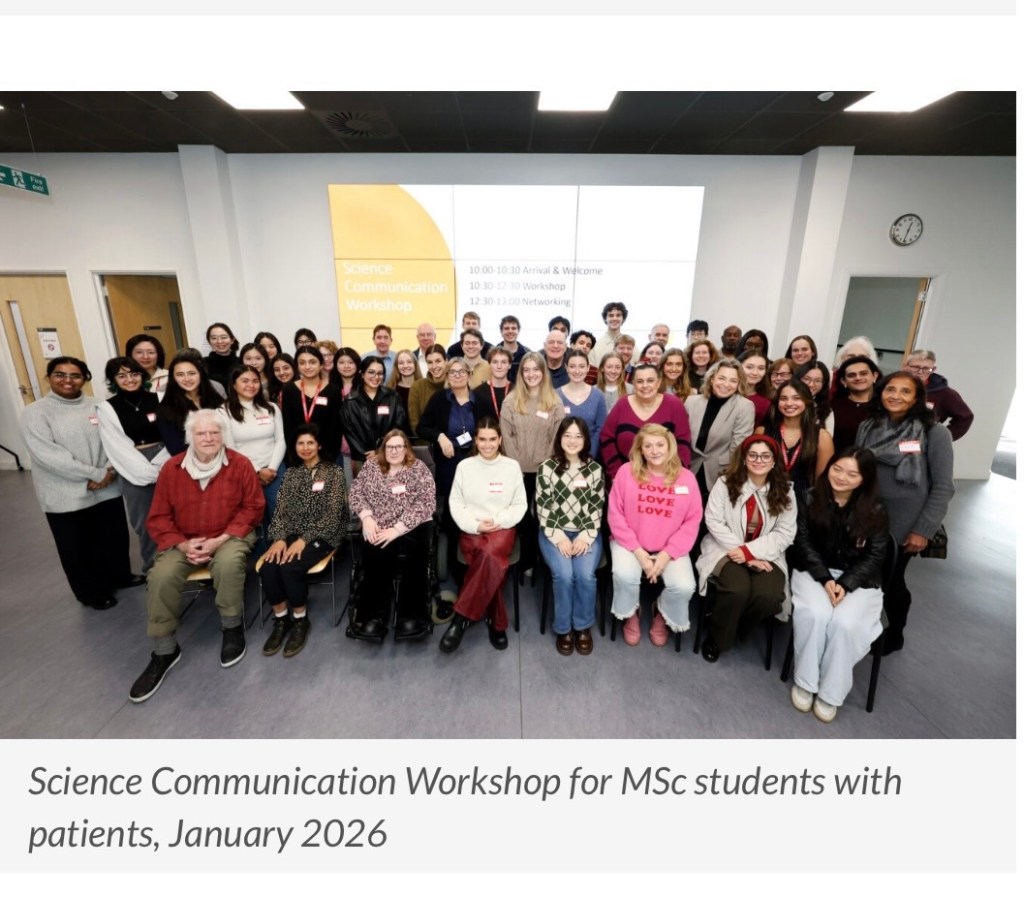
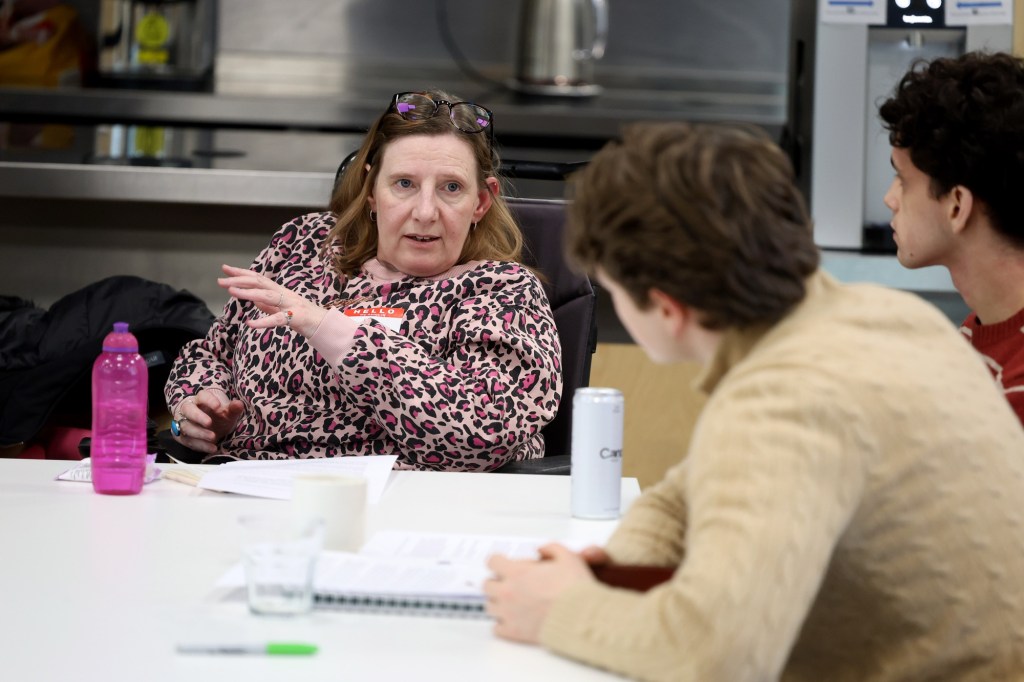
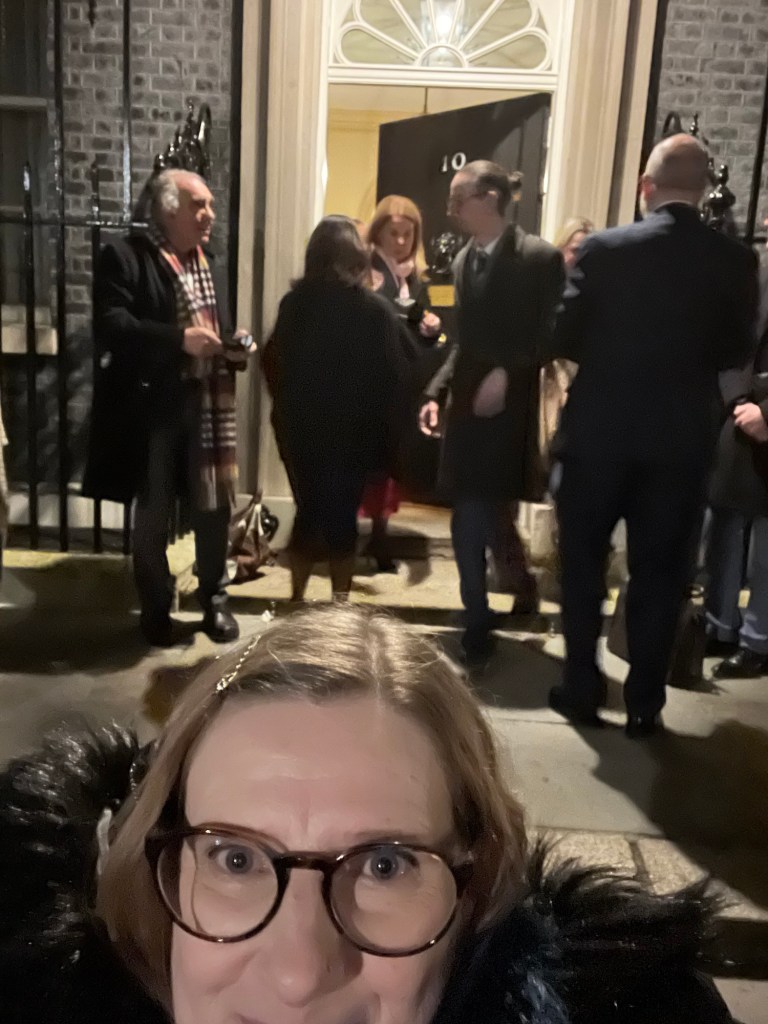
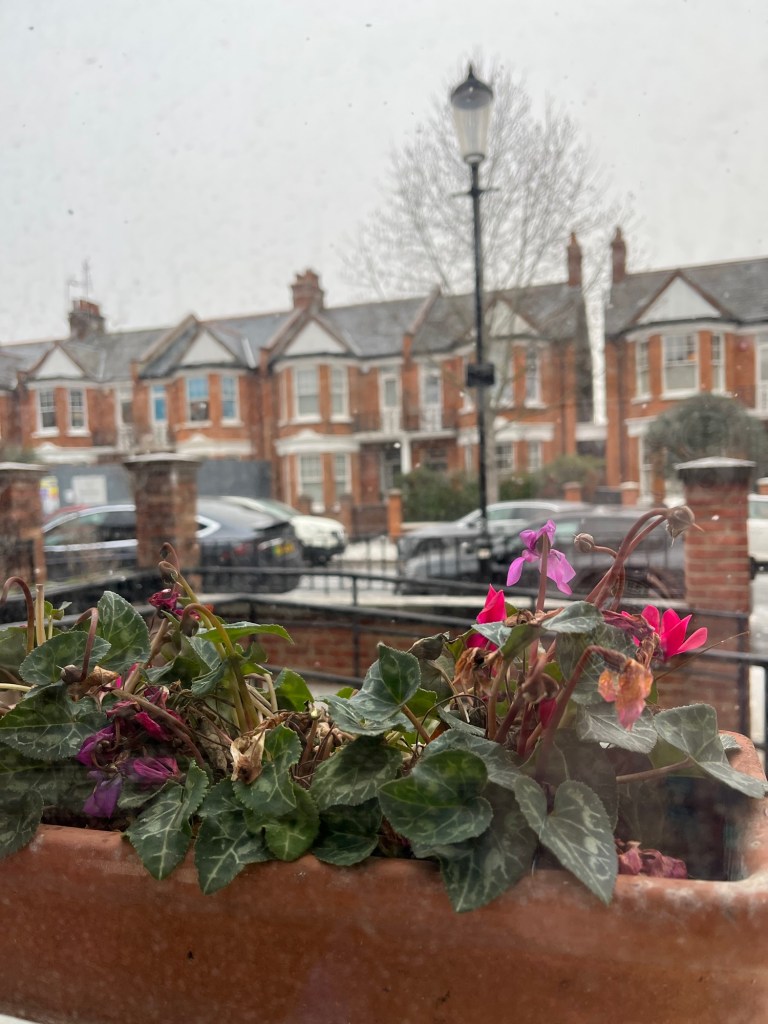

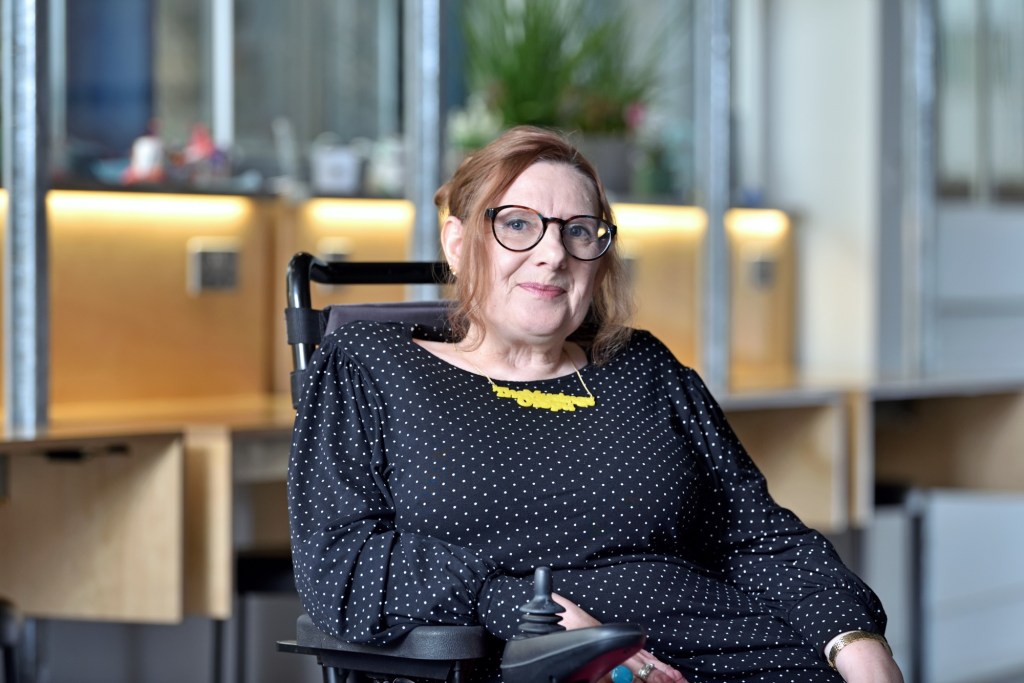
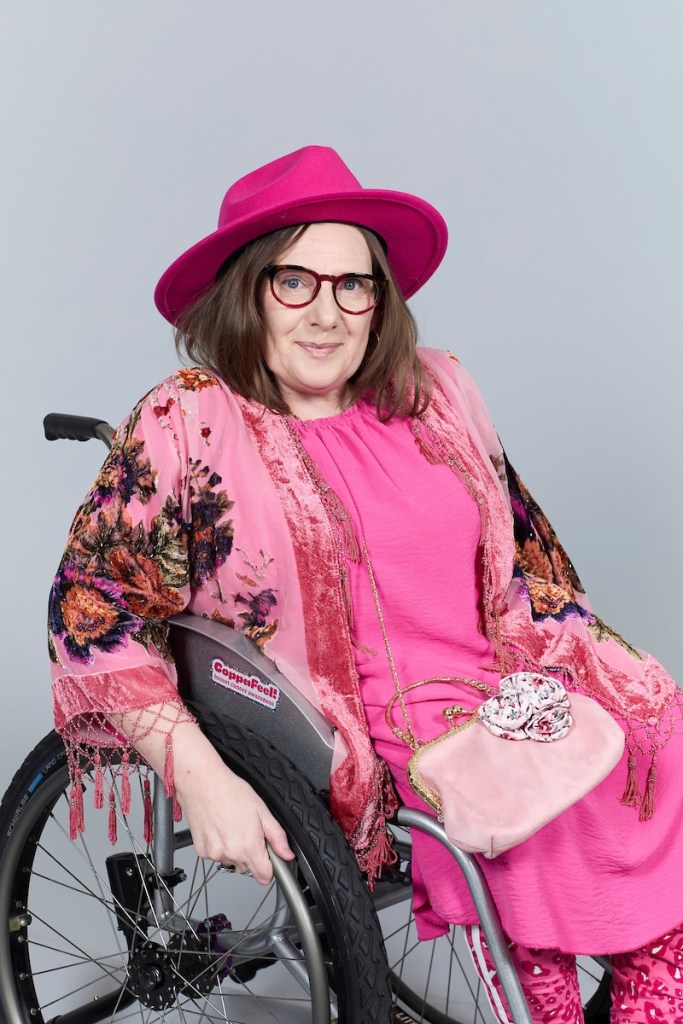
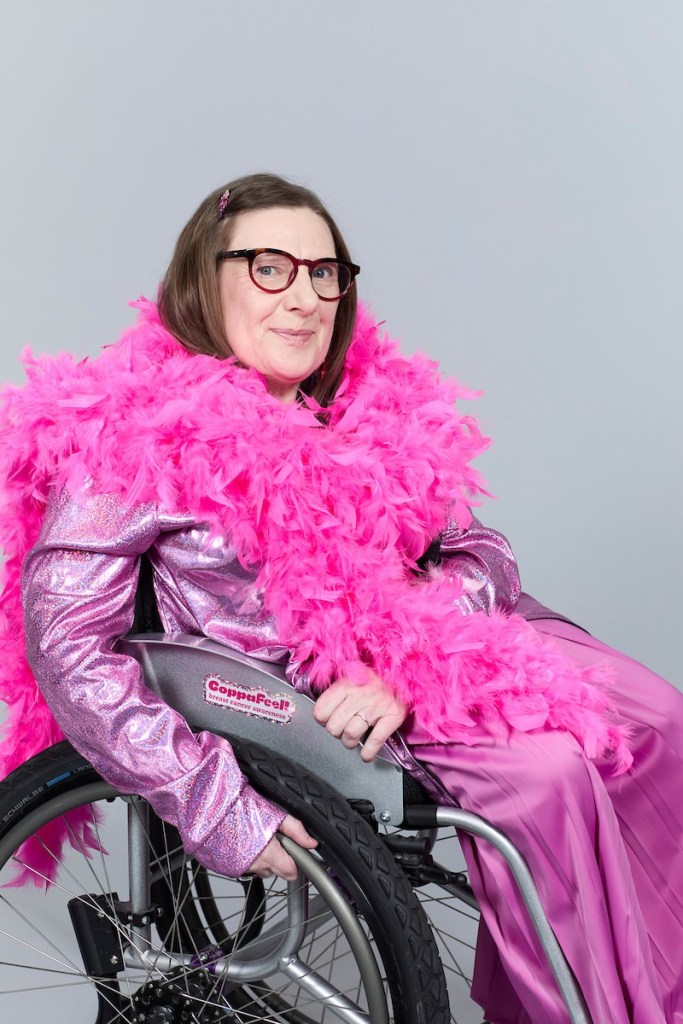

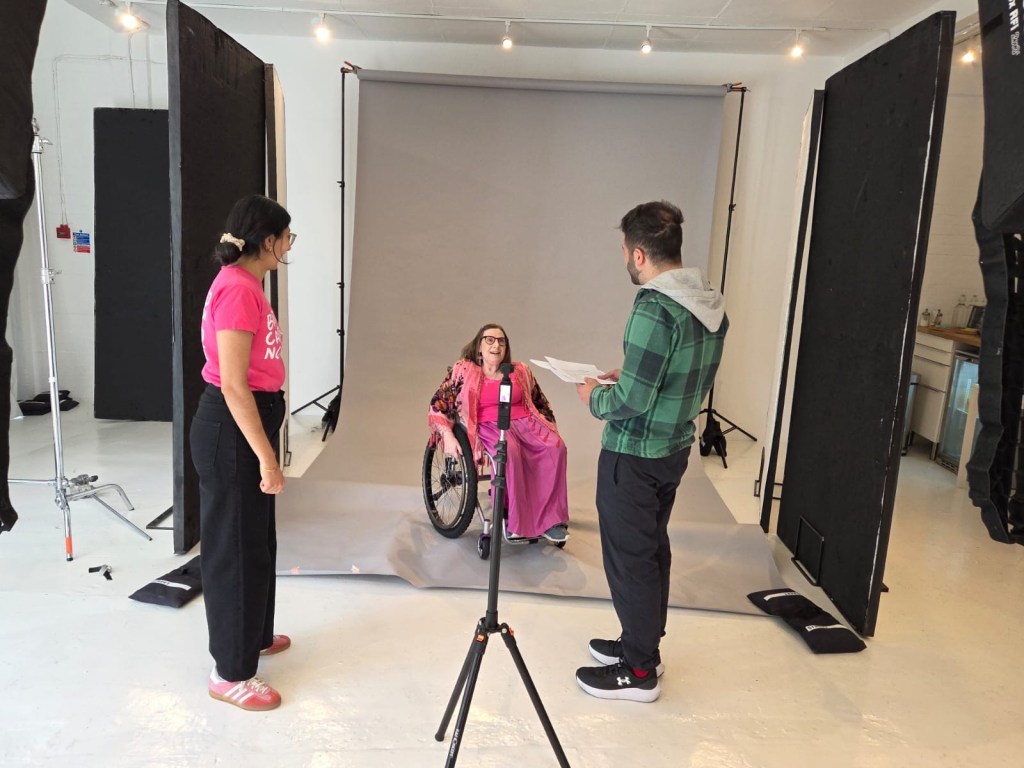

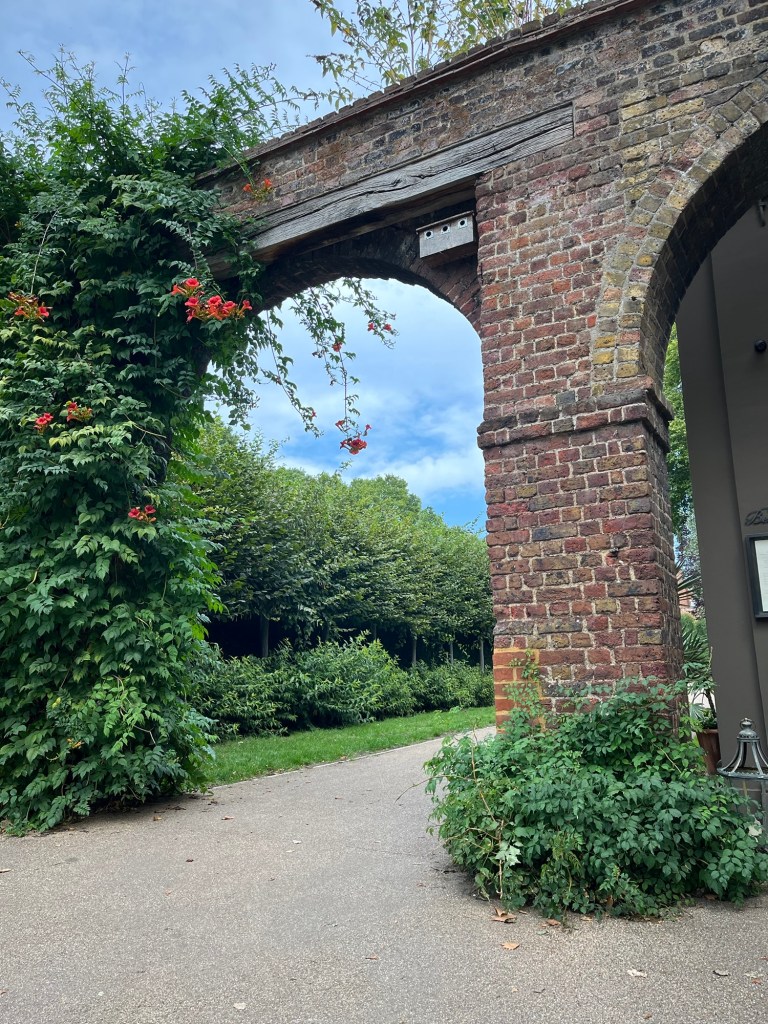
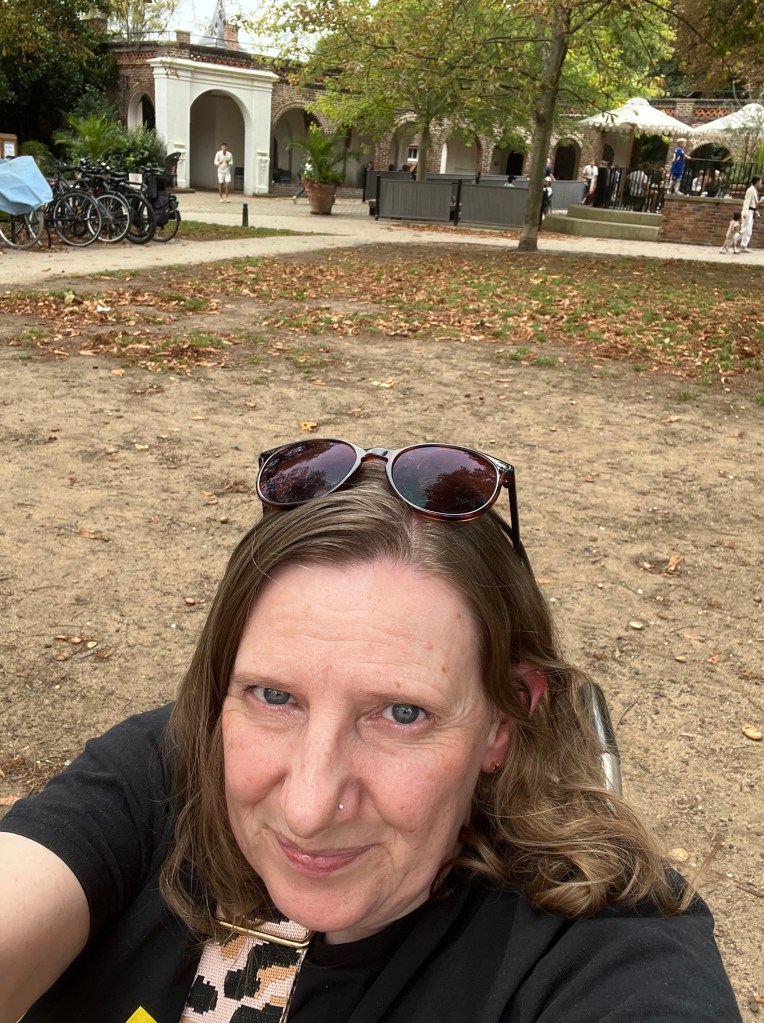


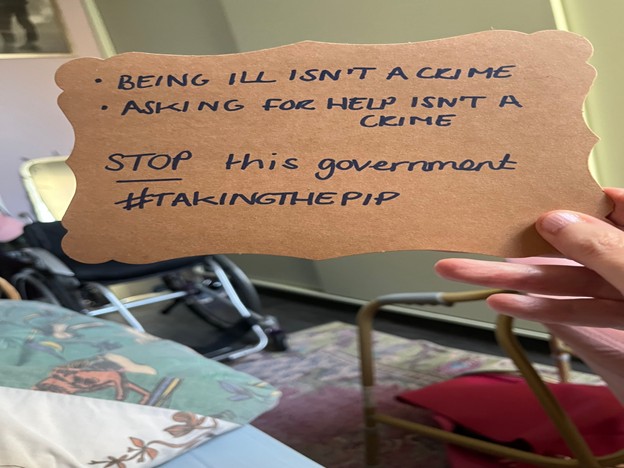
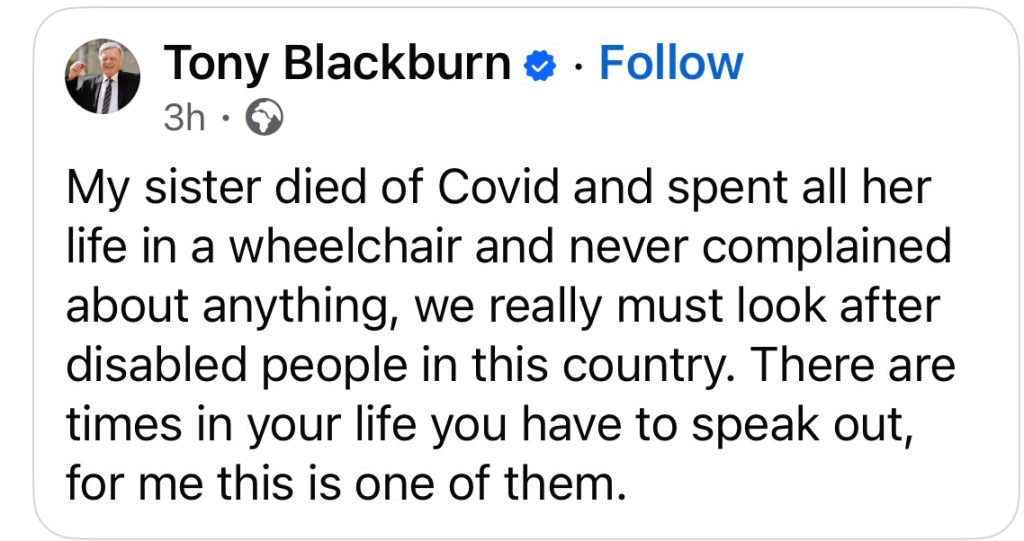
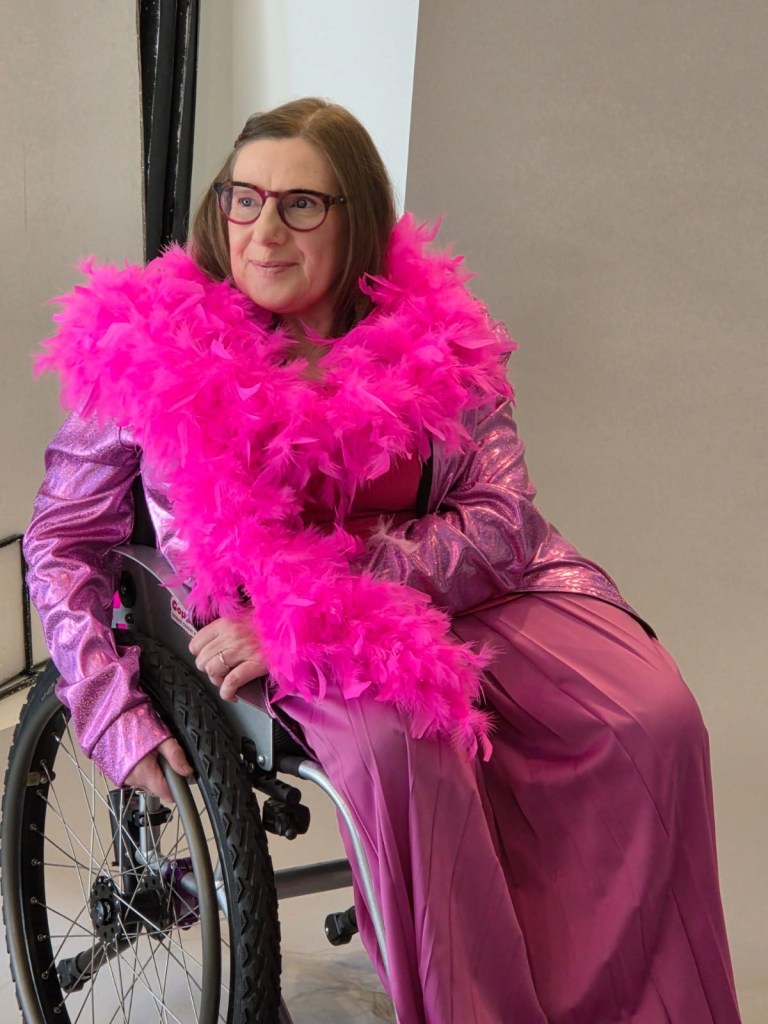


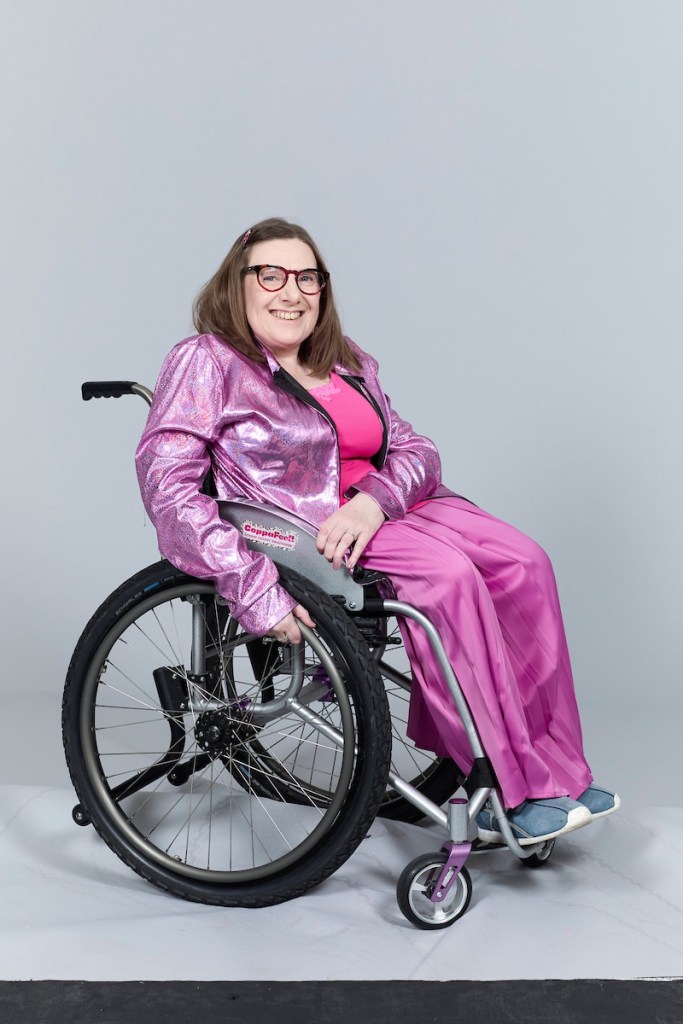
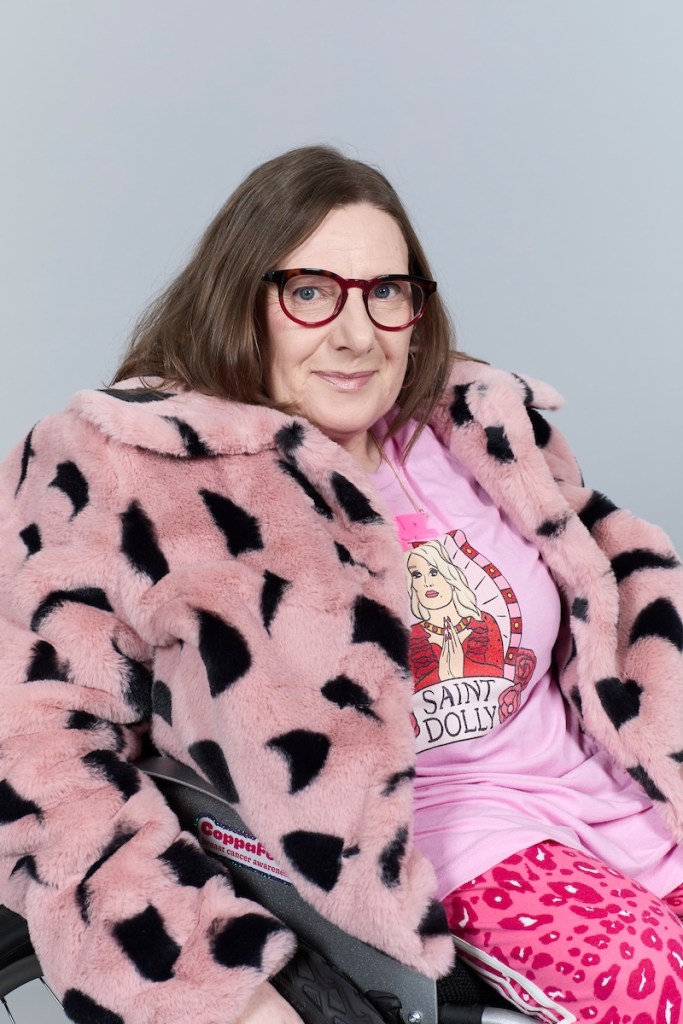
 The Musings of Spu