In search of a calm place.

Spring & summer have been hectic & I’ve been taking the opportunity to find calm spaces where I can.

Alt text: A flower bed against a backdrop of a brick wall & hanging lights. The bed is filled with purple & white flowers, lavender & yellow flowers. In the centre is a small, round, stone birdbath. There is a commemorative plaque leaning against the brick wall amongst the flowers – grey slate with white writing but the text can’t be read.


These last few months have tired me out more than ever. My cancer treatment seems to be taking its toll on me. I don’t think that I’ve changed anything in particular, but I have had really bad back pain for which I had to seek help in A &E. I was sent home with pain relief but not many answers. After much wrangling, chasing & waiting, I had a full spine MRI scan in July. Since being seen in A & E to having the scan, it’s been four months. It’s the 6th month & I still haven’t got the results. The MRI experience was awful but I’m not ready to talk about it yet, except to say that I’m only meant to be in the scanner for 30 minutes because of my breathing, & my bad back. I was left in there for over an hour. I had to have oxygen. I have made a complaint. I hope they learn lessons.


I’m having ongoing issues with being sick & having a bad stomach ache. I had a really bad bout of Norovirus mid-July which didn’t help matters & I just can’t seem to get better. I know all of this could be signs of other cancer, so I promise that I’ve been vigilant & reported it all in. My GP is very good & “on it” as they say. But the NHS waiting lists are long.


For the first time ever, the optician said she saw something flat at the back of my eye, probably a birth mark & that she wasn’t worried at all about it, so I shouldn’t be in any way stressed about it either – but I still had to get it checked. Yep, that wasn’t at all reassuring! Two months later & I’m still waiting for an appointment at Moorfields Eye Hospital.


But finally I did have a pre-op assessment for a minor non-cancer related procedure that I need to have under general anesthetic. I’ve only been waiting since February…no date for the operation yet though!


My partner & I also moved out for a month so that part of our flat could be renovated. We lived in budget hotels for a month which sounds fun but wasn’t. We both got sick. Our backs hurt. We were stoic about it but I was very homesick. All I could bear was coming home once a week to do my washing. We’ve learnt that we can’t stay away from home for long periods anymore. We’re not built physically or mentally for it at our age.


Yet the refurbishment needed to be done. My mobility has really changed & even though our flat is wonderfully wheelchair accessible, I had to get some new flooring & have a complete change in the bedroom. This includes built-in wardrobes with easy-slide panels. I had a radical de-clutter when we moved & a lot of stuff went to upcycling, recycling & charity. I got rid of my bedroom tv. I just have my books & my little digital radio by my bedside. It’s so much better for when my anxiety becomes overwhelming.
I also re-organised the lounge so that I could get around it better. All is nearly in place. My partner & I said we’d re-paint the hallway & the kitchen ourselves, but we haven’t started that yet. We’re still recovering from the move!


I’m not adding any photos of my flat into the blog, even though I’m really proud of what we’ve achieved, including the art deco-style bedroom. Our home is our private space.


With the inside almost done, we turned our attention to the garden. We’re in the process of redesigning the raised beds. We started with the end of the garden where we had the new brick wall – that’s the one in the photo. We’ve tried some new plants that are more suitable for the changing climate – we’re excited to see how they grow. We’ve got a little Buddha statue & a stone birdbath. It’s the first time I could put my family plaque (rescued from the cemetery who were recycling burial plots, very distressing!) in the garden. It’s so relaxing looking out onto this area.


Towards the end of July, my partner & I were able to take a proper holiday – so we went to Primadonna for part of it (LOL, it’s a ‘busman’s holiday’ for us because we work in live music!) Actually I worked a little bit for Primadonna but it didn’t feel like work to me: I was given the opportunity of a lifetime that wasn’t associated with access, disability or cancer.


I happen to know a lot about Britpop. Well, to be honest, I know a lot about many decades of music movements & trends! I’m delighted that a load of books have come out in the last couple of years about Goth, The Scene That Celebrates Itself, Shoegazing & Britpop.
Because I know a lot about Britpop & in fact, some of my friends & acquaintances ended up in these bands (no naming here!) I was asked to lead an “In Conversation with Jane Savidge – on Pulp, Britpop & how fame can let you down.” Yes, it’s that Jane Savidge, co-founder of Savage & Best PR. Yes, that’s the same Jane Savidge that invented Britpop!


I said yes but I was absolutely terrified of having to interview her in public because I was afraid of messing up. Then I remembered, cancer changed all that & my new motto is to feel the fear & do it anyway from now on.


I spent the next month cramming all three of Jane’s books & reading past interviews, reminding myself of really good times with friends & just how good the Britpop bands were – well, ‘are’ I should say because some are still releasing music & touring. I came up with a comprehensive list of questions on Jane’s book about Pulp’s album “This Is Hardcore” & Jarvis Cocker’s breakdown after ‘That Brits 1996 Incident’ with Michael Jackson (yep, let’s not go there!), & some wider questions about Britpop (e.g. if Oasis hadn’t have come along & gone global, would Suede have been bigger – & like me & my best friend, Jane thinks yes). Jane & I had a couple of email exchanges & a Zoom call to organise what we were doing, & then the evening was upon us.


I’m not going to review our ‘In Conversation’ because what goes on tour, stays on tour’, & it was ‘of the moment.’ However, I’d like to say that Jane was very kind & generous in her conversation with me which I really appreciated.

It was great to have Jane’s insight on events that we think we know about, & we all have an opinion on, but of course, we know nothing to the extent that Jane knows because she was at the heart of it all. The Marquee Stage was full & we had some really interesting questions from the audience. I really, really enjoyed myself.


I hadn’t been happy like that for ages.

Furthermore, the Primadonna festival crew met all my access requirements & the stage was set up like a dream for me. That made me relax so much as well. It’s surprising how bad onstage access can affect your performance (take note, promoters!)


I’ve written about Primadonna in a previous blog. It’s still an oasis of calm in a very big, brash world. It’s LIGHT YEARS away from the ‘Burger & Pint’ festivals that I spent years attending. I’m so over being pushed around by fat, balding men with triple A passes, bellowing ‘importantly’ into radios, with their trousers falling down, arse cracks showing. Those days have long gone. Now I want a calm, female / non-binary-dominated crew who are approachable, friendly & treat everyone with respect. I’m happy to report that Primadonna is still very much like its strapline “The World As It Should Be.” It was my partners’ birthday on the Saturday & a couple of our colleagues came down & we had a brilliant day exploring the rest of the festival, discovering new writers & new artists.


We also made all our journeys by train, except for two taxi rides to & from the London train stations but these were electric vehicles. I’m trying to stick with my conviction to travel sustainably when I can.


But the awful reality of living in Britain hit a week later. This is a story for another time, but I’m very aware of the Far Right throughout history & I’ve been waging my own personal war against them since I was 14. What I’m currently witnessing in the UK is Facism, Racism & Islamophobia on our streets. I’m calling it out for what it is. I’m disgusted that life-long friends & colleagues feel terror on our streets & in their homes. Our lovely art group of cancer survivors have had to cancel our art trip to the Serpentine this weekend because of trouble potentially brewing again. We are each other’s support network, we rely on frequent contact & it’s totally unfair that we’ve been prevented from meeting.


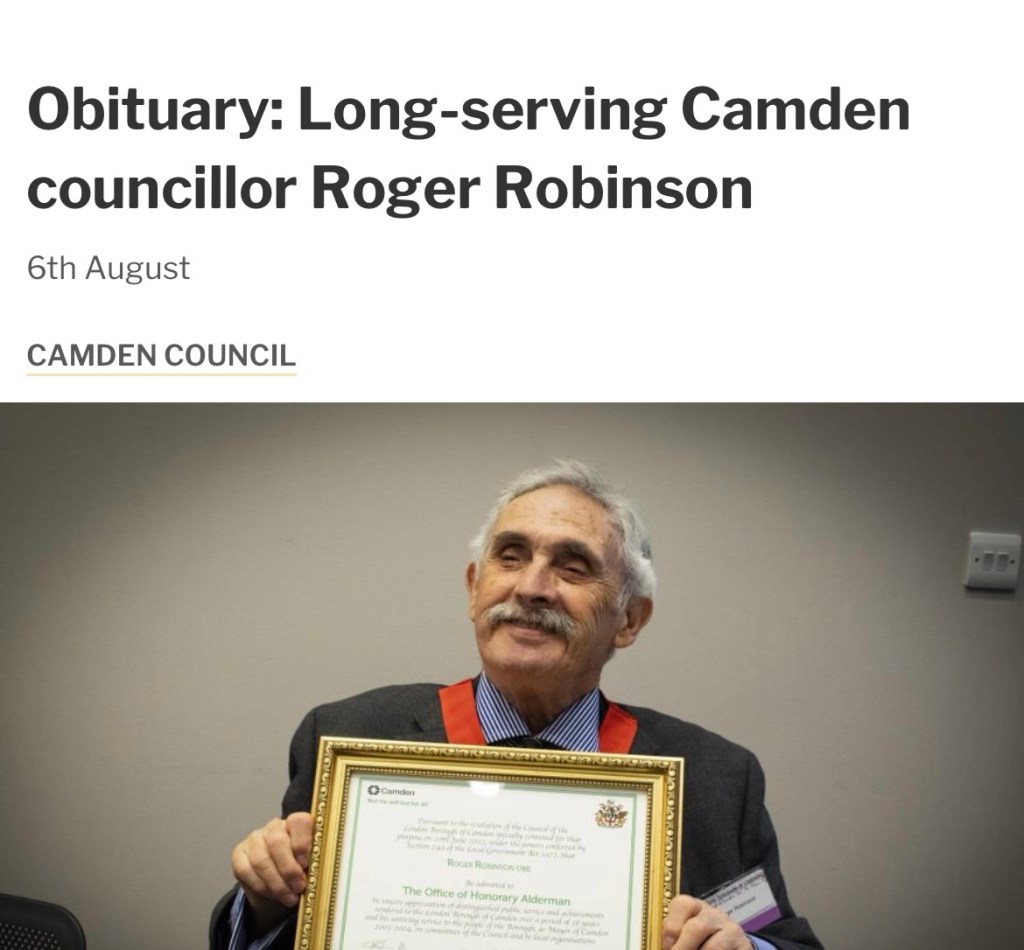
Amidst the terror, I received some sad news about a great friend of mine who spent his life bringing communities together. One of my recent blogs was about the passing of an influential man in my life, my consultant, Dr. Richard Morgan. This week, another of my mentors passed – my ex-Manager Roger Robinson OBE. Roger was an absolute legend. He was one of the great socialists of Britain & I think he holds the record of the longest serving Labour councilor in the UK. He was Mayor during 2001 to 2002. He was conferred Alderman of Camden when he retired as a councilor. Disabled himself, he was a huge supporter & thought-leader on Disability Rights. He used to give us (my colleagues & volunteers) time off to go on demos, because he believed passionately about the right to peaceful protest (my Dad says his proudest moment was Roger & I being quoted by several broadsheets on the front page whilst demo-ing outside Downing Street because Disability Benefits were about to get cut). When we squabbled at work, he reminded us that we all had to get on, because we spent longer with each other than we did with our families!

Every time it was bin collection day, he used to go up & down the corridor with a rubbish bag shouting “bring out your dead!” (Monty Python). He instigated “Quality Time” where we’d all stop an hour earlier on a Friday & have white wine & other treats. News of this reached other organisations in the area, so they started turning up for “Quality Time” as well! We had a day trip out every summer. I remember Capel Manor, East London, with fondness as he loved seeing the piggies (he adopted a pig, he adored pigs). We had Christmas dinner each December & we also celebrated other faith days. He set up a generous Pension scheme for us which I’m entirely grateful for because I’m going to be financially secure in later life.

Roger made sure that everyone was included – he founded organisations & groups that stretched across neighbourhoods & faiths. He believed in helping others & he improved their lives. And there were countless other individual acts of support that he gave willingly & without credit, to others, that fundamentally changed their lives for the better.

I’ll remember Roger fondly, especially in the quiet moments & places that I’m seeking out at this present time. He taught me so much about the world & about people. He’d absolutely hate the riots that were happening now, but I know that he’d be totally in the middle of the action, bringing people together & encouraging them not to tear each other apart.


I’m resolved to #BeMoreRoger & I encourage you to be too.

Photo credit: Ham & High.

Alt text: An elderly man dressed in a suit & tie, holding a framed certificate & smiling. The text says: ‘Obituary: Long-serving Camden councillor Roger Robinson. 6th August. Camden Council.

‘The Way We Roll’ – podcasting with Simon Minty & Phil Friend.

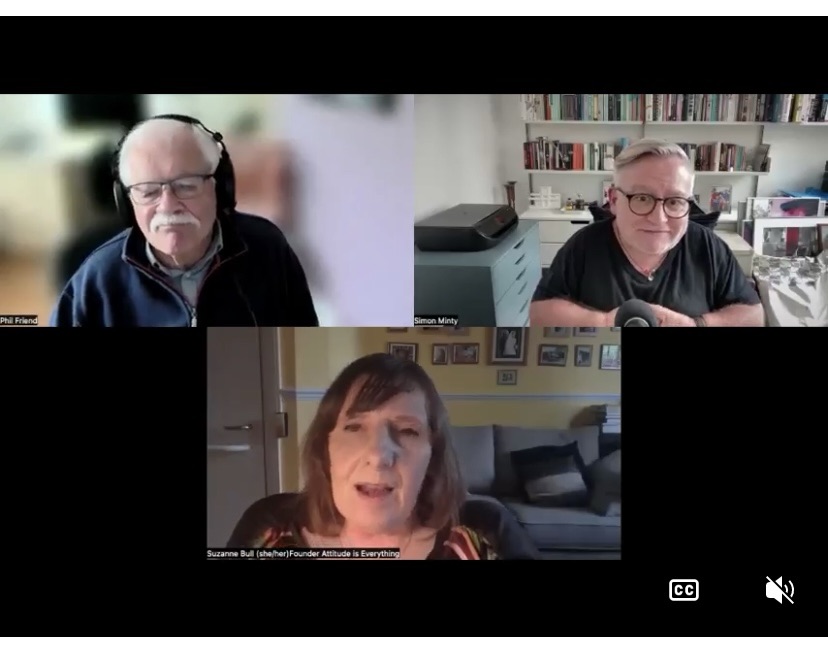
This month’s blog is about recording ‘The Way We Roll’ podcast with Simon Minty & Phil Friend. Called “Live music, Breast Cancer & Me” we talk about some tough stuff (#Trigger Warning), but we also cover the highs of my life in music, not only the lows.

Alt Text: An image on a laptop screen of two white disabled men & one disabled white woman, recording a podcast from their separate rooms, in their separate boxes on-screen.


In June, I was honoured to be invited onto ‘The Way We Roll’ podcast. Simon, Phil & I discussed everything from why I love music & how this helped me found ‘Attitude is Everything’ in 2000, to my old nemesis Breast Cancer. It was great fun recording the podcast, mainly because Simon & Phil are very supportive.

Essentially, it was a conversation between friends (Simon remembers the first time that he & I met in the 1990’s (!) at an event in the ICA, London) & I was never worried or nervous about opening up to them. They made me feel free to tell my story just how it is. Chaotic & mind-bending.

You can listen to the podcast here: https://buff.ly/4bzetuo

I had wondered whether I should be talking about the charity that I founded, ‘Attitude is Everything’ in the same space as my Breast Cancer diagnosis. In some previous articles & interviews about my work to improve disabled people’s access to live music, I’d made brief mentions of diagnosis & treatment when relevant. However, this podcast was the first time that I’d talked about ‘Attitude is Everything’ & Breast Cancer together. And why? Because they’re intertwined in my life experience & they’ve shaped the way in which I’ve worked & lived over the past four years.

We start with why I love music & why, & how this led to me starting ‘Attitude is Everything.’ Since then, I’ve been campaigning for 24 years for disabled people to have better access to venues, festivals & live events, & for disabled artists to be able to play anywhere they want to, & for disabled employees to work in their dream job. We talk about the early days of the organisation, & how, for the first 8 years of our existence, we were a project housed within another organisation – effectively living ‘hand to mouth’ – until April 2008 when Arts Council England gave us our big break & we started being regularly funded by them.

We talk about why it’s important to make sure that disabled artists & employees get their breaks in playing & working in music. We talk about how the music eco-system works, acknowledging the danger that if small venues & festivals fold, then there is a big risk to the talent pipeline. It means that we won’t see our Coldplays or Taylor Swifts at arena tours in the future, if we don’t invest in grassroots & community events. We talk about how the disabled community is an important revenue scheme – we discuss how making your venue, event or site accessible can help you build more audiences, & that more audiences mean more money into the business. We talk about the demand & appetite from disabled people to get involved in live music.

We even get to laugh about my attempts to be in bands & my terrible singing voice!

But then talk turns towards how the campaigner within me had to start advocating for better Breast Cancer awareness & healthcare for disabled people. How I used my project management skills to link all my various consultants together so that they could plan my surgery & subsequent treatment – the things that were said that were unhelpful, & equally, the things that were said & said which kept me going. We touch briefly on why I took part in Breast Cancer Now’s ‘The Show’ & gave a story to Phil Alderson’s collection ‘Someone’s Survival Guide.’

We finish on how you need to be your own advocate, & there is always something you can do to help yourself, no matter how disempowered you feel.

So, give it a listen. It’s probably a lived experience in music that’s rarely heard, as well as a Breast Cancer story told from a different, diverse perspective.

Once more to Simon & Phil for being generous & kind. They’re also incisive, expressing the need for answers & solutions as well as asking the questions.

And here’s the link again to listen to it: https://buff.ly/4bzetuo

Wear It Pink


Every year, the charity Breast Cancer Now devotes the month of October to raising awareness of Breast Cancer and fundraising to support people living with or beyond this diagnosis. This year is no exception. In this blog I talk about how I became one of the campaign’s poster people, & why.

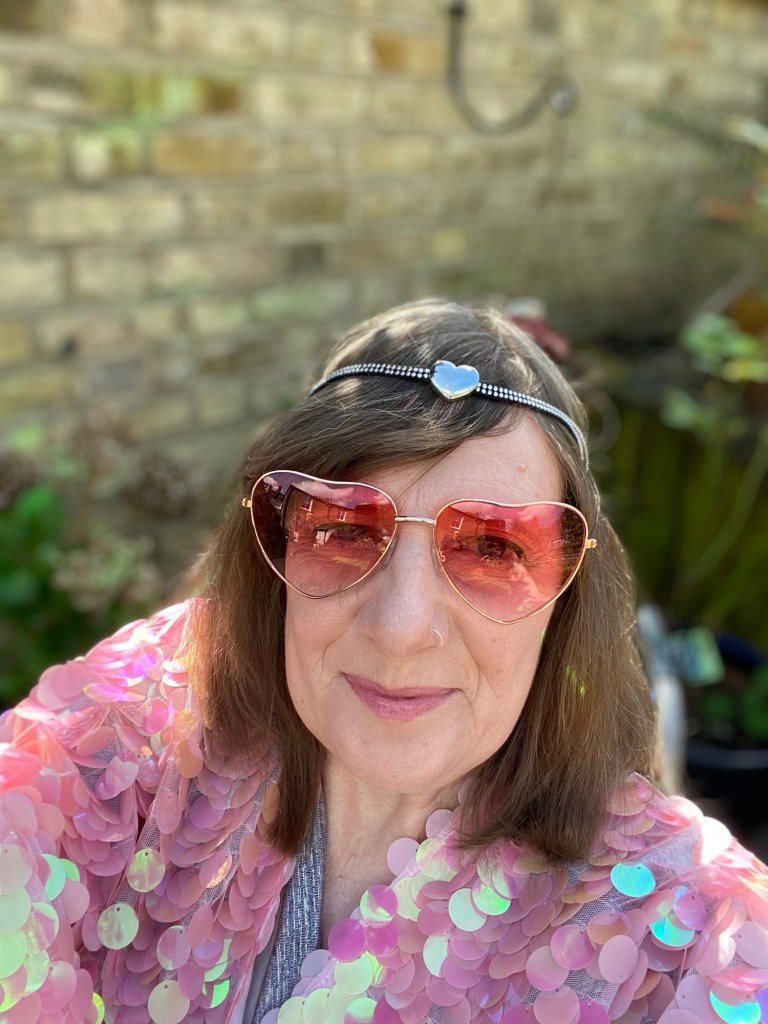
Alt Text: A selfie pose of a white middle-aged woman sitting in a wheelchair, in the garden. She has brown shoulder-length hair flecked with grey strands. She is wearing a small diamante headband with a silver heart, a small silver nose ring, pink sunglasses shaped in pink hearts, & a cape with pink plastic sequins with a silver top underneath. She is smiling.

I know people have mixed feelings about designated days & designated colours for raising awareness & fundraising. Here’s my take on it:

I know that in reality Breast Cancer isn’t remotely pink & fluffy – it’s brutal, painful & terrifying. But Wear It Pink gives the public an opportunity to come together under one unifying slogan & colour to raise awareness of Breast Cancer – to highlight the symptoms & signs to look out for, bring attention to the different treatments & to fundraise.

Here’s why I’m involved in this year’s Wear It Pink campaign:

I’m involved because it gives me an opportunity to share my lived experience of being disabled & living with a cancer diagnosis. In general, the representation of disabled people who live with or beyond Breast Cancer is still missing from the public domain. Just by talking about my current experience of trying to get an urgent MRI scan because of the NHS’ long waiting times in the UK on ‘X’ this week, got a reply from a professor of Teaching in Canada. This is what she tweeted in response: “There was a patient in my surgeon’s office who was a paraplegic (Tweeter’s own description, not mine) & I was struck by how much more difficult her recovery was going to be from a double mx” (MX = mastectomy).” Almost instantaneously there is a person from the other side of the world thinking about the specific experiences that disabled cancer patients have. And then more Tweeters join in as the tweet gets picked up & retweeted.

You can read my story on Breast Cancer Now’s website here: https://breastcancernow.org/wear-it-pink/about-wear-it-pink/meet-our-supporters/suzannes-story/

However, like everything I do, getting involved in the Wear It Pink campaign took some organising, both on my part and the Wear It Pink team. I responded to a social media post from Breast Cancer Now who were looking for volunteers to take part in their photo shoot for the campaign. I saw that the photo shoot was taking place not far from me in West London & that it was on a non-working day for me, so I signed up. I got a message back to welcome me & I could see that the team were really enthusiastic in having me on board, but the photo studio wasn’t wheelchair accessible. This was a bit of a blow to me because I worked with Breast Cancer Now’s The Show team to make the catwalk experience accessible & this was really successful. I guess it takes a while for the awareness of disabled people’s access requirements to filter through the whole organisation. To help, I put the Wear It Pink team in touch with The Show’s team. I’m hoping that a wheelchair accessible photo studio can be found next year (in fact, 2023’s The Show team used Street Studios in East London which are accessible).


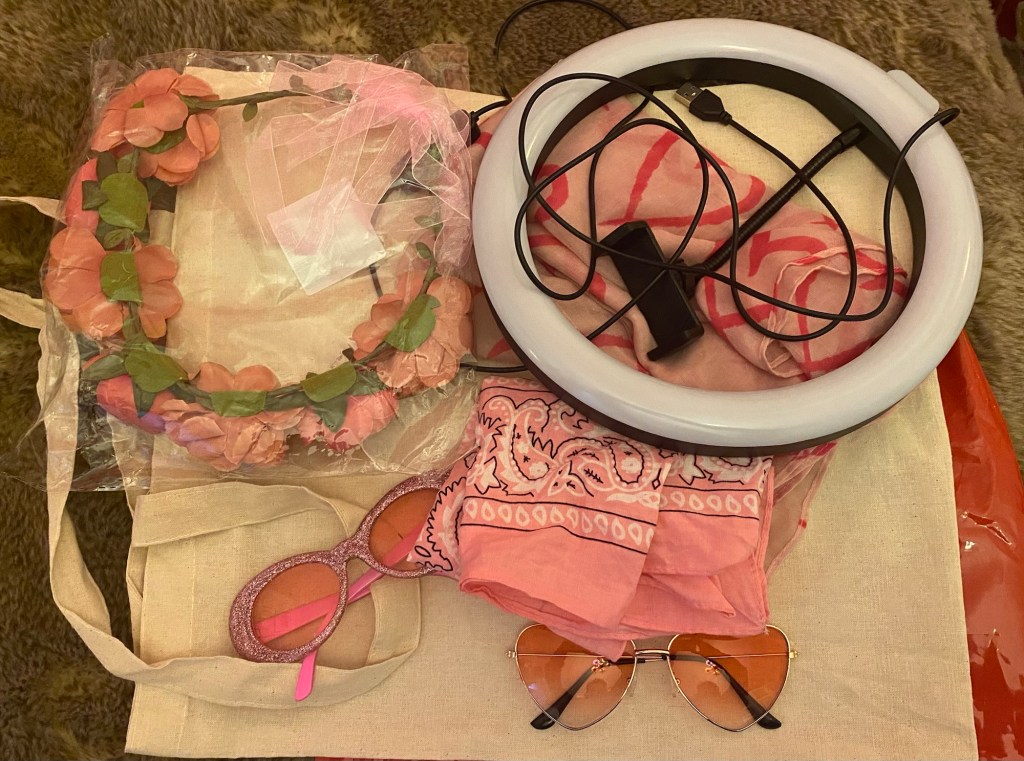
By the time I contacted them, it was too late for the Wear It Pink team to find an alternative studio. However, they mentioned that there were other volunteers that couldn’t make that date, time & location too. When this happens, the Wear It Pink team sent me a huge bag full of goodies – pink flower headbands, pink sunglasses & pink scarves, as well as a photo ring light, to use as props for creating my own shoot at home. It just so happens that my favourite colour is pink, so it was easy to find clothes & shoes that fitted the brief. Very sweetly, the team asked if some of the photos could feature the pink sequinned cape that I have after seeing it on my social media. That made me happy because I love that cape & I can’t really wear it for many occasions (except clubbing!)

Photo Credit: Suzanne Bull MBE

Alt Text: A bag of pink coloured accessories laid out on top of a cream tote bag and a red plastic parcel bag, on a brown faux fur bedspread. There are two pairs of pink sunglasses – one is an oval design, the other shaped in pink hearts, two differently designed pink summer scarves (one has pink hearts all over it), a headband with pink faux roses & a white ring light.

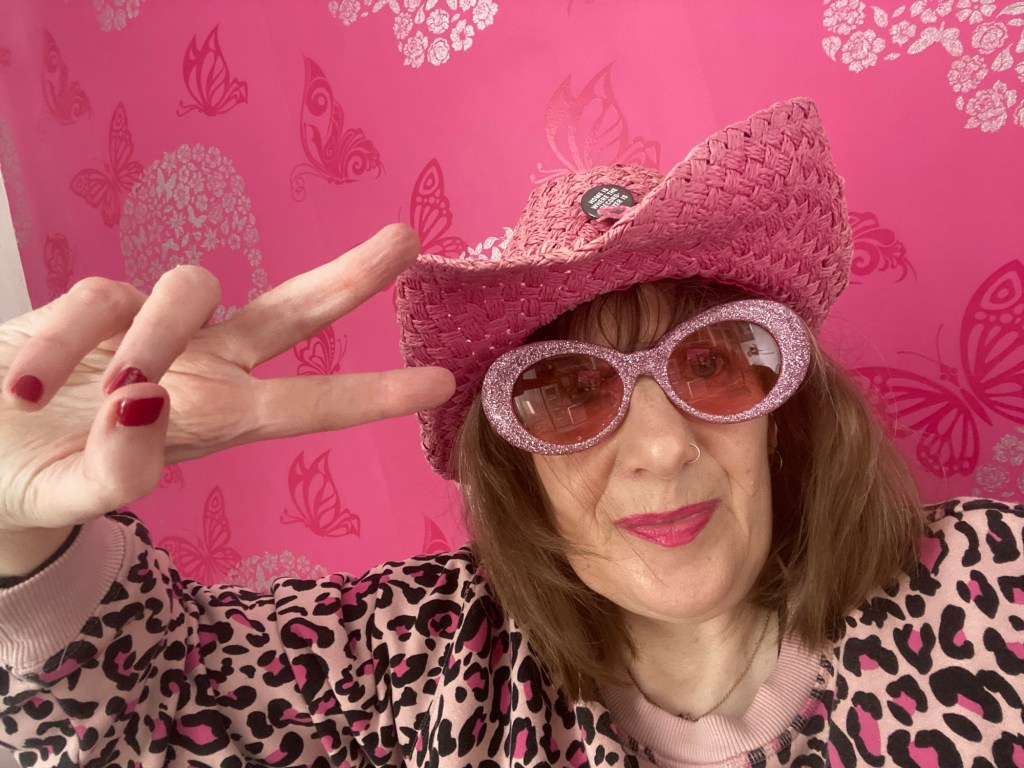
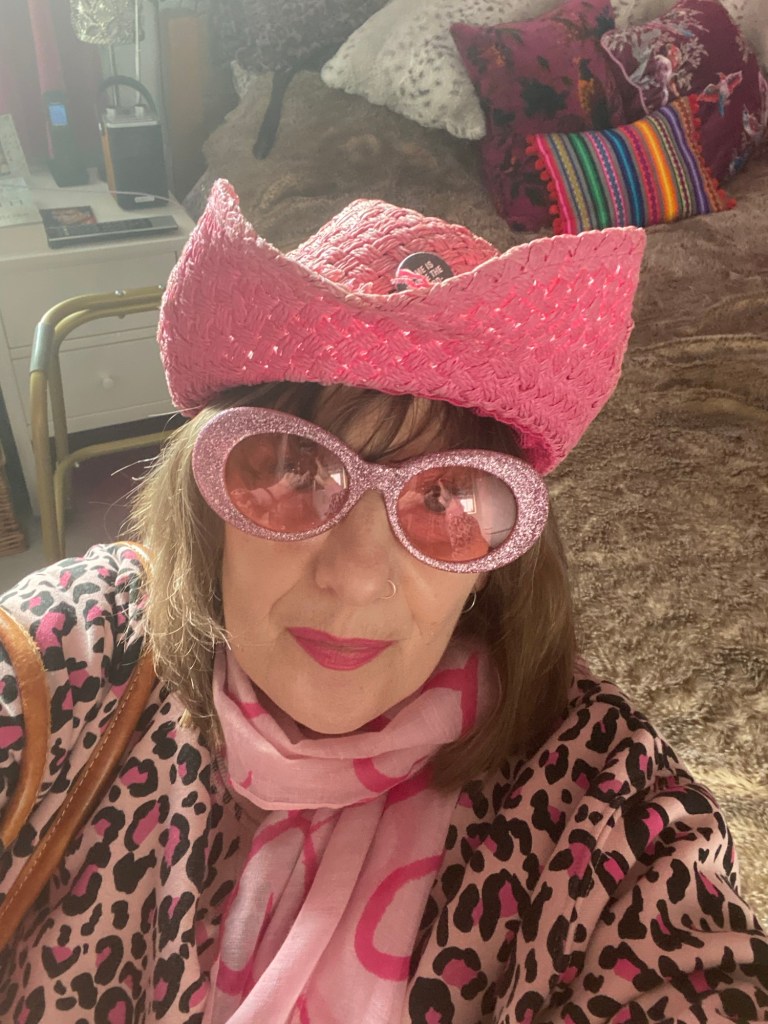
Initially I set a couple of days aside for the photo shoot at the tail end of Winter. I took a series of selfies in my bedroom with my pink ‘skulls’ head wallpaper behind me. The oval sunglasses definitely made me look eccentric. But because the day was so dark, I felt the images were lacking in warmth, no matter how silly they were.

Alt Text: A selfie pose of a middle-aged white woman with brown shoulder-length hair which is flecked with grey strands, sitting against a wall which is wallpapered in pink ‘skull’ heads and butterflies. She is making a peace sign with one hand & her nails are painted red. She is smiling. She is wearing a pink cowboy hat, pink oval sunglasses, a small silver nose ring, deep pink lipstick & a pink leopard skin design sweatshirt.

Alt Text: A selfie pose of a white middle-aged woman with brown shoulder-length hair flecked with grey strands, sitting in a wheelchair in her bedroom. The background is blurred but the faint image of her bed & dressing table can be seen. She is wearing a pink cowboy hat, pink oval sunglasses, a small silver nose ring, a small silver hoop earring, bright pink lipstick, a pink scarf with darker pink hearts on it & a pink leopard skin sweatshirt.

I felt that it was better to do the photo-shoot outside but I had to wait more than a month for the weather to get warmer & sunnier. FInally, there was one sunny afternoon at the very end of March. Enlisting my partner’s help with the shoot this time, we headed out to find a quiet spot in the garden to take photos.

Photo Credit: Stephane Cony

Alt Text: A white middle-aged woman with brown-shoulder-length hair flecked with grey strands, sitting in a silver & purple wheelchair, in a garden. She is wearing a floppy straw hat, pink oval sunglasses, light pink lipstick, a necklace with three teal-coloured swallows, a pink midi dress with puffed sleeves, a silver watch, a silver ring on each hand with blue stones, pink lycra leggings & blue trainers. She has her hands folded across her lap & she is smiling. Behind her is a brick wall & plants in pots, hanging baskets & raised beds made out of railway sleepers.

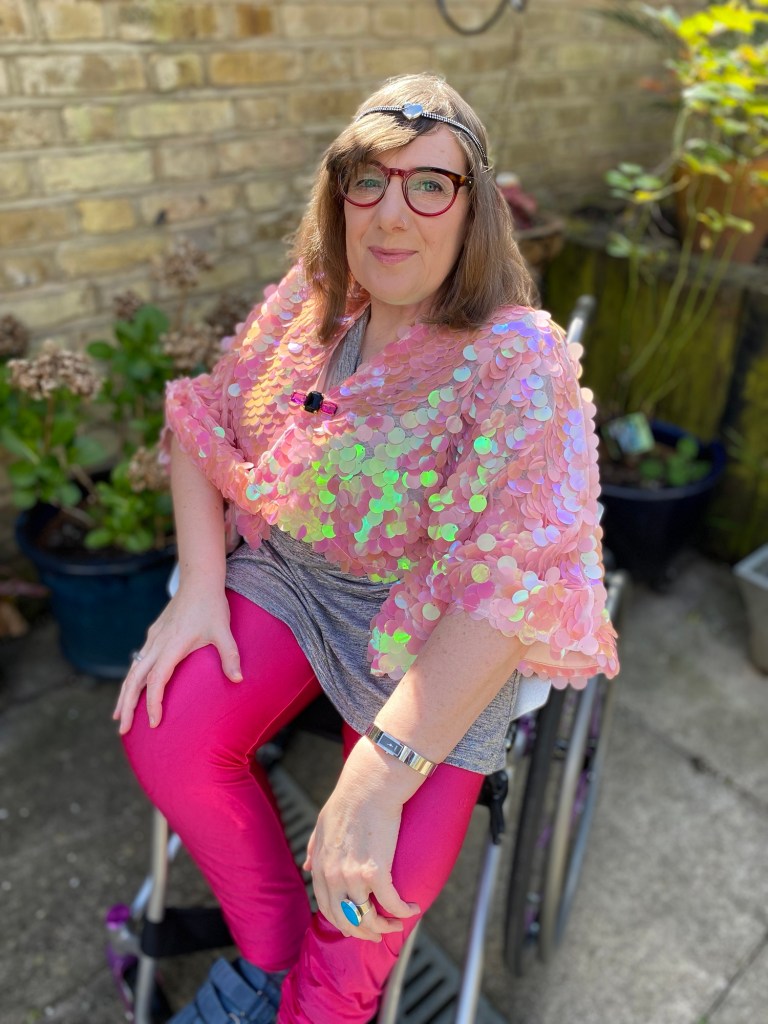
Alt Text: A white middle-aged wheelchair user with brown shoulder-length hair flecked with grey strands, sitting in a silver & purple wheelchair, in a garden. She is wearing a diamante headband with a small silver heart, pink / brown round reading glasses, light pink lipstick, a silver watch, a cape with round pink sequins with a silver top underneath, pink lycra leggings & blue trainers. Behind her is a brick wall & plants in hanging baskets, pots & raised beds made of railway sleepers. She is smiling.

Our garden is our peaceful haven amidst city-living. We spent much of the Lockdown summer – the same time as when I received my Breast Cancer diagnosis – relaxing in the garden, enjoying nature return & watching blue skies without airline vapour trails (that was a surreal sight, wasn’t it?) We read books, we painted, we gardened & we chatted with our neighours over the fence. It felt right to return to our garden to do the photo shoot.

The shoot took less than an hour. This time my partner took shots that were brighter. I emailed the winter-time selfies & the shots from the garden back to the Wear It Pink team. I also posted their props back to them. I wrote a little story to accompany the photos for Breast Cancer Now’s website & it all went ‘live’ on 7th June 2024. I’ve had a great response to the story from my family, friends, colleagues, as well as from people all over the world that I’ve connected with on social media since my diagnosis. I can see the story prompting conversations & discussions over social media, which is fabulous. But even if my story just prompts one disabled person to get a breast lump checked, or a radiologist to think about how to support a wheelchair user whilst administering radiotherapy, then I think my involvement has been a success.

Once again, you can read my story on the Breast Cancer Now website here: https://breastcancernow.org/wear-it-pink/about-wear-it-pink/meet-our-supporters/suzannes-story/

October 2024 is Breast Cancer Now’s Wear It Pink month – more details here: https://breastcancernow.org/wear-it-pink/about-wear-it-pink/

If you can, & want to donate to Breast Cancer Now, please do so here: https://breastcancernow.org/

Dr. Morgan

Paying tribute to one of my favourite humans who passed suddenly last month.

Photo taken at the RHS Chelsea Flower Show 2024 by me.


Alt Text: A stand filled with beautiful varieties of flowers in whites, pinks, yellows, blues & purples. There is a small shed made out of distressed wood. Hanging on the door is some information signage about bees & a certificate that says ‘Gold Medal.’ The display is inside a huge pavilion.


My blog is very late this month. If you’ve been following me on social media, you know I’ve had all sorts of upheavals & tricky times over the last 6 weeks. I moved out with my partner for a month so that we could get a couple of rooms in our flat decorated & we were living in budget hotels. During that time, both of us managed to injure our backs & it’s taken us some time to recover. Living away from home & returning to put our flat back together once again certainly didn’t help matters (thanks to our friend Paul who came to our rescue!) But we do have a beautiful home now.

I had an amazing time at Breast Cancer Now’s The Show 2024. It was so lovely to reconnect with the ‘Gang of 2023’, but I’ll save celebrating that gem of a reunion for another blog. In the meantime, here’s my thoughts about a very special person who passed very unexpectedly last month.


At the beginning of this week, I had such a horrible shock & as these things seem to go nowadays, I found out on social media.

Turning back three decades, I was in a very bad way with my impairment. I’d had a disastrous operation to straighten three toes on my ‘bad foot’ (I’ve called it that for years but it isn’t that bad, in fact it’s rather sweet with its little piggy toes) & because the aftercare wasn’t fully explained to me, the surgery led to a series of terrible infections that needed strong antibiotics, often administered intravenously. It was looking increasingly like I was going to need my foot amputated because I was running out of treatment options – they were no longer effective. I knew that any amputation wouldn’t just be my foot. Because the circulation is bad in my left leg & I’m paralysed from the knee downwards, it would be really hard for my leg to heal. I felt that it could well lead to several amputations, going higher up my leg each time.


What angered me was the general consensus of my orthopedic team. They gave up on my foot pretty quickly & went straight into “let’s cut this off” mode, together with all the usual tropes such as “that foot doesn’t work anyway, you don’t really need it, it gives you more trouble than it’s worth”, etc. OK so my foot has never worked well, but it’s my little baby foot & I’m quite fond of it. With regular monthly podiatry, my foot is managed very well now. But what I definitely needed was my leg for transferring & for balance, even though I can’t fully weight-bear on it.


So there I was, in a hell-hole. In truth, I’d never liked that particular consultant, even when I was seeing him in the wonderful children’s hospital Great Ormond Street. He was patronising, rude & very dismissive of my parents’ questions & concerns. And then when I started going on my own to appointments from the age of 15, he was just like that with me. Horrible man.


Whilst at the GP getting another round of antibiotics, I lamented to him that I really wanted a second opinion. My GP mentioned that a new clinic had been set up for my disability & that because it was at Chelsea & Westminster Hospital, I was able to attend because I lived in the same borough. And then things changed for the better.


Dr. Morgan came into my life when I was about 25. He was gentle & kind. He took time to explain what was going on – not just about my foot, but other aspects of my impairment. He diagnosed several more comorbidities (what a charming term!) & then he put me on the right medication. I discharged myself from the other hospital. It took 2.5 years but my foot recovered.


Dr. Morgan took me from a young, not at all sober, on the verge of homelessness, dating a string of terrible men & very sick, woman, to where I am now: a middle-aged women, safe in my accessible flat in a quiet part of North Kensington, 100% sober & in a long-term relationship that will turn 17 years in October. Ok, I’m still sick, but you can’t have everything, lol!


At the first appointment, Dr. Morgan took time to explain how bad the curvature of my spine was & that I shouldn’t be walking. I was shocked. Year-on-year I had x-ray after x-ray but my former consultant used to put the x-ray images up for his team to see, grunted at the images & then quickly take them down. He failed to even address that I had one of the most serious curvatures & what the consequences were to be if I kept walking. He never, ever mentioned that one of my kidneys was very small. He failed to diagnose that I had Raynaurds. He failed to explain why I was such a poor eater (my stomach is squashed up due to the pressure of my spine). Dr. Morgan explained all of these serious issues to me.


Moving on with the story, at the end of my twenties, I had a very brief spell of wanting to have a child. Dr. Morgan arranged for me to have a tour of the maternity suite & to explore with the team how they might take me through being pregnant to giving birth. I’m not going to give any more detail on this but I decided not to have children in the end (it wasn’t because of the medical team putting me off on the tour at all. In fact, they were very encouraging & supportive).


Dr. Morgan created countless letters & statements in support of better footwear, better lightweight wheelchairs that I could self-propel & other equipment. Every year we’d catch up & he’d tell me that he was supposed to retire, but he was worried about the fact that the clinic was threatened with closure. In 2017, he started to slowly handover his work. He admitted that it was difficult for him. We had lots of discussions about when you found something you’re passionate about (I founded the charity Attitude is Everything), it’s hard to leave it behind. He genuinely cared about all of his patients & he treated them from a holistic perspective – he understood the impact of physical hardships & long term chronic pain on his patients’ mental health.


He knew that I lived life to the full. He accepted that I wasn’t always going to take his advice. He knew that I’d always be pushing the boundaries of my limitations. But he never judged me. He never said “I told you so” when things weren’t a bit awry. Most importantly, he just picked me up & put me back together again after each downfall. That’s probably what I appreciated most of all about him.


When my breathing & sleeping patterns began to change, he arranged for me to become a regular patient at Brompton Hospital. He sent me to the Pain Management Clinic when my pain started to interfere with everyday life.


To be honest, despite the challenges, my life was ok. But then I got diagnosed with Breast Cancer.


As soon as I received the diagnosis, I emailed him. He immediately responded & gave me lots of information. He suggested questions that I should be asking the Breast Care Unit. Over a few months, we emailed back & forth & he gave me a lot of care & confidence. This was during the pandemic, so email or telephone was the only way to communicate. He also communicated directly with my Breast Cancer team.


As soon as I’d had my operation & radiotherapy, Dr. Morgan got me into his clinic. He gave me some very wise advice – that in time, I’d get to know my body again & that I would be able to distinguish what was normal for me & what was new & different (I’m still not at that stage where I can tell symptoms of my impairment from the side effects of my cancer treatment). He told me not to canvass too many opinions when seeking clarity because I could become confused. But most of all, he stressed that I must continue to make plans for the future & not to let my life come to a standstill.


That was my last conversation with Dr. Morgan. We said our goodbyes & we wished each other luck. I was too shy to ask for a photo with him. Although I was very sad that I wouldn’t be treated by him again, he’d worked far beyond the recommended retirement age & I wanted him to enjoy his time. He absolutely deserved it.


A friend of mine who attended the clinic told me that Dr. Morgan loved bee-keeping & that he was interested in bee conservation. With this in mind, I took some time out at Chelsea Flower Show yesterday to seek out a display which focused bee-friendly planting. Once I found a display complete with a pretty shed, I stood there, lost in my thoughts about Dr. Morgan for a while. Then I looked up & there was some information hung on the shed door . It said that there were 24 species of bumble bees. I never knew that.


Dr. Morgan, still teaching me.


Rest In Peace my friend. I’m so gutted that you didn’t get more years to enjoy your retirement. It doesn’t feel fair at all. You’re so loved by many people. You changed lives for the better. I’m so very grateful that you were there for me. You were an exceptionally kind & nice person.

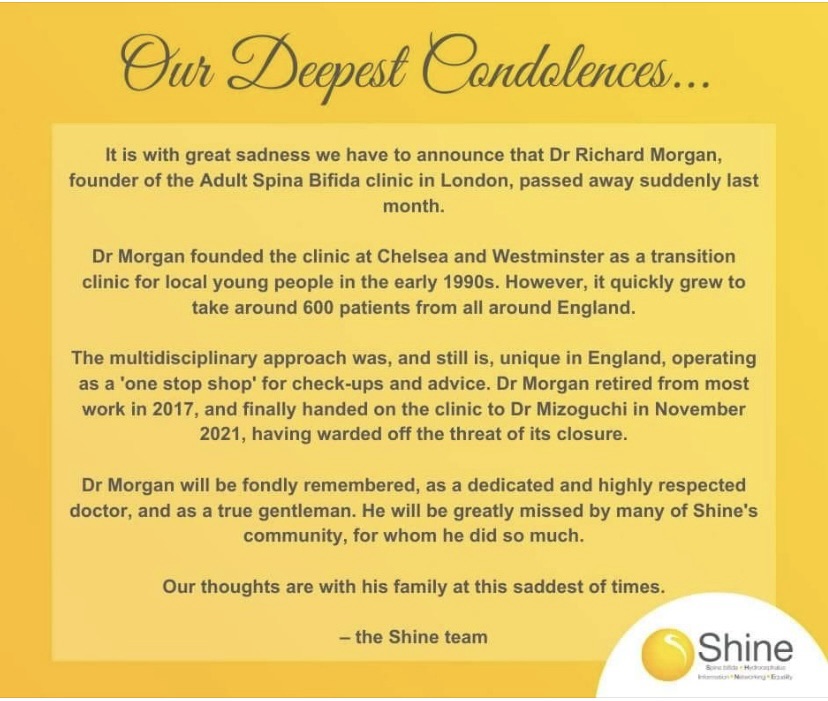
An obituary from the charity Shine.

Alt Text: Grey text on a yellow background, with the Shine logo, a yellow ball & the words Shine. The text says: Our Deepest Condolences… It is with great sadness that we have to announce that Dr. Richard Morgan, founder of the Adult Spina Bifida clinic in London, passed away suddenly last month. Dr. Morgan founded the clinic at Chelsea and Westminster Hospital as a transition clinic for local young people in the early 1990’s. However, it quickly grew to take around 600 patients from all around England. The multidisciplinary approach was, and still is, unique in England, operating as a ‘one stop shop’ for check up’s and advice. Dr. Morgan retired from most work in 2017, and finally handed on the clinic to Dr. Mizoguchi in November 2021, having warded off the threat of its closure. Dr. Morgan will be fondly remembered as a dedicated and highly respected doctor, and as a true gentleman. He will be greatly missed by many of Shine’s community, for whom he did so much. Our thoughts are with his family at this saddest of times. The Shine team.

Revelations

When do you tell people that you’ve been diagnosed with cancer? Who do you tell? What do you tell people? Is this all in your control?

Alt text: A selfie pose of a middle-aged white woman sitting in her wheelchair in the corner of a small, bricked-walled garden. She is wearing pink lip-gloss, a small silver nose-ring, pink tinted sunglasses in the shape of hearts, a small headpiece with a silver heart & silver diamante-effect band, a silver top & a cape covered with plastic, pink, iridescent discs. She has brown/blond/grey hair cut into a bob. She is smiling. Behind her are plants & flowers in hanging baskets, in pots & in raised flower beds. Her sunglasses, headband & cape glint in the sunlight.


Welcome to my 40th blog about being disabled & then being diagnosed with Breast Cancer! For April’s blog, I was going to write about my increasing difficulties with neuropathy in my hands (not great when you’re a wheelchair user), but since Princess Catherine of Wales (UK) was forced to announce to the world that she is undergoing preventative treatment for cancer, I decided to save that topic for another month.


When, who & what you tell people about your cancer diagnosis, if indeed you decide to tell them at all, is difficult for everyone. However, it comes with its own unique pressures when you’re already disabled & if you have a history of cancer in your family.

First of all I want to express how sad I am that Princess Catherine has received a cancer diagnosis & I wish her well with all of her treatment. I know she’s getting the best treatment & I acknowledge that it’ll be completely different for her because she doesn’t have to rely on the NHS like the majority of people in the UK. Yet despite all of her privileges in life, she’s a human being with emotions. Being diagnosed with cancer is terrifying & traumatic no matter who you are.
I felt really angry that the Princess was ‘outed’ by stupid, unkind & unfounded rumours circulated by so-called ‘commentators’ & ‘influencers’ (or idiots, as I like to call them) on social media. Then certain sections of the UK tabloid press picked up those rumours & amplified them. Speculation grew as a direct result of those acts of spreading rumours.


Just like every cancer patient, it was HER choice whether she wanted to tell people. Instead, she had to share her fear with the world on a Friday teatime, during a special televised address.


I listened to her whilst she tried to convey the difficult news as best she could. I watched her looking pale & shellshocked. I watched her try to reassure the public, often in the way that most cancer patients do when they’re telling their loved ones; we all try to put aside our own emotions so we can shield those around us.


The only bit of ‘schadenfreude’ for me was seeing all of the social media & tabloid press idiots looking totally idiotic. They were completely caught out, although I did see a lot of conspiracy theorists coming out with even more s**t & speculation after the televised address. These people don’t have any moral compass.


Anyway this whole horrible situation got me thinking about my own choices about when, who, how and what to tell those closest to me about my cancer diagnosis.


Sometimes telling people is out of our control. It became out of my control when I had to take an extended period of sickness absence. I’ve very rarely taken sick leave for longer than a week over my 30+ years career. However, when I commenced treatment, I started to look physically different; my skin developed a green/grey tinge, my hair started to thin & I wasn’t able to colour it because of active treatment. My eyes became dull & I had large black circles under them. My nails became ragged. I couldn’t follow sentences & plots on the tv. I became exhausted. I got terrible brain fog so I got dates & facts confused. My mobility changed. It became obvious that something was very wrong.


I realise that I had actually forgotten quite a lot about the period just after my cancer diagnosis. It’s probably down to shock. So my recollections of that time might be incorrect. Very few people I told in person or on the phone. It was much easier to tell people in a text or another kind of messaging.


I didn’t tell that many people in person because I knew that I wouldn’t have to manage their emotions as they crumbled in front of me. I know that sounds cruel, but you need to understand that when my mum died, I had to tell people on the phone or in person because there were no such things as mobiles or emails. The hardest thing for me to deal with was their own grieving. I was 16 years old. I had to support my family who were grieving. My sister was 10. I couldn’t even process my own grieving.


I made all the phone calls really quickly & so I’m told, I used a very matter of fact tone. I got criticised for that by a couple of friends. It took another couple of mutual friends to explain the obvious – that I was in total shock & not really equipped to deal with what had happened. Even though I knew deep down that my mum was really, really ill & that she was going to die, no one ever sat me or my sister down to prepare us for it. That’s not a criticism, that’s just how things were years ago. And it’s also a reflection of how my family members couldn’t process their own terrible & painful grief.


When my sister got diagnosed with cancer, I asked her if she wanted me to tell people & how she wanted me to tell people. She wanted me to be open & to keep it factual, so I set up little messaging groups etc which gave me (& her) some control. Some of the extended family were elected to update people as & when. That’s actually a good method because as a cancer patient, you get so tired during treatment.


Because this method of messaging had worked quite well, I adopted it when I was diagnosed. Both my sister & I were open with our families & we prepared our loved ones the best we could. We’d had that experience of being ‘left in the dark’ & it’s not a place that we wanted others to be in.


I told close family, my best, closest friends & my work colleagues. Then I elected a couple of friends to update others & they carried the responsibility selflessly. Most of them were the same friends who had supported me when my mum died all those years ago. With work colleagues, I elected a close friend to update them & brilliant – he made sure that he protected my partner & I throughout. All updates were empathetic but as factual as possible to protect mine & my partner’s dignity. I’m forever indebted to my lovely friends.
I never put anything on social media until I finished all of the active treatment. From the messages of love & respect that I received afterwards, I understand now that people were aware that “something” was going on. There’s no doubt that friends told ‘friends of friends’ & colleagues; that’s natural to me. Afterwards I told people that I didn’t mind that this had happened because it made managing my emotions easier. But what I don’t like to think about, & I don’t think this happened anyway, is if people were gossiping &/or speculating behind my back. I come from a small town where everyone knows everyone so I’m hyper-sensitive to gossip. Speculation & gossip are so degrading & detrimental to your wellbeing. It’s so unnecessary & it can do so much harm.


By keeping the updates factual, it gave me the space to manage the mind-bending s**t show that was coming my way. That’s important because you need all your mental & physical strength for you. In my case, I also wanted to shield my loving & loyal partner who faced everything beside me.


I think I’ve blogged about this before, but when you tell people, there’s always someone who says that friend/cousin/postman etc died of exactly what you’ve been diagnosed with. It happened to my mum & my sister too. When someone responded like that to me, it was a new Personal Care Assistant from an agency. I remember simply turning around to face her, looking her straight in the eye & responding “well, that’s not going to happen to me.” She went bright red & looked away from me. Gotcha, as they say! Honestly though, what f**kwit would respond in that way, especially someone from the caring profession! I haven’t got any sympathy for people who respond by saying that they knew so & so who died from the same type of cancer. They are stupid.


The other stupid people are those who say that you’ve brought on the cancer yourself & those that claim that your cancer can be cured by alternative herbal treatments/diets alone.


As a disabled person, I had the very strong suspicion that some people around me might be saying that I’d got cancer because I’d pushed my body too hard. Meaning that the stress of living in an impaired body had finally taken its toll; that I’d been pushing myself too hard & for too long. This isn’t an unfounded paranoia. I’ve had a couple of people in the caring profession who have said that I’ve made my impairment worse because I wasn’t living within the limitations of my body. I once asked an orthopedic surgeon if this could be true. He replied that it didn’t matter what I did or how I lived my life, because the muscles would still constrict around my joints anyway, but it would just take a longer period for my body to deteriorate. His conclusion was that I needed to live life to the full & on my terms. Despite this being excellent advice, my internalised ableism meant that I nearly didn’t tell anyone about my cancer diagnosis.


Newsflash: cancer is random in who it affects – it affects Royals like Princess Catherine & working class Essex girls like me. Most of the time, it doesn’t really matter what people do & how people live, they still get cancer.


No matter how I tell people, I try to be as supportive & kind to the other person. It is shocking to hear that someone you love is seriously ill. I quickly learnt what & how much to tell people. There’s only a handful of people that can handle being told the whole picture. This is down to a combination of reasons – fear, lack of knowledge, a tendency to speculate & a tendency to give an unsolicited opinion which you might not be (ever) ready to hear. At times I didn’t want to answer any in-depth questions. It was emotionally painful but it was also because I didn’t know the answers.


Finally I want to end with what I took away from Princess Catherine’s address to the Nation. Her speech was fantastic but it was the look in her eyes that resonated most with me. It said, “I’m going through stuff here, it’s enormous & I’m absolutely shattered. Please let me be with my family.” That’s the look that I recognise & probably every other cancer patient recognises too.

So be generous, be loving and be kind to your loved ones, or anyone, if they ever have to tell that they’ve been diagnosed with cancer.

Four Years On

It’s four years on since my Breast Cancer diagnosis.

Alt text: A selfie pose of a middle-aged white woman sitting in her wheelchair in a room that is made of wood paneling & floor to ceiling windows. She is wearing a white face mask, a black puffa jacket with a black faux fur hood, a blue t-shirt & a blue jumper over it. She has brown/grey shoulder-length hair with a fringe. She has a pair of round pink/brown glasses perched on top of her head.


Four years ago today (10th March) I heard the dreaded words “You have Breast Cancer.” Such a small statement to have such a huge impact on my life. I’ve just had my annual mammogram & I’m happy to say that I’m still cancer-free. This is also your reminder that I’m cancer-free because the drugs are still working. It’s got nothing to do with being positive, fighting hard or any other crap tropes that people trot out.

It’s also Mother’s Day (in the UK) which is always a difficult day. My mum died of secondary Breast Cancer & I’m reminded that the treatment was so different back in the 80’s. They didn’t even remove her lymph nodes when they removed her breast.


I’ve written before that February & March will be difficult months forever. It’s always taken up with the annual mammogram & then waiting for the results. My scanxiety was particularly high because I haven’t felt well since my last bone infusion. I’ve been so sick & nauseous that I’ve had to reduce a lot of food groups & take all my evening medication an hour after dinner with the hope that food will stay down. I also had some additional scans to deal with – abdominal & pelvic scans in case the vomiting & pain was something “else” (thankfully it wasn’t). I had some pain in the areas where I had my Breast Cancer surgery – it was a different kind of pain than I’ve had before. Plus I had pain in my armpit which really, really worried me because a small cancer was found there during my lumpectomy. After a glorious birthday month of January, I went into February & March feeling very scared.


The breast pain was really weird. It felt like someone was squeezing my nipple very hard. I know some people pay good money for this kind of thing but I can assure you, it was so unpleasant! On top of that, my armpit just ached & ached. At my mammogram, I requested to see a Breast Cancer nurse so I could let her know what other symptoms I was having. She took them seriously, especially because I’d had bouts of vomiting. Without hesitation, she booked me into the ‘One Stop Clinic’ for a week & a half later.


As you know, mammograms are tricky for me as a wheelchair user, & as time goes on, I don’t know for how much longer I’ll be able to balance precariously on my legs so I can have the scan. Thankfully this year’s mammogram passed without particular incident which was a relief because I was feeling fragile. My radiographer was really nice but U could see she was a bit phased. She immediately said that she might have to get another person to help her, but I reassured her that I’d had lots of mammograms & that I could help her. She agreed to this & we got the mammogram done with the minimum of fuss. This was in part because we kept talking & working together throughout the whole procedure. There was a lot of mutual respect there. She got some very clear scans which also makes things a whole lot easier. All in all it was a better experience than some others in previous years.


I also had a really good experience at the ‘One Stop Clinic.’ The last time I was there was in July 2023. It was when I met the new Breast surgeon that had taken over from my (wonderful!) surgeon (he has since retired). This new surgeon was very confident – telling me all about the great things he’d learnt from my surgeon. Unfortunately he was also a bit patronising towards me, which you know, never, ever goes down well with me. I asked a couple of supplementary questions during his examination & he dismissed them in a very off-handed way. He basically said that he didn’t know the answers, that it was a Saturday, couldn’t I see that the waiting room was packed, & that I needed to go back to my GP to ask (incidentally, the GP didn’t know the answers either!) Then he sent me for an ultrasound. Low & behold, the radiographer was grumpy too & what’s more, she tutted when she found that there was nothing there! I was shocked! She ought to be thankful for me that there wasn’t anything there (except this stupid ball of fluid at the incision site that won’t go away).


The point I’m trying to make here is that the poor attitude of the new surgeon had permeated through the whole clinic that day. However, the Breast Cancer nurse working alongside him gave me a knowing, sympathetic look. I felt sorry for her having to work with him all day. He was lucky that I was too pent up that day about the ultrasound to challenge him. Otherwise I would have remarked that he hadn’t taken on board the great bedside manner that my Breast surgeon had!


After that experience, I was a bit concerned about going to the ‘One Stop Clinic.’ I needn’t have worried. There was no sign of ‘Mr Dismissive.’ Instead I saw a female consultant who was very kind & respectful. She reassured me that the pain was probably post-surgery because of the nerve damage to my breast & armpit, but she still requested other checks after examining me. Then my Breast Cancer nurse that got me through all my active treatment turned up. It was so great to catch up with her. She always had such a way of reassuring me & making any kind of (usually horrendous) situation ok. With her by my side I felt like I could cope with anything.


The Breast surgeon referred me for another ultrasound. There was no sign of ‘Mrs Grumpy’ this time. Instead the radiographer was gentle & kind. She started the conversation by informing me that my mammogram was clear; in fact, my breasts hadn’t changed at all from the previous annual scan. I was delighted! Then she started the ultrasound. There was no sign of anything in my armpit. I breathed another sigh of relief. Quite soon, she saw the source of the breast pain – it was that pesky ball of post-surgery fluid (a seroma)! The radiographer offered to drain my breast but warned that it could fill up again. I’ve had it drained twice before when it was really big & it wasn’t exactly pleasant. But draining involves needles so I had to decline as I felt that I’d been through enough that day. She was very understanding – she even wrote to my GP to say that she would be happy to do the drain if I changed my mind in the future.

I left the clinic knowing that I was cancer-free for another year. I cried happy tears, drank lots of tea & ate lots of biscuits at the Maggie’s Centre. Then I went back to work in the afternoon. I’m still in pain & I’m still being sick (less now which I’m thankful about), but I’m reassured.


All of that pressure takes its toll mentally as well as physically. I was working on a big project at work which served as a very useful distraction from the scans as well as being something positive that I could put all my energy into. But after a few long days at conferences & enjoying myself at the UK Brit Awards (I work in music!) I had to take some rest.


I want to say a massive thanks to Stephane (my partner), my family, my friends & my colleagues for being by my side throughout. I’d like to urge people to go onto the streets & protest about waiting times for cancer treatment, mis-diagnosis, poor communication & success rates in treatment being woefully behind many of the UK’s peer countries. It’s an absolute disgrace & the future looks very frightening. We have the money here to fund the NHS properly. Why has the life-extending drug Enhertu not been approved for NHS use in England by NICE & NHS England? As someone who lost my mum to cancer at 16, I know how important it is to have as much time as possible to make memories & to be unconditionally loved. Please sign the petition on the http://www.breastcancernow.org website.


I watched ‘Breathtaking’ on ITV a couple of weeks ago. It brought back everything about the pandemic & what I went through as a cancer patient when I was diagnosed in March 2020. I think it’s a miracle that I’m still here; I caught ‘the other C’ three times & my surgery was delayed for four months. My lovely friend Freddie Stabb played the disabled character Ellie Bridges, the young mum who was denied treatment because of the cruel policy that placed disabled people (& other groups of people) on the DNR list. That moment came close to reflecting my experience; you know that I had a DNR placed on me during the pandemic (this is detailed in my first ever blog) & that Ellie could have been me. The other hard moment was when the character who had treatable (I think it was bowel cancer) was denied treatment because the hospital was overwhelmed with ‘the other C’ patients.


Seeing the medics, the patients & families suffering as the drama unfolded was horrific. Except it wasn’t a drama, it was f**king REAL! From what I saw at the time in the NHS back in March 2020, ‘Breathtaking’ got it spot on.


I don’t feel like looking back in detail over the past 4 years. It’s been an emotional couple of months. I’m here living in the here & now, that’s all that matters.

Who holds your hand?


Who’s going to hold your hand through this Breast Cancer ‘stuff’? What’s going to help you cope? After much consideration, I think it’s others going through the same & being generous enough to share their stories.

Alt Text: A middle-aged white woman sits in a sunny spot in her lounge. She holds a small paperback back that’s called “Someone’s Survival Guide – Real stories & advice from Breast Cancer Survivors.”

When I got diagnosed with Breast Cancer, I thought I knew all about it because my mum & my sister had been diagnosed with it too. I thought I knew all about pain & getting through difficult situations because I was already disabled. I was completely wrong. I didn’t know s**t about Breast Cancer until I got it myself.


Since being diagnosed with Breast Cancer, I’ve gone on a massive learning curve which I’ve explored with you in my blog. Now I have a greater love, appreciation & respect for my mum & my sister & all Breast Cancer patients. Breast Cancer is relentless. It takes you to unimaginable depths of pain & fear.


I think I’ve written this before: once my surgery was canceled because of the pandemic, I decided to go back to work to take my mind off things. I told my sister what I was doing, giving her the reason that I was already disabled, so I was used to powering through medical upsets. She didn’t say much. About a month later, I phoned her up, crying, because I couldn’t cope with work. I admitted that having cancer was nothing like I’d ever experienced. She gently said that she knew that would happen, but she knew that I wasn’t ready to hear that. She said that the only course of action was to let me find out for myself. I’ve never played down having cancer since & I have a greater respect for the respite & recovery process.


I’m lucky because I have got my sister to turn to when I’m feeling anxious, as well as few dear friends & colleagues who have sadly walked the path of Breast Cancer. I’ve also got the new friends that I’ve made through Breast Cancer Now’s The Show & my online art class organised by Maggies Centre at Charing Cross Hospital. There’s a wonderful Cancer Community over on ‘X’ & we’ve embraced each other’s blogs & books alongside frank (& sometimes humorous!) exchanges about what we’re going through.


A couple of blogs back I reviewed some books about the cancer / disability experience which really helped me. After all, who’s best to hold your hand through all of this? In all reality, I think it can only be people who have been through exactly the same. They live the scanxiety, the fear, the pain & the confusion that I live through. On repeat.


Because I’ve got so much help & support, I jumped at the chance when my friend Philip Alderson asked me to be part of a book that he was putting together. I was eager to ‘pay it forward’ & help others. It was a simple invite to contribute – it didn’t matter how much you wanted to write. You could share your story, any advice, words of wisdom, a quote that might have helped you, song lyrics, anything really. I decided to keep mine very short; half a page to highlight that I have the special hell of being disabled & then getting diagnosed with Breast Cancer. I included a quote from the artist Tracey Emin about how she felt about getting cancer. That really resonated with me.


Despite the simple invite & instructions about how to submit my piece over instagram, I still messed up the format in which I had to send it. This happened because I’m a complete technophobe & because my brain seems to be in a permanent muddle – not a great combination! Philip was so kind to me because he updated the version which had been on sale for a couple of weeks so that my piece was included at the end. What a complete star you are Phil!


The book is called “Someone’s Survival Guide – real stories & advice from Breast Cancer Survivors.” What I like about the guide is that we were all given free reign to express what we wanted to. As a result, the book sends into the world a lot of love, kindness, generosity & empathy to people in the same situation. There are over 70 contributors, all living with & beyond Breast Cancer; all wanting to help people by telling their own narratives. All very different in their diversity but all offering some kind of hope & light in the bleakest of times. The practical advice gives insights into coping with the treatment. The quotes all resonate & they can motivate too. The songs can provide relief & solace during horrible, horrible times. What shines from the book is the triumph of the human spirit & our ability to be resilient.


I’m so glad that Philip asked me to be part of it & I’m so proud to stand beside all the other contributors. All proceeds of “Someone’s Survival Guide” go to Breast Cancer Charities & you can buy it here: https://www.amazon.co.uk/dp/B0CRBHPSFH


Writing my blog & being part of the book has made me think more seriously about how I can contribute to the Breast Cancer narrative in a more public way & to give the perspective of a disabled person. This perspective is rarely included in any narratives. I haven’t got any daring plans this year – not like in previous years where I was an artist in Grayson’s Art Club & modelling in The Show, so it’s time that I explored writing outside of my blog. I’m intrigued to see where my writing can take me.


Before I go, I wanted to show off my new logo necklace – it’s the name of my blog site – ‘The Musings Of Spu.’ It’s been made by Tatty Devine & I think it’s so beautiful! I love their jewellery & I was lucky enough to model it on the catwalk last April. The new logo necklace will become the feature of the main page of my blog site. It’s part of a revamping that I need over the next couple of months. I hope you like the necklace as much as I do!

Alt Text: A necklace with a gold chain & yellow words which say “The Musings Of Spu.”

Happy Twixmas

I never knew Twixmas existed until I saw it on social media as a hashtag! So what does Twixmas mean to me & what do I do during this ‘in between’ period?

Alt Text: A lightbox positioned on a carpeted floor in front of a real Christmas tree, decorated with baubles, felt toys & paper Cornucopias filled with sweets. The lightbox has a message in black capitals which says “Happy Twixmas.”


My blog is a bit later than planned this month. I got very sick after my last bone infusion – I got Mastoiditis – the best way to describe this is an infection in the large bone behind the ear. It’s a very rare side effect of the Zometa infusion, but you know me, I get all the rare stuff! Luckily I didn’t need any intravenous antibiotics to clear the infection, I just had two weeks of strong penicillin & pain relief instead. I’m still on antibiotic ear drops to clear the last of it up, but it’s still fairly unpleasant. At least it doesn’t feel like I’m being drilled in the head through my ear now!


Before Christmas, it’s always a hive of activity around my flat. Aside from ordering all the food for a mega feast, I make my own Christmas cards & email cards. This year, I also finished off a wooden Advent House that I’d been painting. I decided to fill it with Christmas cracker jokes, wax melts & tree decorations rather than sweets. I saved the sweets for some little paper Cornucopias that I hung on the tree. For the first year, I contacted family & friends to ask if it would be ok if we didn’t buy presents for each other anymore, apart from the kids. Thankfully everyone agreed to this. We’ve made a pledge instead to spend more quality time together which really is a better present to each other. I don’t need anymore ‘stuff’, I want to surround myself with laughter from my loved ones. And what’s the point in bankrupting ourselves at a time when we’re all suffering from the cost of living crisis?


So this Twixmas, I’ve been spending even more time with family & friends than usual. It’s been really relaxing. I’m taking Stephane (my partner) to the Panto – despite living here for 50+ years (he’s French), no one has ever taken him to see a Panto. I’m very excited to see his reaction.


London empties out over Christmas & it always feels like I have London to myself. I love this! Many families in our street have gone to their second homes in the country, lol (I’m lucky that I have a Housing Association – social housing – flat in the Royal Borough of Kensington & Chelsea)! I chill out at home, taking advantage of the peace & quiet. This period has always been my time for reflection. I don’t make New Year Resolutions, instead I think about the significant events from the past year & deciding what I might want to do in the next.


But Twixmas has a special meaning for me – I call it my ‘waiting time.’ I’m basically counting down the days to the New Year because on the 2nd January, I turn another year older. That means another exciting year of adventures. It’s always my best day of the year because I genuinely feel grateful to be here.


And speaking of being grateful, I want to wish you all a Happy New Year. I hope it brings you peace & comfort.


Thank you so much for reading my blog. I’m very humbled by how loving you all are to me.

Stay safe & stay brilliant!

X

The Greatest Club in the World

I don’t know how long I’ve been going to Whirl-Y-Gig but I do know that it’s the best club in the world.

Alt Text: A selfie pose of an older white man & woman, in front of a white wall. Pale disco lights reflect on the wall, their clothes & their faces. The woman is in a wheelchair & she has long brown/blond/grey hair, some of which is tied back. She wears pink/brown round glasses, face jewelry, large silver hoop earrings, a necklace with a pink flamingo, a silver top & a cape made of plastic, translucent pink discs. The man is crouching behind her. He wears a muti-coloured trilby hat, a red t-shirt with a slogan in white lettering that says “I wanna…” & black & grey stripy trousers.

Because October’s been Breast Cancer Awareness Month & I’ve been sharing past blog posts that have contained tough subject matters, I decided that my November blog would be about partying. And there’s no better place to party than Whirl-Y-Gig.


I genuinely can’t remember when I first started going to Whirl-Y-Gig & who introduced me to this awesome rave night, but it was in the early to mid-1990’s. No one of my generation remembers much from the 90’s, lol, so I’m not too worried! Not that I’d want to tell you everything that happened at Whirl-Y-Gig of course, because as you know, what goes on tour, stays on tour. I do remember everyone going out about the “Parachute at the end” & I was intrigued by their venues of choice – town halls.


So one night I found myself queuing at Hammersmith Town Hall with lots of people dressed in bright, dayglo colours & with painted faces & bodies. Ravers. Good people.


Being wheelchair users, my friend & I were taken to the back entrance, basically what I call the ‘Tradesmen Entrance,’ which was flat, & a Whirl-Y crew member guided us through a maze of corridors until we reached the ballroom area. As we passed the offices, I couldn’t help laughing to myself as I pictured all the office workers at their desks on Monday, having no idea that a couple of alternative party-goers had danced past on their way to a rave less than 24 hours earlier.


Whirl-Y-Gig is just madly beautiful & it’s always given me so much energy. The community of people that go are friendly & generous. In the early days, kids were allowed in and some of those same kids share the dancefloor with me today. People in their 70’s & 80’s go to Whirl-Y-Gig. It’s so special when all of us dance together.


The decor is exquisite. You’re bathed in rainbow colours & lights which makes the experience all the more magical. And then there’s the music. Oh the music. Celtic, global, psychedelic, dub-step, drum n bass – all sounds from around the world. The end finishes when a Parachute comes down to cover everyone & cool them down. I confess that I was sick from vodka once under the Parachute which very much ruined the moment for a lot of people! I’ve always felt bad about that, so now I’m one of the people who hold the edge of the Parachute, gently fanning people back to reality.


When Whirl-Y-Gig reached its 25th Anniversary, it had moved to Camden Town Hall. It returned to this venue a few times over the years & it’s my favourite venue because of its Art Deco surroundings. It’s also central London with good transport links which does make a huge difference. Over the years Whirl-Y- has hosted some great live bands, I remember Eat Static being epic on this night. ‘Adam & Joe’ (from the show of their names) were there too & remember being so happy about that!


The best venues for Whirl-Y-Gig were always the ones with the high ceilings & large dance floors. I need a lot of space to dance & to breathe so I have enough inner energy to power me on. Because I’m lower down than everyone else & I tend to swirl about in my chair, once the dancefloor gets busy, I don’t have the space to do my moves & then I find it hard to breathe as well. At Whirl-Y-Gig I can dance all night so I get a bit frustrated if I have to leave the dance floor. Don’t get me wrong though, the other clubbers are absolutely brilliant around me & try to give me the space that I need. If there’s less room in the venue, the crew have started to section off an area for disabled people which makes it so much easier to dance & socialise.

Over the years, the club night has been very popular with disabled people & I think it’s because of its open ethos. However, it’s not always been possible to host the club in a wheelchair accessible venue because of availability & finances, but as soon as they can switch clubs, the crew will. The night is currently being held in Hackney Wick, London, UK, at Studio 9294. The club has a step-free route to get in, to get to the bar & the dance floor, but unfortunately the accessible toilet is in the venue next door. This means that if you need a wee, you have to get an escort out of the venue & take the ramp to enter the next one. Thankfully the venue staff act quickly to help you, but I wouldn’t advise leaving it to the last minute before you decide you need the loo. And I recognise that some people might not get much warning when you need the loo (I’m one of them), so bear this point in mind.


The other joy about Whirl-Y-Gig is discovering bands and new music. Zion Train, Astralasia, Transglobal Underground, Banco de Gaia, St Germain, Afriquoi…& so many others. In past years there was a drum circle that played along, which was awesome, but that seems to have fallen by the wayside in later years.


I can’t blog about Whirl-Y-Gig without highlighting the outfits. There’s lots of shimmering face & body paint, glitter, sparkles, headdresses & capes, but the outfits that light up are the best ones. Who doesn’t love a full-length set of butterfly wings complete with little white fairy lights? You can be as creative & as outrageous as you want to be & I love it!


So who created Whirl-Y-Gig? Richard (also known as DJ Monkey Pilot) & Mary, that’s who. Richard DJ’s for the majority of the night & Mary is always about in the crowd. She often takes the mic to introduce the live acts & always, always thanks people at the end of the night, reminding us all of the special time that we’ve had together, & to get home safely. They are the Pearly King & Queen of the global beats & totally lovely people.


In 2022, I was beside myself when I discovered that Whirl-Y’s New Year’s Eve party was going to be held at Subterania which happens to be 20 minutes walk/push from my flat! So Stephane & I put on our best, outlandish party wear, & went up the road to party. I don’t usually party on the New Year because it’s two days before my birthday as I like to get stuck into my day, but I couldn’t pass up the opportunity of going to the best club in the world taking place in my manor!


Speaking of my birthday (I do like to prepare people a couple of months ahead, lol), it’s very nice of Whirl-Y-Gig to organise their Winter Warmer in January which is my birthday month. Even better, Zion Train are playing live. I’ve already bought my ticket!


In October 2023, Whirl-Y-Gig celebrated its 42nd Anniversary & Transglobal Underground played (hello to the drummer who is one of my neighbours). It was also a double celebration because one of my close friends turned 60! She’s a wheelchair using, Whirl-Y veteran like myself & a lot of drink was taken onboard!


Some would say that because I’m a couple of months shy of 53, that I’m too old to go raving now. That’s horses**t. But what I will say is that I don’t think it’s worth bothering with any other clubs. Not one of them touches or comes close to what Whirl-Y-Gig has or what it does for my soul.

To end, I’m going to share some lyrics from a track that I discovered at Whirl-Y-Gig. It’s “Never Too Old” by Monrroe & Emily Makis.


“These days go too fast
For me to limit
All my decisions…


I never feel too old for this
Cause something in my soul says I’m not old for this

I’m gonna let life call for me
And follow my resolve to focus on the beat

I’ll never, never leave.”

Alt Text: A selfie pose of an older white man & a white woman in a dark club. The woman has brown/blond/ grey long hair, some of which is tied back, & she is wearing rainbow-coloured face jewelry, silver hoop earrings, a black sequinned mask, a necklace with a pink flamingo, a cape with plastic pink, translucent discs, a silver top with a pink top underneath & a translucent-coloured bum bag. The man is bald & he has bright blue & pink eyeshadow on. He is wearing a red t-shirt.

Self-Help Books


Over the last few months I’ve been reading lots of self-help books and lots of books by people who have lived experience of breast cancer. It’s not such a horrific read as you may think!

Alt Text: A middle-aged white woman with long, straightened brown/blond hair sits in her wheelchair, in her bedroom. She is smiling & holding a book entitled ‘Emerging – Stories from the other side of a cancer diagnosis, loss and a pandemic’ by Nancy Stordahl. She is wearing round, pink/brown glasses, small, silver hoop earrings, a small silver nose ring, a silver watch, 3 silver rings (one with a large turquoise stone) on her fingers, blue plisse trousers & an oversized orange blouse with yellow, blue & white flowers, & green foliage printed on it.


I’ve spent the last few months delving into self-help books and reading autobiographies of people who have a breast cancer diagnosis. I wasn’t ready to read any books like this before now, although I was a regular reader of blogs from the start of my treatment.


Reading them has been difficult for all the obvious reasons; it’s brought up some feelings & thoughts which I’d rather have buried. And, of course, none of them detail anything on the disability experience with breast cancer. However, they were really good in helping me understand my emotions. They gave really great practical advice & a couple were really good at explaining the medical science behind breast cancer treatments.


During this period I read:
● ‘Emerging – Stories from the other side of a cancer diagnosis, loss and a pandemic’ by Nancy Stordhal
● ‘The Cancer Survivors’ Companion’ by Dr Frances Goodheart & Lucy Atkins
● ‘Glittering A Turd’ by Kris Hallenga
● ‘The Complete Guide To Breast Cancer – How To Feel Empowered & Take Control’ –
Professor Trisha Greenhalgh & Dr Liz O’Riordan
● ‘Under The Knife’ – Dr Liz O’Riordan
And then I also read two books which aren’t about breast cancer at all but I can really relate to them because of my disability experience – I’ll come back to why I added them in later in the blog:
● ‘Reasons Why You Should(n’t) Love Me’ (playscript) – Amy Trigg
● ‘First In the World Somewhere’ (autobiography) – Penny Pepper (I actually contributed to
its crowdfunder for Unbound & I read this years ago but it’s a book that’ll stay with me forever)


I’m not going to review them because I want people to discover them for themselves & I think it’s important for people to take what they need from the books. Instead, I’m just going to say why they stood out for me, even if it’s just one phrase that helped me, an experience that I could relate to, a piece of advice, or something that helped me get some perspective.


‘Emerging’ by Nancy Stordahl:
So in the interests of transparency, I’ve been a big fan of Nancy since coming across her blog, ‘Nancy’s Point’ on ‘X’ (formerly known as Twitter). Nancy has been equally supportive to my blog, retweeting & sharing each one. I bought her book & after leaving a short review, Nancy approached me to help her get her book & blog into wider circles. I agreed because I was excited at being part of a ‘gang’ of self-published, independent writers across the world that offer support to one another.


I enjoyed ‘Emerging’ because I was getting the perspective from a US citizen. Through Nancy, I learnt about the US way of life, the way in which the US handled the pandemic, & how Nancy experienced all of this as a breast cancer patient. Nancy also gave an intimate insight into how she coped with grief & family loss. This was helpful to me after losing my Mum to cancer, & seeing both my Dad & my sister go through their own cancer diagnosis.


But what I related to the most was Nancy’s concept of ‘Moving Forward’ after a cancer diagnosis. Did you know that the most annoying thing to me is when people say that it’s time that I moved on from cancer & start to put my life back together & to start enjoying life again? All with the notion that doing this will help me feel much better. Oh do f*k off! Like many cancer patients, I can’t actually move on from cancer. For a start, I have a LOT more scars & a large dent in my boob. Then I have to take daily medication to prevent the cancer from recurring, & then a whole lot of other medication to try to stop the side effects of the cancer drugs. A large needle punctures my stomach every month to suppress my ovaries & every six months I get an infusion to stop my bones from breaking. And then there’s the menopause & I can’t remember sh!t. So excuse me if I can’t move on! But Nancy talks about the concept of ‘Moving Forward.’ You can’t move on from a huge trauma. However, she encourages you to move forward in your life, carrying all this ‘stuff’ with you, & she encourages you to embrace your life with a cancer diagnosis in it. I found this idea more helpful than any CBT (Cognitive Behavioural Therapy) techniques & Mindfulness. Nancy is a star for highlighting the difference between ‘Moving On’ & ‘Moving Forward.’


‘The Cancer Survivors’ Companion’ by Dr Frances Goodheart and Lucy Atkins:
This book was helpful in some areas, but it was too general for me in its advice & support. Some of its advice was really obvious, but that could be because I’ve had a lot of therapy in my life (before your minds start whirling – I didn’t seek treatment because I was depressed about being disabled!) & I had a course of CBT from my local Maggie’s Centre whilst I was waiting for my surgery (which was delayed because of the pandemic). I think the difference between this book & other books was that the lived experience wasn’t there from the authors; it felt more like theory, although there were featured case studies from patients peppered throughout the book as real-life illustrations.


‘Glittering A Turd’ by Kris Hallenga: I love the title!
This autobiography is a beautiful, life-affirming, brutally honest book & I loved it. If you don’t know Kris, she founded the charity ‘CoppaFeel.’ As a charity-founder myself, I could relate very well to starting something yourself to help a community that isn’t being supported. In Kris’ case, it was because younger people were often being dismissed as being ‘too young to have breast cancer.’ (To be frank, young women are still being dismissed in the same way today). Kris was diagnosed with breast cancer at 23 & very quickly it was diagnosed as secondary.(i.e. It has spread to other parts of her body).


What stood out to me was Kris’ lust for life. I’m someone who has a lot of challenges but I love life too so it was easy for me to relate to Kris. But the most important affirmation was when Kris said that she wasn’t afraid to challenge medical teams & to make sure she fully understood the implications of treatments before making any decisions. I was relieved to read that in print. If you’ve been reading my blog for a long time, then you’ll know how much I’ve had to challenge, but at the same time, I’ve expressed guilt for ‘acting like a Diva’ (at the end of my radiotherapy, I apologised to the Breast Cancer nurse for my demanding ways, my angry outbursts & my temper. She replied that there was no need for me to apologise & she said that it was important that I’d done this – it was the way that the medical team knew I would be able to get through everything that was thrown at me).


‘The Complete Guide to Breast Cancer’ by Professor Trisha Greenhalgh & Dr Liz O’Riordan:
I really, really should have read this book three & a half years ago, at the point when I was diagnosed. There’s no better way of giving a 360 degree of the breast cancer experience by two breast consultants who then got diagnosed with breast cancer. It’s so generous of them to share their experience to help other women. I couldn’t imagine knowing what was going to happen to me because I’d been treating so many women with breast cancer. I find that so terrifying.
But because the two consultants have treated so many different types of breast cancer & they’re updated on all the research & medications, it means that they can give so much detail (it’s important to add that their guide is currently being updated). They include case studies about themselves that serve as a comparison (because their types of breast cancer were different & their treatment options were different) & there are case studies from other patients too. I liked the comparisons of how they dealt with their diagnosis in different ways. It was so helpful to have a guide on how you might want to tell people about your diagnosis (& if you don’t) & giving some details about practical help that you might need both throughout your treatment & support after it when you’re not seeing your medical team anymore. This book also acknowledges your family & friends – they could equally pick up this book & it would help them to understand what they could do to support. I loved this book & I can see that I’ll be dipping into it for the rest of my life.


‘Under The Knife’ by Dr Liz O’Riordan:
Liz’s autobiography was published this year by Unbound & it details her life in medicine, her battles with depression & when her life gets turned upside down by a breast cancer diagnosis – twice. Like Kris’, it is uplifting (especially when Liz finds her passion in running & cycling) but it’s also brutally honest. It made me think much more about the emotions that medical teams go through & how hard it hits them when they can’t save a patient. How hard surgeons & consultants work to give you the best possible chances. That they don’t always have the answers but they so often have to figure a way through in a split second & in the most challenging environments (thinking about A & E here). And the relentless march of patients who are going through their worst moments & then the medical teams have to put them back together again – but who puts the medical teams back together again? Liz describes the camaraderie of medical teams & her own coping mechanisms.


As Liz was reacting to her diagnosis, it brought me sharply back to my own & how absolutely terrifying it was. I’m so grateful for the kindness & dedication of the breast cancer team at Charing Cross.


Some of the books cover different communities & diversities of people, & how diagnosis can impact differently, but none of the books covered the disability experience. The difficult, sad part of this is that sometimes the books highlighted my isolation.


The books didn’t cover poverty either. There were lots of references to treating yourself, having massages, sleeping in a separate bedroom if your menopause symptoms were disturbing your partner, making use of a downstairs bathroom if stairs were too much at the beginning, etc. It took me back to the pandemic where a family might have had one computer between them, if they had one at all, kids completing their homeworks on a family mobile, people in shared houses having to share bathrooms & kitchens, etc. I thought back to when I’d graduated from university. I wouldn’t have coped with cancer treatment then. My first home was a single room in a housing co-op where a bed & a chest of drawers just about fitted in. The house was meant to be for ten single people but we had twenty in ours as a family of five were in the room next door to me. In later years, I lived in an old people’s home (this often happens to disabled people as these are often the only local homes that are accessible) because it had a semi-wheelchair accessible bedsit. My kitchen was a cupboard off a main space that was my bedroom/sitting room – I slept in the same room as my fridge & freezer! At least I’d upgraded to having my own bathroom by then.


I know someone who was going to their biopsy & they were 20p short for their bus fare. Despite explaining their situation, the bus driver refused to let them onto the bus so they walked to their appointment. They arrived two hours late – they had rung ahead & luckily they were still seen. Their breast cancer team were appalled at what had happened.


Whilst some services are free to access & some people might be eligible for help with transport & other living costs, this is absolutely a postcode lottery & help isn’t consistent across the country. I’d like to see books that speak honestly & openly about how poverty impacts on the cancer experience.


Returning to the subject of lived experience of disability, I’m going to reference two books that haven’t got anything to do with cancer, but they kept me sane whilst I was reading the books about cancer. These two books aren’t self-help books at all, they are autobiographical & written by disabled people.

I read Penny Peppy’s ‘First In the World Somewhere’ & because Penny is a dear friend of mine & I love the bones of her! I had so much in common with Penny’s lived experience, not just disability, but she’s post-punk as well, was in bands, writes, & into the DIY scene. She talks openly about her sexual experiences & being comfortable with her body which is important. Penny is an activist & she’s been campaigning her whole life for disability equality & equity for the disabled community.


In 2022 I went to see Amy Trigg’s one woman show ‘Reasons Why You Should (n’t) Love Me’ & it blew me away. It was like my life on the stage – growing up in Essex, trying to avoid the religious groups that would pray for my miracle cure & many hours spent at the Spina Bifida Clinic in Chelwest (big shout out to their team as they’re amazing as well). I spoke to Amy afterwards, mainly about growing up in Essex. I bought the play script which she signed (I’m very proud of this!) I read the script in between all the self-help books & it reminded me that my lived experience of disability is probably the strongest thing that I have in this world & although it complicates my cancer treatment, it has helped me self-advocate in the most desperate of situations & helped me navigate the NHS.


So, to conclude – the best self-help books are ones written by those who have lived experience, & we need more about cancer & disability, & cancer & poverty.


Boom!