Welcome to my 70th blog post! This month I’m going to be focusing on what Breast Cancer Awareness Month looks like from a disability perspective.
#TriggerWarning: contains very frank discussions & information about cancer, cancer screening & the impact when you’re first diagnosed as someone who is also disabled.
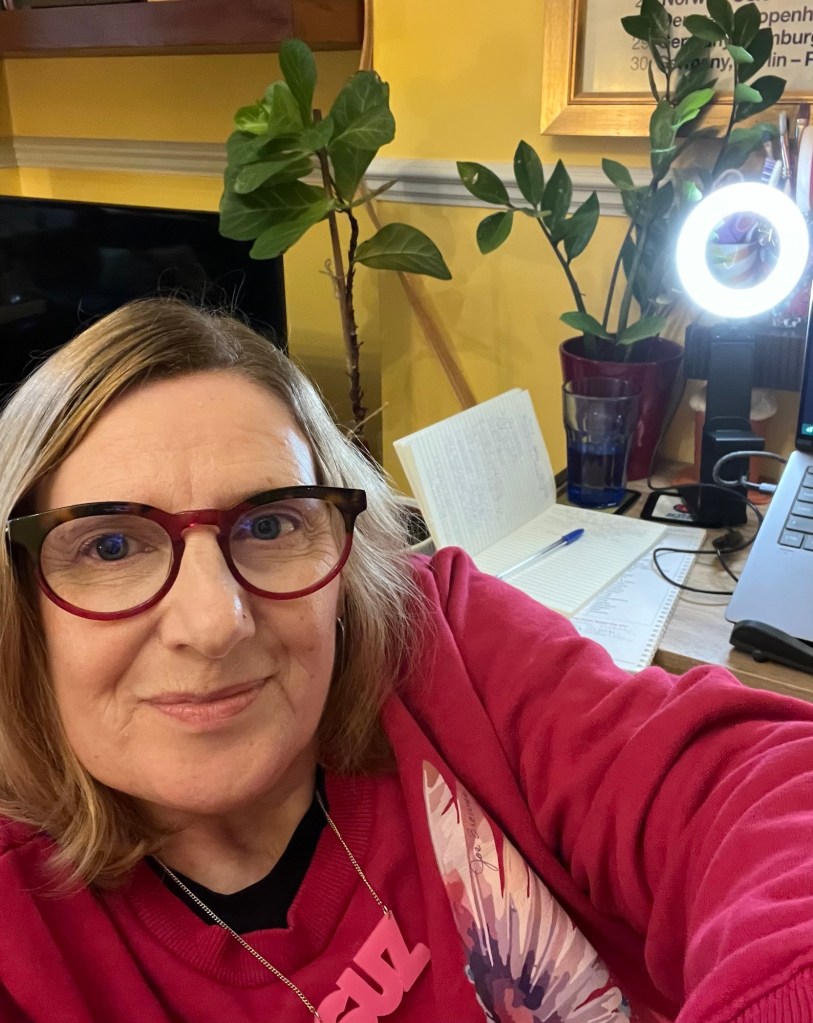
Alt Text: A selfie pose of a white-skinned woman who is wearing pink/brown round reading glasses, a pink sweatshirt with a humming bird on it, a black t-shirt underneath her jumper, & a necklace with the name ‘Suz’ in large pink capitals as a pendant. She has shoulder-length blond/brown wavy hair. She is smiling. Behind her is a part of a wooden desk. On the desk is an open laptop, a pen, an open notebook, an open workbook, a blue glass of water, two coasters, a bright-coloured ring light & a red plant pot with a green-leafed plant in it. Above the desk, part of a brown shelf is showing. In sight are two pen pots holding pens, rulers, scissors, paint brushes, etc. Above the shelf is a framed poster with lots of tour dates printed on it. Next to the desk is another larger green plant & part of a large screen tv. The walls are painted yellow & the daido rail, grey.
First of all, 70 blog posts! Nearly six years since I started the blog & it’s still going strong! Thank you to everyone who reads my posts – you give me a reason to keep the blog going!
Everyone’s going to be either taking part in October’s Breast Cancer Awareness Month (BCAM), or capitulating & then disengaging with social media for a few weeks. I completely understand why. This month can bring back some awful memories however you’ve been touched by breast cancer. Hearing about other people’s lived experiences can be overwhelming if you’re feeling low or vulnerable.
I’m not participating in any official BCAM duties this year. In previous years, I’ve taken an active part in promoting BCAM because I knew it was the only way that I’d see disability represented in any way shape or form. I’ve been featured twice in Breast Cancer Now’s ‘Wear It Pink’ campaign. I was at Downing Street for World Cancer Day when the UK Government launched its ‘National Cancer Plan.’ A couple of years ago on Instagram, I read out the ‘Top Tips’ from the section on ‘Disability & Breast Cancer,’ a chapter that I co-authored with Dr Liz O’Riordan from ‘The Complete Guide to Breast Cancer.’ A couple of weeks ago, I was featured in the BMJ (British Medical Journal) alongside the other members of Imperial College’s EDI PPI group (Equality, Diversity, Inclusion, Public Patient Involvement) with Professor Michael Fadel. We worked together with Professor Fadel on the development and evaluation of a quality assessment tool for EDI (called Quality-EDI) within healthcare research.
Across the world, there’s no definite data or statistics about disabled people who live with a cancer diagnosis. I know this because I’ve asked numerous times. This means that disabled people can’t find out how the cancer treatment is going to impact their specific impairments. It means that they can’t read about the lived experiences of other disabled cancer patients who might share the same impairments. It means disabled people aren’t represented. It’s like disabled people don’t get cancer, or something.
This year I’m sitting back & carefully observing. I’m really, really hoping that I see other visibly disabled people in the breast cancer awareness campaigns of 2026. Why? It makes me feel ‘seen.’ It makes me feel less isolated & alone. Disabled people do get breast cancer. I’m one of them.
BCAM is a good opportunity to touch upon some of the barriers that disabled people face in cancer treatment but because we have it drummed into us that early screening can save our lives & many campaigns focus on this during awareness months, I’ve chosen to write about this aspect of the cancer journey.
It can be really hard if you’re disabled to get a cancer diagnosis because the GP or other healthcare professional may assume that you’re experiencing difficulties, pain & changes because of something relating to your impairments. Last December, I went to a conference run by Imperial College where the following data was presented:
- Pre-existing comorbidity (sorry, awful terminology) rates were higher in the disabled cancer population (13%) compared to their non-disabled peers; & those people with more comorbidity rates were more likely to have an extended referral interval.
- Pain, multiple symptoms and less typical symptoms were all associated with long referral intervals.
- There’s an increased primary care attendance history in the two years prior to diagnosis by disabled people – even when matched with non-disabled peers.
- People with severe and enduring mental health health conditions (not my terminology) had the most clinical contact, but were diagnosed at a later stage.
SignHealth is an incredible UK charity working towards a future where there are no barriers to good health & wellbeing for deaf people. Here’s some of the experiences that deaf people have had in cancer healthcare over the past few years:
- (2026) Hospital staff asked a teenage boy (hearing) to tell his mum (deaf) that her father (deaf) might die because the staff had no knowledge of BSL – British Sign Language – & they hadn’t provided an interpreter.
- (2025) A deaf woman only knew that she was being sent for a test to see if she had a brain tumour when she was sent a post-appointment letter due to the lack of appropriate communication.
- (2024) A deaf man who pulled cancer out of his own throat claimed ‘doctors dismissed me instead of treating me.’ (This really is very, very shocking).
And people with a learning disability don’t fare much better. According an article in The Lancet from January 2026:
- Cancer screening uptake is lower amongst people with a learning disability than the general population – 50.3% vs 66.8% for bowel cancer & 47.2% vs 61.9% for breast cancer.
- Cancer is often diagnosed late – nearly 45% of cancers in people with a learning disability were diagnosed at Stage 4. (That’s completely unacceptable).
- Qualitative research highlighted a tendency for clinicians to offer less intensive or more palliative treatment to patients with a learning disability without clear rationale. (That’s also completely unacceptable).
On a previous blog, I highlighted a Channel 4 News feature from last year about a lady with a learning disability who wasn’t diagnosed with breast cancer until the cancer was poking out of her skin. She lived in a residential home. What on earth were the care staff thinking? Channel 4 News interviewed her in a hospice during the last few weeks of her life. She said that if someone had told her that she needed a mammogram, & that this test wasn’t painful or scary, she definitely would have gone for it.
Within screening there are many, many issues. They range from poor attitudes to physical inaccessibility. Some I’ve experienced myself & written about on this blog. If you’re being screened for breast cancer, there is a distinct lack of wheelchair accessible mammograms. I’ve never had one & I’ve been screened from the age of about 36 years old because my mum & my sister also had breast cancer. Here’s some recent information about disabled women & mammograms from Breast Cancer Now:
- Disabled women in England were 36% less likely to attend breast screening.
- 5,000 women in England in a year were recorded as having a partial or incomplete mammogram.
- Over 50% of these cases were due to women having restricted mobility or being able to attain or maintain a position, or due to restricted positioning from being a wheelchair user.
- Over half the cases where screening wasn’t fully completed, it was due to inaccessible screening equipment.
- The numbers underestimate the scale of the issue. Some disabled women won’t go to their appointment if they think they can’t undergo screening or have been put off by bad experiences.
I want to shout out this point – where’s the data on disabled men because they get breast cancer too?
But it’s not just the physicality of being screened that can be a barrier. If we look back to some of the evidence that SignHealth presented, mis or inappropriate communication between clinical staff & patients can have a devastating impact.
In my opinion, these are the other potential barriers for disabled people:
When you’re being taken through screening & diagnosis, do you understand what’s going on? Is the information in a format that is accessible to you, e.g. Easy Read, Large Print, Audio, BSL video? Organisations like ‘CoppaFeel’ and ‘The Eve Appeal’ (for gynaecological cancers) have some brilliant information in Easy Read.
Do you know how to spot signs & changes, & also check for lumps? Have you got someone to ask that can help you with this? Can someone accompany you to reassure you if that’s the support you need & want?
Are you being spoken to directly by the healthcare professional, or are all the questions solely directed to the person with you – by that I mean is the healthcare professional making a judgement that you can’t understand & be capable of making your own decisions? Is your confidentiality being respected & by that I mean, you may not want your assistant knowing such sensitive information about you? Has the healthcare professional assumed that you’re there with your ‘carer’ who is actually your partner, a family member or a friend?
Is your healthcare professional going to fully liaise with the healthcare teams that look after your other impairments before any treatment starts? Is the healthcare professional informed enough about your impairments or are they dismissive about them – a common phrase that’s been said to me by healthcare professionals is ‘well, we treated all sorts of people with underlying conditions.’ A) I’m not sure I believe that because no one seems to show signs of understanding about my impairment, Spina Bifida, or treating other Spina Bifida patients & B) even if the healthcare professional regularly treats individuals with underlying health conditions, we’re all individuals that require a personalised treatment plan.
Over the last six years other contributors to my blog & myself have been doing the majority of the ‘heavy lifting’ around raising awareness that disabled people get cancer during BCAM. It’s time for others to join in because lives are at stake.

