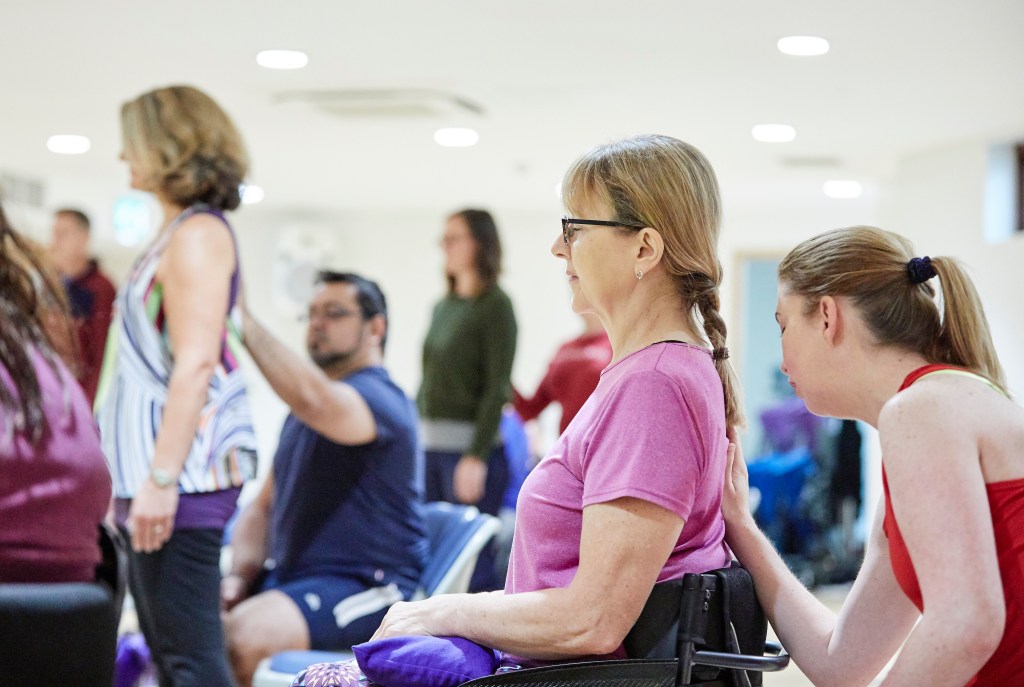
Alt text: A diverse group of people, including wheelchair users & people with other impairments, in a bright, light studio practising yoga.
For this month’s blog, I’ve invited my good friend Miranda McCarthy, Founder of Adaptive Yoga Live – https://adaptiveyogalive.com/
I’ve been practising Adaptive Yoga now for about 5-6 years & I absolutely love it! Not only has it helped keep me fit, it’s also great for my anxiety & breathing. In fact, my breathing has improved so much that my team at Brompton & Harefield Hospitals Trust, London, UK, have noticed clear improvements in my lung function tests & sleep studies.
But the best thing about Adaptive Yoga is all the new friends I’ve made & & love that they’ve given me through some very tough years.
Over to Miranda…
“You know it’s inevitable,” I said to him, standing at the bar. “What’s inevitable?” he replied. “Us,” I said with a cheeky smile as I seductively took a sip of my vodka Redbull. He was my younger self’s idea of a dreamboat – tall, blonde floppy hair, Cambridge-educated and with a body of a Greek god. “Why don’t you come by the gym one day then” he prompted. “Maybe I will.”
I saw Gym Bunny (a nickname my twin sisters gave him) only a week later at the local fitness centre – a place I dreaded going into for fear of social judgement and general awkwardness. I have been Disabled since the age of two, have undergone multiple operations, and live with chronic pain from over 30+ arthritic joints. Using gym equipment was never recommended as it can be high-impact. However, I was told gentle weight training could help improve the strength and stability of my joints, so I thought I might as well give it a go.
Being Disabled means there are several moments, on any given day, where you just have to suck it up and face your fears and challenges head-on. This one was BIG. Dream man – nightmare scenario. I headed over to the weights and started looking at them, bewildered. What am I doing here? I asked myself. I glanced in the mirror next to me and saw that Gym Bunny was strutting his way over to me. “Hey you, looking to do some weight training?” “Um yeah, the thing is…” This is where it started to go downhill. At this time in my life, my disability was almost completely hidden. You couldn’t tell by looking at me that I had titanium hips and knees, that my ankle joints were fused, or that my range of motion was only a few degrees in my upper limbs. That is until I try to pick up a ten-pound dumbell and do a bicep curl.
It was like something out of a cartoon, we consecutively went down in size until I was left holding the smallest dumbbell on the rack, and that’s when it happened. Gym Bunny burst out laughing and screamed across the gym, “Hey, we’ve got a weakling here. Can someone get the purple weights?!” A bunch of other gym bunnies joined in, repeating the question, “The purple weights?” “Who needs the purple weights?” He handed them to me, and said “Don’t wear yourself out!” and walked away.
Needless to say, it put me off from going to the gym and any other mainstream fitness facility for years. The ableism in the attitude and practices of some fitness professionals, who see those living with a disability or chronic illness as people who haven’t done enough to live a ‘normal healthy’ life, is a frustrating reality. Fitness industry standards and expectations still do not include the abilities and needs of people with disabilities. That’s why finding adaptive yoga was such a game-changer for me.
I remember the first day I walked into the tiny studio at the Westway Sports Centre in London. A few chairs were set up, and the teacher was sitting in front of the class. People with various types of disabilities and impairments joined us. People in wheelchairs, on walking sticks, with carers, it dawned on me that this was the first time I had socialised with other Disabled people. I became acutely aware that I was in a safe space, maybe for the first time, where I felt totally free to be Disabled.
Did you know that virtually any yoga pose can be made accessible? Well, neither did I until I saw my fellow yogis all doing different variations of the same pose. Some were seated, some were on the mat, and some were being assisted. Our teacher was able to give verbal cues and adjustments tailored specifically to each student’s needs so that everyone could participate regardless of their level of ability.
Adaptive yoga is designed to meet people with disabilities where they are at in terms of physical fitness. The poses and exercises can be modified or adapted to accommodate any type of disability. I particularly like seeing the ingenuity of my fellow yogis in their use of props such as chairs, blankets, and blocks for support during the practice. When properly supported, the struggle to hold a pose is eliminated, and one can more easily detect the presence and movement of the breath (this serves to unify the physical, mental, and spiritual body – the essence of yoga).
What surprised me the most was that yoga is actually a form of meditation. Even if you are just being aware of the rise and fall of your chest as you breathe, you are practising yoga. This sets it apart from any other form of exercise because it’s not a physical workout; it’s a mind-body practice that produces a change in calm and relaxation on a neurobiological level through mindfulness.
My regular yoga practice has not only increased my physical strength and flexibility, but it has provided a number of psychological benefits, such as reduced stress, improved mood and self-esteem, increased relaxation and mindfulness, increased resilience to my life’s challenges, improved body image and acceptance of my physical limitations.
Additionally, joining an adaptive yoga class provided a supportive and inclusive environment where I could learn from and connect with other Disabled yogis who have similar challenges and experiences. I had found my tribe, my community, and not a gym bunny in sight! The only problem is, at the moment, 99% of images you see representing yoga are of hypermobile white women contorting themselves into impossible shapes. Different body types and abilities are not represented in mainstream yoga studios, publications, or advertising. Yoga’s global popularity, as well as its proven benefits in terms of physical, mental, and social development, makes it a perfect tool for promoting the inclusion and well-being of people with disabilities.
It’s why I launched my nonprofit organisation adaptiveyogalive.com to provide free-of-charge classes so that everyBODY can have access to yoga regardless of their financial status, shape, age, weight, race, gender, or level of ability!
My yogic lifestyle has supported me on my journey to a new, healthier way of living, and I’ve never felt more connected to myself and to those around me. I am so happy I finally found a physical activity that I could enjoy and engage in, on my terms, without feeling limited by my limitations. I feel nourished, nurtured, and empowered.
From Suzanne: you’d be made so welcome if you want to join in or if you’re a yoga teacher wanting to learn the Adaptive Yoga practice – https://adaptiveyogalive.com/
Alt text: a rolled up, pink yoga matt, a pink foam yoga block & a pink yoga strap pokes out of an open blue sports holdall, laying on a grey carpeted floor.
Happy New Year! So, let’s talk exercise – because we’re all supposed to be in the gym in January, right?!
This month features my first guest blogger, my former colleague Natalie South-Law. Ta da! I’m really proud to announce this! I feel like my blog has ‘come of age’, so to speak.
I briefly covered the challenges of understanding the importance of keeping physically fit, but not knowing how to do that when you’re also disabled in my Breast Cancer Now IG Story Takeover in October 2021. I spoke about what I can do which is basically swimming, yoga & light gym exercises.
But as I’m someone who had to stop PE at 14 because I was running the 100 metres & getting slower each year, I thought it would be an idea to hand over to Natalie who’s passionate about supporting disabled people to exercise & making exercise accessible. Here’s what she says:
‘If you had told me as a child that I would be writing a blog about how integral to my life as a disabled person exercising and sport is, I’d have thought you were mad!
That’s because back in school. PE and fitness was never really something I enjoyed, was on my radar or actually was even included in. I went to a mainstream school through my whole education.
In primary school, I would be taken away from the class when it was time for the PE lesson, and have to do my physio instead with the support worker.
As a disabled adult, I wasn’t getting any regular physio or medical intervention, but I was still riding, that one consistent movement activity, just now at a non-disabled school. I went to watch the Para Dressage at the 2012 Paralympics in Greenwich Park.
This was a huge turning point for me. People like me, doing sport!! Now I’m not saying all disabled people want to be in the paralympics, as that is simply not true. What I am saying is that it was so nice to see that representation.
Alongside all of that, there was also discovering the gym, and how enjoyable, and fundamental, strength and conditioning training is to me as a disabled adult. I spent a number of years trying to find an accessible gym and a Personal Trainer who had an understanding of disability, and this was quite an arduous process. Luckily, I found a PT who was willing to work with me, despite not having any previous experience of working with disabled people, and we learnt together. I worked with him for just over 6 years, and learnt so much. I probably would advocate more towards finding someone with experience of working with disabled people, but I’m definitely glad I took the risk, as I have seen such an improvement in my impairment with regular movement. Now I take part in an adaptive CrossFit class with Alt Movement, which has been great, as the coaches adapt the movements to suit the individuals, and it’s so good to surround myself with other disabled people. If you are in Essex, definitely recommend checking them out!
I have developed so much, not only physically, but mentally too through my fitness journey over the years. I soon realised that it’s a process and not an overnight fix, and this has been really important in building up the habit.
All my workouts complement the sports that I take part in (wheelchair basketball and shooting), but they also help with managing my impairment, and, as boring as it can be, I make sure to include stretching in every session.
I think one of the most important things for me with discovering sport and movement has been the support networks I have surrounded myself with, including my family, friends, workplace and sporting colleagues, and peers with Cerebral Palsy. I also think having myself as my biggest inspiration is really important to me – as big headed as that might sound! I have developed a drive to always do better, but equally as important, to not compare myself to others. Everyone is on their own journey and will have different goals, so that is a big reason why I use myself as my own inspiration. And setting those goals with my coaches has always helped with my drive. I think it’s so important to recognise that disabled are actually able to have goals and aspirations, just as non-disabled people.
I think the biggest thing for me that has got in the way is lack of representation. As a child, I didn’t know any other disabled children, I didn’t see disabled people in the media, so I didn’t really know what I was capable of, as I didn’t see myself represented. Of course, sport isn’t for everyone, and I think that I was lucky in that I enjoy it. Also, ableism was a huge factor too. Not being able to do something “because I’m disabled” was a big part of my childhood. In 2017 I completed a half tough mudder, which is a good example of this mindset shift, as I definitely wasn’t sure if it was for me. BUT not because I was disabled, but because I wasn’t sure about the mud!
If you are reading this and you are a disabled person, I hope it has encouraged you to get out there and see what you are capable of. It’s important for me to end this by saying movement looks different for everyone, and that’s okay! It’s more important to be safe, and work out what is a suitable goal for you. If, like me, you were excluded from PE as a child, any form of movement would be enough to make our younger selves proud!’
Natalie South-Law
Natalie South-Law is on instagram as @itsthatgirlwithcp
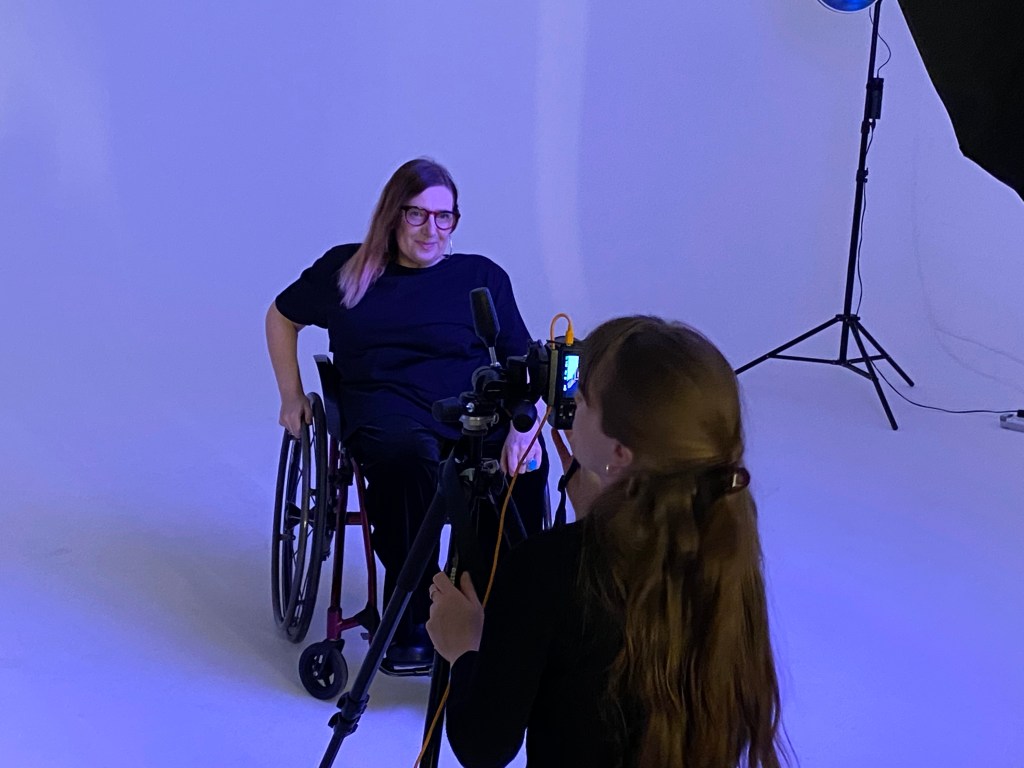
On the first proper wintry weekend in mid-November, I found myself in an east London studio, being photographed with a lovely bunch of kind & funny people. We’re all volunteering to be models in a unique Fashion Show which will take place in Spring 2023.
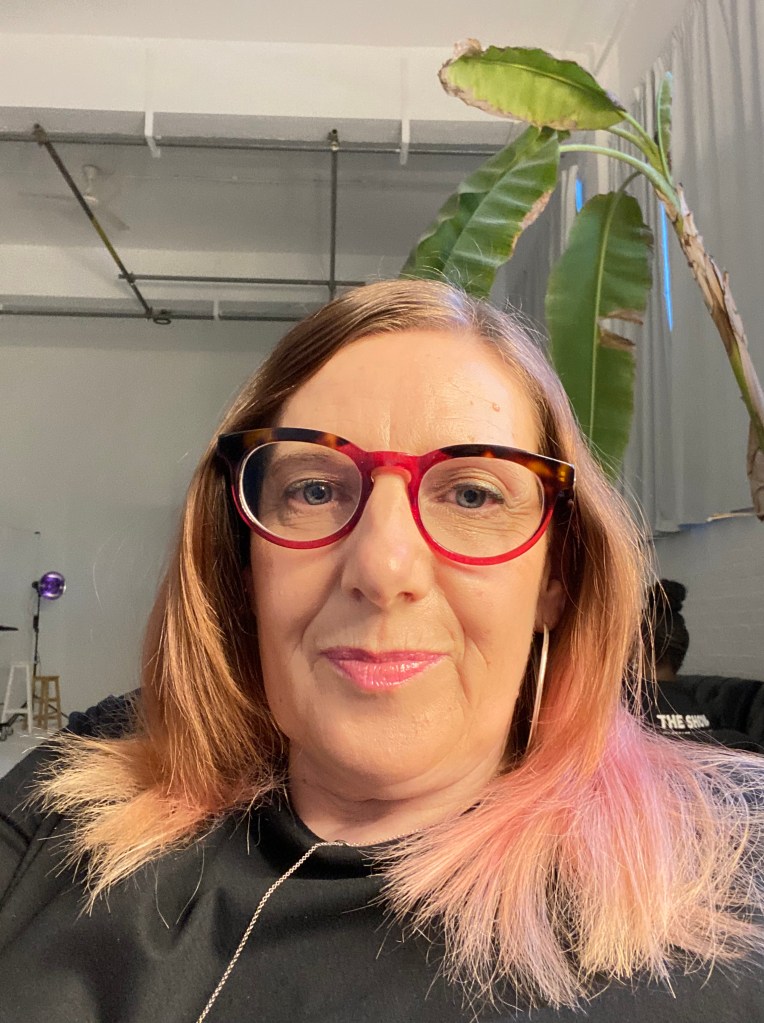
Alt Text:A selfie pose of a White woman with long, straightened, brown/blond hair with a hint of pink. She is wearing round, pink/brown glasses, large silver hoop earrings, a silver necklace & a black t-shirt. Behind her is a large, leafy, green plant, photographic equipment & a Black woman sitting with her back to the camera. She has her hair in a bun & she wears a black t-shirt with the words “The Show” printed across the back in white capital letters.
Many of you who have known me a long time have seen that I’ve always strived to get the most out of life & to embrace new experiences. This has become more intense since I was diagnosed with Breast Cancer.
So, my next adventure is going to be… becoming a model! Yep! Next April I’ll be on the catwalk at the Science Museum, South Kensington, London, UK, taking part in Breast Cancer Now’s ‘The Show’, a fundraising fashion show that they host every year with volunteer models who all share one thing in common – our lived experienced of Breast Cancer.
I volunteered to be part of the show to raise awareness that disabled people get Breast Cancer too. When I was accepted by the show, the Events Team told me that this is the first time that they’ve had a wheelchair-using model who has an impairment not caused by Breast Cancer.
I’m so nervous about modelling & the ‘runway’, but I’m determined to come out of my comfort zone. There’s all the physical stuff to work out with the Events Team, such as turning space for a wheelchair-using model, the timing of the clothes changes to when you go out again on the catwalk, creating a private, accessible changing area backstage, etc. But there’s also a lot of emotional baggage to deal with. That’s not just down to being disabled. What I share with a lot of the other models is that my body changed in an instant. All of us want to get our confidence back & feel beautiful again.
As with all application forms, the questions were standard – perfectly understandable as to why, but I’m not really standard, lol! Even before I gave my access & COVID-19 safety requirements, there was so much more detail to give about my clothes & shoes preferences. For example, when it came to describing my size, I found that very difficult. I don’t really have a ‘size’, as such. I tend to choose clothes by their style instead, something which I’ve worked out over many years. I don’t fit into any conventional shapes, certainly nothing figure-hugging with my spine of three bends at 120+ degree! I’ve got some skin allergies (which are a bit worse now because of the side effects of treatment), so there’s all sorts of textures, textiles & make-up brands that make me come out in hives. I can’t wear zips, hooks or shoe-shop footwear either.
After I’d got this all down on paper, I could then move onto what designs & particular clothes shops that I liked. That’s helpful for the stylist as many of the clothes are donated by brands. But I asked if I could wear some of my own clothes, as I thought it might be easier for the stylist. Plus, I wear some wild stuff sometimes, especially when raving or ‘festivaling’ (remember the two shiny capes that I bought in lockdown?!!!) I nearly always need to have trousers, skirts & dresses shortened. I was thinking that it might be hard for the stylist to find ‘off the peg’ outfits for me that wouldn’t need extensive alteration. For years my footwear has been made by the hospital (thankfully it’s a world away from the ‘clod-hoppers’ that I had to wear as a kid!)
I’m really, really fussy about what I wear & I’m vain. Looking ‘top dollar’ has always been important to me. I made quite wild & non-conventional fashion choices from a young age. This was encouraged by my mum who spent a lot of time & interest in dressing both me & my younger sister. She used to make her own clothes & my grandmother made her own clothes too, including sequinned gowns because she was a dancer.
And why is it important to me that I look good? Because I’ve always been stared at. Instead of being embarrassed, I’ve used clothes, jewellery & make-up to accentuate what people might be staring at. So I wear wacky patterned trousers & leggings, statement jewellery that has slogans, such as my Brexit protest slogan necklace that says ‘European’, & lots of UV make-up & face glitter when I’m out dancing. I’m almost 52 but there’s no chance of me toning down my style!
In preparation for the modelling experience, I also had a video call with Catherine Gunn from the Events Team. She was very supportive, generous & kind. We talked through everything; she put my mind at rest about many aspects of the photo shoot & the show. I opened up about how nervous I was about taking part; how I felt uncomfortable about changing in communal places & having people dress me who I don’t know – I really didn’t want that to happen. I’m wary of being dressed by someone that I don’t know because of the amount of attention that needs to be given to my personal care requirements. Although I’ll have a dresser, I’m going to have my own support with me, which will calm my nerves on the day. With my access requirements met, it means that I can just focus on the modelling part. And I’ll have a private changing area to myself, near an accessible toilet & with a bed as I find it easier to get changed on one. We talked about how tired I might get, so I chose the latest photo shoot session time & travelled to the session by taxi, taking the overground rail from Haggerston to get home. For the night of the show, I explained that it was easier for me to sleep in my own bed rather than staying in a hotel – in fact, I live in the same borough as the show’s venue, so it’s easier for me to get a taxi there & back. We discussed whether I’d have to miss the show’s meal the night before, & only do one of out of the two shows. However, I’ve just heard that I can have annual leave from work around the time of the show, so I’ve confirmed that I’ll be attending the meal & I’ll be taking part in the afternoon & the evening shows. I don’t want to miss out!
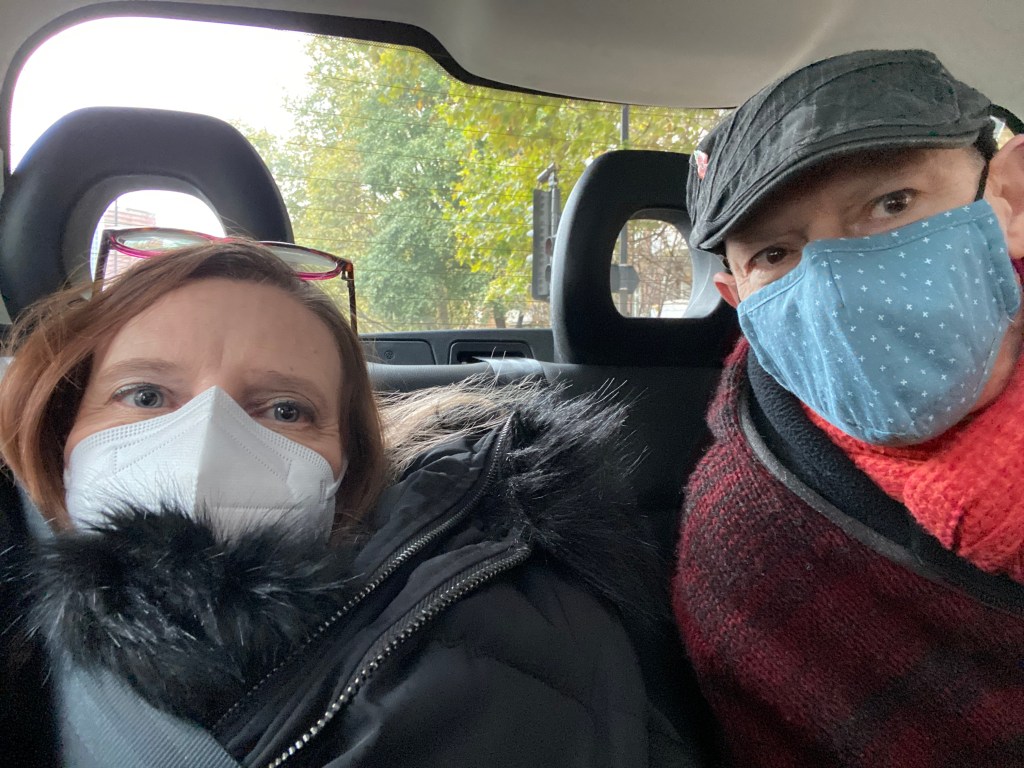
The day of the photo shoot was a Saturday in mid-November & it was the first cold, foggy day of the season. I got all masked up ready & I sat in the cab with my legs shaking away! At times when I get nervous, I feel grateful that I sit in a wheelchair to stop me from collapsing to the floor.
The ground floor of the studio, Street Studios in Haggerston, east London, UK, was wheelchair accessible, including a designated toilet. I’ve put the details of it at the end of the blog if it’s helpful to anyone. There were loads of people milling around but I was greeted very warmly by everybody (with a cup of tea which always helps) & my nerves started to melt away. Everybody was so excited & it was infectious. I had a good chat with as many people as I could, but Stephane (my boyfriend) was able to spend more time with everyone than me. He just chatted away, it’s always so sweet to see. There was lots of lovely food, especially biscuits made with the Breast Cancer Now and The Show logos, so nice!
One of the first people that I met was the choreographer, Deborah Britz. She was very encouraging & she’d choreographed wheelchair users before, which really helped me. We all had a modelling lesson from her & a couple of turns at practising a mock runway, which was really fun. She made it really inclusive too which I really appreciated. The practise enabled me to show off what my manual wheelchair can do. I actually love my chair; I’ve had this particular one for nearly five years – it’s super-light & speedy with a glittery purple frame which catches the light. Although it’s nerve-wracking to pose in front of a whole lot of people that you’ve just met & you’re physically different from them in every way, gliding through the practise in that chair made the experience much easier. I do a lot of yoga too, so that helped me to visualise sitting up straighter & breathing through each pose that I was asked to do.
The next experience to tackle was the photo-shoot. That was a whole lot of fun, especially when the photographer, Sarah Page, brought the wind machine out – yes, A WIND MACHINE, LOL! As usual, my glasses were on wonky because I’ve got one ear that sticks out more than the other (a source of much merriment in my family!) & I was trying not to show my bad teeth, but she managed to get a whole lot of nice shots. She also showed me the shots as we went along to check if I was happy & comfortable, which was really kind. We had shots in a small group as well, but my group shot was a little bit more spread out to be COVID-safe. Everyone is the group was really supportive about that (thanks ladies 😉!) Stephane also took some unofficial shots of us laughing & mucking around which are really funny.
Then it was onto the Videographer, Steve Torpey, to capture some movement which I found quite tricky, but still amusing. He asked if I had a signature move & all I could think about was that I give ‘the bird’ quite a lot which obviously I didn’t do this time, lol! I just said that I didn’t have one. I swung about a bit in my chair & smiled inanely. I’m honestly not sure how the video will come out, but I know Steve did his very best with my messing about!
The part that I was most nervous about was meeting the stylist, Rebekah Roy. As agreed with Catherine, I brought a few examples of clothes & my new bespoke trainers made by the hospital to show her. Rebekah was really supportive; she said she felt confident about planning what I was going to wear, she could see that I wasn’t afraid of bold colours & patterns – not only from the range of clothes that I’d bought, but also because my glasses were pink, & my I’d dyed my hair pink. I was quite chuffed by that!
And then as quickly as it began, it was all over. Stephane & I emerged into the cold darkness but we both had a warm glow whilst taking the overground rail at Haggerston to Shepherd’s Bush which makes up most of our journey home. I was exhausted the next day, but boy, was it worth it!
Thank you to the Breast Cancer Now team – Ellie Barnes – Senior Special Events Manager, Catherine Gunn – Senior Special Events Officer, Mark Sydserff – Senior Multimedia Manager, Sarah Page – Multimedia Producer, Steve Torpey – Multimedia Producer, Harry Frostick – Multimedia Production Assistant & Rebekah Roy – Stylist, Catherine Britz – Choreographer & all ‘The Show’ models for an awesome day.
I’d also like to take the opportunity to wish all my blog readers Season’s Greetings. I hope you have a restful & peaceful holiday, & thanks for all your encouragement this year.
Photo Credit: Stephane Cony.
Alt Text: A photo shoot with a white floor & white walls. A White woman sitting in a purple wheelchair, with long, straightened, brown/blond/pink hair, wearing round, pink/brown glasses, a black t-shirt, black trousers & black boots, smiles into a camera on a tripod. Operating the camera is a white woman with long, curly brown hair & a black jumper, crouching down. In one corner is some photo shoot equipment.
Alt Text:A selfie pose of a White woman & man, wearing masks, sitting in the back of a London Taxi. The woman has long, straightened, brown/blond/ pink hair & she is wearing a black puffa jacket with a faux fur hood, a black faux fur scarf & a white medical mask. Her round, pink/brown glasses are perched on the top of her head. The man is wearing a grey flat cap, a blue mask with white polka dots, an orange scarf & a dark mauve & red wool hooded coat.
Alt Text:A white logo that says ‘The Show By Breast Cancer Now’ in white capital letters on a black background.
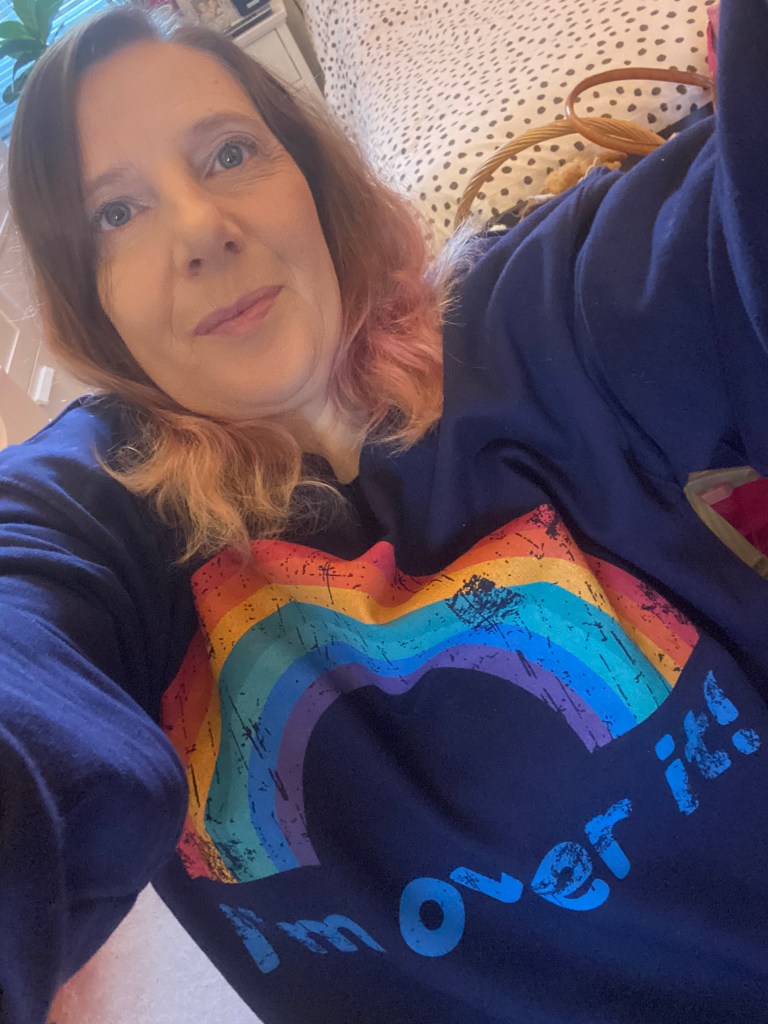
One of the most debilitating aspects of cancer is the impact on your confidence & self-worth. I can’t tell you how much I want this particular aspect to be over!
Alt Text:A selfie of a white woman with long, curly dyed pink here, wearing a blue sweatshirt with a rainbow & the words ‘I’m over it!’ printed on the front. She is in her bedroom, sitting on her bed which is covered in a pink, grey, black & white spotted duvet.
I guess we all have periods of questioning our self-value & self-worth depending on what might be happening in our lives. However, living with a cancer diagnosis can really negatively impact on how we see ourselves or how we think others see us.
I think my self-doubt stems from the fact that I didn’t find my breast lump myself. Instead, it was found in a routine mammogram. Being disabled & having an awareness about my impairment gave me a level of confidence in understanding my body. Cancer took that understanding & confidence away.
I already had generalised, low-level anxiety anyway (it’s very connected to living with an impairment; everyday you’re dealing with a serious of dumb-arse scenarios such as ‘will the cabbie moan about how my wheelchair folds, will the assistance staff come with the ramp to get me off the train before the door closes’ – the list is endless), but this increased to a much higher level once I’d had the cancer diagnosis. I try to reason with myself, trying to accept that getting anxious is entirely understandable after all that I’ve been though. But what I really don’t like about anxiety is when it affects my self-worth, sometimes to such an extent that I lose confidence in thinking that I can’t do something anymore. Trying to counter-act those overwhelming, negative feelings is the debilitating part of it.
When I returned to work, I felt that I had a lot to prove – would I still be up to the job – & did others think that I could still do the job. As a friend send to me recently, if you’re a lead in an organisation & you return from a long sickness absence, or you announce any kind of “transition,” the vultures start circling. That’s 100% true in my experience.
After an astonishingly successful result at work within the last couple of weeks, I can say with total confidence that I am very much back ‘in the room’, but it took a while to get there. For reasons of confidentiality & privacy, I’ve left out names & supplied general details in order to describe my experiences in the blog.
In the early part of this year, the charity that I founded had to re-apply for its core funding. It’s always really intense work & takes a few months away from running the business. However it comes around every few years, so you accept it, roll up your sleeves & get on with it. I’ve led the application process as directed by that particular funder a few times over & the organisation has always been successful, so I took some confidence from that. But this time around it was particularly challenging.
The first indication that things could be altogether very different was when the funder’s guidance came out. Not only were there pages & pages of guidance & bespoke templates to read through, but I also simply couldn’t understand what was being asked of the organisation by the funder. I was deeply shocked. Then shock turned into terror – had my level of comprehension been reduced to almost zero? In an instant, it took me back to when I was put on tamoxifen before my surgery & how I had to eventually take sickness absence because I couldn’t even follow a plot on EastEnders!
My mind & stomach began to do somersaults. The organisation was looking towards me to help them understand how we were going to apply, to decipher any jargon, to co-lead them through the process & to co-lead them to another successful result. The more I read, the more I cross-referenced, the more my brain fog grew.
In a complete state (yes, I’d worked myself up into a frenzy), I turned to my co-lead who responded in the kindest way ever, first & foremost reassuring me that it wasn’t just me finding it impossibly hard. She directed me towards social media where literally all the applicants were expressing the same difficulties as me. And then some other kind & generous souls started releasing Easy-Read guidance & templates & deciphering all the jargon. And then there were others who were willing to have a conversation about what I was finding difficult & then make what I didn’t understand, understandable. Thank god for those generous people.
But all this help doesn’t take away from me having to de-construct all of the guidance so that I could get us into a position where we could start the application. I set about distilling all the guidance down to its essentials. It was only by doing this that I was able to present the different funding models to the team, making recommendations to what our appropriate model should be. This took HOURS of work. Eventually I went back to a tried & tested set of questions – what does our organisation do best, what do we want to achieve in the next few years, how are we going to achieve it & how much budget do we need? Then I matched our aspirations with our what funders would want to know – what does the organisation want to do, how much is it going to cost, have they got the structure to support the activity & how does it meet our criteria? Bam. It sounds so simple doesn’t it! The irony was that I became so proficient in explaining the funder’s different models, one of our other funders claimed that it was the clearest explanation that anyone had ever given them!
Once the recommendations for our funding model were agreed, the whole organisation got to work to complete the application. I regarded the experience like creating a plan which everyone had creative input into & had ownership of, & as a result, it became our most ambitious application to date.
I adopted the position of ‘morale-boaster’ within the organisation, endlessly injecting enthusiasm & positive energy. But all this took its toll. Inevitably I was ill from the ongoing side effects of cancer medication & with work-stress on top of that, I had to withdraw a couple of times in order to make sure that I was recovering in time for the next step of the process. As we came closer to announcement day, there were lots of external rumours. I ignored them, focusing instead on knowing that our organisation was great & there was no reason to think that we wouldn’t be funded. It was really difficult to maintain so I coped by mostly withdrawing from discussing the subject unless I absolutely had to. Of course, on the lead up to the announcement, I happened to be waiting on x-ray results for my right knee & hips (the results were clear, phew!) So, my mind was a jumbled-up jelly mess, but my mantra became “We’re going to get everything that we’ve asked for.”
And do you know what, WE DID! WE DID IT! That’s what I screamed into my laptop screen when I announced it to the team. I cried loads as well. It was such an emotional moment. It felt that all the mental & physical struggles that I’d had for most of the year, melted away. It felt massive. But then it was massive.
Hence the biggest rule in doubting yourself is never to doubt yourself, LOL. And then the next rule is that some things are literally out of your control so all you can do is make the very best of them. Quite often, returning to things that bring you comfort & pleasure, & implementing ways of working that are beneficial to you, really help dissipate some of the anxiety & most definitely increase your feelings of self-worth! Hanging out with good friends & colleagues who are all routing for you, who are willing to help & who are there to remind you that they believe in you, were hugely motivating factors for me.
I’m going to finish this blog by congratulating my colleagues on our massive, collectively-earned success – you’re bloody fantastic!
And also, I’m going to say, ‘I still got it.’ Because I have!
I was invited by Breast Cancer Now to take over their Instagram Stories for #BreastCancerAwarenessMonth2022
Alt Text:A screen shot of an Instagram page. A white lady with long brown/blond hair, wearing round pink/brown glasses, a black top, large silver hoop earrings and a silver chain, leans against pink wallpaper with skulls & butterflies on it. She is smiling. The main text in black on a white background says – ‘Breast Cancer Now, 55m, Welcome to Suzanne Bull’s Instagram Takeover.’
During the summer, I was contacted by Breast Cancer Now to takeover their Instagram account & describe what it’s like to be diagnosed with breast cancer when you’re already disabled. There’s a link to it here but you can also find it on @BreastCancerNow Instagram account.
Originally my IG Stories Takeover was supposed to come out in the summer. However, I was struggling with my pain levels due to my 6-monthly Zometa infusion & trying to save my energy for returning to festivals. I had also underestimated how long it would take me to think of what I wanted to present, how to present it, & then to storyboard & script it. Not only did I want to make it authentic to my lived experience, but I also wanted to make it accessible. I found out that Instagram Stories isn’t a completely inclusive format but I’m hoping in the future that I can work out a way putting my story into a post with all the alt text provided in the photos. The video clips are captioned, & where I could, I self-described on film (I should say, in truth, when I remembered as my brain fog is terrible at the moment). I want to say thanks to my colleagues in the Comms team at Attitude is Everything who gave me lots of guidance on how to make the film clips accessible, & also Breast Cancer Now who uploaded all the captions, film & pictures for me.
As time went on & my piece still wasn’t finished, I suggested to Breast Cancer Now that my IG Story Takeover could go out during October, which is #BreastCancerAwarenessMonth – they agreed. It went out on 11th October.
I could have done a “live” blog where people send their questions in & I answer them, but I really wasn’t confident about doing a live Q & A. I was scared of getting a question that I couldn’t answer! I also wanted to control the dialogue & the way in which my story was told because I had never seen a story from a disabled person with a breast cancer diagnosis. It’s so important that disabled people tell their own stories because we’re still so misrepresented in society.
Over the course of a couple of months, I planned, scripted & filmed the story. Yes, I do discuss challenging times, especially during the early months when I was diagnosed & then I had my operation cancelled because of COVID-19 spreading across the UK. I also describe many complex decisions, like having a lumpectomy instead of a mastectomy, & how I accessed radiotherapy as a wheelchair user – subjects all previously covered in my blog. But additionally, I didn’t want to make it seem like every moment was really horrible. I had some fun times, such reinventing myself as an artist & taking part in Grayson’s Art Club (all thanks to Maggie’s West London’s Expressive Art Group) & joining The Invisible Café’s Writing for Wellbeing sessions.
I wanted to demonstrate that I was active & enjoying my life, so there are pieces about yoga & swimming. But at the same time, I wanted to make the point that it’s not easy exercising as a wheelchair user, & I’d got support to plan out an exercise routine. The final take happens at Elton John’s gig at British Summer Time at Hyde Park, London.
I had a lot of fun making the IG Stories Takeover. Now I reflect on it, it was another way of helping me process what I’d been through.
I learnt new skills. Through the planning, I began to shape how I present myself & my story. There are many breast cancer stories out there, but I want to tell a breast cancer story from a diverse perspective, because I only know one other person with my disability & who lives with a breast cancer diagnosis (she’s been utterly brilliant throughout my ordeal). I learnt how to make IG Stories as accessible as possible, & it’s given me ideas about how to use other digital platforms that allow a greater level of accessibility.
I got some great feedback on my own social media – one of my twitter followers said that she was glad that a large charitable organisation had backed me because it was important for marginalised people who have breast cancer to be given a voice. That made me quite emotional. Breast Cancer Now also said that they’d had a lot of positive feedback because of the different perspective, but they also got a personal message from one of my oldest friends who said that my mum would be so proud of me. That made me cry. In many ways. I’m telling her story as well as my own, because she never got the chance to.
I want to finish by saying a MASSIVE THANK YOU to everyone who commented & who sent messages of encouragement & love to me & to Breast Cancer Now, to my newly-found Twitter #CancerBuddies, to my friends & my boyfriend Stephane who gave their permission to be part of the story & to my PA’s who supported me at the filming locations.
And I think Breast Cancer Now are wonderful. Their social media team encouraged & guided me but never pressurised me with deadlines or anything like that. They took accessibility on board, & they were so enthusiastic. But most importantly, they let me tell my story in the way that I wanted to. I can’t thank them enough.
It’s deeply unfashionable for a post-punker to be writing about the Queen. But I’m not in fashion.
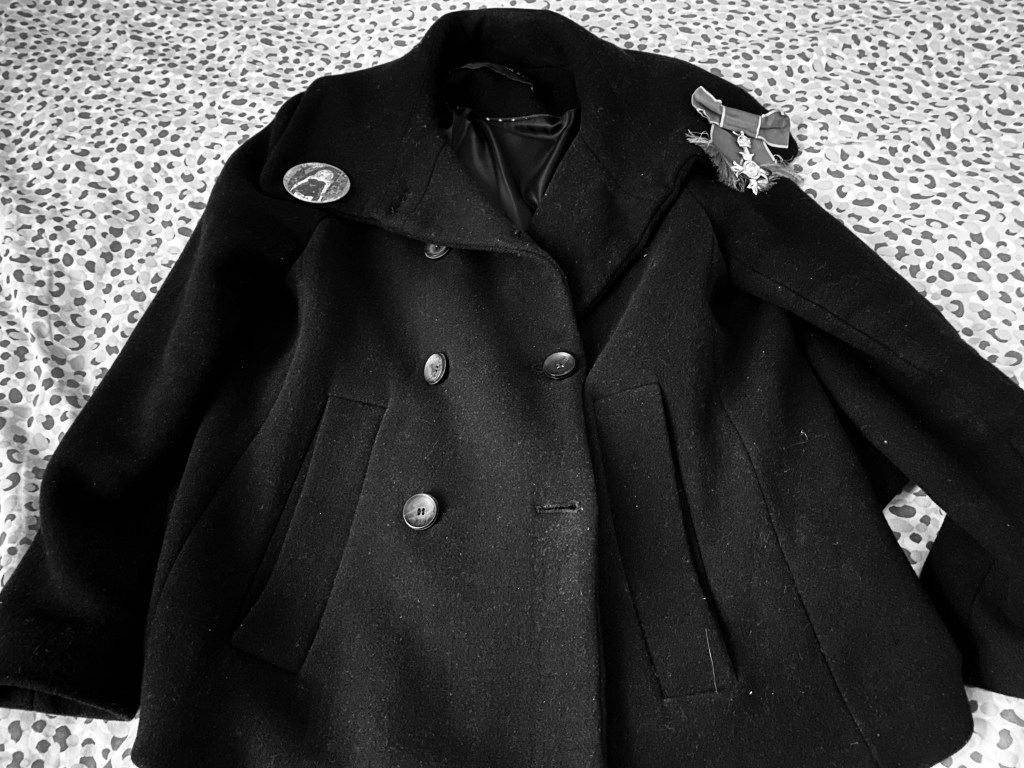
Alt text:A black woollen winter coat is laid out on a spotted duvet cover. Pinned on one lapel is a round badge with a painting of a woman on it. Pinned on the other lapel is a medal with ribbon & a cross.
During our #WritingForWellbeing sessions, hosted by The Invisible Café, we’ve been encouraged to share our memories of the Queen & the Royal Family. Here are some of my recollections.
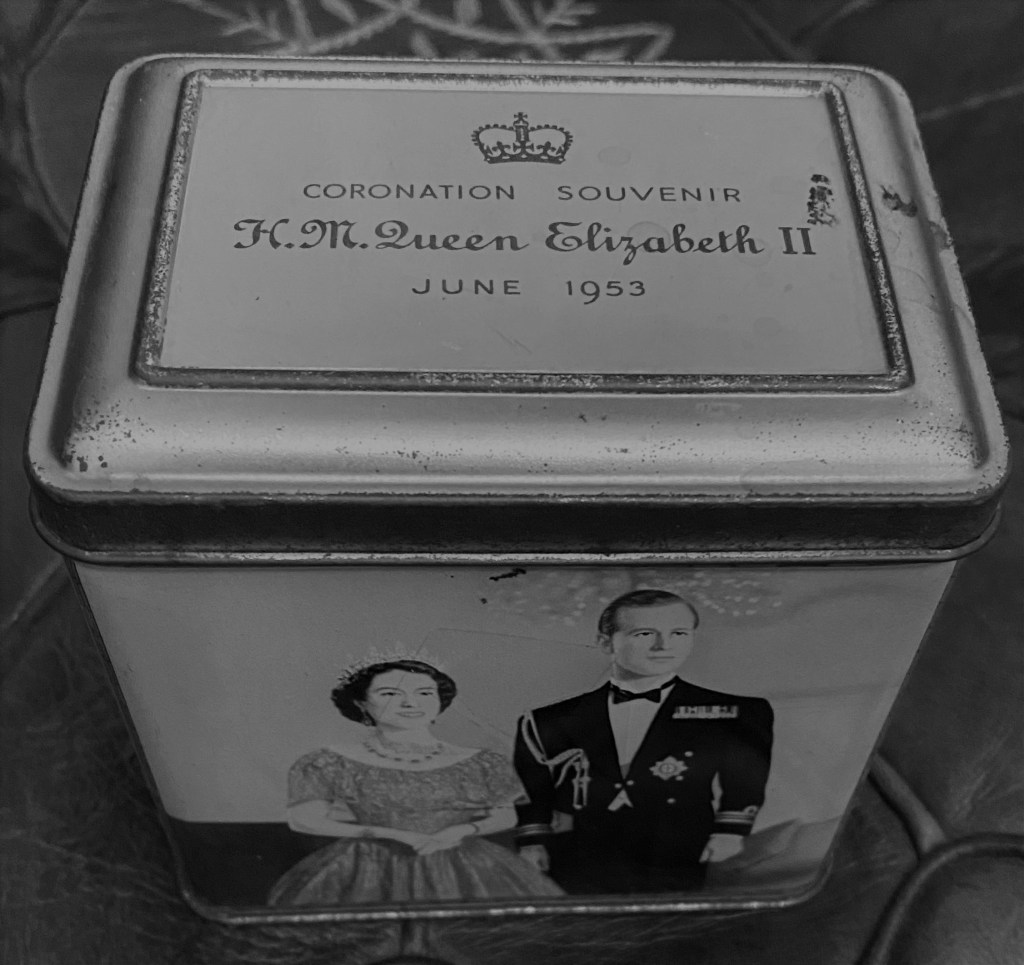
I inherited a Coronation Souvenir Tin
Alt text:A black & white photo of an old tin. Printed on the top of the tin is a logo of a crown & the following words: “Coronation Souvenir. H.M. Queen Elizabeth II. June 1953.” On the side of the tin are a Royal Couple (Queen Elizabeth the second & her husband Prince Phillip). She is dressed in a ballgown, wearing a diamond tiara & necklace. He is dressed in Military uniform complete with medals & a bow tie.
Objects & Stories (a poem – a draft was originally written for one of the 64 Million Artists’ #TheWeeklyChallenge)
Holding the Coronation Souvenir Tin
Brings memories flooding back of the green school notebook with your recollection of the Queen’s Coronation
Your writing neat, confident, in blue fountain pen
You made me a dress from multi-coloured tissues for the Silver Jubilee Fancy Dress Parade
And when my wobbly tooth fell out
Together we rifled through the blades of grass on all fours
Now I’m talking to your photo as I watch Sunday’s Platinum Pageant on the telly
I’m alone but feeling that that you’re close by as you always are for these grand occasions
Dressed to the ‘nines.’
Waiting for the Funeral Cortege
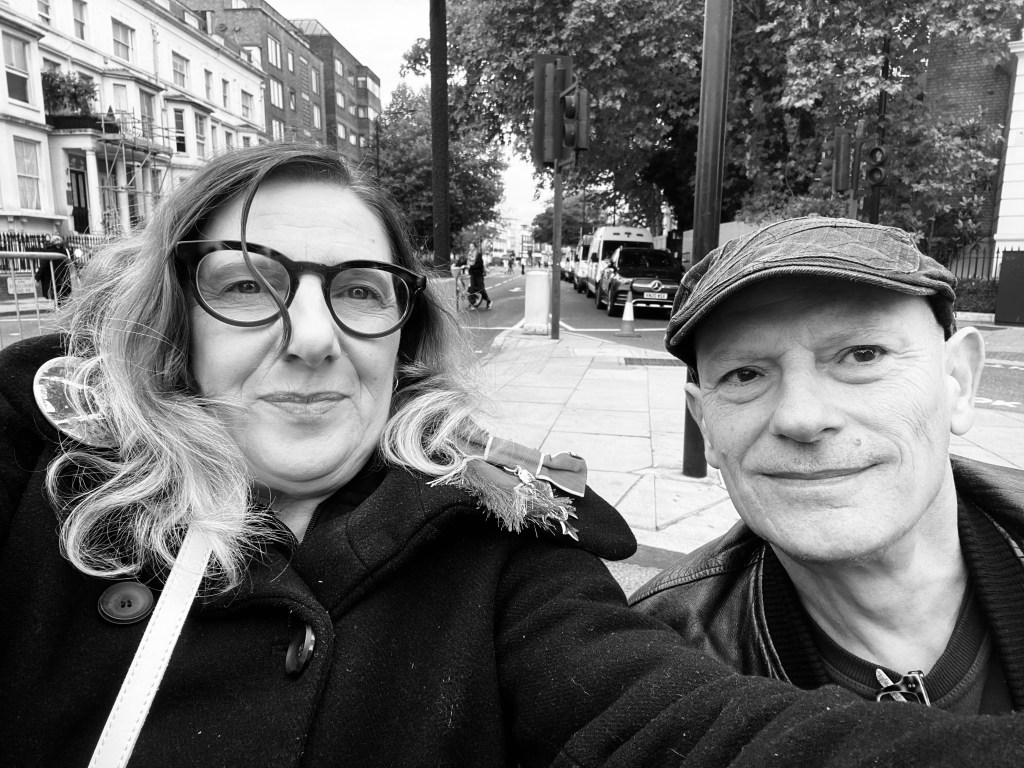
Alt text:A white man & woman pose for a selfie at the corner of a road. The woman has long curly hair & she is wearing round glasses & a black woollen coat. On one of the lapels is a round badge & on the other, a medal. The strap of her bag is showing. The man is wearing a flat cap, a leather jacket & a t-shirt from which his glasses hang. Behind them is a London Street with large, four-storey terraced houses & flats, railings, traffic lights, bollards & many parked cars.
On the day of the Queen’s Funeral, I felt it would be too upsetting to watch it on tv (I’ve never been good with death. The first funeral that I ever attended was my mum’s). Instead, Stephane (my boyfriend) & I went to the neighbourhood that I used to live in 20 years ago, Earl’s Court. We knew that the Cortege would pass along the A4 on its final journey to Windsor, so we took position at the corner of Earl’s Court Road and Cromwell Road just before 10am.
I hear the questioning voices all around me; “Why would you do that for someone you’ve never met? For someone who you don’t know. For someone who’s rich beyond most people’s means & who doesn’t give a s**t about you?”
Here’s why:
The Queen & I
I thought the Queen was a nice lady. When I think of the Queen, I think of all the Jubilee parties & Royal Wedding parties that we had. When we got together with families, friends & our neighbours. Both sets of nans & grandads, my great-grandmothers, & my great aunts & uncles loved the Queen.
The Silver Jubilee was so exciting. At that time, I lived in a little cul-de-sac on an Essex estate & all the neighbours came together to organise a street party. I remember my dad & my neighbour Uncle Dave fixing Perspex sheets to wooden stakes with an industrial sized stapler. They wanted to protect the large tent they’d made “in case of inclement weather.” The other things I remember were the fancy dress parade & the infamous dress & hat that my mum spent weeks making, hand sewing all these multi-coloured tissues onto fabric, & then losing my tooth which we couldn’t find in the grass (but the Tooth Fairy still came).
I went to the ‘Longest Street Party in the World’ on Oxford Street for Charles & Di’s Wedding. That was great. Dad came with me. We met the cast of ‘Rentaghost’ who were really, really weird & very, very happy. Dad & I still laugh about it now because even as a small kid, it was obvious to me why! He said my little bemused face was a picture.
The sadness around the Queen dying was hard for me to process because many of my family members are no longer with me. They were so much fun. Any excuse for a party. I love partying. I get it from them.
I met the Queen nine years ago. She gave me my MBE at Buckingham Palace (for ‘Services to Music, Arts and Disabled People’). I was worried because I couldn’t stand so she could reach me to pin on the medal. The guard said not to worry as she would come to me. And sure enough, she jumped off the podium & there she was, so close.
The Queen looked like my nan, Nancy Wallace, so much so that one time when my dad & step-mum watching the news, my brother Pieter pointed at the telly & exclaimed, “Look, it’s Nanny Nancy getting off a plane!” He was about 3 at the time. It’s one of my favourite stories about him.
The Queen had a cold which I caught because we shook hands. She asked me to explain how I helped disabled people, so I gave her my best ‘pitch.’ I wasn’t nervous; she made me feel calm & I felt that she was genuinely interested in me.
I did all the ceremonial stuff right; all the correct addresses when greeting her & leaving her, including wheeling myself backwards & bowing to her at the end (on the DVD which my dad insisted that we got, you can see my sister creasing with laughter because she thinks that I’m going to wheel into someone because I’m not looking where I’m going. Ye of little faith). I stopped talking as soon the Queen’s hand came out to shake mine (the protocol is that when she stretches out her hand, that’s the sign for you to move on).
There were about 100 to 150 people receiving Honours that day. The stage managing of the ceremony was amazing & everything was done in time to the music. One of my friends describes it as being bounced along as you collect your award & make your way to the back of the room. It’s exactly that.
At the end, the Queen walked back up the central aisle, then she stopped & turned towards Stephane & I. Looking at us, she bowed. And then she went on her way.
This year I returned to experiencing outdoor festivals (thank god!)
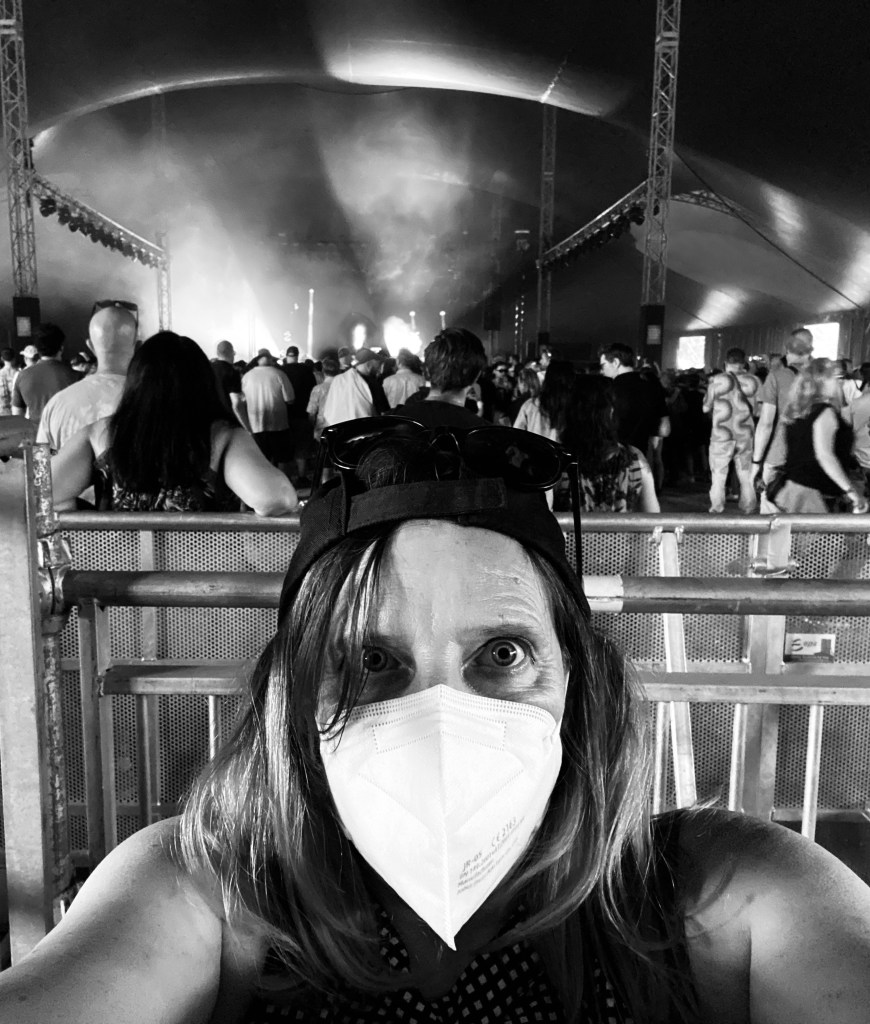
Alt text:A black & white ‘selfie’ of a lady with long hair, wearing a baseball cap backwards, a face mask & a spotty halter neck top on a viewing platform. Her eyes are wide. Behind her a crowd of people are watching a large stage bathed in lights & smoke.
The photograph shows me on the viewing platform (area for disabled people & their families, etc, to watch shows in comfort & safety, if they choose) in one of the tents at All Points East Festival. ‘Squarepusher’ is playing. I look as if I’ve been partying hard but in reality, I’m stone cold sober. I’m just deliriously happy to be at ‘dance day’ of All Points East. ‘Squarepusher’ was awesome & played the best set of the day.
This summer I returned to outdoor festivals. To gently ease myself in, I chose festivals that were either a short drive or train ride away. I also opted not to do any overnight stays. I chose BST’s (British Summer Time) Elton John in Hyde Park, Ealing Blues Festival, Primadonna, All Points East & Notting Hill Carnival.
I also packed plenty of PPE – gloves, masks, alcohol wipes & hand sanitiser. I drank plenty of water & cranberry juice (such a nice cranberry juice drink at All Points East!) I wore Factor 30 or Factor 50 suncream, but in general, I stayed out of the sun. I wore my baseball cap. It was an exceptionally hot festival season & my lungs don’t cope well when the temperature goes over 30 degrees centigrade.
In general, I’m terrible at pacing myself, but I had to this time around due to my Zometa infusion (to protect my bones) as well as my monthly Zoladex injection being due in July. The combination of these treatments always wipes me out for two weeks plus.
Elton John, BST, Hyde Park
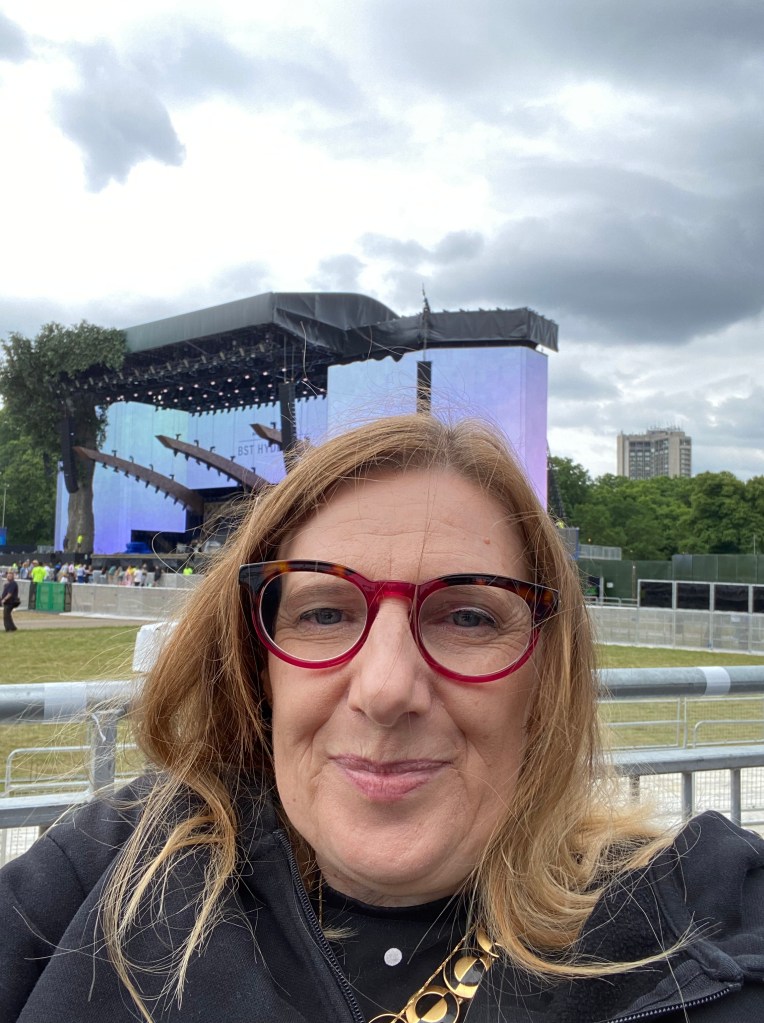
Alt text:a coloured ‘selfie’ of a white woman with long blonde / brown straightened hair, wearing pink / brown rimmed round glasses, a back hoodie, a gold & black necklace, another thin gold chain & a black halter neck top with white dots on it. She is on a viewing platform at an outdoor festival. She is smiling. Behind her is a large outdoor stage, crash barriers & a few fans gathered at the front of the stage. It’s a cloudy day.
The photograph shows me on the viewing platform at the main stage in Hyde Park. It’s shortly after I arrived so that’s why I’m smiling so much. Behind me the main stage is being prepped for the opening act of the afternoon.
But despite this meticulous planning, on the night before the Elton John gig, I had a huge panic attack. It was all over COVID. I was suddenly filled with self-doubt – should I be even going to a huge, crowded festival site, how would I be able to keep myself clean, what if I can’t cope? My boyfriend very calmly reassured me & said that if I felt anxious, we could come home immediately. However, he also said that I’d be disappointed if I didn’t at least try. And he was absolutely right.
Just like I love gigs, I love festivals too. Going to festivals is normally what I do for the majority of the summer & now I had the opportunity to return after my period of enforced isolation. So, I cried a bit more to get the fear out of my system & then went to bed early so I could rest up before ‘The Big Return.’
I’m so lucky to have a boyfriend who totally ‘gets me’ & understands the situation that I’m in. He’s been gently reassuring & encouraging me to return to the things that I love doing because he knows how miserable I’d be without them.
As soon as I entered the festival site & I wheeled onto the large viewing platform (the main stage one at Hyde Park is one of the biggest in the UK; there is a fantastic view of the stage & across the site), I felt ok. All my worries disappeared & to be honest, it felt like I’d never been away from a festival site.
The BST is a huge site, so I just stayed on the main stage viewing platform for the majority of day. Usually I’d be frantically wheeling up & down the festival site, tent-hopping to see my favourite artists but just driving to & from the festival (having said this, Hyde Park is only about twenty minutes’ drive from my flat), as well as entering & leaving the site was enough for me on that particular day. The viewing platform also has a bank of clean, flushing accessible toilets which I need to be near to these days, LOL!
Whilst enjoying the music, I was able to catch up with a few colleagues in the events sector that I’d missed, which was lovely. In the guest area, I got talking with another customer who’d also been treated for cancer over the pandemic. We bonded over how scared we were about returning to festivals & festivals portaloos in particular, but ultimately, we agreed that we needed to restart our lives once again. I know this conversation will become one of the most important ones that I’ll ever have with a random stranger.
I’d never seen Elton John before. What a mega star! He played effortlessly & I loved his gentle interaction with the audience. He was completely different to what I imagined him to be. He was humble, appreciative & came across very genuine. Much like when I saw Barry Manilow play in Hyde Park for the BBC’s Proms in the Park, I was amazed at the musicianship.
Not only was Elton John great, but he put on some really talented artists that he’d chosen especially for his show. I love that he’s so supportive of new music.
After the Elton John day, I had a couple of weeks off to receive intense treatment, returning to festival going towards the end of July.
Ealing Blues Festival, Walpole Park, West London
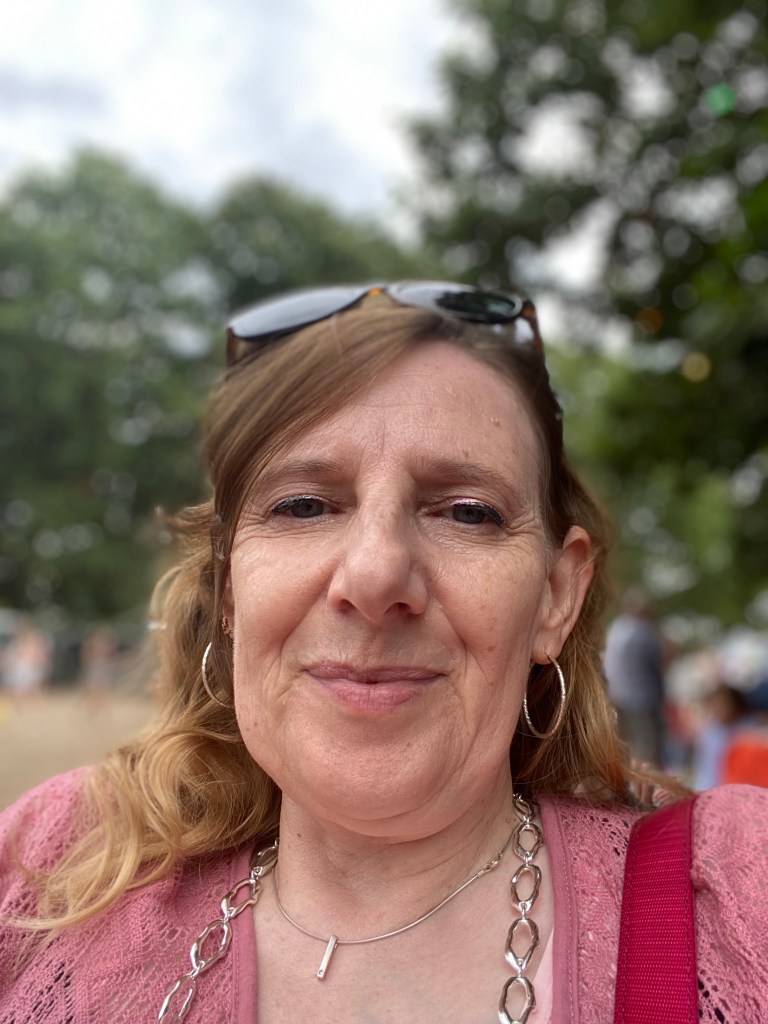
Alt text:A coloured ‘selfie’ of a white woman with freckles & long blond / brown curly hair, wearing sunglasses on her head, a silver chain, a long silver necklace with large links & a pink top. She is smiling. Behind her are trees, a dusty parkland & blurred images of other people.
The photograph shows me onsite at Ealing Blues Festival, looking really relaxed on a lovely Sunday afternoon.
One local festival that I rarely miss is Ealing Blues Festival & I often go to the Jazz Festival too. They often coincide with my boyfriend’s birthday celebrations. In fact, we had a glorious party over the Blues Festival four years ago for his 60th. It’s also the first time that I’d attended a festival with my dad!
For a number of years, Ealing Council has supported a series of festivals based in Walpole Park, most of which are subsidised for the local community. Alongside the Blues & Jazz Festivals, there’s also a Comedy Festival.
Ealing Festival also has its roots in the Ealing Blues Club, its most famed artists being the Rolling Stones, & it’s been awarded a ‘Blue Plaque’ to commemorate the beginning of British Rhythm & Blues.
I’m intending on taking the bus to the festival & back in future years as an attempt to live my life more sustainably, but Walpole Park is just a twenty-minute drive from my home & I can park on the street right outside the park’s entrance. You can also take your own food, drink, picnic blankets & chairs which is so handy if you’re ‘festival-ing’ on a budget. It’s so easy to load up the car & head off.
I had another important reason to go to Ealing Blues Festival this year – Canvey Island’s own Wilco Johnson was playing & I’ve never seen him before. I think Wilco is amazing! A few years ago, he was told that he had incurable cancer, so he went on a final farewell tour for his fans. He had his treatment & it was so successful that he became NED (No Evidence of Disease). So now he’s back out on continuous tour & making the best of his life. When I was onsite, I made him a little film to say that I’d come to support him, then I tweeted him & he clicked the ‘like’ button. I was so chuffed!
In reality, Ealing Blues Festival was quite tough going for me. I was still in pain after the infusion & then I got an infection. It was ridiculously hot too which made the site extremely dusty & this just added to my nausea & general discomfort. Luckily the site has plenty of trees where you can shelter from the sun & I was drinking plenty of water. St John’s ambulance also assisted me that day because I’d forgotten my paracetamol & they provided me with some. Such lovely people!
I had tickets for both days of the festival. To manage my energy, I left at 5pm on the first day. I wanted to save the rest to see Wilco who was headlining on the second day. The only time that I’d previously left a festival early was my last camping festival about 20 years ago. It was freezing in my tent & my bones couldn’t take it anymore. I packed up my stuff & found a taxi that would take me the hour & a half drive back to my London flat. It wasn’t that expensive either!
Anyway, back to Ealing Blues Festival. We were joined by more of our lovely friends the next day to see Wilco Johnson. A couple of my friends had experienced their own serious health challenges during the pandemic, so we were really glad to be with each other again.
And Wilco Johnson was fabulous, strutting back & forth & up & down the stage in his trademark way. He seemed genuinely chuffed that many people had come to watch him.
Primadonna, The Food Museum, Stowmarket, Suffolk
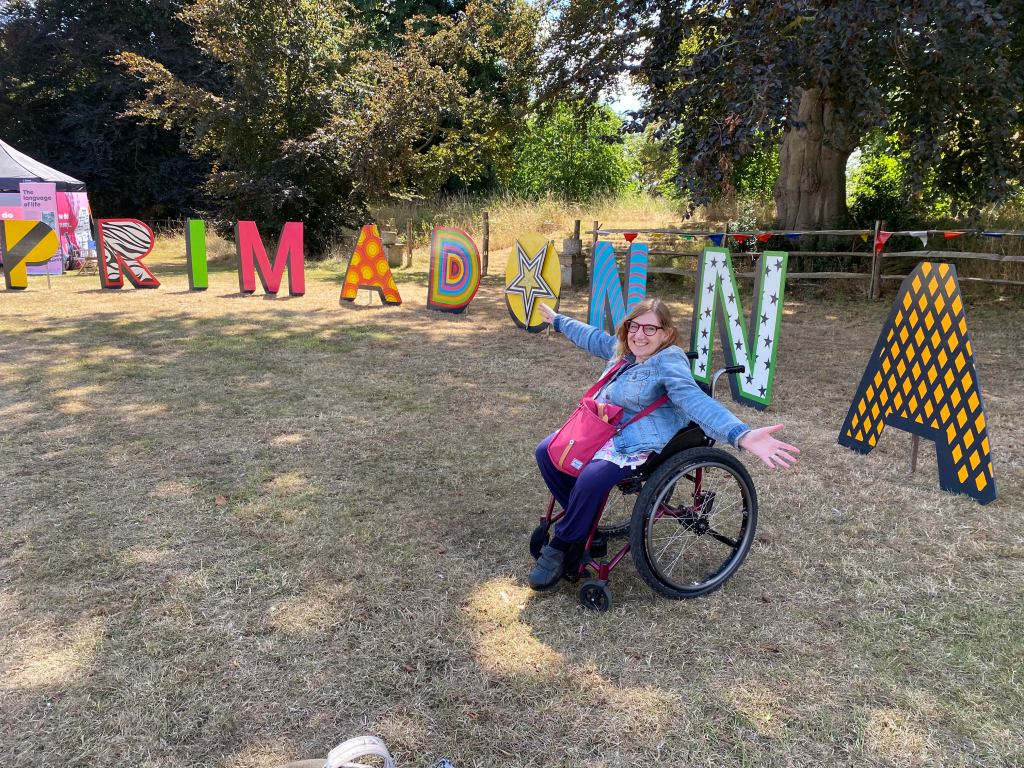
Alt text:A photo of a white woman with long blond/brown hair in a wheelchair sitting with her arms outstretched to the side. She is sitting in a tree-lined festival field in front of huge, multi-coloured letters that spell out ‘Primadonna.’ She is wearing a blue denim jacket, a white top, blue trousers, black trainers & pink/brown rimmed glasses. She is smiling.
This photograph was taken shortly after I arrived at the Primadonna Festival site. My smile reveals how happy I was to finally get there. I love the huge multi-coloured letters & the festival’s branding in general. It’s so jolly!
The following weekend I did my only ‘out of town’ festival for the season – Primadonna Festival. (I’d also researched getting to Nozstock & 2000 Trees Festivals by rail & taxi/accessible bus & staying in accessible accommodation nearby, but it was impossible to do).
Primadonna is a boutique festival that I’d been wanting to try out for a couple of years. It’s a literature & music festival, based at The Food Museum in Stowmarket, Suffolk. The audience-base is predominately women. The Founders of the festival, ‘The Primadonnas’ include Sandy Toksvig, Catherine Mayer & Kit De Waal.
I wasn’t able to book any wheelchair accessible accommodation in the local area, so I bought a day ticket for the Saturday, leaving early from Liverpool Street Station to reach Stowmarket at lunchtime. And then a rail strike was announced! I’m not complaining because I support the unions & workers’ rights, but it did mean re-organising my passenger assist & return train tickets for the Friday instead. I was only able to experience the festival for four hours because it started part way through the afternoon, but that was my choice because I could have attended on Sunday instead. I didn’t because I thought travelling by train would still be complicated after the strike.
Primadonna Festival site is set in beautiful countryside just a 10-minute push from Stowmarket train station, through the town centre, to the Food Museum. Despite being there for just the afternoon, the experience was transformative. As soon as I entered the site, I experienced something that I’ve never had on a festival site before – peace. The museum grounds are gorgeous & we were totally spoilt by the sunny weather.
I worked out why I was at ease onsite – there were no surly men, barking their orders, radios blaring, swaggering about, tripping over the huge egos of one another – I could go on, but you get my drift! It was so refreshing.
The atmosphere onsite was calm, positive & supportive. It seemed that people cared about your wellbeing & went out of their way to ensure that you had everything you needed to just ‘be’ at Primadonna.
I met up with some old friends as well as meeting new people; including interesting people who made podcasts, who wrote, made new outfits from recycled clothes & wood sculptors. I listened to a talk about the Witchfinder General & that terrifying era for those who were accused of being witches, but who were entirely innocent (Manningtree, the home of the Witchfinder, is located just across the Suffolk border, in Essex). I listened to a debate between two established writers about their writing processes & their early careers. I did a lot of shopping, including a necklace shaped into the word ‘Difficult’ from Perspex (according to the makers, ‘Wear & Resist’, that was the most-bought necklace by festivalgoers that weekend & if that doesn’t say that we live in a misogynistic world then I don’t know what does!) I watched a female musician play an acoustic set whilst her little daughter danced enthusiastically at the front of the stage with her young friends.
The slogan of Primadonna Festival is that you’re there to experience ‘the world as it should be.’ Festivals don’t have to be banging music, frenetic rushing from stage to stage, large crowds to negotiate; they can be gentle places, relaxed approaches, spaces to breathe in & at which you can take stock.
I’ll definitely be returning to Primadonna next year. I’ve worked out that I can stay in accessible accommodation in Ipswich & then travel between there & Stowmarket every day. It’s a really cheap journey. I’m just waiting for ‘The Primadonnas’ to release the tickets…
All Points East, Victoria Park, East London
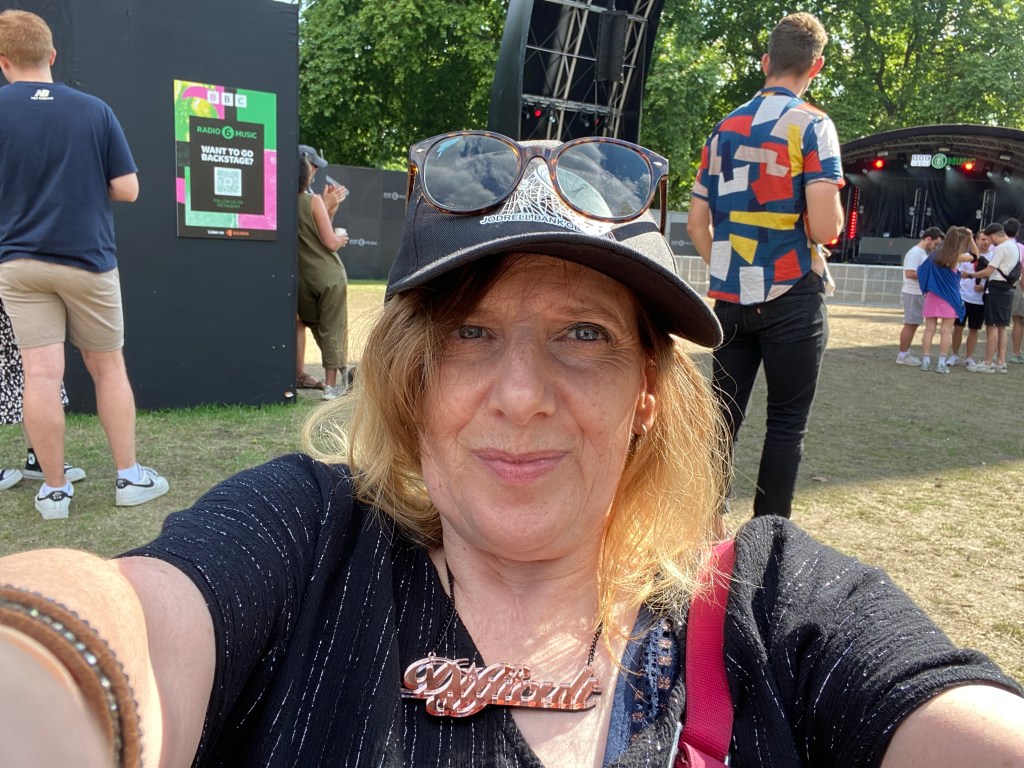
Alt text:A ‘selfie’ of a white woman with blond/brown hair on a festival site. She is wearing a black baseball cap with a pair of sunglasses perched on top of it. She is wearing pink/brown rimmed glasses, a black V-neck top with silver threads running through it, a leopard-skin print bracelet with fake stones & a Perspex necklace that spells out the word ‘Difficult.’ Behind her stand a few people, waiting for the DJ to come onstage, the stage itself & large banks of speakers, including one which forms an arch above her.
This photograph was taken at one of the All Points East days. I’m at the 6 Music stage, waiting for Afrodeutsche to come on – she didn’t disappoint!
I went to two days of All Points East, but they weren’t consecutive days which made it much easier to manage my energy levels. I drove to the festival & back, the journey is about an hour & a half each way from my flat. It didn’t seem to make much difference that one day when there was a rail strike.
The days that I attended were two very different days – one dance (the headliners were The Chemical Brothers) & the other a calmer day (the headliners were The National). Both days were equally enjoyable. On the first day, I had enough energy to explore all of the festival site & I went to watch artists at a few of the other stages. I’m really glad that I experienced all of Squarepusher’s set; he was awesome. I got a bit frustrated with myself as I had to keep resting between my bursts of frenzied dancing! I have to practice dancing for longer periods. I don’t want the pain from the cancer treatment to take away that joy as well. I can’t let it suck up all the joys of life!
All Points East is one of the festivals that programme a lot more female, non-binary and trans artists (which frankly is how it should be) & I was really pleased to be able to experience Mary-Anne Hobb’s All Queens line-up at the 6 Music stage. One of the areas where female artists are under-represented in a major way, is electronic music. I listen to her 6 Music show pretty much every weekday, so it was great to see the artists that she champions, in the flesh.
The Chemical Brothers’ Day was on a Saturday, so everyone was up for a party which was really good to be part of. But by the end of the afternoon, I had to retire to the main stage Viewing Platform for a rest & to get some shade under the trees. It meant that I missed Kraftwerk on the other stage, but I honestly didn’t have the willpower to push my way back through the crowds from one viewing platform to the other. I wasn’t too upset, I’ve seen Kraftwerk before. Having said that, I’ve lost count of the number of times that I’ve seen The Chemical Brothers. I always go & see them play at festivals & when they’re touring. They’re one of my all-time top electronic acts & I love how their visuals have developed over the years. I was with my good friend Mandi who is an awesome VJ -artist (playing under the name of ‘Mouse on the Telly’) & she goes to watch them for the same reason. During the set, she was explaining to me how some of the effects were created, which I found fascinating.
The National’s Day was altogether a more relaxed affair. Most of the artists that I wanted to see were on the main stage, so I settled myself in for a gentle day on the viewing platform. Again, I could have crossed the site to experience Public Service Broadcasting & Fleet Foxes, but I wasn’t feeling too great that day, so I decided to take it easy on myself.
I loved Mogwai’s set. What a great band they are. I love the way that band member Stuart says “thank you” or “thank you so much” after every song, as if he’s surprised that people turned up to watch them. Mogwai played instead of Low & I want to take time to wish Low’s Mimi well as she is undergoing cancer treatment & was too ill to play. Damn bloody cancer.
The National were epic but what made it really special was an Autistic girl sitting on the platform with me. She absolutely adored The National & sang her heart out to every song & she was just so excited to see them. That honestly made my festival day & everyone on the platform fell in love with her.
And then when we left the site, many people in the crowd were singing. It was so nice to experience that. The perfect end.
Notting Hill Carnival, Ladbroke Grove, West London
Alt text:A ‘selfie’ of a white man & woman in the middle of a crowd. The man is wearing a pink paisley trilby hat, a blue flowered shirt & rectangular glasses. The woman is sitting in an electric wheelchair. She has brown hair, which is tied back, but some strands cover her face because it is windy. She wears pink/brown rimmed glasses, a turquoise halter-neck top, a gold chain & small silver hoop earrings. She is cheering. Behind them, a diversity of people in ethnicity & age gathers.
This photograph was taken at Notting Hill Carnival, at the top of Barlby Road where my boyfriend & I stand most years to watch our local carnival, which happens to be the biggest one in Europe. Although you can’t tell from the photo, we’re right at the front & we’re squashed in by people either side of us.
My festival-going usually ends with a day at Notting Hill Carnival, but I was lucky enough to go to two consecutive days this year (I hadn’t been to Kids’ Day for years). I’m going to attempt to explain Carnival, but in reality, I can’t because you need to experience it for yourself, even if that’s just once.
I’ve lived in the Ladbroke Grove area for 20 years now. I’m just a few streets away from the main procession. The performers & the lorries tend to get ready in the next street, so the sound of Carnival usually begins at 6am on each day & the police helicopter can be overhead until the early hours of the morning. My road is usually the car park! With Carnival dominating the area, you can either go away on holiday for a few days or join in the fun. Just staying around for the festival, but not joining in, isn’t really an option because it’s all-consuming. I feel bad if I don’t go to Carnival because the performers make so much effort with their amazing costumes & dance routines.
In years gone past, I’ve roamed around Carnival as best I could, but it’s became more difficult as I’ve got weaker. Towards mid-afternoon, the crowds are huge & jammed packed into the roads & I can no longer cope with this. For the past 15 or so years, I’ve taken my place at the top of Barlby Road where it meets Ladbroke Grove. It’s where the lorries sometimes turn in & there is always a large police presence, so I feel safe there. I’m by no means the only disabled person at Carnival – we’re part of the crowd & part of the performance as well. Everyone goes – elderly people, kids, babies, young people, old ravers like me & my boyfriend, lol. My boyfriend isn’t a great lover of crowds, so we agree to stay in this spot until 5pm when the crowd tends to start surging in different directions. Barlby Road is just a couple of streets from my flat, so it’s easy to get to & from it by walking / wheeling.
Carnival is loud, loud, loud & has a huge party vibe. I absolutely love the Carnival tunes. Of course, this is very physical experience for me, but the music tends to spur me on to keep dancing.
2022’s Carnival was mega-busy; hardly surprising because it wasn’t permitted to take place for the past two years due to the pandemic. As my boyfriend & I arrived at our usual spot in Barlby Road, we were struck by how big the crowd already was. Unfortunately, we got caught up in a crowd surge about 3.30/4pm but I managed to force my way out of it. I never use my manual wheelchair at the event, I always take my electric chair which is very strong & big, & it creates a presence in the crowd. I told my boyfriend to hold on tightly to the back of my chair & I powered through the people, quickly. I tend to get a mixed reaction when I push through the crowd; obviously it’s unfortunate if anyone’s toes get run over (I never do this to kids or elderly people) & some people insist that I can’t get through. Every year there’s one person who says, “you shouldn’t be here!” I don’t bother with ignorance as base as that. A quick giving of ‘the bird’ usually suffices, although I don’t always do that because situations can be tense. Other people actively move or get others to move, warning others that there are wheelchair users, kids or elderly people around them.
So, due to the crowd surge we lost our front row view, but a good friend of ours turned up to say hello, so we had a really nice time hanging out with her.
I didn’t feel in particular danger whilst the surge was taking place, but I could see that my boyfriend was scared. One of the young stewards fell at my feet & I hauled her up, sharing a joke that it was her that was meant to be protecting me, but she wasn’t harmed, just a bit shaken. I didn’t want anyone to fall on me though, especially where I’d had surgery, so I took the wise decision to step back from the front.
I also want to say that crowd surges happen anywhere & everywhere, & a crowd surge at Carnival is the same as ones that you could get at any large festival. I got caught up in one when I left Hyde Park after the Elton John gig & we had to shout out to other members of the crowd to form a protective ring around me until another side entrance was quickly opened.
And finally
I’ve concluded that as long as I pace myself carefully & that I’ve meticulously planned ahead for each outdoor event, I can return to enjoying festivals. I discovered that I prefer smaller festivals now because I can relax more & it’s easier to take time out if I need to. Travelling by train & back to a festival is a really nice journey, especially if it’s with other festival goers.
In years to come, I hope to be able to drive long distances in comfort once again & be able to return to festivals that are more remote. But until then, these four festivals that I went to in 2022 will suffice for my festival experience.
I also want to thank my boyfriend Stephane for coming to the festivals with me because I couldn’t do it without him. And anyway, a festival ain’t a festival without him by my side.
#TriggerWarning: This blog contains details about medical procedures & emotions before, & after cancer scan results.
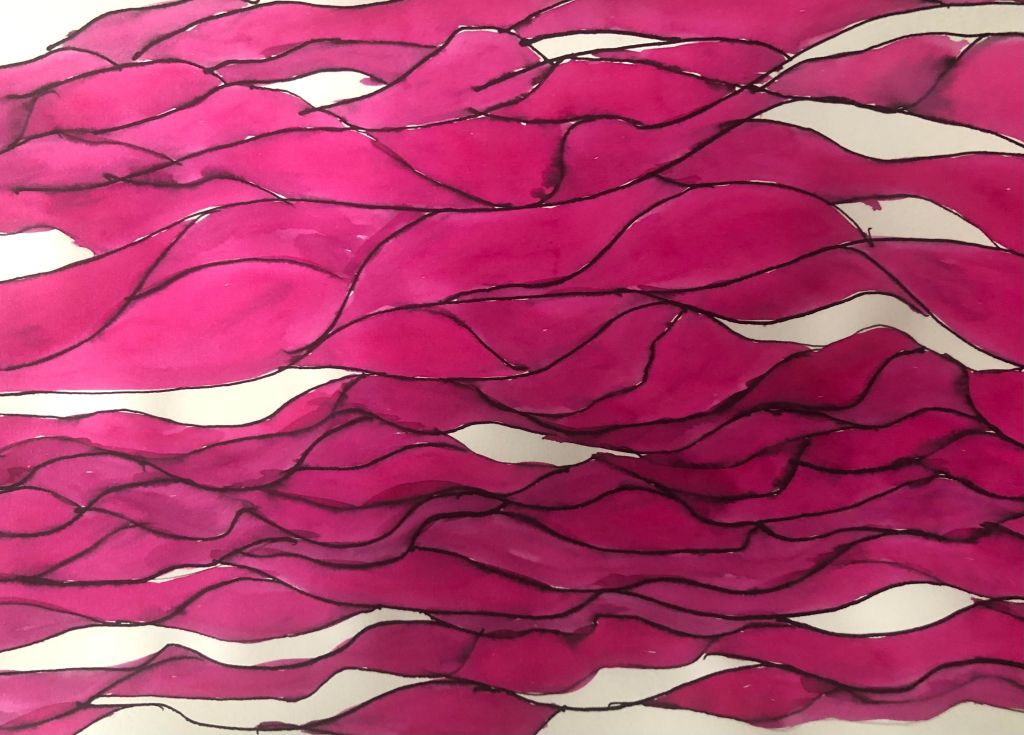
Alt Text: A pen & ink painting of shapes that resemble waves at sea. The waves are outlined in black & filled in pink. There are random spaces that have been left white to represent glimmers of hope.
In early July, I had my first proper scare. I found a new lump in my breast.
Actually, my partner found the lump because he helps me to check each month. I’ve lost all confidence in my ability to judge what’s different in my body after my Breast Cancer was picked up in a routine mammogram.
We both checked a few times over the course of two weeks. The lump stayed. It was definitely a lump. It was near to the operation site. I knew I had to act fast. No matter the fear (cancer is all about not wanting the test results but wanting the test results at the same time), I knew that I had to get the lump checked out ASAP.
Although my GP Practice is very supportive, I didn’t bother to go through them first. I was going to the hospital chemo unit for my bone infusion in mid-July. I decided that to save time, I’d pop along to the Breast Cancer Unit after I’d had my blood and COVID tests. At bloods, I happened to bump into my Breast Cancer nurse & I told her about the lump. She urged me to ring the nurses’ line so they could book me an appointment. And of course, as always, she reassured me, explaining that lumps can appear for all sorts of reasons. But she also stressed that I mustn’t delay in getting it checked.
Despite her advice to ring, I went around to the Breast Unit anyway & to be honest, I was in a bit of a blur. I thought that a nurse might be able to check it there & then & I’d have an answer. The receptionist was very kind but said no, I actually needed to be seen by a surgeon. Of course I did. I felt a bit silly thinking that a nurse could give me a diagnosis there & then & after a ‘feel.’ The receptionist took my number so that a nurse could call me back. I went round to the Maggie’s Centre for a cup of tea & a chat. One of the kind staff there said that I shouldn’t delay getting it checked & that I’d done the right thing to speak up.
Two days later, I had my bone infusion as planned. Later that day, one of the Breast Cancer nurses rang me & was again, very supportive & reassuring, but after listening to what I’d found, she said that I needed to see a surgeon. She said that my one had left, but I’d still be in good hands. Within two minutes of our phone call ending, I had an appointment for a week later. I was amazed at the speed in which I was to be seen. But I was very, very frightened.
Whilst waiting for the appointment, I saw my GP for my monthly Zoladex injection. He said I’d done exactly the right thing in ringing the Breast Cancer Services. He was also reassuring, saying that I’d had several tests over the past year & he felt confident that I’d be ok, but that I still needed to be checked (there’s a theme here).
And then the guilt came. It’s true that I’d had lot of tests & scans over the past year. All, thankfully, showed NED (No Evidence of Disease). Most of the side effects that I’m experiencing are due to my body getting used to the medication but confusingly, they also look like the signs of secondary (or metastatic) Breast Cancer. I still can’t tell the difference between what’s my ‘usual’ chronic pain from my existing impairment, or what are new symptoms. My GP has always erred on the side of caution; always agreeing to further scans & checks. This is because a small amount of cancer was found in one lymph node, plus I had waited an additional four months for my lumpectomy because of the pandemic. The original breast lump had shrunk whilst I was on tamoxifen, but another small one had grown by its side.
I felt guilty because I didn’t want to waste anyone’s time, or NHS resources. But then I realised that no one minds, they just want to help you & they aren’t judging you. And my GP also said that it was important for me to have clarity for my own mental health. I felt really ‘heard’ when he said that. He recognises that my mental health has taken a real knocking since diagnosis.
Many people who live with a cancer diagnosis speak of #Scanxiety – I’ve previously covered this in my blog. Yet I couldn’t let my mental health spiral again. I’d been happier in the last few months & feeling quite good about my life. So, I focused very hard on convincing myself of two things – that the lump would be absolutely nothing & that there was no point catastrophising until I knew exactly what it was. Impossible as it sounds, I did largely manage to push negative feelings away, but it took a huge amount of mental energy.
As I’ve written in previous blogs, the cancer treatment is having a drastic effect upon my mobility, & I couldn’t bear to think that I was going through so much treatment & then for it not to work. I was frightened about potentially having more powerful treatment & that chemo would most certainly drastically affect my long-term quality of life – I already have very poor circulation, I have osteoporosis, I’m at risk of blood clots & my lungs are restricted. I remember what my sister had said about chemo – that she wasn’t disabled at all until she had it, & if I could avoid it because there might be only a 6% difference to the predicted outcome, then I should. My sister now has COPD (Chronic Obstructive Pulmonary Disorder), has injections to ease the chronic pain in her bones & is currently receiving treatment for a blood clot.
The day of the appointment came & it was at a different hospital to the one that I usually attend for cancer check-ups with oncology. Apparently, a few services & departments had been moved around post-COVID in order for the Hospital Trust to cope with the demand of new cancer patients, alongside those needing treatment but caught up in the ‘backlog’ caused by COVID. My Trust now has a “Cancer First Stop” department – I guess it’s like a triage system. I was nervous. I find new medical teams very daunting.
To cut a very long story short, I’m absolutely ok.
First, I saw a new Breast surgeon & she gave me a thorough physical examination. She explained that I had a lot of scar tissue, & even though she couldn’t feel anything that alarmed her, she still needed to send me for further tests that day. She also marked up the area that she wanted the radiographer to check. That freaked me out a bit because it reminded me of my pre-surgery. Then she sent me off to the Breast Imaging Department but with lots of words of reassurance which I found comforting. I’d had mammograms in this department before, so that made me feel a little easier, but my heart was beating very fast & I was furiously blinking away tears.
When I got to the Imaging Department, a kind colleague of my NHS support person, Margaret, arrived to help, & we went into the ultrasound together. As I’d only had a mammogram in February & it was clear of disease then, the mammogram part could be skipped. The radiography team were really supportive. After two minutes in ultrasound, they had located the lump & they were able to tell me what was going on – they were able to clearly see the cause of the lump – a small amount of fluid. A completely normal occurrence two years post-surgery. It made total sense to me that fluid was still left. I had my breast drained twice after surgery (remember “Alien Boob!” LOL!)
Then the team checked my armpit as this was very sore, but again, thank God, everything was clear. I didn’t need a biopsy (& that meant no needle, hurrah!)
I must have said “thank you” a million times over – at least, that’s all my partner was able to hear me saying in the examination room. I think a lot of the relief came from the fact that it was actually “something” that we had both felt, & not like the other tests & scans where there wasn’t “anything” found. This might sound a bit strange, but it made me feel like I wasn’t wasting the NHS’ time.
Then I jumped into a taxi & went straight home. I cheered in the cab & the driver asked me if I was celebrating something. “Good news!” I replied without going into detail. For a few hours afterwards, I couldn’t get over the fact that it was going to be ok. I was astounded & very, very relieved.
I hadn’t told anyone except my sister & one other close friend what I was going through. Again, to manage my mental health, & remembering how hard it can be to manage other people’s emotions & reactions, I decided that it wasn’t worth worrying people. So, I did a few post-result texts to family & close friends, along the lines of, “well, I’ve had a bit of a scare, but I didn’t want to worry you unnecessarily, so I didn’t say anything, & that was right thing to do because I’m absolutely fine.” I think there was shock because my social media shows me doing stuff & getting on with life, but that’s exactly how I want it to be.
But the next few days I crashed. I don’t know what I was expecting, really. I thought I’d be deliriously happy without a care in the world. I thought I’d be organising a party. But I just felt really flat & empty. Like an anti-climax. I put it down to being mentally exhausted.
But ‘The Scare’ is over & it’s business as usual.
P.S. Remember, anything that doesn’t feel right, a lump or something else, & you feel uneasy, don’t let fear or inertia prevent you from getting checked out. Please, please, always go. Don’t dismiss your pain or malaise – or let anyone else dismiss it – including medical professionals. Be persistent. Get someone else to advocate for you if you need to.
My partner said several times over that he felt bad about finding the lump & potentially throwing my life into turmoil once again. I assured him that he’d done absolutely the right thing because he could have saved my life, or he could be giving me a better chance of longer survival through early detection.
With my lifestyle, you’d be forgiven for thinking the obvious from the blog title, but I’m referring to a wholly different type of acid & not a pleasurable experience!
Me photographed at 6 West, Charing Cross Hospital, London, 6th July 2022.
Alt Text:A white woman sits in a large red, faux-leather hospital chair. She has long brown/blond hair & she wears red/brown glasses, a white surgical mask & a black t-shirt that says ‘Rebellious Hope’ in gold capital letters across it. Her left hand & forearm rest on a white pillow. In the back of her left hand is a cannula which is connected to a plastic drip wire. On her right wrist is a white hospital tag.
Let me start by saying right here & now that I’ve been in & around the music industry for a long time, but I’ve never taken any illegal drugs. Having to take medication in pill form from such a young age means that psychologically, it’s genuinely inconceivable for me to believe that I could have a magical, transforming experience by popping a pill; whenever I take pills, it’s always because something really bad has happened to me.
It turns out that the regular medication that I take (Letrozole (orally) & Zoladex (monthly injection into my stomach) – both are used to treat certain types of breast cancer such as hormone-receptor-positive breast cancer) might be really good at preventing cancer recurrence, but they’re absolutely s**t for my existing impairment. Oh joy! I already have osteoporosis due to being disabled & being a wheelchair user for over 25 years (I think it’s 25 years, I forget because becoming a wheelchair user was a gradual, ethereal process over a couple of years & not one that I regret in the slightest). Now I’m on a treatment of an infusion of Alendronic Acid (a Bisphosphonate) to protect my bones from decaying as much as possible. I have this every six months & it takes 15 minutes to go in, including the saline wash afterwards, but the infusion creates two weeks of havoc afterwards & some of the side effects don’t disappear until it’s time for the next one. Even deeper joy!
At first, I took Alendronic Acid in tablet form. This involved timing the tablet carefully before food every week & then having to sit up straight for at least 30 minutes afterwards to let the medication ‘do its thing.’ Unfortunately, the tablet form wasn’t really strong enough to protect me, so about 18 months after my surgery (which took place in July 2020), I started on the infusions. At the moment, I’m currently booked for this treatment until November 2023, but cancer being the unpredictable beast that it is, who knows for sure!
Before having an infusion, I had to have a dental check up because this treatment can cause serious damage to jawbone & teeth; it’s called osteonecrosis of the jaw but thankfully this is a rare side effect. I passed my dental check-up but with a warning from my dentist to keep up the 6-monthly visits to her which I have done ever since.
I’ve had three infusions now. At the first one, one of the seniors, Paul, in the Chemo Unit told me about all the possible side effects. He also talked me through how he was going to deal with my needle phobia. I was banking on being able to put Emla (numbing cream) on the back of my hand, but Paul told me how the infusion had to be given through a little tube that would be inserted into my vein, & the numbing cream would restrict the opening of the vein. I felt sick because the worst part of my phobia is when I have to have needles inserted into the back of my hand. And my veins tend to be hard to find due to their deepness – I have Raynaud’s Syndrome.
He went off to prepare everything.
By the time he called me to come forward for my infusion, I was shaking. But two simple, but effective, ‘tricks’ changed the situation for me & made me feel less apprehensive. The first was that a lovely lady called Margaret (I think I’ve spoken about her before in my blog) was accompanying me. She’s a hospital staff member, responsible for making sure that patients with learning disabilities are safe & comfortable, but she was assigned to me because of my needle phobia. She’s absolutely fantastic because we have a good laugh & a catch up whenever we see each other, & this is a very good distraction technique from the procedures. She was the last person I spoke to in the Operating Theatre before I went under the GA (general anaesthetic) & it was extremely comforting. Everyone needs a ‘Margaret’ by their side in hospital.
The second trick was that Paul immersed my hand in warm water for about 10 – 15 minutes to open up my veins. Why had no one thought to do this before?!!! It was a game-changer for me. He was very gentle & I honestly wasn’t aware of when the cannula & its little tube went in. The Alendronic Acid doesn’t really feel of anything as it goes in. Perhaps for the first one I felt a bit of a sensation, but I’ve just had a third infusion & I didn’t feel anything except for a bit of discomfort in the back of my hand. The saline wash is a bit cold, but on the third time, I didn’t feel any coldness.
I was honestly expecting a lot of stinging & I remember asking Paul several times if the infusion would hurt. This fear is borne out of having many intravenous antibiotics due to feet infections & kidney problems. One horrendous time about 20 years ago when my veins weren’t taking a drip anymore, a nurse decided to inject me at speed into my forearm with antibiotics instead. It burnt inside my veins so much but my howling was met with “hurry on up back to London where you can be treated there!” (I had been taken as an emergency from a major music festival site in the south-west of England to a main regional hospital where I stayed for a week with no clothes or money, so the patients had a whip round to help me out!) Charming. I love a positive bedside manner!
My needle phobia started when I was a toddler. I remember being in hospital (Tadworth) when I was about three; I was sitting on a nurse’s lap & she was feeding me. Another nurse came along & she asked me to stick out my thumb, which I duly did, only for her to shove a huge needle into it. It really hurt & I bawled my eyes out because I was so shocked. And it bled as well, which was horrible as I was eating at the time. I really hope that no one does that to kids these days.
Anyhow, back to the here & now. After the first infusion I went home & became slowly sleepier over the course of the afternoon & evening. Paul had warned me to expect flu-like symptoms, but nothing prepared me for the searing pain in my bones, joints & muscles which woke me up the following morning. My teeth hurt (even my false one!), my jaw ached (I have existing a-typical facial pain), all the areas where I’d had surgery over the years & all the sites where I’d had vaccines & other injections were throbbing. And I was slurring my words. Desperately trying to keep calm in an online work meeting that afternoon, I had to confess that I hadn’t had a couple of gins at lunchtime, but this was a side effect of some new treatment that I was having. Now I take two weeks off when I have the infusion. It’s impossible to work through the side effects.
The bone pain in my forearms & lower calves was horrendous. I believe that I can tolerate a lot of pain because of the chronic, long-term pain that my impairment causes, but god, this pain was like someone had taken hold of my forearm & was trying to snap it in two. Feeling sharp pain in my shins & foot in my left leg was a revelation because I’m paralysed here & I don’t normally feel much of anything. With this level of pain, it’s hard for me to understand exactly how this treatment is meant to be protecting my bones because it honestly feels like the Alendronic Acid is breaking them down, bone by bone.
I probably should be taking a short-term dose of morphine for this level of pain, but anything from tramadol, to pregabalin, to gabapentin, to buprenorphine patches just really stresses both my mind & body out, so I just regularly top up with some strong codeine & I also use a small regular dose of amitriptyline for neuropathic pain for two weeks. It isn’t great I know, but you have to find what works for you personally & try not to let others belittle your pain if you aren’t taking anything stronger. And if you need something stronger after these infusions, I encourage you to ask for it because I don’t believe anyone should suffer in indescribable pain.
On my second treatment, I asked one of the nurses if the side effects would improve as my body became used to the infusions. She said “no” & looked at me with kind eyes. I’ve just got to suck it up, then.
I know that exercise is a terrible cliché that medics often use to beat people over the head with, & exercise is hard to do when you’re disabled (don’t @ me with your Paralympians, they’re elite athletes!) but regular exercise really does help me. More than ever before, my bones feel so stiff & heavy. I think I’ve mentioned in previous blogs that I’m having issues with my right ankle & at times, I can barely stand to transfer, but after each infusion, I have issues bending my thumbs & fingers & I struggle to fully grip things; I have severe pain whenever I flex my wrists & elbows. But I’ve found that swimming really opens up my body. I really look forward to my weekly swim now. I struggle to do yoga just after the infusion, but in a week or two, I’m usually back to my regular class. I think that gym-work is tough, so I normally give that a longer pause before returning to a regular routine. I have a little set of 1kg weights at home, but I don’t use them for a month or so post-Alendronic Acid.
Post-third Alendronic Acid infusion & today, post-Zoladex injection, I’m trying to stay cool in the 30 degrees centigrade of West London. I’m well out of the sun & typing away at my laptop in the coolest past of the flat, the lounge. Extremes of very cold & very hot weather are equally hard to deal with during treatment, so I just do a little bit of this & a little bit of that, until I feel like I can do more.
Just putting one wheel in front of the other & slowly moving forward, that’s the best way to do it.
P.S. Paul from Chemo Unit, if you’re reading this, I’m missing you, I hope it’s all going well in your new department!
Me pictured with Margaret from Imperial Hospitals Trust, at my third Alendronic Acid infusion, 6 West, Charing Cross Hospital, London.
Alt Text:Two white woman wearing surgical masks sit in a hospital bay. One of the women is hooked up to a drip via a cannula in the back of her left hand.
Part of returning to life ‘After B.C.’ (Breast Cancer) is going on holiday outside of the UK.
Alt Text: A selfie of a white man & woman, taken at an intersection of the road with a statue in the background (it’s Bastille, Paris). The man is wearing a grey, flat cap, tortoise-shell rimmed glasses, a blue denim jacket & a blue/grey t-shirt. He is smiling. The woman has long, curly brown/blond hair & she is wearing brown/pink rimmed, round glasses, a white mask & a metallic pink rain jacket.
Going on holiday can be a major undertaking as a wheelchair user, especially overseas, but I wondered how complicated it would be post-COVID (i.e., extra checks for vaccinations, etc.), post-Brexit (my partner is French & has E.U. Settled Status) & post-surgery/radiotherapy. But after two years of watching how countries were slowly opening their borders & getting used to my new diagnosis, I decided that the best way to find out was to actually go on a holiday outside of the UK.
I started with the easy option. All of my partner’s family live in, or around, Paris & we’ve frequently travelled by Eurostar. As we’d been separated from them for a couple of years, we were excited to be able to see them.
It was too early into diagnosis for me to comfortably fly anywhere. I’ve got many personal stories of being left stranded on planes, nearly missing planes because assistance arrived late, my wheelchair being broken or lost, & inappropriate questioning &/or comments about my impairment by airport staff &/or cabin crew. And all of this happened way before COVID-19 temporarily shut down the air industry. I couldn’t face being manhandled by staff from wheelchair to aisle transfer chair to plane seat, & vice versa, because of the pain levels that I’m currently experiencing due to medication.
In contrast, I love travelling by train & if I can choose this option over flying, I will every time. Plus, it’s more environmentally friendly. Of course, the train isn’t without its problems, such as luggage blocking the wheelchair space, the accessible toilet being out of order, or being left on the train or missing the train because ramp assistance hasn’t been provided. But I’ve always had a great experience on Eurostar, including as a frequent lone traveller.
I always book in person at St Pancras station (London) rather than over the telephone or online because I prefer the face-to-face communication when I’m trying to explain my access requirements. Booking was easy & not much of the booking assistance process had changed in the past years when I hadn’t been able to travel to Paris. The agent showed us on his phone how to download the NHS COVID-Pass App which was the only unfamiliar thing that we had to do. Even my partner’s E.U. Settled Status was straightforward when booking. The only minor blip came when I got an email to say that my train had been cancelled & new tickets had been issued to via online booking which had been set up for me. After faffing around with that for a while, I saw that our tickets were exactly the same as before – a relief because I can’t travel without being allocated the designated wheelchair space.
Travel out to Paris was hectic, but it did go smoothly, considering the situation we had found ourselves in. When we arrived at St Pancras, I’d never seen so many people queuing to get through security; the queue was so long that it was coming out of the station. Luckily, travellers needing assistance can queue-jump but when we reached the assistance area, there were more people than I’d ever seen waiting for support. It turned out that we’d booked to travel on the same day as the 30th Anniversary of Disneyland Paris opening. And here was I, thinking I was clever for booking a holiday during school term-time! However, there were many Eurostar personnel on hand to help, so we managed to get through all checks very quickly. The only long wait was to board the train; our train was delayed as it was taking longer to on-board all the families for the Disneyland train. Yet our Eurostar staff member stayed with us on the platform until the train doors opened & we were handed over to the train staff. Being abandoned for hours without assistance at airports & train stations was a big reason for me to stop travelling on my own.
The delay in getting on the train was the first time on the journey that I started to get fatigued. Due to my impairment, I move around frequently in my wheelchair, but now because of the Breast Cancer surgery & the side effects of treatment, I find sitting for extended periods without stretching out my arms & legs, really painful. When it came to pushing myself up the ramp, I couldn’t do it; I needed extensive help but once onto the train & into the wheelchair space, I could stretch my legs out & have a sleep.
The trains have been modified since I last travelled & they’re more like UK trains now – a bit less luxurious – I have to be honest – but actually I had more space to move around & the route to the accessible toilet was much clearer. It seemed to me as if there were a couple more wheelchair spaces (always in the Business Class) per train, but I couldn’t be entirely sure.
I was also relieved that we still got a meal on the train (& very often the meal is very nice). The Eurostar train staff are always really helpful & check that you’re ok – I do appreciate this. I can’t travel alone in standard carriages on UK trains because I haven’t got any means by which to get to the restaurant carriage. I even if I could get there, that wouldn’t be an option for me now; currently I don’t appear to have the strength or dexterity to negotiate tight spaces & I often drop things that I’m carrying because the nerves in my hands are messed up. That loss of grip in my hands & my balance being even poorer ‘After B.C.’, made going to the loo almost impossible. I don’t really know how I didn’t fall to the floor when I was transferring, or even off the toilet itself mid-wee (lol!). I was sweating when I came out of the loo due to all the energy that I’d used up just to do this simple task!
Post-cancer diagnosis, I have stronger anti-sickness tablets & these were a game-changer for me during the journey. Usually, I have to face the direction that I’m travelling in (& even then, it’s no guarantee that I won’t be sick!) but for the first time, I was completely fine travelling backwards.
Once we reached our destination, Gare du Nord, Paris, the staff were already there with the ramp on the platform (as they should be on every journey, anywhere in the world!) & a staff member, recognising that I was tired, helpfully pushed me to the taxi rank (a little fast & a little close to the platform edge for my liking, but he was determined to whizz me through the crowds, lol). At Gare du Nord, disabled people go to the front of the taxi queue, but it’s always chaos as the taxis come in & staff literally hustle you into one. It really is like that, being hustled! You’re swept along with staff, taxi drivers & confused passengers with a lot of raised voices & wild arm gestures. I’d so missed this!
My partner & I had started speaking in French as soon as the train crossed the border. Although I have a degree in languages & my conversational French isn’t too bad, I was worried about how much my menopausal brain would screw up & I’d be coming out with some random, nonsensical words. There were instances of this across our stay, mainly in the evenings as I experience a lot of fatigue then, but on the whole, I surprised myself at how much I could remember.
Like my partner, I’m a creature of habit. After thinking carefully about whether I now needed a bigger accessible ‘wet room’ (a bathroom without a step to the shower, without a bath) because of my reduced mobility, but we decided to book again with our favourite budget chain hotel in the 11th area of Paris. The accessible room & shower are probably too small for people who use larger wheelchairs & who may need a hoist, but I’m happy to report that the facilities were still manageable for me. And it’s a home from home – most of the hotel staff were still there from our previous visits & we were incredibly happy to see each other again.
We spent five days in Paris. It was the perfect amount – enough for us to see all the family & have some time by ourselves too. I was anxious about how tired I would get each day, especially in the evenings as most nights, I’m lucky if I stay awake until 9pm. I knew we’d be occupied all day & then I’d have to get ready to go out to eat in the evening, without much, if any, rest in between. And understandably I didn’t want to miss out on anything or have to stay back in the hotel room. I only had one “OMG I CAN’T DO THIS, I’M SO F****** TIRED!” one evening, but after a little rest, I was able to muster the strength to eat late at a nearby restaurant. One morning I overslept, so my partner brought some breakfast back to our room, so I didn’t have to rush to get ready. I found that exploring places & being out of my usual routine kept me energised – I mean, who doesn’t find Paris fascinating! And of course, it was so lovely to spend quality time with family once again, & to meet my partner’s great-niece for the very first time (an adorable moment!)
Of course, Paris has its challenges because it’s an old city. It’s also being refurbished & cleaned in preparation for the Olympics & Paralympics 2024 so there is a level of disruption. There’s never been many wheelchair-accessible toilets (I’m hoping that this changes during the course of the refurbishment!) & I tend to plan sightseeing around where I know there is a toilet that I can use; they can be found at most of the large tourist attractions, art galleries & museums. But if you like to go to places off the beaten track & fully adopt the Parisian café culture like I do, then finding suitable toilets is trickier, & the only option is to limit your fluid intake. This really isn’t a great thing to do.
I got ‘caught short’ once at Parc de Bercy in the 12th. It’s pretty modern around there & has undergone a redevelopment similar to Granary Square (Kings Cross, London) but the lift to the cinema which houses the accessible toilets was broken so we had to wander around for a while in search of an appropriate toilet. Out of the corner of my eye, I spotted a wheelchair symbol through the open doorway of a modern Japanese restaurant, so we stopped there for a drink & to use the facilities. However, I guess some aspects of inaccessibility are universal because the accessible toilet was narrow & baby highchairs were being stored in there!
Public transport can be tricky in Paris – I’ve used the buses (there are wheelchair spaces on board), the taxis (but often my style of wheelchair is tricky to fit into the average Parisien taxi) & the RER (this is the mainline overground train system & the ramp access is managed by the train driver – so much more efficient) but mostly my partner & walk. Paris has grand, wide pavements that don’t get too crowded & if you walk into central Paris by the river Seine, passing Notre Dame Cathedral, it’s so beautiful.
In case of any detailed explanations that I may have needed to give, or any emergencies, I’d practiced saying “I had breast cancer, radiotherapy, no I didn’t need chemo” etc in French but apart from the tiredness & having to scrutinise the menus for any food allergies, e.g., mushrooms (anyone else having that issue? My sister couldn’t keep down mushrooms either whilst in treatment!), thankfully I didn’t need any of those phrases.
I cried on the morning of our return. I’d missed all the family & the beautiful city so much. Anxieties started to creep back into my mind: “What if this is the last time that I visit Paris?” Always so much to process & so many irrational thoughts to dispel.
The UK Customs guy at Eurostar Paris made it worse for me by barking: “Where do you live?” I so wanted to say “Paris, thank God!” but instead I replied: “London” to which he then asked why I’d been there. “On holiday!” I replied even grumpier than ever. In fact, I almost said: “So are you going to deny me a bloody holiday as well after all this Brexit shambles?” He pursed his lips & let me through, thankfully, as I was already over-tired & in increasing levels of pain. Note: My French partner got no questions whatsoever from either French or British customs – he was really worried about this. We were also able to stay together at all times during all the security checks, despite having passports issued by different countries which was a huge relief to us both because I need a lot of help from my partner.
But my holiday ‘After B.C.’ had passed successfully, so now I know that I can holiday outside of the UK. TICK!