It’s four years on since my Breast Cancer diagnosis.
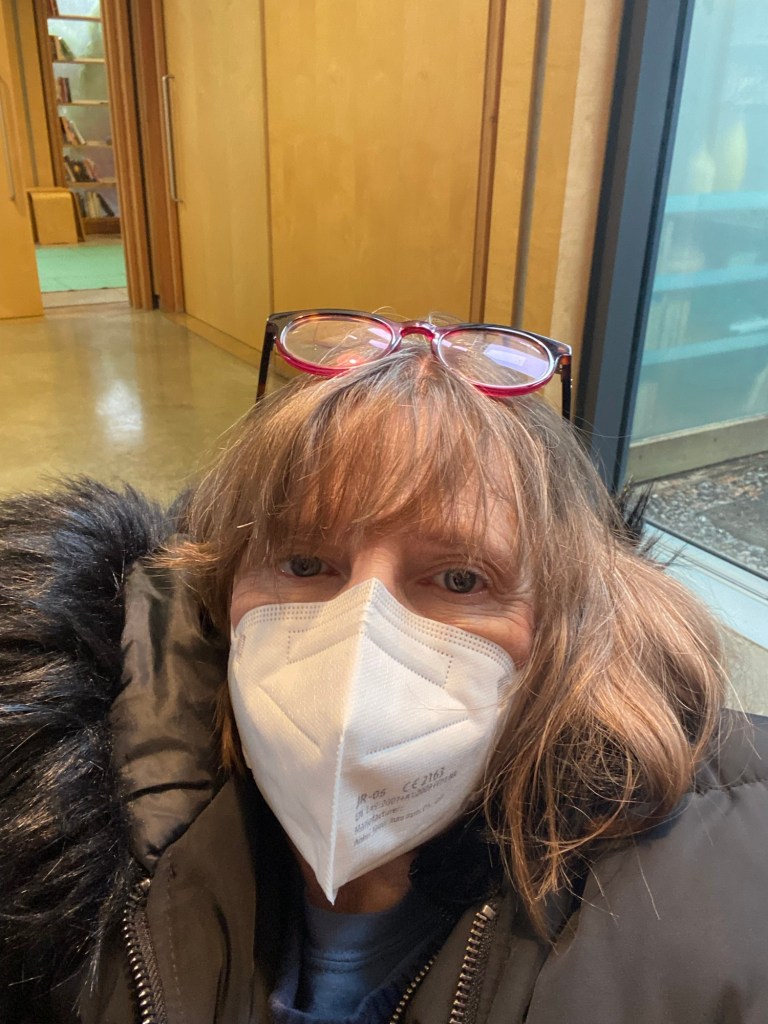
Alt text: A selfie pose of a middle-aged white woman sitting in her wheelchair in a room that is made of wood paneling & floor to ceiling windows. She is wearing a white face mask, a black puffa jacket with a black faux fur hood, a blue t-shirt & a blue jumper over it. She has brown/grey shoulder-length hair with a fringe. She has a pair of round pink/brown glasses perched on top of her head.
Four years ago today (10th March) I heard the dreaded words “You have Breast Cancer.” Such a small statement to have such a huge impact on my life. I’ve just had my annual mammogram & I’m happy to say that I’m still cancer-free. This is also your reminder that I’m cancer-free because the drugs are still working. It’s got nothing to do with being positive, fighting hard or any other crap tropes that people trot out.
It’s also Mother’s Day (in the UK) which is always a difficult day. My mum died of secondary Breast Cancer & I’m reminded that the treatment was so different back in the 80’s. They didn’t even remove her lymph nodes when they removed her breast.
I’ve written before that February & March will be difficult months forever. It’s always taken up with the annual mammogram & then waiting for the results. My scanxiety was particularly high because I haven’t felt well since my last bone infusion. I’ve been so sick & nauseous that I’ve had to reduce a lot of food groups & take all my evening medication an hour after dinner with the hope that food will stay down. I also had some additional scans to deal with – abdominal & pelvic scans in case the vomiting & pain was something “else” (thankfully it wasn’t). I had some pain in the areas where I had my Breast Cancer surgery – it was a different kind of pain than I’ve had before. Plus I had pain in my armpit which really, really worried me because a small cancer was found there during my lumpectomy. After a glorious birthday month of January, I went into February & March feeling very scared.
The breast pain was really weird. It felt like someone was squeezing my nipple very hard. I know some people pay good money for this kind of thing but I can assure you, it was so unpleasant! On top of that, my armpit just ached & ached. At my mammogram, I requested to see a Breast Cancer nurse so I could let her know what other symptoms I was having. She took them seriously, especially because I’d had bouts of vomiting. Without hesitation, she booked me into the ‘One Stop Clinic’ for a week & a half later.
As you know, mammograms are tricky for me as a wheelchair user, & as time goes on, I don’t know for how much longer I’ll be able to balance precariously on my legs so I can have the scan. Thankfully this year’s mammogram passed without particular incident which was a relief because I was feeling fragile. My radiographer was really nice but U could see she was a bit phased. She immediately said that she might have to get another person to help her, but I reassured her that I’d had lots of mammograms & that I could help her. She agreed to this & we got the mammogram done with the minimum of fuss. This was in part because we kept talking & working together throughout the whole procedure. There was a lot of mutual respect there. She got some very clear scans which also makes things a whole lot easier. All in all it was a better experience than some others in previous years.
I also had a really good experience at the ‘One Stop Clinic.’ The last time I was there was in July 2023. It was when I met the new Breast surgeon that had taken over from my (wonderful!) surgeon (he has since retired). This new surgeon was very confident – telling me all about the great things he’d learnt from my surgeon. Unfortunately he was also a bit patronising towards me, which you know, never, ever goes down well with me. I asked a couple of supplementary questions during his examination & he dismissed them in a very off-handed way. He basically said that he didn’t know the answers, that it was a Saturday, couldn’t I see that the waiting room was packed, & that I needed to go back to my GP to ask (incidentally, the GP didn’t know the answers either!) Then he sent me for an ultrasound. Low & behold, the radiographer was grumpy too & what’s more, she tutted when she found that there was nothing there! I was shocked! She ought to be thankful for me that there wasn’t anything there (except this stupid ball of fluid at the incision site that won’t go away).
The point I’m trying to make here is that the poor attitude of the new surgeon had permeated through the whole clinic that day. However, the Breast Cancer nurse working alongside him gave me a knowing, sympathetic look. I felt sorry for her having to work with him all day. He was lucky that I was too pent up that day about the ultrasound to challenge him. Otherwise I would have remarked that he hadn’t taken on board the great bedside manner that my Breast surgeon had!
After that experience, I was a bit concerned about going to the ‘One Stop Clinic.’ I needn’t have worried. There was no sign of ‘Mr Dismissive.’ Instead I saw a female consultant who was very kind & respectful. She reassured me that the pain was probably post-surgery because of the nerve damage to my breast & armpit, but she still requested other checks after examining me. Then my Breast Cancer nurse that got me through all my active treatment turned up. It was so great to catch up with her. She always had such a way of reassuring me & making any kind of (usually horrendous) situation ok. With her by my side I felt like I could cope with anything.
The Breast surgeon referred me for another ultrasound. There was no sign of ‘Mrs Grumpy’ this time. Instead the radiographer was gentle & kind. She started the conversation by informing me that my mammogram was clear; in fact, my breasts hadn’t changed at all from the previous annual scan. I was delighted! Then she started the ultrasound. There was no sign of anything in my armpit. I breathed another sigh of relief. Quite soon, she saw the source of the breast pain – it was that pesky ball of post-surgery fluid (a seroma)! The radiographer offered to drain my breast but warned that it could fill up again. I’ve had it drained twice before when it was really big & it wasn’t exactly pleasant. But draining involves needles so I had to decline as I felt that I’d been through enough that day. She was very understanding – she even wrote to my GP to say that she would be happy to do the drain if I changed my mind in the future.
I left the clinic knowing that I was cancer-free for another year. I cried happy tears, drank lots of tea & ate lots of biscuits at the Maggie’s Centre. Then I went back to work in the afternoon. I’m still in pain & I’m still being sick (less now which I’m thankful about), but I’m reassured.
All of that pressure takes its toll mentally as well as physically. I was working on a big project at work which served as a very useful distraction from the scans as well as being something positive that I could put all my energy into. But after a few long days at conferences & enjoying myself at the UK Brit Awards (I work in music!) I had to take some rest.
I want to say a massive thanks to Stephane (my partner), my family, my friends & my colleagues for being by my side throughout. I’d like to urge people to go onto the streets & protest about waiting times for cancer treatment, mis-diagnosis, poor communication & success rates in treatment being woefully behind many of the UK’s peer countries. It’s an absolute disgrace & the future looks very frightening. We have the money here to fund the NHS properly. Why has the life-extending drug Enhertu not been approved for NHS use in England by NICE & NHS England? As someone who lost my mum to cancer at 16, I know how important it is to have as much time as possible to make memories & to be unconditionally loved. Please sign the petition on the http://www.breastcancernow.org website.
I watched ‘Breathtaking’ on ITV a couple of weeks ago. It brought back everything about the pandemic & what I went through as a cancer patient when I was diagnosed in March 2020. I think it’s a miracle that I’m still here; I caught ‘the other C’ three times & my surgery was delayed for four months. My lovely friend Freddie Stabb played the disabled character Ellie Bridges, the young mum who was denied treatment because of the cruel policy that placed disabled people (& other groups of people) on the DNR list. That moment came close to reflecting my experience; you know that I had a DNR placed on me during the pandemic (this is detailed in my first ever blog) & that Ellie could have been me. The other hard moment was when the character who had treatable (I think it was bowel cancer) was denied treatment because the hospital was overwhelmed with ‘the other C’ patients.
Seeing the medics, the patients & families suffering as the drama unfolded was horrific. Except it wasn’t a drama, it was f**king REAL! From what I saw at the time in the NHS back in March 2020, ‘Breathtaking’ got it spot on.
I don’t feel like looking back in detail over the past 4 years. It’s been an emotional couple of months. I’m here living in the here & now, that’s all that matters.
Who’s going to hold your hand through this Breast Cancer ‘stuff’? What’s going to help you cope? After much consideration, I think it’s others going through the same & being generous enough to share their stories.
Alt Text: A middle-aged white woman sits in a sunny spot in her lounge. She holds a small paperback back that’s called “Someone’s Survival Guide – Real stories & advice from Breast Cancer Survivors.”
When I got diagnosed with Breast Cancer, I thought I knew all about it because my mum & my sister had been diagnosed with it too. I thought I knew all about pain & getting through difficult situations because I was already disabled. I was completely wrong. I didn’t know s**t about Breast Cancer until I got it myself.
Since being diagnosed with Breast Cancer, I’ve gone on a massive learning curve which I’ve explored with you in my blog. Now I have a greater love, appreciation & respect for my mum & my sister & all Breast Cancer patients. Breast Cancer is relentless. It takes you to unimaginable depths of pain & fear.
I think I’ve written this before: once my surgery was canceled because of the pandemic, I decided to go back to work to take my mind off things. I told my sister what I was doing, giving her the reason that I was already disabled, so I was used to powering through medical upsets. She didn’t say much. About a month later, I phoned her up, crying, because I couldn’t cope with work. I admitted that having cancer was nothing like I’d ever experienced. She gently said that she knew that would happen, but she knew that I wasn’t ready to hear that. She said that the only course of action was to let me find out for myself. I’ve never played down having cancer since & I have a greater respect for the respite & recovery process.
I’m lucky because I have got my sister to turn to when I’m feeling anxious, as well as few dear friends & colleagues who have sadly walked the path of Breast Cancer. I’ve also got the new friends that I’ve made through Breast Cancer Now’s The Show & my online art class organised by Maggies Centre at Charing Cross Hospital. There’s a wonderful Cancer Community over on ‘X’ & we’ve embraced each other’s blogs & books alongside frank (& sometimes humorous!) exchanges about what we’re going through.
A couple of blogs back I reviewed some books about the cancer / disability experience which really helped me. After all, who’s best to hold your hand through all of this? In all reality, I think it can only be people who have been through exactly the same. They live the scanxiety, the fear, the pain & the confusion that I live through. On repeat.
Because I’ve got so much help & support, I jumped at the chance when my friend Philip Alderson asked me to be part of a book that he was putting together. I was eager to ‘pay it forward’ & help others. It was a simple invite to contribute – it didn’t matter how much you wanted to write. You could share your story, any advice, words of wisdom, a quote that might have helped you, song lyrics, anything really. I decided to keep mine very short; half a page to highlight that I have the special hell of being disabled & then getting diagnosed with Breast Cancer. I included a quote from the artist Tracey Emin about how she felt about getting cancer. That really resonated with me.
Despite the simple invite & instructions about how to submit my piece over instagram, I still messed up the format in which I had to send it. This happened because I’m a complete technophobe & because my brain seems to be in a permanent muddle – not a great combination! Philip was so kind to me because he updated the version which had been on sale for a couple of weeks so that my piece was included at the end. What a complete star you are Phil!
The book is called “Someone’s Survival Guide – real stories & advice from Breast Cancer Survivors.” What I like about the guide is that we were all given free reign to express what we wanted to. As a result, the book sends into the world a lot of love, kindness, generosity & empathy to people in the same situation. There are over 70 contributors, all living with & beyond Breast Cancer; all wanting to help people by telling their own narratives. All very different in their diversity but all offering some kind of hope & light in the bleakest of times. The practical advice gives insights into coping with the treatment. The quotes all resonate & they can motivate too. The songs can provide relief & solace during horrible, horrible times. What shines from the book is the triumph of the human spirit & our ability to be resilient.
I’m so glad that Philip asked me to be part of it & I’m so proud to stand beside all the other contributors. All proceeds of “Someone’s Survival Guide” go to Breast Cancer Charities & you can buy it here: https://www.amazon.co.uk/dp/B0CRBHPSFH
Writing my blog & being part of the book has made me think more seriously about how I can contribute to the Breast Cancer narrative in a more public way & to give the perspective of a disabled person. This perspective is rarely included in any narratives. I haven’t got any daring plans this year – not like in previous years where I was an artist in Grayson’s Art Club & modelling in The Show, so it’s time that I explored writing outside of my blog. I’m intrigued to see where my writing can take me.
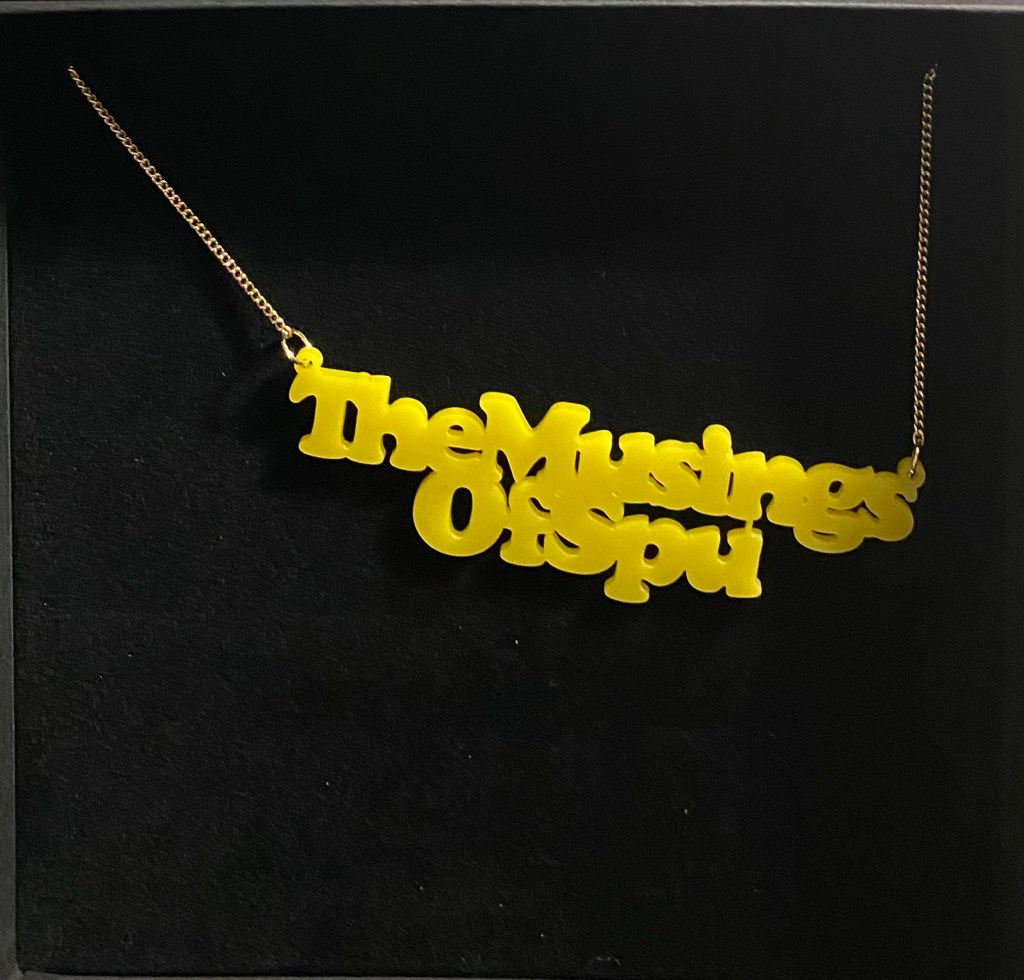
Before I go, I wanted to show off my new logo necklace – it’s the name of my blog site – ‘The Musings Of Spu.’ It’s been made by Tatty Devine & I think it’s so beautiful! I love their jewellery & I was lucky enough to model it on the catwalk last April. The new logo necklace will become the feature of the main page of my blog site. It’s part of a revamping that I need over the next couple of months. I hope you like the necklace as much as I do!
Alt Text: A necklace with a gold chain & yellow words which say “The Musings Of Spu.”
I never knew Twixmas existed until I saw it on social media as a hashtag! So what does Twixmas mean to me & what do I do during this ‘in between’ period?
Alt Text: A lightbox positioned on a carpeted floor in front of a real Christmas tree, decorated with baubles, felt toys & paper Cornucopias filled with sweets. The lightbox has a message in black capitals which says “Happy Twixmas.”
My blog is a bit later than planned this month. I got very sick after my last bone infusion – I got Mastoiditis – the best way to describe this is an infection in the large bone behind the ear. It’s a very rare side effect of the Zometa infusion, but you know me, I get all the rare stuff! Luckily I didn’t need any intravenous antibiotics to clear the infection, I just had two weeks of strong penicillin & pain relief instead. I’m still on antibiotic ear drops to clear the last of it up, but it’s still fairly unpleasant. At least it doesn’t feel like I’m being drilled in the head through my ear now!
Before Christmas, it’s always a hive of activity around my flat. Aside from ordering all the food for a mega feast, I make my own Christmas cards & email cards. This year, I also finished off a wooden Advent House that I’d been painting. I decided to fill it with Christmas cracker jokes, wax melts & tree decorations rather than sweets. I saved the sweets for some little paper Cornucopias that I hung on the tree. For the first year, I contacted family & friends to ask if it would be ok if we didn’t buy presents for each other anymore, apart from the kids. Thankfully everyone agreed to this. We’ve made a pledge instead to spend more quality time together which really is a better present to each other. I don’t need anymore ‘stuff’, I want to surround myself with laughter from my loved ones. And what’s the point in bankrupting ourselves at a time when we’re all suffering from the cost of living crisis?
So this Twixmas, I’ve been spending even more time with family & friends than usual. It’s been really relaxing. I’m taking Stephane (my partner) to the Panto – despite living here for 50+ years (he’s French), no one has ever taken him to see a Panto. I’m very excited to see his reaction.
London empties out over Christmas & it always feels like I have London to myself. I love this! Many families in our street have gone to their second homes in the country, lol (I’m lucky that I have a Housing Association – social housing – flat in the Royal Borough of Kensington & Chelsea)! I chill out at home, taking advantage of the peace & quiet. This period has always been my time for reflection. I don’t make New Year Resolutions, instead I think about the significant events from the past year & deciding what I might want to do in the next.
But Twixmas has a special meaning for me – I call it my ‘waiting time.’ I’m basically counting down the days to the New Year because on the 2nd January, I turn another year older. That means another exciting year of adventures. It’s always my best day of the year because I genuinely feel grateful to be here.
And speaking of being grateful, I want to wish you all a Happy New Year. I hope it brings you peace & comfort.
Thank you so much for reading my blog. I’m very humbled by how loving you all are to me.
I don’t know how long I’ve been going to Whirl-Y-Gig but I do know that it’s the best club in the world.
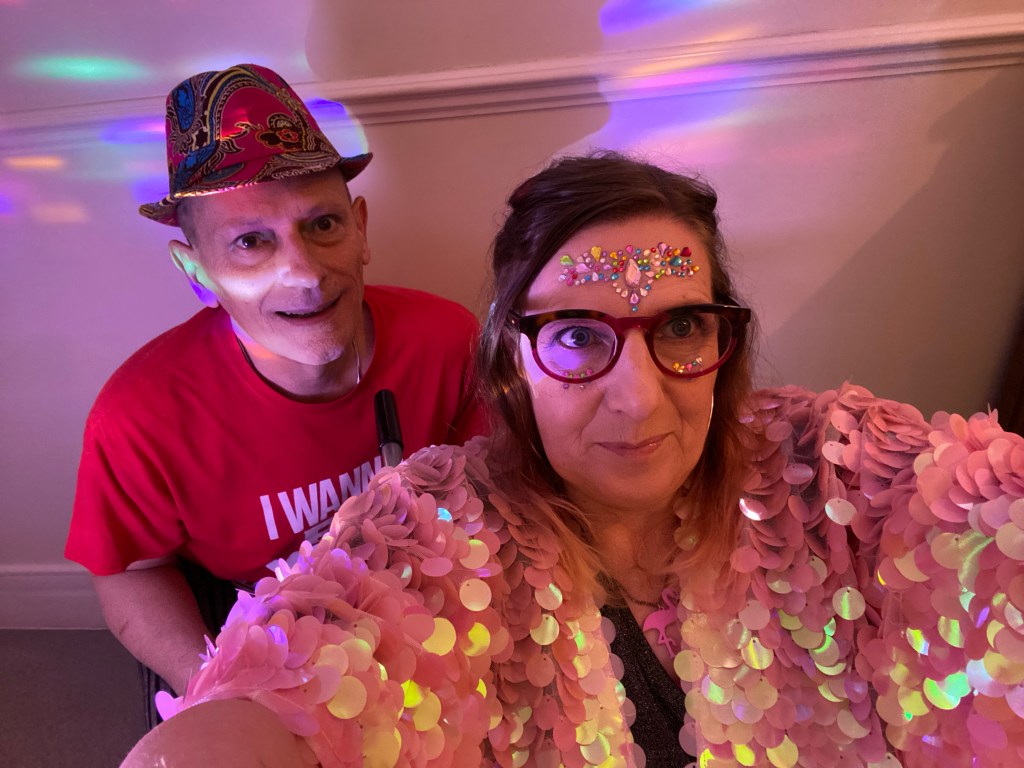
Alt Text: A selfie pose of an older white man & woman, in front of a white wall. Pale disco lights reflect on the wall, their clothes & their faces. The woman is in a wheelchair & she has long brown/blond/grey hair, some of which is tied back. She wears pink/brown round glasses, face jewelry, large silver hoop earrings, a necklace with a pink flamingo, a silver top & a cape made of plastic, translucent pink discs. The man is crouching behind her. He wears a muti-coloured trilby hat, a red t-shirt with a slogan in white lettering that says “I wanna…” & black & grey stripy trousers.
Because October’s been Breast Cancer Awareness Month & I’ve been sharing past blog posts that have contained tough subject matters, I decided that my November blog would be about partying. And there’s no better place to party than Whirl-Y-Gig.
I genuinely can’t remember when I first started going to Whirl-Y-Gig & who introduced me to this awesome rave night, but it was in the early to mid-1990’s. No one of my generation remembers much from the 90’s, lol, so I’m not too worried! Not that I’d want to tell you everything that happened at Whirl-Y-Gig of course, because as you know, what goes on tour, stays on tour. I do remember everyone going out about the “Parachute at the end” & I was intrigued by their venues of choice – town halls.
So one night I found myself queuing at Hammersmith Town Hall with lots of people dressed in bright, dayglo colours & with painted faces & bodies. Ravers. Good people.
Being wheelchair users, my friend & I were taken to the back entrance, basically what I call the ‘Tradesmen Entrance,’ which was flat, & a Whirl-Y crew member guided us through a maze of corridors until we reached the ballroom area. As we passed the offices, I couldn’t help laughing to myself as I pictured all the office workers at their desks on Monday, having no idea that a couple of alternative party-goers had danced past on their way to a rave less than 24 hours earlier.
Whirl-Y-Gig is just madly beautiful & it’s always given me so much energy. The community of people that go are friendly & generous. In the early days, kids were allowed in and some of those same kids share the dancefloor with me today. People in their 70’s & 80’s go to Whirl-Y-Gig. It’s so special when all of us dance together.
The decor is exquisite. You’re bathed in rainbow colours & lights which makes the experience all the more magical. And then there’s the music. Oh the music. Celtic, global, psychedelic, dub-step, drum n bass – all sounds from around the world. The end finishes when a Parachute comes down to cover everyone & cool them down. I confess that I was sick from vodka once under the Parachute which very much ruined the moment for a lot of people! I’ve always felt bad about that, so now I’m one of the people who hold the edge of the Parachute, gently fanning people back to reality.
When Whirl-Y-Gig reached its 25th Anniversary, it had moved to Camden Town Hall. It returned to this venue a few times over the years & it’s my favourite venue because of its Art Deco surroundings. It’s also central London with good transport links which does make a huge difference. Over the years Whirl-Y- has hosted some great live bands, I remember Eat Static being epic on this night. ‘Adam & Joe’ (from the show of their names) were there too & remember being so happy about that!
The best venues for Whirl-Y-Gig were always the ones with the high ceilings & large dance floors. I need a lot of space to dance & to breathe so I have enough inner energy to power me on. Because I’m lower down than everyone else & I tend to swirl about in my chair, once the dancefloor gets busy, I don’t have the space to do my moves & then I find it hard to breathe as well. At Whirl-Y-Gig I can dance all night so I get a bit frustrated if I have to leave the dance floor. Don’t get me wrong though, the other clubbers are absolutely brilliant around me & try to give me the space that I need. If there’s less room in the venue, the crew have started to section off an area for disabled people which makes it so much easier to dance & socialise.
Over the years, the club night has been very popular with disabled people & I think it’s because of its open ethos. However, it’s not always been possible to host the club in a wheelchair accessible venue because of availability & finances, but as soon as they can switch clubs, the crew will. The night is currently being held in Hackney Wick, London, UK, at Studio 9294. The club has a step-free route to get in, to get to the bar & the dance floor, but unfortunately the accessible toilet is in the venue next door. This means that if you need a wee, you have to get an escort out of the venue & take the ramp to enter the next one. Thankfully the venue staff act quickly to help you, but I wouldn’t advise leaving it to the last minute before you decide you need the loo. And I recognise that some people might not get much warning when you need the loo (I’m one of them), so bear this point in mind.
The other joy about Whirl-Y-Gig is discovering bands and new music. Zion Train, Astralasia, Transglobal Underground, Banco de Gaia, St Germain, Afriquoi…& so many others. In past years there was a drum circle that played along, which was awesome, but that seems to have fallen by the wayside in later years.
I can’t blog about Whirl-Y-Gig without highlighting the outfits. There’s lots of shimmering face & body paint, glitter, sparkles, headdresses & capes, but the outfits that light up are the best ones. Who doesn’t love a full-length set of butterfly wings complete with little white fairy lights? You can be as creative & as outrageous as you want to be & I love it!
So who created Whirl-Y-Gig? Richard (also known as DJ Monkey Pilot) & Mary, that’s who. Richard DJ’s for the majority of the night & Mary is always about in the crowd. She often takes the mic to introduce the live acts & always, always thanks people at the end of the night, reminding us all of the special time that we’ve had together, & to get home safely. They are the Pearly King & Queen of the global beats & totally lovely people.
In 2022, I was beside myself when I discovered that Whirl-Y’s New Year’s Eve party was going to be held at Subterania which happens to be 20 minutes walk/push from my flat! So Stephane & I put on our best, outlandish party wear, & went up the road to party. I don’t usually party on the New Year because it’s two days before my birthday as I like to get stuck into my day, but I couldn’t pass up the opportunity of going to the best club in the world taking place in my manor!
Speaking of my birthday (I do like to prepare people a couple of months ahead, lol), it’s very nice of Whirl-Y-Gig to organise their Winter Warmer in January which is my birthday month. Even better, Zion Train are playing live. I’ve already bought my ticket!
In October 2023, Whirl-Y-Gig celebrated its 42nd Anniversary & Transglobal Underground played (hello to the drummer who is one of my neighbours). It was also a double celebration because one of my close friends turned 60! She’s a wheelchair using, Whirl-Y veteran like myself & a lot of drink was taken onboard!
Some would say that because I’m a couple of months shy of 53, that I’m too old to go raving now. That’s horses**t. But what I will say is that I don’t think it’s worth bothering with any other clubs. Not one of them touches or comes close to what Whirl-Y-Gig has or what it does for my soul.
To end, I’m going to share some lyrics from a track that I discovered at Whirl-Y-Gig. It’s “Never Too Old” by Monrroe & Emily Makis.
“These days go too fast For me to limit All my decisions…
I never feel too old for this Cause something in my soul says I’m not old for this
I’m gonna let life call for me And follow my resolve to focus on the beat
I’ll never, never leave.”
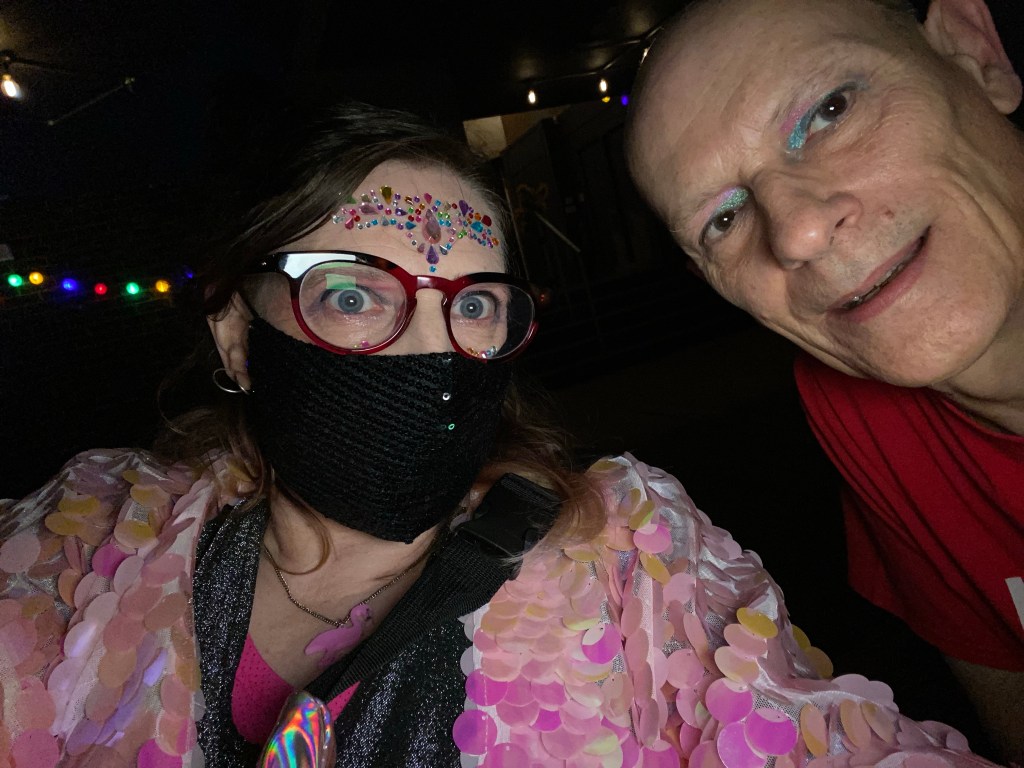
Alt Text: A selfie pose of an older white man & a white woman in a dark club. The woman has brown/blond/ grey long hair, some of which is tied back, & she is wearing rainbow-coloured face jewelry, silver hoop earrings, a black sequinned mask, a necklace with a pink flamingo, a cape with plastic pink, translucent discs, a silver top with a pink top underneath & a translucent-coloured bum bag. The man is bald & he has bright blue & pink eyeshadow on. He is wearing a red t-shirt.
Over the last few months I’ve been reading lots of self-help books and lots of books by people who have lived experience of breast cancer. It’s not such a horrific read as you may think!
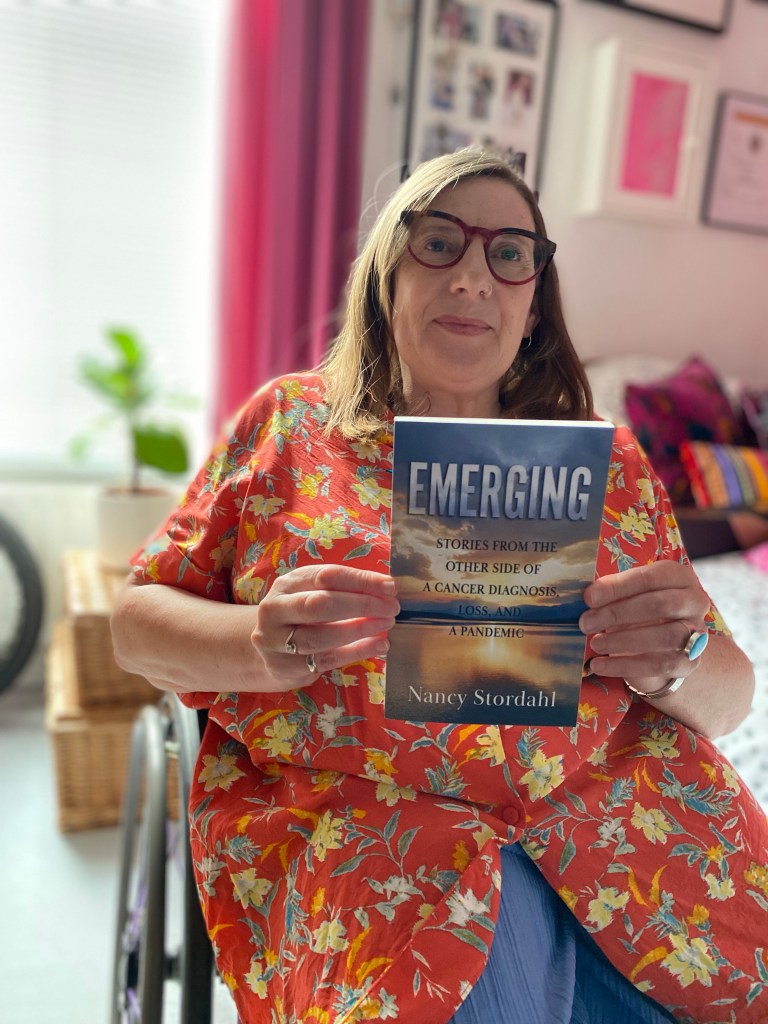
Alt Text: A middle-aged white woman with long, straightened brown/blond hair sits in her wheelchair, in her bedroom. She is smiling & holding a book entitled ‘Emerging – Stories from the other side of a cancer diagnosis, loss and a pandemic’ by Nancy Stordahl. She is wearing round, pink/brown glasses, small, silver hoop earrings, a small silver nose ring, a silver watch, 3 silver rings (one with a large turquoise stone) on her fingers, blue plisse trousers & an oversized orange blouse with yellow, blue & white flowers, & green foliage printed on it.
I’ve spent the last few months delving into self-help books and reading autobiographies of people who have a breast cancer diagnosis. I wasn’t ready to read any books like this before now, although I was a regular reader of blogs from the start of my treatment.
Reading them has been difficult for all the obvious reasons; it’s brought up some feelings & thoughts which I’d rather have buried. And, of course, none of them detail anything on the disability experience with breast cancer. However, they were really good in helping me understand my emotions. They gave really great practical advice & a couple were really good at explaining the medical science behind breast cancer treatments.
During this period I read: ● ‘Emerging – Stories from the other side of a cancer diagnosis, loss and a pandemic’ by Nancy Stordhal ● ‘The Cancer Survivors’ Companion’ by Dr Frances Goodheart & Lucy Atkins ● ‘Glittering A Turd’ by Kris Hallenga ● ‘The Complete Guide To Breast Cancer – How To Feel Empowered & Take Control’ – Professor Trisha Greenhalgh & Dr Liz O’Riordan ● ‘Under The Knife’ – Dr Liz O’Riordan And then I also read two books which aren’t about breast cancer at all but I can really relate to them because of my disability experience – I’ll come back to why I added them in later in the blog: ● ‘Reasons Why You Should(n’t) Love Me’ (playscript) – Amy Trigg ● ‘First In the World Somewhere’ (autobiography) – Penny Pepper (I actually contributed to its crowdfunder for Unbound & I read this years ago but it’s a book that’ll stay with me forever)
I’m not going to review them because I want people to discover them for themselves & I think it’s important for people to take what they need from the books. Instead, I’m just going to say why they stood out for me, even if it’s just one phrase that helped me, an experience that I could relate to, a piece of advice, or something that helped me get some perspective.
‘Emerging’ by Nancy Stordahl: So in the interests of transparency, I’ve been a big fan of Nancy since coming across her blog, ‘Nancy’s Point’ on ‘X’ (formerly known as Twitter). Nancy has been equally supportive to my blog, retweeting & sharing each one. I bought her book & after leaving a short review, Nancy approached me to help her get her book & blog into wider circles. I agreed because I was excited at being part of a ‘gang’ of self-published, independent writers across the world that offer support to one another.
I enjoyed ‘Emerging’ because I was getting the perspective from a US citizen. Through Nancy, I learnt about the US way of life, the way in which the US handled the pandemic, & how Nancy experienced all of this as a breast cancer patient. Nancy also gave an intimate insight into how she coped with grief & family loss. This was helpful to me after losing my Mum to cancer, & seeing both my Dad & my sister go through their own cancer diagnosis.
But what I related to the most was Nancy’s concept of ‘Moving Forward’ after a cancer diagnosis. Did you know that the most annoying thing to me is when people say that it’s time that I moved on from cancer & start to put my life back together & to start enjoying life again? All with the notion that doing this will help me feel much better. Oh do f*k off! Like many cancer patients, I can’t actually move on from cancer. For a start, I have a LOT more scars & a large dent in my boob. Then I have to take daily medication to prevent the cancer from recurring, & then a whole lot of other medication to try to stop the side effects of the cancer drugs. A large needle punctures my stomach every month to suppress my ovaries & every six months I get an infusion to stop my bones from breaking. And then there’s the menopause & I can’t remember sh!t. So excuse me if I can’t move on! But Nancy talks about the concept of ‘Moving Forward.’ You can’t move on from a huge trauma. However, she encourages you to move forward in your life, carrying all this ‘stuff’ with you, & she encourages you to embrace your life with a cancer diagnosis in it. I found this idea more helpful than any CBT (Cognitive Behavioural Therapy) techniques & Mindfulness. Nancy is a star for highlighting the difference between ‘Moving On’ & ‘Moving Forward.’
‘The Cancer Survivors’ Companion’ by Dr Frances Goodheart and Lucy Atkins: This book was helpful in some areas, but it was too general for me in its advice & support. Some of its advice was really obvious, but that could be because I’ve had a lot of therapy in my life (before your minds start whirling – I didn’t seek treatment because I was depressed about being disabled!) & I had a course of CBT from my local Maggie’s Centre whilst I was waiting for my surgery (which was delayed because of the pandemic). I think the difference between this book & other books was that the lived experience wasn’t there from the authors; it felt more like theory, although there were featured case studies from patients peppered throughout the book as real-life illustrations.
‘Glittering A Turd’ by Kris Hallenga: I love the title! This autobiography is a beautiful, life-affirming, brutally honest book & I loved it. If you don’t know Kris, she founded the charity ‘CoppaFeel.’ As a charity-founder myself, I could relate very well to starting something yourself to help a community that isn’t being supported. In Kris’ case, it was because younger people were often being dismissed as being ‘too young to have breast cancer.’ (To be frank, young women are still being dismissed in the same way today). Kris was diagnosed with breast cancer at 23 & very quickly it was diagnosed as secondary.(i.e. It has spread to other parts of her body).
What stood out to me was Kris’ lust for life. I’m someone who has a lot of challenges but I love life too so it was easy for me to relate to Kris. But the most important affirmation was when Kris said that she wasn’t afraid to challenge medical teams & to make sure she fully understood the implications of treatments before making any decisions. I was relieved to read that in print. If you’ve been reading my blog for a long time, then you’ll know how much I’ve had to challenge, but at the same time, I’ve expressed guilt for ‘acting like a Diva’ (at the end of my radiotherapy, I apologised to the Breast Cancer nurse for my demanding ways, my angry outbursts & my temper. She replied that there was no need for me to apologise & she said that it was important that I’d done this – it was the way that the medical team knew I would be able to get through everything that was thrown at me).
‘The Complete Guide to Breast Cancer’ by Professor Trisha Greenhalgh & Dr Liz O’Riordan: I really, really should have read this book three & a half years ago, at the point when I was diagnosed. There’s no better way of giving a 360 degree of the breast cancer experience by two breast consultants who then got diagnosed with breast cancer. It’s so generous of them to share their experience to help other women. I couldn’t imagine knowing what was going to happen to me because I’d been treating so many women with breast cancer. I find that so terrifying. But because the two consultants have treated so many different types of breast cancer & they’re updated on all the research & medications, it means that they can give so much detail (it’s important to add that their guide is currently being updated). They include case studies about themselves that serve as a comparison (because their types of breast cancer were different & their treatment options were different) & there are case studies from other patients too. I liked the comparisons of how they dealt with their diagnosis in different ways. It was so helpful to have a guide on how you might want to tell people about your diagnosis (& if you don’t) & giving some details about practical help that you might need both throughout your treatment & support after it when you’re not seeing your medical team anymore. This book also acknowledges your family & friends – they could equally pick up this book & it would help them to understand what they could do to support. I loved this book & I can see that I’ll be dipping into it for the rest of my life.
‘Under The Knife’ by Dr Liz O’Riordan: Liz’s autobiography was published this year by Unbound & it details her life in medicine, her battles with depression & when her life gets turned upside down by a breast cancer diagnosis – twice. Like Kris’, it is uplifting (especially when Liz finds her passion in running & cycling) but it’s also brutally honest. It made me think much more about the emotions that medical teams go through & how hard it hits them when they can’t save a patient. How hard surgeons & consultants work to give you the best possible chances. That they don’t always have the answers but they so often have to figure a way through in a split second & in the most challenging environments (thinking about A & E here). And the relentless march of patients who are going through their worst moments & then the medical teams have to put them back together again – but who puts the medical teams back together again? Liz describes the camaraderie of medical teams & her own coping mechanisms.
As Liz was reacting to her diagnosis, it brought me sharply back to my own & how absolutely terrifying it was. I’m so grateful for the kindness & dedication of the breast cancer team at Charing Cross.
Some of the books cover different communities & diversities of people, & how diagnosis can impact differently, but none of the books covered the disability experience. The difficult, sad part of this is that sometimes the books highlighted my isolation.
The books didn’t cover poverty either. There were lots of references to treating yourself, having massages, sleeping in a separate bedroom if your menopause symptoms were disturbing your partner, making use of a downstairs bathroom if stairs were too much at the beginning, etc. It took me back to the pandemic where a family might have had one computer between them, if they had one at all, kids completing their homeworks on a family mobile, people in shared houses having to share bathrooms & kitchens, etc. I thought back to when I’d graduated from university. I wouldn’t have coped with cancer treatment then. My first home was a single room in a housing co-op where a bed & a chest of drawers just about fitted in. The house was meant to be for ten single people but we had twenty in ours as a family of five were in the room next door to me. In later years, I lived in an old people’s home (this often happens to disabled people as these are often the only local homes that are accessible) because it had a semi-wheelchair accessible bedsit. My kitchen was a cupboard off a main space that was my bedroom/sitting room – I slept in the same room as my fridge & freezer! At least I’d upgraded to having my own bathroom by then.
I know someone who was going to their biopsy & they were 20p short for their bus fare. Despite explaining their situation, the bus driver refused to let them onto the bus so they walked to their appointment. They arrived two hours late – they had rung ahead & luckily they were still seen. Their breast cancer team were appalled at what had happened.
Whilst some services are free to access & some people might be eligible for help with transport & other living costs, this is absolutely a postcode lottery & help isn’t consistent across the country. I’d like to see books that speak honestly & openly about how poverty impacts on the cancer experience.
Returning to the subject of lived experience of disability, I’m going to reference two books that haven’t got anything to do with cancer, but they kept me sane whilst I was reading the books about cancer. These two books aren’t self-help books at all, they are autobiographical & written by disabled people.
I read Penny Peppy’s ‘First In the World Somewhere’ & because Penny is a dear friend of mine & I love the bones of her! I had so much in common with Penny’s lived experience, not just disability, but she’s post-punk as well, was in bands, writes, & into the DIY scene. She talks openly about her sexual experiences & being comfortable with her body which is important. Penny is an activist & she’s been campaigning her whole life for disability equality & equity for the disabled community.
In 2022 I went to see Amy Trigg’s one woman show ‘Reasons Why You Should (n’t) Love Me’ & it blew me away. It was like my life on the stage – growing up in Essex, trying to avoid the religious groups that would pray for my miracle cure & many hours spent at the Spina Bifida Clinic in Chelwest (big shout out to their team as they’re amazing as well). I spoke to Amy afterwards, mainly about growing up in Essex. I bought the play script which she signed (I’m very proud of this!) I read the script in between all the self-help books & it reminded me that my lived experience of disability is probably the strongest thing that I have in this world & although it complicates my cancer treatment, it has helped me self-advocate in the most desperate of situations & helped me navigate the NHS.
So, to conclude – the best self-help books are ones written by those who have lived experience, & we need more about cancer & disability, & cancer & poverty.
What’s it like going through a medically-induced menopause? Not fun is the short answer! I spoke with India Fisher about it for her ‘Be More Orca’ podcast.
Note: Trigger warning – the blog, podcast & transcript talk frankly & intimately about the menopause, Breast Cancer & life/death.
Alt Text: A cartoon of a blond haired lady, wearing glasses, a blue t-shirt & blue denim shorts, riding on the back of an Orca whale. She is smiling & waving. The text says “Be More Orca, buck the menopause with India Fisher.”
A year ago, India Fisher invited me onto her new podcast ‘Be More Orca’ to discuss my experience of the menopause. We were introduced to each other by a mutual friend. India wanted to create a community for people to share their experiences whilst going through the menopause. I wanted an opportunity to give a different perspective as someone who was thrown headlong into the menopause because of treatment for ER+ Breast Cancer. Of course, for me, like some other women, this means that taking HRT (Hormone Replacement Therapy) to relieve symptoms isn’t an option. India was happy to help me share my story & I’m very grateful to her for that.
We actually recorded my episode in August 2022. India wanted to delay it going out so that it could be part of four special episodes on Breast Cancer & the menopause.
I read the transcript first & I cried. Not because I hated it, or because I regretted anything that I’d said, far from it. I cried because I realised that I’d been through an awful lot. Dealing with the menopause on top of being disabled & living with a cancer diagnosis is just the nastiest-tasting icing on the shittiest cake ever. Of course, I’d forgotten half the things I’d said & I was surprised at how candid I’d been with India. But it’s easy to open up to her because she’s really generous & kind with her questions.
If this recording had been completed a year later, then I would have had exactly the same discussion. You see, absolutely NOTHING has changed in 12 months. My only relief from symptoms is still having eyedrops to manage my dry eyes! Yep, eyedrops. And I even had to fight to get them on prescription! If you can’t take HRT then the options are zero. No wait, there are some options – eating healthier (remember I gave myself a severe lack of vitamin B12 attempting that!) & exercise (as you know, fairly limited for me as a wheelchair user, but yoga, swimming & a bit of gym work gets me through). As India says at the end of the episode, there is a new drug that’s been approved in the US – NK 3 Receptor antagonist which Davina McCall alluded to in the 2nd of her Channel 4 series ‘Sex, Myths & the Menopause.’ Knowing my luck, I will have already been through the menopause because NICE licenses it for use in the UK!
A couple of days after reading the transcript, I settled down to listen to my episode. I cried again. This time it was because I could hear that stoicism in my voice; the times when I faltered in the conversation & then covered my emotions with dark humour or the straightforward matter-of-fact tone that I adopt to prevent me from becoming overwhelmed. I sensed India gently guiding me through the episode & I felt grateful that I was having this conversation with her & not anyone else.
Much like the second after I publish each blog, I always think “maybe I shouldn’t have said that” & the cringing begins. But this feeling always passes because, frankly, my shit is real, & not only is it real for me, it’s real for other disabled people too. There’s always someone who responds to say, “I’m glad you’ve written that because that’s what I’ve been through & I felt exactly the same.”
I’m not going to give any of the content away about the episode because I’d like you to listen to it, or read the transcript that India very kindly provided, or do both.
When our recording finished, I did cry a little to India because of our closing conversation. I’ll leave you to discover it for yourselves. Oh, & be mindful the next time you moan about growing old.
India: [00:00:00] Hi, my name’s India. This is Be More Orca :Buck the Menopause. Now, I’m not a medic or an expert or a celebrity, I’m just going through it myself. I was totally blindsided by my symptoms. I knew nothing about this stage of my life. And then I discovered neither did any of my friends. So I’m on a mission to find out everything I can explore every avenue to help us manage our symptoms and get our lives back on track.
This episode marks the start of a little run of four episodes, concentrating on the menopause and breast cancer. I’m talking to Suzanne Bull. Founder of Attitude is Everything about her breast [00:01:00]cancer diagnosis and coping with a medically induced menopause. Suzanne proves to us all that we need to advocate for ourselves, do our research, and know our own bodies.
Suzanne, thank you so much for coming and talking to me today. ’cause it’s a really important subject that I don’t think gets talked about enough. And there’s a lot in the press at the moment about H R T and that’s a good thing in many ways. But for those women who can’t, or choose not to take it, then you’re sort of left in a bit of a black hole, aren’t you?
You were diagnosed with breast cancer back in March, 2020. That’s a date that’s indelibly linked on all our brains, isn’t it? Can you talk us through that?
Suzanne: Yeah, sure. So I had no idea that I had breast cancer at all. I didn’t feel a lump. It was picked up on an annual mammogram in the hospital, but a couple of [00:02:00] months before that I felt really, really strange. I was really busy. I was really busy at work, but I had the urge to like really party all the time. Like I was really unsettled. It was like the last year of my forties I was drinking more and I was feeling that something big was gonna happen and I also had the sense. That time was running out. Now, as weird as that sounds, that’s honestly true. What happened, and then I felt like I had definitely had hot flushes, more headaches. Although with my disability, I get headaches anyway.
India: Yeah. Just to clarify that, just for people listening, you are a wheelchair user. You’ve been disabled from birth. Am I right?
Suzanne: Yeah, that’s right. So you were having hot flushes. Yeah, I was having hot flushes. I felt like I was going into puberty again. It was really weird, like my boob were really painful and they felt really heavy. I’m never hot ever because most of [00:03:00]the time I’m freezing cold because I’ve got Raynaud’s as well and another circulatory disease. So it was really strange for me to be hot. But what really made me question whether I was in perimenopause or menopause was, I saw Meg Matthews on Lorraine one morning and I had no idea that the symptoms and the impact of menopause could be so devastating. And I listened to what she was saying and I was like, Hmm, that sounds really familiar. So I signed up to her website and I checked my symptoms and then I cross-referenced that with everything that was on the N H S website, and I had nearly every one of those symptoms. I was like, Wow, okay. But what really happened was that my mammogram came back with a callback saying possibly you might have to have a [00:04:00] biopsy. And actually I was experiencing the menopause, but what I was really experiencing was estrogen positive breast cancer.
India: So do you think you were starting. Into the menopause? Or was it the cancer that was feeling like menopausal symptoms?
Suzanne: I think it was the cancer that was making me feel menopausal symptoms. Looking back on it.
India: You said you were 49?
Suzanne: Yes, that’s right. Yeah.
India: And you were having regular mammograms?
Suzanne: Yeah, I was having regular mammograms. ’cause I’m in the breast history clinic at Charing Cross because my mum had breast cancer and my sister did as well. But they got diagnosed between the ages of 36 and 38.
India: Wow. So much earlier.
Suzanne: Yeah, so I sort of got a bit lax about it all. I still went for my mammograms and I have had a couple of callbacks before and it’s all been fine. And then a couple of mammograms ago, as it were, [00:05:00] they said to me, oh, you are coming out of the period of being diagnosed like your mom and your sister. So I was thinking, oh, that’s good. It might have missed me, but it, it didn’t, I’m not genetically connected. To my mum and my sister. The NHS did a test on me when I got breast cancer, and I’m not genetically connected to them. I’ve got a different type of cancer, but they do believe my mum and my sister were connected.
India: Just to clarify, you are obviously genetically connected to your mum and your sister, but in terms of the breast cancer that you had, so there wasn’t any more genetic risk for the fact that you had a family history of
Suzanne: yeah, because it was a different type of breast cancer that you got. So I don’t have BRCA.
India: And that’s the mutated gene, isn’t it?
Suzanne: Yeah, but they dunno whether my mom and my sister. Had that either because they both weren’t tested.
India: Right.
Suzanne: So it’s kind of, I went for the test ’cause I was convinced, I was like, it’s the three of us. I’m convinced nothing. And [00:06:00] so you sort of felt, oh, well I’m clear of that.
India: Family history risk.
Suzanne: Yeah.
India: And so you got the estrogen receptor positive breast cancer where the cancer feeds off the estrogen in your body?
Suzanne: Yeah, that’s right. Basically now I have to get the estrogen taken out of my body as quickly as possible, so I had to get my marina coil taken out and no HRT at all.
India: Also you are, I presume, on aromatase inhibitors. Is that how you pronounce it?
Suzanne: Yes, I think it is. I can only pronounce the one I’m on, which is Letrozole. When I was on the table as it were having the biopsy, they said to me, we see something in your lymph node. So I, I panicked and started to really, really cry. And they were like, oh, why are you so, are you okay? And I was like, oh, I think that’s how the cancer went round. My mom’s body and I’m, I’m really scared. I’m really scared. [00:07:00] And I did have a cancer in the end, in my lymph node, so I had two lumps in the end and a cancer in my lymph node. So, you know, it’s, it’s a huge thing. Yeah. And then if that wasn’t enough, because it was the beginning of the pandemic, my operation got delayed for four months because they. Said to me that it was too dangerous to operate on me because my disability affects my lungs as well.
India: And this was right at the start of the Covid Pandemic?
Suzanne: Yeah, they didn’t have enough ventilators, but they also were frightened about me catching Covid and they said, if you were to catch Covid, we think that you will die. And we also think that we wouldn’t be giving you a ventilator. Basically, they were saying to me, we’ve put a DNR on you, do not resuscitate on you, and we think that you are not gonna make it. Now actually, I got Covid twice. It was really, really unpleasant and I was very, very lucky not to be hospitalized, but I, I [00:08:00] still actually got it twice. My immune system was so low, so. Fast forward to July, the hospital rang me up and said, what are you doing next week? I said, nothing. And they were like, good, we’re bringing you in.
India: And when they decided what to do, it was lumpectomy?
Suzanne: Right?
India: Which is what they’re now saying is a much better treatment than the full mastectomy?
Suzanne: The treatment’s always personalized to you, so you have to weigh up. What is best for you and what the treatment of what the oncologist and the breast surgeon is saying to you. So I could have had either, but my sister said, well, the lumpectomy is probably better because it can still come back in the mastectomy scar anyway.
India: Oh, really? See, I didn’t know that.
Suzanne: Yeah, it can.
India: And the lumpectomy is, Keyhole, is it? Do they literally just take out the actual lump?
Suzanne: Well, they have to give you clearance as well. So my breast cancer surgeon, he’s retired now, but he’s very old school, and [00:09:00] basically he said, look, I’ve taken a lot away around the area. You’ll have a lot of scar tissue, but we don’t wanna put somebody like you under a general anesthetic too many times because it’s, it’s difficult for you. It’s it. It’s a difficult procedure for all of us. As it was. They had me down for a ventilator, being in hospital for at least three weeks, a bed in ICU. I came out of recovery maybe about a couple of hours later. Went into ICU, was in ICU all night, didn’t need a ventilator. Came home the next night.
India: You are obviously steel I have to say.
Suzanne: I always say what’s written on paper. Especially about me. You can read it all and think, oh my God, oh my God. But I said to everyone, I bet I’ll be fine. Don’t worry, it’ll be fine. I mean, I wasn’t sure. I was terrified before I went down, to be honest. I was thinking, well, none of this is great.
India: [00:10:00] No, and at the worst possible time, I mean, it’s never good to get a breast cancer diagnosis whatever time, but in the middle of a global pandemic that’s that’s properly shit.
Suzanne: Yeah. And, and with lungs that aren’t great and with my disability it’s hard. It’s hard for them to kind of operate on me anyway. But essentially it was fine. But then of course, whilst I was four months, like waiting for the operation, I said, you can’t just leave me. I’m not going to let you just leave me and phone me every week to see how I am. That’s not how this is gonna work. I’ve read up and I want Tamoxifen. And they were like, Oh, okay. And I rang them every day for about 10 days, saying, when are you gonna get the tamoxifen? I think it’s gonna have the least impact on my disability, but it’d be good for getting the cancer not to progress. And then we’re like, okay.
India: It stops your body producing estrogen, so therefore, hopefully slows down the cancer that is feeding off the estrogen?
Suzanne: Exactly. Exactly.
India: But does that not [00:11:00] also then shove you into like cliff edge menopause?
Suzanne: Yeah, it did.
India: For you to go Right, this is what I want. I absolutely get that. But that is also hardcore menopausal symptoms overnight, isn’t it?
Suzanne: It is. Yeah. So straight away I had pain, really, really bad pain in my joints anyway, in my chest, but I had really bad pain down below, let’s be honest, because I still had the marina coil in at first. So it’s trying to give me progesterone and then it’s all been taken out and it was agony. It was, it felt like someone was stabbing me down below. It was really, really bad, and I was like, Oh my God, what is this? And then it started like I couldn’t follow a plot on East Enders or I was like, what is happening? My hair actually did start thinning and falling out, my skin went bad, my nails went bad. I was like, I really, really don’t understand what’s happening here.
India: And presumably for [00:12:00] you, it’s really hard to work out what’s menopausal symptoms and what’s your body fighting the cancer.
Suzanne: Yeah. So it was doing both at the same time because my sister rang and said, oh, your bone’s grinding yet? And I said, yes. They are really, really badly.
India: So that’s the cancer thing?
Suzanne: Yeah. The cancer’s trying to advance through the bones and the tamoxifen is trying to push it out as fast as it can and it is awful grinding. Grinding pain. I mean, I’m used to having pain because my disability.
India: So your pain threshold is high?
Suzanne: Yeah, it is. It is high.
India: They usually give tamoxifen to people who’ve gone through the menopause?
Suzanne: That’s right. You see. So they were a bit like, do you really want this? But what I was looking at was things around my circulation and things like joint pain, which could be worse under the other drugs. I think basically what they did was they knew they had to do something. They knew that I would not let up until I got something. So they just [00:13:00] said, alright, have that, and let’s see.
India: And it was a personal choice for you, wasn’t it? You weighed up your pros and cons.
Suzanne: Personally, I had to do all of that because, you know, I’ve got an existing disability. So what I also had to do was link all my various consultants together to talk about how they were gonna treat this and how they were gonna put me under the anesthetic and how they were gonna actually treat the cancer. ’cause they had to treat the cancer, they had to save my life. You know, one thing I’ll I’ll say is the cancer treatment is not good on somebody whose bones are already not great, but you, you have to weigh it all up. But the only way to weigh it up was get them all together to talk, which they did. They all provided a lot of advice to one another and to have that in the middle of the pandemic. Was absolutely amazing.
India: So you felt as supported as you could possibly be?
Suzanne: Yeah, and I’m lucky where I live, I live in Labroke Grove, so we’ve got four leading hospitals here. So [00:14:00] maybe it was easier for me in some ways, but no, here I was for four months shooting through the menopause, like absolute crazy.
India: At break neck speed and still doing, did you do chemo or did you do radiotherapy?
Suzanne: I couldn’t have chemotherapy. Really? I, well, I had a choice. I mean, if you have to have it, you have to have it because they found another lump in the four months. Another lump grew next to the original lump. They took my cells to, they sent ’em to America on a system called Myriad. But we don’t have it here at the moment, but it tests the cells and it gives you like a predictor. And so what they said was they predict what they think it’s gonna do. They said that it would only be 6% benefit if I was to have chemo. And radiotherapy, they brought me in. They said, let’s discuss the chemotherapy. We have to go through a list of things that might happen. So I was like, okay. And they went for the [00:15:00] list. I was like, yeah, I already have that. Yeah, I already have that. Yeah, my circulation’s really bad. Yeah, I’ve really, uh, my nerve’s really bad. Nerve pain’s really bad. Uh, yeah, that goes on as well. And they were, I a lady that was was training, the oncologist happened to be away, and she did the interview with me and we were together for about 45 minutes and her eyebrows just kept shooting up further. And she said, look, she said, um, this has been really great and really informative. Uh, I need to talk it over with someone. Is, is that okay? I’m, I’m gonna phone your oncologist. I know she’s on holiday, but I’m gonna phone her because, um, This could seriously affect your quality of life. And I said, yeah, I know. I mean, that’s what we’re always weighing up all the time. You know, I, I sort of rang my sister up and I said, well, I’ve got this list of pros and cons. The cons, you know, against having chemotherapy are much longer, unsurprisingly. And then she said, look, Suzanne, look at me. I am disabled ’cause of chemotherapy. I had to [00:16:00] have it. I had a very aggressive cancer. I had to have it. I’m disabled now. I’ve got COPD. Imagine you are already disabled. Think about this, what it’s gonna do to you. It’s only 6% benefit. You’ve got a good. Chance on the predictor scale if it’s to be believed. So the assistant oncologist, she rang me up and she’s like, we’ve got an answer. What do you feel about it? And I was like, bit afraid to say, no, I don’t want it. ’cause I didn’t wanna come across like a wimp. I know that’s really a strange thing to say. And I said to her, um, I, I don’t really know what to do. And she said, okay, let me help you. We know that you want to have the best chance ever because you’ve told us over and over again, but we are actually not gonna give you chemotherapy. And I went, oh my God, I’m so happy. And she said, oh, you agree? And she said, the other thing we’re gonna do is we’re gonna try you with partial radiotherapy so that we don’t harm your lungs. So I had five sessions of very, very targeted [00:17:00]radiotherapy. After that, the oncologist said, right, I wanna change you over to Letrozole, right? Which is one of these AI aromatase inhibitors, which blocks estrogen again, because she said, you haven’t quite gone through the menopause. ’cause I did another blood test for her and things like that. So I think now looking back, I was probably perimenopausal rather than menopausal. I said, okay, and she said, But there’s something else. I need you to have. The Zoladex injection, the gosser injection in your stomach once a month. And I was like, oh, I don’t want to. And she was like, we’ll help you, support you as much as we can. ’cause I, I basically, I’ve got a needle phobia.
India: Right, and I presume they’re quite big needles.
Suzanne: I have no idea. You don’t look, I pretend I’m somewhere else. They fire a pellet into your stomach every month and it dissolves. And that’s how it, it gets rid of it as well.
India: Now Zoladex is an injection that stops the release of luteinizing hormone?
Suzanne: Something like [00:18:00] that. Yeah.
India: Which is also to do with estrogen production, isn’t it? So you are getting a double whammy of shutting down all estrogen that your body is trying to produce.
Suzanne: Yeah. So that’s where I am two and a half years later, and really going through a menopause, which is medically induced, so it’s hardcore menopause and there really isn’t a lot that relieves the symptoms.
India: So for you, you are literally just taking vitamins and an eye drop, were you saying?
Suzanne: Yeah, so the dry eyes is really unpleasant. My sister had really bad dry eyes as well, so I’ve got some eye drops and I take calcium tablets with a vitamin D supplement. I asked for those and I’m back to the good old exercising as much as I can.
India: I was gonna say, it’s this thing of when people choose or can’t take HRT, [00:19:00] then we are told nutrition exercise. But if you’re a wheelchair user, do you not like go, you know, how can I,
Suzanne: I do. I comment quite a lot on Twitter on that. I just said all, all of these things that you are suggesting, there were some very fit people running marathons and biking and all of that. And I was like, look, I don’t mean to be rude, but how on earth is this inclusive and accessible?
India: Yeah.
Suzanne: For people who can’t do any of this. So basically what I do, I am fitter than I ever was. I’ve always done a form of yoga called adaptive yoga. And it’s created by a guy called Matthew Sanford in America. He’s tetraplegic and it’s a form of yoga for disabled people. And I’ve been doing that for about five years. Anyway, the most difference it’s had on me is my breathing. Uh, my breathing is loads better. And, um, Brompton have definitely noted it down that it’s much better than it was.
India: Well, that’s amazing.
Suzanne: But yoga’s quite tough. Now with [00:20:00] the increasing pain that I’m in, I swim. Every week as well. I got a gym referral from my GP and the lady from the council met me at the gym and taught me all these gym exercises, swim exercises that would just keep me going and keep me moving. I’m not brilliant at the gym. I. There’s so many machines I’m not allowed to use, so really I’m just keeping moving. I’m just lifting the lowest weights and doing little things. But the gym, I don’t go every week because that’s hard going. I do eat much better than I used to. During lockdown, I started getting a box of fruit and veg delivered from, I’m gonna give him a shout. Devlin’s ’cause they’re amazing. The store on Portella Road, and they continue now to deliver fruit and veg every week, but exercising, I mean, I think that there needs to be, anyway, just generally a lot more awareness about how disabled people can exercise anyway.
India: And what you were saying, you are very worried by the recent narrative of [00:21:00] HRT being ported to be safe for people with breast cancer.
Suzanne: Yeah. I’m really, really worried about this because it isn’t, if you’ve got any breast cancer whatsoever, you really shouldn’t take it. At all. You shouldn’t even be having a discussion. You know, it shouldn’t even be brought up with your GP or anything. Do you know what I mean? I, I think awareness raising is brilliant and I, I think Davina McCall’s done a really great thing,
India: Hasn’t she.
Bring the menopause and
Suzanne: this discussion into the public arena. But then what I’m worried about, and it’s, it’s not just her, but there’s, there seems to be these other experts popping up everywhere going, oh yes, the figures are quite low now on HRT and breast cancer. And, uh, and it’s like, no, why? You’re trying to get estrogen out of your body. HRT putting it back in. So what are you doing? I just don’t understand why people are not questioning it a bit more. [00:22:00] Where you get your information from is really, really important. And I read a lot of Dr. Liz O’Riordan, who is a breast cancer surgeon, but she also had breast cancer twice as well, and she dispels quite a lot of these myths. She has this thing around nutrition where people say, oh, if you eat this or you’ve eaten that and you must eat more of this or drink my special tea or something. She calls it nutri bollocks. And it really, really makes me laugh. ’cause it, it’s true. You know, and I think there is a, a tendency now for everyone to be jumping on the menopause bandwagon. And therefore there’s a lot of things being said that are, this is what we should all be taking and this. Supplement will help. And actually it’s just feeding on people’s fears.
India: You introduced me to Liz O’Riordan and just to play a devil’s advocate, even she did say that it has to come down to personal choice with HRT and ER Positive Breast Cancer because if you are so [00:23:00] debilitated in a similar way to you said, actually, I want Tamoxifen. That’s my personal choice and I want you to give it to me. If you are so hideously debilitated by your menopausal symptoms, then it’s, it’s a weighing up the risks, isn’t it? How risk averse are you in the fact that, you know, it might increase your risks of getting cancer again, or, I can’t get outta the house because my menopausal symptoms are so appalling. She was saying that obviously there aren’t enough long-term 10 to 15 year studies to be able to definitively say whether it is safe or not. But she was saying that it is whether you can live with the guilt, is how she put it. If it recurs, what do you feel?
Suzanne: I hear her and I understand that, but I’m not gonna take the risk. ’cause I know how difficult it was to operate on me and give me treatment when I only had three small lumps. And I, I saw my sister go through the whole works of chemo and with a very aggressive cancer with a very, very young family. [00:24:00] Her youngest was like 18 months old. I’ve seen all that. I’ve seen my mum die of cancer. I, I don’t wanna play down anyone’s menopause symptoms ’cause I know they can be like really, really awful, the symptoms, but I think it might be slightly. Easier for me because I’m used to having a really hard time with my body and I’m used to like, where’s the limit? And then pushing it over the limit because I kind of have to, and I think for me, you know, my menopause symptoms prob probably are like really, really bad. And, and if you’ve never had anything like that before, some people be like, this is not how I wanna live but me, I’m like, this is just something else I just have to learn to manage because I don’t want that cancer to come back.
And that is the thing I
India: think, I can’t speak for breast cancer survivors not being one, but I would’ve thought the majority of people feel the same way you do, as in, I have just got over this. I am not going to take any chances to bring it back again.
Suzanne: No. No, I mean, I think what I don’t [00:25:00] like is the positioning of HRT, like you said, like the wonder drug. I work in the music and live events industry and what’s happening. They’re doing lots of talks about menopause and HRT and all of that. At the moment, they don’t really wanna hear. I can’t take HRT. They don’t want to hear it. And I’m like trying to say, you probably need to offer a range of solutions to this because you can’t just say to your colleague, oh, maybe go to the doctors and get some HRT. Yeah.
India: This is what I am determined to do on this podcast. I’m gonna look at all avenues because I’m on HRT and it transformed me overnight, but I know that I’m really lucky. And also I think I hit it at the right stage. I was perimenopausal, so my symptoms weren’t hideously debilitating. But I’ve got friends who just go, well, I don’t, I don’t want to take it. And then you are left in a wilderness. ’cause personally, all of the alternatives that people are offered, everyone should be doing [00:26:00] anyway. You know, eating better, sleeping better mindfulness, cutting down on stress, exercising, whether you’re on HRT or not. There need to be some concrete alternatives out there, and I think that comes from women’s health being pushed up the agenda. Which I do think Davina has done.
Suzanne: Yeah, definitely. And in the second program that she did, and she said there is apparently something coming in 2023, so I tweeted. Uh, and said, I’m holding you to that. I’m like, there’ll be a lot of people out here doing the same. You know, to be fair, I think vaginal, estrogen is safe.
India: Yes. So the vaginal, estrogen, the pessary is like a tiny risk and even. Dr. O’Riordan says that she takes it because she was a cyclist and she was getting labial tears and things like that, and so she’s said that’s transformed her life. So as I said, I think it’s that thing, isn’t it? It’s what works for you. It’s about personal. [00:27:00] Choice, isn’t it? Which part of my life is being debilitated by this?
Suzanne: Yeah. I mean, the other thing as well is that there are other things aside from the breast cancer, which HRT might not be a good idea, and I’ve joined a Facebook group for disabled women who are going through the menopause and some of the things that they’re saying and they’re worried about. HRT some of them are, some of them aren’t, but lots of them are because it interacts with other medications that they’re on. And it also makes their symptoms of their disability worse.
India: This is a voice that we need to massively hear. And it needs to be part of the discussion, doesn’t it?
Suzanne: It does, yeah.
India: And so how are your symptoms now then? What are you experiencing menopausaly?
Suzanne: Um, I think the, the worst thing is the joint pain and the muscular pain because I’ve already got chronic pain [00:28:00] anyway. And neuropathic pain and it’s made that whole load worse. And it’s actually, sadly, and I dunno where this is gonna end, it’s affected a lot of my mobility or the bit of mobility that I had. So of course my cancer would have to be on the right side of my body, which is my strongest side. My left leg basically doesn’t really work. So, so, um, you know, my right arm’s operated on. My right side’s all operated on my right leg. Wasn’t affected by my disability at all. So I always drove with one leg and now I’m finding that it’s really hard to drive. I’m having really bad foot and ankle pain and really bad arm pain, and that’s a nightmare because I stand and do all my transfers from wheelchair to bed to. Chair to getting in the pool, all that kind of thing. I need both my arms. Otherwise, if they don’t both work, you know, which is all I can do, go around in circles all day. It’s crazy. You know, you’ve gotta think about it. And that is [00:29:00] probably the most frightening thing. And I think if I’d have known those cancer drugs would do all of that, I would’ve. I dunno, but then I have to take ’em anyway. So what am I saying?
India: It was a life and death situation, wasn’t it?
Suzanne: Yeah, yeah, yeah. I suppose I sort of, sometimes maybe I’ll talk to my friends about the menopause. We just laugh about it and just go, oh yeah, it’s this. But I’ve never really spoken to them about HRT because. Well, I think they kind of are quite kind to me ’cause they know that I can’t take it. So they just wanna know that I’m okay and my scans are all right and things like that.
India: Yeah. And for me, I don’t think that the menopause needs to be HRT and that’s it.
Suzanne: No.
India: You know, I think there needs to be a bigger, wider discussion on the menopause and it shouldn’t be, oh, your menopausal. Here, take HRT, tick. There you go. We need to work out a more holistic way of dealing with it.
Suzanne: [00:30:00] I mean, certainly we talk about the pain that we’re in and the hot flushes, they’re quite unpleasant as well.
India: Are you still getting hot flushes?
Suzanne: Yeah. Yeah. They’re a bit less, actually when I think about it, my hair’s stopped thinning. Thank God for that. My nails are really, really bad, but it’s just, for me, it’s, it’s. It’s really like, well, it’s just something else, isn’t it?
India: And it’s all tied in for you. You can’t pull apart what’s menopause, what’s breast cancer?
Suzanne: yeah. You can’t pull apart the three things that menopause breast cancer and disability. And that’s one of the main things that I came on to talk about was the fact that, you know, I swear to God, even some medics think that the menopause and breast cancer does not happen to disabled people. ’cause they put everything down to your disability. And I think that’s the worrying thing. And when you see on the Facebook group, you see that a lot of women are being dismissed as, oh, it’s just part of your disability. And I think that’s quite dangerous. And I do wonder if things are being, like [00:31:00]the menopause is being diagnosed properly, if, if cancer’s being diagnosed properly
India: in disabled women?
Suzanne: Yeah, because I just really, I, it’s something I worry about. I ask my surgeon, am I literally the most complicated person that you’ve ever worked on? And he said, you’re the second most complicated. I did work on someone that was more complicated than you, and I got you both through the operation. And he said, I know what you’re saying. Where are the people coming forward, or I think people do come forward and you will see this, I. Because of the pandemic, you’ll see, you will start to see the effect of this, but nothing could be done because it was covid or they couldn’t get through to the doctor or there’s all sorts of things. And I know, ’cause I’ve asked the questions, I say to them, are things worse? And they’ll say, yeah, yeah. They’re people who we definitely could have had a good chance and now they’ve left it to, I mean, you imagine the phone call, you know, I got, which was right. We’re putting you in any menopause. There’s covid around, we are not gonna save your life if you get covid. And, and the only thing that [00:32:00]ified me, I had a really great breast cancer nurse, she’s brilliant. She said to me, look, she said, it is gonna be awful. She said, but we think we’re gonna get a similar outcome, but there’ll be people I’ll be phoning today who won’t have the same outcome as you. And that put it in perspective for me. I mean, literally, I was screaming. Down the phone going, you can’t do this to me. I’d rather die of covid than cancer. You know, you end up having these really stupid, stupid, unreal conversations. I. I mean, who would sit there and say, I’d rather die of Covid than cancer?
India: Well, I think what you meant was I’d rather risk getting covid. ’cause you got it twice the idea that you weren’t being treated for cancer ’cause you might die of covid. Well, I’d rather take the risk of dying of covid than not treat my cancer.
Suzanne: Yeah, exactly. It was that conversation that I just thought, no, Suzanne, you really have to fight for your life here. You really have to advocate for yourself. You might be ill, but you have to do it. Because no one else at this point. I mean, obviously my family would [00:33:00] and Stefan would, but he said, but if you did get Covid, Suzanne, they wouldn’t let me in hospital with you.
India: No, of course.
Suzanne: And then who would speak up for you? So we had this pact that we’d only call an ambulance if my lips turned blue and then it would probably be too late. I mean, that’s a nuts. Yeah.
India: That is not a conversation you want to be having, is it?
Suzanne: No. But I’m sure that there are many conversations like that that went on.
India: Yeah.
Suzanne: Anyway, we’re supposed to be talking about the menopause. There. There are some things I wish I’d known before, like just how many different symptoms there were and how it might affect my strength and mobility because it does, and you can watch and listen to all the television and radio programs and your podcasts and read your magazines and online articles, but get your advice from medics. Please get it from medics. Don’t compare yourself to others. Um, menopause is a very, very personal experience. It’s different for everyone. You don’t have to be Wonder Woman. You [00:34:00] really don’t. And if you can take HRT and I bet you, but you can’t believe, I’m gonna actually say this, if you can take it or other medication, take it. Don’t suffer unnecessarily. There’s no point suffering unnecessarily. You don’t have to. No one has to.
India: We’ve got to stop suffering in silence. We, as women put up with so much as supposedly our lot in life and that’s just got to stop. And seeing as we are talking about being more Orca, this is the whole purpose of this pod. How do you feel now at this stage in your life? Are you more confident feeling that life is there for the taking again?
Suzanne: Well, I think I am more confident and felt more confident. Anyway, coming into my fifties, certainly the menopause, you don’t suffer falls gladly anymore, and you’re on a bit of a short fuse anyway, so there’s all of that. But I just felt with the cancer as well, [00:35:00] that it made me reprioritize things very, very quickly.
I think that might be, Tough for some of the people around me, especially the people that work with me, because I’m like, listen, if it’s not life or death, we are gonna be all right and we’ll get through this. You know, it’s solvable. We can find a way around this problem. No drama. Why is this drama.
India: Which is brilliant. I think we all need big slice of that.
Suzanne: But then in other ways, I’m not confident because I should, in theory, have felt that lump when they put my hand to my breast and said, can you feel the lump now? I was like, why the hell did I miss that? What was I doing? And I was just so busy and stressed out at work. My life. I just, I had let things go lax, so now I’m like, I used to know my body so well and had to know it so well to advocate for myself and say, no, don’t. Touch me with those latex gloves please, because I’m allergic to latex. All of those kinds of [00:36:00] things. No, I can’t stand up for two minutes. Just you can measure me. Can you get me a weighing scales that wheelchair uses use, but it’s made me very confused about my body and I’ve had all sorts of tests. Like I convinced myself that the cancer was in my brain because I was getting more and more headaches. Then I had really bad pain in my ribs that I never had before. I had chest x-ray, rib x-ray. I ended up in tears in a and e because my foot wouldn’t stop hurting and I didn’t know what it was and there was nothing there, you know? But everyone’s incredibly nice about it. They’re like, look, nothing shows up, but you haven’t wasted our time.
India: Well, no. And do you think these were menopausal then?
Suzanne: Yeah, I think some of them are, because my anxiety, I always was quite anxious person anyway, but my anxiety has got worse. Like there’ll be days where I kind of wake up and think I, I’m just not together today and it’s horrible when it’s the first thought of the day and then you go. No, it’s just the [00:37:00] menopause messing my head around and it’s gonna be fine. And also the other thing is like, well today’s just today, isn’t it? I had to get used to like living in the moment. We all did in Covid anyway, but it’s like tomorrow’s another day and that’s gonna be different. And no matter how long the night is, the day comes, daylight comes and it’s gonna be fine. I also tend not to. Look anymore too far into the future because I find that that’s not helpful and I find that I start worrying. So with my variability now, I’m like, oh my God, what if it gets worse? And what if this and what if that? And in five years, how’s it gonna be? And it’s just, it’s not helpful. I can do it for work or these plans for the organization we’ve got a business plan till 2027. I can do all of those kinds of things. But for myself, I just learned, no, all you have to do. At the moment, and all that’s required of you is to put one wheel in front of the other Suzanne.
India: And so why do you feel women are so loathed to admit that this is [00:38:00] something they’re going through and by something they’re going through I mean, the menopause, not breast cancer at this particular point, but the signs they can all be stress related or just modern life. Do you think if we took away the stigma of aging, women would more readily seek help.
Suzanne: So I find this hard to answer genuinely because I had no problem admitting the menopause and I’m not worrying about aging. Because to me it’s a natural process. I’m disabled and my body’s discussed, and bodies of my friends who are disabled are discussed and judged and portrayed as negative thing every day and what we’ve been disabled. And with my disability, you can die of it as well. So, or being disabled and now living with a cancer diagnosis I’d be so happy to age. I’m telling I’d be so happy to live a long life. So many people, they don’t get that chance. My [00:39:00] mother never got that chance to do it. Why on earth you worried about aging? Why on earth you worried about hair and going gray and the white, you know, I just, I don’t, I don’t get it. I’m sorry. I just don’t get it.
India: I think that is just one of the most brilliant things. It’s the idea of we should all be lucky to age.
Suzanne: I’ve seen so many close friends of mine, so many disabled or not die in their prime time, and it’s just, it’s not right. It’s, it’s not right. You know, I just wanna party all the time. I don’t really do much else. You might have got that impression from
India: your brilliant blog. So Suzanne does a brilliant blog, which I will put a link to in the show notes ’cause it’s fabulous and it is how we should all party and live out the rest of our lives. Postmenopausally. In one big gig,
Suzanne: but even with the menopause, just go with it. Just go with the flow. It is hard though. I find it [00:40:00] really, really hard, the menopause, but it’s something that is there and I can’t change it, so I’m not gonna moan about it. I’m just gonna go through it
India: and it happens to us all.
Suzanne: It does. It does. Yeah.
India: Whatever stage you are, whatever lifestyle you’ve led, it happens to us all.
Suzanne: Yeah. And don’t beat yourself up about all these things. Oh, if I’d have done more of that, I wouldn’t have got that. Or maybe I’ve made it worse by doing this. We have enough guilt. You can’t add guilt on that. No one should beat themselves up about this.
India: It’s an extraordinary thing you’re doing. Thank you very much for talking to us about it. I really appreciate
Suzanne: That’s alright, I just wanted to give a bit of a different perspective, and I know it’s probably a perspective that a lot of people don’t hear very often, but I think it’s one that’s needed
India: vital. I would say vital. And you’ve said it brilliantly, and thank you very, very much for taking the time.
Suzanne: That’s fine. I really enjoyed it. I know it’s a difficult subject to talk about, but [00:41:00] I did really enjoy it.
India: I recorded this episode with Suzanne at the end of last year, and as she mentioned, there has indeed been a new drug called NK 3 receptor antagonist, which has been approved in the US and hopefully will be here soon. The does offer a non-hormonal alternative for women to reduce hot flushes and sweats.
Which could be a real game changer. I’ll be talking about this with Dr. Katie in the next episode as we carry on looking at breast cancer. She also explains how to give ourselves a proper breast exam and we look again at the risks associated with being on HRT. If you want to Be More Orca head to bemoreorcapod.co.uk. For all the latest on what’s coming up, I’ve cherry picked articles to keep you informed so you don’t have to sift through the news and become a member. Tell me what [00:42:00]matters to you or what questions you want answering, help shape the pod and help other women just like you so we never have to feel like we’re going it alone again.
And if you’ve liked this episode, please subscribe as it helps with those pesky algorithms and lets others find us and become part of our pod. And follow me @be.more.orca for my no filter menopause diary.[00:43:00]
In mid-July I contracted the other ‘C’ for the third time.
Alt Text: A selfie pose of white middle-aged woman with shoulder-length grey, brown, blond, curly hair, wearing pink and brown, round glasses, a black t-shirt & a black hoodie. She is sitting in a black electric wheelchair, at the top of a concrete ramp that’s lined with plants, in a small, brick-walled garden. She is smiling.
There’s so much stigma & arguing over COVID-19, that I felt it was better if I didn’t put any reference to it in the title, or the subtitle. How bloody ridiculous is that?! I’ve also avoided writing about it, apart from in my first ever blog, but I felt the need to return to writing about my COVID-19 experiences because I’ve had it very recently.
Despite having six vaccinations, & still masking, wearing PPE & testing regularly (& everyone close to me is doing the same where appropriate), to my surprise & annoyance, I contracted COVID-19 for the third time.
I know that just because I’ve had my jabs & I continue to take all the necessary precautions, it won’t stop me from getting COVID-19, but I felt that my chances of catching again were minimal. I was wrong.
I became ill very suddenly over one afternoon – a bit of a cough but a really sore throat, earache, & achy muscles. Very familiar symptoms. I took an NHS lateral flow test which said I was negative but not convinced, I did a second lateral flow test supplied by work. Sure enough, a faint line on the ‘T’ level appeared. (I mean, how rubbish are the NHS tests anyway? Sometimes I have to go through nearly a whole box before I get a test that actually works!) I confined myself to my bedroom. The following day I tested twice again & this time the ‘T’ line was very thick on both the NHS and the work-supplied test, & I was definitely feeling hotter & rougher than the day before.
As per the guidance, I rang 111 (because it was the weekend) & reported that I had COVID-19 & that I was in the CEV (Clinically Extremely Vulnerable) group, thus eligible for antivirals. A GP then phoned me back but he was clueless about how I should get the antivirals (I swear he didn’t actually know) & he said gruffly that I should go to the hospital if I got worse. I replied that the hospital was the last place that I was going, as I had been told that I wouldn’t be offered a ventilator because I was deemed one of the people that wouldn’t survive COVID-19. End of conversation with the GP who didn’t like what I said. Oh well.
If you’re one of my ‘blog regulars’, you’ll know the story about how I found out that I had a DNR (Do Not Resuscitate) placed on me. Forgive the repetition, but for new followers, this is what happened:
I was diagnosed with Breast Cancer just before #Lockdown started. I was given an operation date but it was canceled four days later over the telephone. The reason given was that it was too dangerous to take me into hospital. I was advised that if I caught COVID-19, it was deemed highly likely that I wouldn’t survive it. And it was complicated by the fact that I would probably need a ventilator after the operation because of my lung issues. There was a severe lack of ventilators available. And even if a few more became available, I was deemed someone not worthy of having one because I was unlikely to survive.
The irony was that I had COVID-19 twice before being vaccinated & although I was very ill, I wasn’t hospitalised. When I had my operation, I didn’t need a ventilator either. My ‘comorbidities’ (such a charming phrase!) appear so much worse on paper than in reality.
The first time I contracted COVID-19 it was March 2020 & it was likely that I caught it from the Breast Cancer Unit. However, I had no idea that it was COVID-19. At the same time, I’d started on Tamoxifen in an attempt to stop the cancer spreading whilst I waited for a new surgery date. All cancer drugs are powerful, as required. The cancer & Tamoxifen were battling inside my body, making my chest hurt & my sternum & ribs grind – at least I thought it was the Tamoxifen making my body hurt, but it turns out that it was also the effects of COVID-19.
The second time I caught COVID-19 was in January 2021. My lung consultant wanted me to have my first vaccination in December, but because West London still hadn’t got its s**t sorted, I was still unvaccinated. Ironically I got COVID-19 the week before my first vaccination date. So I waited additional time before I could get vaccinated, again, putting me at risk again.
By getting COVID-19 a second time, I realised that I’d had it before because my chest, sternum & ribs were grinding again. I also had a lot more very unpleasant & aggressive symptoms. I’d never felt so hot in my life. I had terrible migraines. I couldn’t move for days. It completely wiped me out. I got really angry about how terrified I’d been about contracting COVID-19, when in fact, I’d already had it & I had already survived it.
You’ll forgive me for not having any empathy or sympathy for COVID-19 deniers or those who moan about masks & PPE. My cancer got worse whilst I waited an additional four months for my surgery. Am I bitter about that? OF COURSE I BLOODY AM!
Anyway, back to the present day. After having no luck with getting antivirals from 111, I rang my GP practice the next day & they booked me in for a callback with the COVID-19 unit at the local hospital. They didn’t ring me. Together with the surgery, we spent another two days re-booking appointments because the unit said they’d rung me, but my phone wasn’t working (it was). Then they emailed a couple of letters about missed appointments, & from these letters, I was able to work out which hospital was ringing me, & from which department. I then rang the respiratory unit at the local hospital, & one of the receptionists there went out of her way to help me. She did an internal email & bingo, five minutes later the unit called, but still claiming that my mobile wasn’t working. In fact, their phone kept cutting out so I suggested that it was the unit that had the dodgy phone! After a phone assessment in which their consultant was struggling to work out whether my cancer medications would interact ok with the antivirals, I was deemed ‘ok’ to have Paxlovid. I waited another day for the courier to arrive. When he arrived, he said he had “no idea” if he was carrying medical supplies & he didn’t need any kind of signature as proof of receipt. Oh well.
Five days into the virus & was it really worth starting the antivirals?
Well I gave them a go. I started vomiting & other nasty stuff, & rashes started to appear on my arms & knees. Turns out I was allergic to Paxlovid. I stopped taking the pills after two days. Ironically it took me another five days to get over my stomach upset & chronic migraines. I was more ill from the antivirals than the COVID-19 itself! Because I’d had all my jabs, the virus didn’t have that much effect on me, I just felt a bit tired & hot. My cough, sore throat & ear ache went away fairly quickly.
Because of my experience, I ask whether COVID-19 is being taken seriously in this country (it isn’t in my opinion). I was ill & lying in my bed when I was hunting down the COVID-19 unit – frantically googling on the internet & getting my Cockney Essex voice to be recognised by the hospital’s automated switchboard service. I was stressed out when I was taking calls from the surgery who were trying their best to help me. I was tired from explaining my personal circumstances to the 111 service & to the COVID-19 unit who quite frankly, didn’t give two s**ts. And yet I’m mindful that the whole of the health service is on their knees & they can only work with the system that’s badly broken. I feel bad that I have to write negative stuff, but it’s my experience & the losers are always the patients.
There’s still that manipulation of the public, you know, the way that the official guidance is worded, e.g. ‘Here is some guidance – it’s up to you whether you follow this guidance – but if you don’t follow it & you catch COVID-19, then it’s your fault for not following the guidance.’
I still can’t get out of this loop & I’m blaming myself for catching the virus. I went to an industry summer celebration & I had such a great time. Because I hadn’t seen in person, or let alone hugged, many external colleagues for such a long time, I threw caution to the wind. Off came my mask & I hugged as many assembled guests that I could. I’ve never removed my mask for a long length of time before, (except for a photo), & I rarely hug people. I’m usually the only one wearing a mask to gigs, on public transport, in the shopping centre, etc. I’ve rarely had abuse for wearing one – can you imagine the ROASTING I give people if they do. Plus if you answer these anti-maskers with, “I’m wearing one because I have cancer treatment,”people blush & stare at the floor. It’s a great shutter down on awkward & intrusive conversations.
So, no hugging or removing my mask again, I’ve learnt my lesson.
The NHS guidance changed again in late June 2023, & it’s made my situation much worse as a CEV patient. Now I can only get free NHS tests if I have symptoms or I’ve been directed by a health provider to do one. I don’t even have to test before going into the chemo unit now. I can politely ask for staff in healthcare settings to wear masks but they don’t have to (some of my providers do, some don’t). I’m so lucky that the care agency staff are still testing and wearing masks to keep me safe, as are my colleagues at work.
I know that masking & taking the main precautions have a positive impact because only once did my partner & I have COVID-19 at the same time. We live together. I’ve only once passed it to a PA as well.
I’m gutted that I contracted COVID-19 in July because I missed out on the only two festivals that I booked to go to. It’s unlikely now that I’ll be going to any. I’m not going to Carnival (Notting Hill) either this year. It’s weird. It’ll be the first time since I was 17 that I’ve not been to, or worked at, any festivals.
I feel that I’ve made a good recovery from COVID-19 which I’m relieved about. The GP recorded my experience with 111 and the COVID-19 unit, so hopefully that will prevent others from having such a horrible time. I’ll keep taking all the necessary precautions.
If you can / feel able to, please isolate away from others if you get the virus, & please, take the precautions and mask up. Err on the side of caution, not just because COVID-19 cases are on the rise again, but it’s about respecting & caring about everyone in the community around you.
I have three friends that either had their treatment temporarily paused during #Lockdown 1, couldn’t get a face to face appointment with their GP & didn’t realise how ill they were, or their treatment was late in starting because there was such a backlog of other patients to be seen first. They all died of cancer within the last two years.
I’ve had so many conversations with cancer surgeons & oncologists who are gutted that their patients have died needlessly, or that they’ve had to prescribe more complicated treatments because their patients weren’t referred sooner.
I’m not lying or exaggerating about any of the above. It’s starting to come out how bad life-saving services have been affected by the pandemic & as someone who has experienced both cancer & COVID-19, I’m right in the middle of this s**tshow.
Just as the title says, fatigue isn’t remotely like being very tired. I’ve discovered this in recent months.
Alt Text: A black & white photo of a middle-aged white woman. She is lying on a pillow with a printed dot design. She has shoulder-length hair & she is wearing a small, silver nose ring & a leopard print pyjama top. She looks into the distance, solemn.
Chronic fatigue
The effects of chronic fatigue are much like this: after you’ve showered, you have to sit on your bed for 10 minutes before attempting to dress yourself. I thought I understood it until Cancer-related fatigue came & kicked my ass.
I’ve had a few changes in recent months, mainly driven by a swap to different medication. I was on an incredible high after being in Breast Cancer Now’s ‘The Show.’ Then I went on a very active holiday to The Lakes & I was away working at Falmouth University. Yet those things shouldn’t have exhausted me. Usually I’m as right as reign after a couple of days of rest. I’ve had another Zometa infusion & two weeks off from work to recover, but that’s usually enough convalescing time for me.
However, during the first couple of months when one medication was leaving my system & another one was entering, I’ve been experiencing periods of insomnia, alternating with terrifying & gory nightmares. Now the nightmares have turned into prolonged bouts of sleeping. Sometimes I’m struggling to keep awake in the early evenings & at weekends.
My old friend ‘anxiety’ has returned with a vengeance & they’ve started playing cruel tricks on me, messing up my head.
At my annual clinic visit for my impairment, the consultant diagnosed me with lack of vitamin B12. I was really quite shocked. I must be the only person to give themselves another condition whilst trying to eat more healthily! I haven’t really changed much in my diet, I’ve just cut out a lot of red & processed meat. I’ve always been allergic to fish & eggs, & I’ve avoided dairy and milk for at least 20 years. The only big change that I’ve made is eating & drinking more fresh fruit & veg from my local market.
At first, the consultant wanted me to start on three vitamin B12 injections a week at my GP practice. I can’t face that with the level of needle phobia that I have. Plus it’s hard enough getting booked in for my monthly injection, let alone if I was trying to access the GP every few days! I asked the consultant if there were any alternative ways of taking this medication & she recommended tablets instead – although she warned that it would take longer for my B12 levels to come back up again. I’ve taken the tablet option but I might have to bite the bullet & get the injections going.
Fatigue is horrible. I think it particularly gets to me because I like doing stuff & keeping busy. However, doing most activities seems overwhelming at the moment, so I’m having to work very hard to motivate myself. Even whilst I’m writing this blog, my mind is wandering & I’m taking prolonged pauses in between. I’ve not been on any big clothes shopping trips & I haven’t decided whether to go to one big London festival in August. Attending Notting Hill Carnival is completely out of the question for the first time that I’ve lived in the area. Instead, the smaller festivals are more appealing to me, especially local ones. I’m just doing two small festivals this year (Ealing Blues Festival & Primadonna). Even more surprising is that I couldn’t face going to Depeche Mode, Pulp or Blur this summer. Three of my top favourite bands. I’ve missed parties & gatherings as I’ve been flat out on the sofa or in bed. It’s all very dull & it just won’t do!
Chronic fatigue is a big part of my impairment & the impacts increase as you get older. I’ve never really found a way to manage it properly, I tend to just push on through (I don’t recommend anyone does this though) because I’m useless at pacing myself. I thought I’d got away without having Cancer-related fatigue because I wasn’t tired after radiotherapy. In fact, I painted the shed with my boyfriend in between my Lumpectomy surgery & the radiotherapy sessions because I was so bored with doing nothing! But three years on & the situation is very different; coping with a severe lack of energy isn’t something that I was expecting to do.
About a month ago, I embarked upon a journey to sort out stuff like getting the Housing Association to stop my garden back wall from falling down, sorting out the damp & mould in my flat, getting a new manual wheelchair & getting an O.T. (Occupational Therapist) to assess me for some new equipment now that my mobility has changed. If you’re disabled, you’ll know that getting all of the above revolved is an absolute nightmare because support services & Housing Association repair teams are monolithic in their process & will do everything not to help. However, it turns out that having a cancer diagnosis as well as being disabled, bumps you a few more notches on the waiting list! I can’t get excited though, it’s a huge waiting list.
I spoke to my GP about being overwhelmed & he suggested that their Social Prescriber got involved. His suggestion was that they coordinate everything so that I didn’t have the burden & worry. That was over a month ago. This person hasn’t been in touch so I’m doing it all myself. I’m already in the midst of getting a number of things resolved.
But this comes at a cost to my physical & mental wellbeing. I’ve had to forego the nicer things in life so I can conserve my energy for recalling details, such as appointment dates, measurements for wheelchair commodes, all the medications that I’m on, etc. These are all details which I haven’t got a hope in hell of remembering now I’ve got raging brain fog!
I’m showing workmen around the flat & jumping around like a performing clown to show O.T.’s what I can (or more like, can’t) do. I’m telling them to wear masks & other appropriate PPE whilst in my flat (yes, even being in the CEV group doesn’t guarantee that visitors will accommodate you).
And it’s so damn daunting dealing with these people!
I’m hoping that all these things get resolved & the fatigue decreases so I can enjoy more of summer 2023 & I can have a gentle easing into Autumn.
It’s showtime! How did I do as Breast Cancer Now’s first ever wheelchair-using model?
Photo Credit: Breast Cancer Now. Oversize shirt & trousers from Primark. Blue/green Swallows necklace from Tatty Devine.
Alt text: A middle-aged, white woman in a wheelchair on a fashion runway with other diverse models. They wear summer outfits. She has curly, grey, blond & brown shoulder length hair. She is wearing a necklace with blue/green swallow bird shapes, pink/brown round glasses, a blue, white & yellow oversize shirt, blue Plisse trousers & blue & silver trainers. She poses for the camera, smiling, at the end of the runway. Behind her in the distance is a white wall with ‘The Show by Breast Cancer Now’ written in black capital letters.
To recap: In Autumn 2022 I was chosen to be Breast Cancer Now’s first ever wheelchair-using model for ‘The Show’, their event to celebrate diverse models who are living with or beyond Breast Cancer.
What happened?
Did I f**k it up? Yes, during the first show in the afternoon!
Did the sequins survive the runway? They all stayed intact & never got caught up in my wheelchair.
Did my sister Louise blag her way into the evening show? Of course she did!
How much did I cry? Not really that much. (Usually I get very emotional at everything).
And how good was the backstage cottage pie? OMG! We got fed this before the evening show started & it was magnificent!
I left May’s blog at the point of going onto the runway. On the Floor Manager’s command of “Go, go, go!” I shot out from behind the curtain but then I remembered that Kam had told me to go slow as she was following me. I’m not sure if I did go slow because I heard afterwards that everyone went much faster than expected & the first show was over in a record time. That’s nerves for you!
I was blinded by lights & faces. All around me people were one big, happy, smiling, crying (happy tears) & cheering blur. This might sound cheesy but it was so uplifting & heartwarming. I had to really fight to keep the tears back. I was so overwhelmed but in a really lovely way. I felt so much love! I was looking for my friends & family, but it wasn’t until I slowed down for the pose & the end of the runway, thenI turned the corner, that I saw Caroline & Catherine. I hope I said hello! And then as I was coming to the end of the runway, I could hear Model Buddy Fay Field screaming my name & I knew Stephane (my boyfriend) was seated at the end, so I gave them both a massive grin.
After what seemed like a one second whizz around the floor, I met Hana, my dresser & Stephane, & we took the lift to my dressing room. I sped around fast. I got a loo break in, which impressed Hana as she said she’d never seen anyone do that so fast. Then Hana & Stephane started helping me into the long sequined dress & trench coat. The lists that Stephane had stuck to the curtain which detailed which accessories went with which outfits, came in very handy. I was really, really nervous that time was running away from us. Both Hana & Stephane reassured me not to panic & that we had plenty of time, but I was listening to the music for my cues. As I said in May’s blog, I was so right to remember the music! I was gently urging both Hana & Stephane to get a move on, but they were very laid back. Then as we were putting the trench coat on & making sure that it wasn’t caught in my wheels or my shoes, I heard Joan Jet & The Blackhearts ‘I Love Rock & Roll’ from the floor above. “Wait, I said, if that’s Joan Jet, that means that they’ve reached the third scene already & it’s nearly time for the final party scene.” A few minutes passed. Hana & Stephane were still reassuring me. Suddenly from the dressing room, I heard Ellie, one of the Events Team, screaming “quick, get in the lift now!” Apparently the models had gone around twice more, waiting for me to come up to the second floor to join the runway! OMG, Hana, Stephane & I had never moved so fast in our lives! Poor Hana was still doing my head-dress in the lift. I shot out of it and straight onto the runway again.
I was absolutely mortified. From my perspective, the last thing I wanted to do was to make a mistake. As the first wheelchair user in ‘The Show’, I wanted to show that it’s absolutely doable to have disabled people in fashion shows. I know I shouldn’t put any pressure on myself & I fully recognise that this is internalised ableism, but there you go. I felt gutted.
Now I was confused & disorientated on the runway. Coming out late meant that I wasn’t in the same place now in the line-up. But being in this new place meant that I suddenly saw the rest of my friends & my sister in one big group. I laughed & I waved because they were all cheering & I was so relieved to see them.
Photo credit: Breast Cancer Now. Dress & Trench Coat from Jayley Collection. Jellyfish earrings from Tatty Devine. The rest of accessories are the model’s own.
Alt Text: A fashion runway. A middle-aged, white female wheelchair user with curly brown, blonde & grey shoulder-length hair, wears a full-length rainbow sequined party dress & trench coat with a pink faux fur collar, a headband with a silver heart, pink dangly earrings shaped like jellyfish, round pink/brown glasses & black court shoes. She is moving along the catwalk, waving, smiling & looking surprised to see the people she recognises.
We were at the point when all the models had to line up & wait for everyone to join the runway. My thoughts turned once more to the mistake. I think you can see in some of the photos that I’m looking flustered & anxious. But Chris came to my rescue. I was standing next to her & suddenly she turned around to face me with her arms outstretched. We hugged. I felt so much better & very touched that Chris had realised how anxious I was. And then the mistake didn’t matter anymore.
Photo Credit: Breast Cancer Now.
Alt Text: Two white women in sequined dresses hug on a fashion runway. One is a wheelchair user. They are both smiling. The woman who is standing is wearing a full-length blue sequined dress & blue platform shoes. She has curly, white hair. The wheelchair user is dressed as before.
As for the mistake, I found out later that I wasn’t the only one who missed my cue. Phil & Jim were also changing on the floor below – the three of us had our dressing rooms there for privacy. In my feedback, I suggested for next time that they have a video link on the floor below so everyone can see the pace of ‘The Show.’ Incidentally, Jim & Phil had four changes to do so all power to them for changing so fast between all of the scenes. I only had two changes & it was exhausting!
The first show was over very quickly. I apologised to everyone I could for making a mistake but the crew reassured me that the audience wouldn’t have noticed, which is true. Hana, Stephane & I had a quick debrief in which we all agreed that we didn’t really have a lot of time for changing after all! And then we laughed about it because in the grand scheme of things, the mistake really didn’t matter. Hana then went for her debrief with the crew. I was so flustered that instead of getting changed first, I went to see my family & friends in my designer outfit. I was still going on about the mistake I’d made but they all comforted me & said that they’d had a great time. They found Dahlia’s speech very moving & they loved all the models. I daren’t not tuck into the Afternoon Tea provided for fear of spilling anything down the dress! Hana then returned to remind me that I had to change into my own outfit before I carried on partying with my family. In my own clothes once again, I started to relax. I had some very special guests & I was very grateful that they came. All my guests have helped me so much in many ways, not just over the past three years of Breast Cancer hell, but some have helped me over decades. Here’s just one of the lovely group photos that we took.
Photo credit: unknown.
Alt Text: A group of diverse people wearing great outfits, all gather for a group photo at the side of the runway. We’re all smiling.
And here’s a very special one of me & my sister Louise. I’m not sure what I’ve said to make her laugh so much, probably something highly inappropriate knowing our relationship, but I think this is one of the best photos of us.
Photo Credit: Unknown.
Alt Text: Two white women are sitting against a white wall. One is kneeling & one is sitting in a wheelchair. The woman who is kneeling is bent over double, laughing. She has long, straight, blond hair & she is wearing a short, leopard-print dress with puffed short sleeves & black tights. She leans on one wheel of the chair. The wheelchair user is whispering something in the other woman’s ear, grinning & with one arm around her. She wears the same glasses & trainers as before, but this time she is wearing a light blue maxi dress with small white & pink flowers, a large white necklace of flowers, large silver hooped earrings, white tights with little black skulls on them & two silver rings, one of which has a blue stone.
After crying happy tears, talking, reminiscing about the old days, photo-taking & laughing, it was the end of the Afternoon Tea party. Louise (my sister) said she was going off to hide in the toilet so she could get into the next show! Everyone started laughing. I guess blagging runs in the family! One of my friends jokingly said he was leaving in case she got him into trouble! Not wanting to be banned from future Breast Cancer Now activities, lol, I took her to see one of the event organisers. We both explained that we hadn’t seen our brother, Liam, in ages, & he was coming alone to the evening show. Thankfully Louise was allowed to stay for the evening show (thank you crew!)
I relaxed with Hana & Stephane between shows. We also took the time to replan the changeover. We agreed to drop the loo break if we could & to reducing the amount of accessories. Thankfully this worked because we did it so fast the second time around, that Hana & I had about a 10-minute wait backstage to go on. We were very proud of ourselves!
The changeovers are mad. It’s exactly like you see in any fashion show footage – clothes, arms, legs, bags & hats flying everywhere! Before the afternoon show, we laid everything neatly out. By the end of the afternoon show, clothes, underwear, shoes & accessories were scattered all over the bed & over the floor, completely jumbled up. At one point, I had Stephany taking my tights off one leg whilst Hana was doing the other! I needed both of them to put the floor length dress over my head whilst I was sitting in my wheelchair. But we did get a good system going in the end because if Stephane wasn’t needed for outfit duties, he took the position of handing me the accessories.
In between shows I also got a chance to spend time with the models. With 22 of us, I hadn’t spoken to everyone & it was really nice just chilling out with them. We were all tired, but we were all absolutely loving our runway experience. And we were absolutely slaying it like pros!
Now about that magnificent cottage pie…I usually don’t do so well in coping with what I call ‘mass catering’ situations, but everything about this pie was beautiful. Just the right amount of meat (there was a veggie option), & a divine mash potato topping. MMMMMMMMM!
After dinner, it was time to get a hair & make-up ‘touch up.’ Our Model Buddy Fay had said that we’d all feel more confident the second time around. This was so true. This time on the runway, followed our choreographer, Deborah’s, guidance, & I did more of looking up ahead of me & smiling. This definitely makes you look better in the photos. When I look back at the photos, I can see that I look more confident in the photos from the evening show.
The evening show was wild. Traditionally, most of the designers, suppliers & celebrities come to the evening one. They were certainly up for a party! They were all so enthusiastic which really spurred all the models on. To start proceedings, Dahlia did her speech once more. I heard a flicker of emotion in her voice; it’s so brave of her to share her experience with an audience once, let alone twice.
The tears pricked my eyes. I breathed in deeply. I really was here. I’d always wanted to try modeling. It is kind of weird that a horrible medical event should offer me the opportunity of a lifetime. As a cancer patient, you can’t just flick a switch & move on because you’re changed forever. But what you might be able to do is move forward. And I’m fairly resilient. If I set my mind to it, I can do anything. I also scrub up mighty fine, which I’m grateful for. It’s a miracle at my age & with the trauma lines that life has left on my body.
It was about this time that I learnt an important style tip backstage. Our stylist Rebekah was lightly spraying all of the dresses & skirts on the models to avoid creases, so Dahlia’s speech was punctuated backstage by quiet hisses here & there from the spray pump. It all added to the surrealness!
And then it was “Go, go, go!” again! This time, I slowed my runway pace right down which enabled me to smile at everyone as I came along. I soon saw my brother Liam with Louise & he was cheering, smiling & filming. (They were both crying happy tears at different points). I’ve never seen Liam & Louise look so happy.
There was a change in ‘The Show’s’ presenter – Sarah Cawood. This was a big deal for me because I grew up with the tv show ‘The Word’ & other such cutting edge cultural programmes. Back in the place that I rehearsed in the final scene, I was flanked by Mary Elisabeth & Jim. We all lined up as the other models came onto the runway. Sarah Cawood was crying her eyes out in front of me, Jim & Mary Elisabeth, bless her. I was so overwhelmed & again, I fought back the tears (I had to think of my false lashes!) I saw later on social media that she’d put up a little film that she’d made of the three of us & she’d captioned it with pink hearts & the words “Stronger Than Cancer.” That really melted my heart. I don’t really think think that anyone is stronger than that b****** cancer but I really appreciated the sentiment.
Just like the afternoon show, our names were read out & we came out one by one at the end. This time I got a standing ovation, which Liam filmed. It was one of those ‘wow’ moments. I got a massive rush of adrenalin. I felt very, very alive & so ready to face the world again. As I came off the runway, Baroness Delythn Morgan, CEO of Breast Cancer Now, handed me a bunch of flowers that were larger than my head (we all got flowers). All of the crew were lined up just as we all came off. They were clapping & cheering. I joined the others backstage. Hana gave me a massive hug. What a sweet, kind lady she was. She said that she’d cried too & she showed me a little film that she’d made. As models we hugged each other too. We all wanted to do it again!
I had yet another outfit that I’d especially put together for the evening reception, so I did my last change downstairs, & then I went back upstairs to party with Louise, Liam & Stephane. At the lift, I bumped into designer Zandra Rhodes & her husband, which I was thrilled about. She had leant outfits to ‘The Show.’ She was a very kind, friendly lady & said that she loved my Jayley Collection outfit. She said she’d enjoyed herself very much.
Once reunited with my family, I could properly relax this time around! I drank a couple of glasses of prosecco – I rarely drink alcohol now so the prosecco went straight to my head! Me, Stephane & Louise caught up properly with Liam for the first time in months. Here I am with Liam & Louise, with prosecco.
Photo Credit: Stephane Cony.
Alt Text: Two white women with a young, white male, sitting at a party, smiling & holding glasses of prosecco.
There were a lot of photos being taken & Chris led the charge to the dance floor. We partied the night away at Illuminate, Science Museum, with its windows looking out from the West into Central London. London lights are mesmerising. I realised that I was sitting near to Diane Moran BEM, who is a patron of Breast Cancer Now, (some of you will know her as ‘The Green Goddess’ fitness instructor from BBC 1’s Breakfast Time programme). She was the first profile person that I was aware of as a child that had breast cancer. I introduced myself to her & her friend, & we talked for ages about how breast cancer treatment has advanced over the years. We also said how grateful we all were to still be here. I’m so glad that I took time out to speak with them both. It’s comforting to know that people from my mum’s generation, who were diagnosed decades ago, are still enjoying life.
Photo Credit: Stephane Cony.
Alt Text: Three older white women looking very glamorous, holding glasses of wine or prosecco, sit together in a party venue, smiling for the camera.
And then the party closed.
There were more surprises for the models when we got back to the floor below. We got lovely goody bags (so did the audience) & each of us received a lovely dressing gown. It was so unexpected. We said our final goodbyes & thank you’s, & hugged each other once again. I wandered into the night, feeling happier & richer for making so many new & kind friends.
Now & again, images from ‘The Show’ flicker back into my mind. Jim in his suit made of silver sequins. Phil dressed in a Matrix-type costume & doing all the Matrix-like poses at the end of the runway, so funny. Mary Elisabeth gliding down the runway in her silver dress with her pink hair in little curls. The ladies in the first scene, ‘At The Beach’, with their straw bags & massively over-sized sunglasses. I just laugh to myself.
This is difficult to write. When I think of ‘The Show’, I think of Mary Huckle the most, gliding down the runway in her red chiffon dress. Our kind, beautiful, generous friend Mary passed six weeks after ‘The Show.’ She was a fierce advocate for people with metastatic (secondary) breast cancer. She leaves a lasting legacy & she’ll never be forgotten.
Photo Credit: Breast Cancer Now.
Alt Text: A fashion runway lined with models on one side, clapping, & audience members on the other, also clapping & giving a standing ovation. Most people are looking at one model who is walking down the runway. She is a beautiful middle-aged lady with live skin, & a black & grey straight bob hairstyle. She has a butterfly tattoo on the inside of one of her forearms. She is wearing a red, floor-length, halter neck chiffon dress that is split at one side. One of her legs is showing as she walks gracefully down the catwalk, gently holding each side of her dress. She wears red trainers. She is smiling to herself.
In April, I took part in Breast Cancer Now’s ‘The Show’ – it was a first for me on a fashion runway & a first for ‘The Show’ because they’ve never had a wheelchair-using model before. However, there’s so much to write about that I’m splitting my story over the May & June blogs.
In April, I took part in Breast Cancer Now’s ‘The Show’ – it was a first for me on a fashion runway & a first for ‘The Show’ because they’ve never had a wheelchair-using model before. However, there’s so much to write about that I’m splitting my story over the May & June blogs.
Photo credit: Breast Cancer Now – I’m at the end of the runway, Illuminate, Science Museum, London. I’m wearing Jayley Collection & a mixture of Tatty Devine accessories, & my own.
Alt Text: A fashion runway. A middle-aged female wheelchair user with brown/blond, shoulder-length hair, wears a full-length rainbow sequined party dress & trench coat with a pink faux fur collar, a headband with a silver heart, pink dangly earrings shaped like jellyfish, round pink/brown glasses & black court shoes. She has her hand on her heart & she is smiling for the camera. Other diverse models in very glamorous party clothes are following her on the runway. On a white back wall, the words “The Show by Breast Cancer Now” are printed in black capitals.
November 2022’s blog was all about being selected for ‘The Show’ & the photo shoot. This month’s blog is all about what happened pre-show. June’s blog will be about ‘The Show’ itself because I’ve got so much to say!
‘Showtime’ came around much quicker than anticipated, which basically meant that it was too late for me to back out, lol! I’m glad that I pushed myself out of my comfort zone because I had the time of my life & I made some lovely friends. Before I tell you about my experience, I want to pay tribute to all the other volunteer models. I don’t usually use the word ‘brave’ because of its somewhat patronising context when it comes to describing disabled people, but my new friends are brave. They’re also beautiful, welcoming, funny & celebrate life to the max. All of them are living with or beyond Breast Cancer. They’re determined people. They spread love & joy. They accepted me for who I am. They immediately made me feel comfortable & part of their gang. That doesn’t always happen to me.
And then there’s ‘The Show’ crew – Rebekah Roy, our stylist, who absolutely ‘got’ me, & then dared me to push my style a little further. Well actually I went a lot further as she got me into a full-length rainbow sequined dress & a trench coat with a pink faux fur collar by Jayley Collection! She’d also picked up from my notes that I love Tatty Devine jewellery, so I got to wear a statement necklace & statement earrings from their brand. We didn’t have to do that many alterations to the clothes, except for a lovely pair of Plisse blue trousers that we cut to fit my non-conventional leg lengths. The trousers were part of the first outfit from Primark which I really loved wearing as it matched my newly-made, silver & blue orthotic trainers (yep, orthotics on the catwalk, baby!)
About a week before ‘The Show’, I went to Breast Cancer Now’s offices in the City (London) to see my outfits for the first time. When Rebekah wheeled in the rail, my eyes immediately went to a long sequined dress & matching floor-length coat. “Wow!” I exclaimed. Rebekah said she was pleased that I liked it, because she had it in mind that I would wear it!
When I first met Rebekah, I fired all sorts at her – clothes that I wouldn’t wear, fabrics that I didn’t like, that I chose clothes for their shape rather than their sizes, etc. I brought some of my own clothes & accessories to show her. I wrote copious notes about brands & accessories alongside my access notes. Rebekah took all that in, & some! It’s like she had started to live inside my head. She could see the clothes that I liked & that I would wear a bit of glitter or sequins. However, she realised that I wasn’t going as far as I could. What Rebekah did was take my style & take it up a notch, not only to push me out of my comfort zone, but to also make me look a million, trillion dollars. It didn’t matter if it was High Street or Designer fashion, she made it for me & my body.
Photo credit: Stephane Cony – Rebekah Roy & I at the final dress fitting, Breast Cancer Now’s offices, City of London.
Alt Text: A lady with red/brown curly hair & a long fringe, wearing a black dress with gold studs & gold sleeves, black tights & black patent shoes kneels next to a wheelchair user, smiling. The wheelchair user is the same lady from the first photo & she’s wearing the same outfit. She’s also smiling. They have their arms around each other. In the background is a camping bed & a tv screen. They’re in a small office space.
Deborah Britz, our choreographer, had thankfully worked with a wheelchair user before. I think she was pleased that I didn’t run anyone over or crash into anyone! I loved the practices that we did together & all the advice about keeping your head up & looking straight forward whilst always smiling. She said at the end of ‘The Show’ that I’d been really easy to work with (I hope she doesn’t mind me saying that), so that’s a ‘first’! I made sure that I told my family who all think I’m a complete Diva!
Each show always has a ‘Model Buddy’, someone who has been a volunteer model for ‘The Show’ before. She’s there to support us through the process & to give us encouragement. Our Model Buddy Fay was wonderful. Every time I got to the end of the runway, I could hear Fay shouting & cheering for me. You can hear her in all the film footage that my family & friends made, it’s so funny! She was so enthusiastic about every single one of us. Thank you Fay for being amazing.
Ellie Barnes, Catherine Gunn & Maggie Dent are Breast Cancer Now’s Special Events Team. They did everything they could to meet my access requirements. We went on a journey together, such as learning about the height of camping beds (I get dressed in bed so they managed to source one backstage for me), & the size of the turning circles of my wheelchair on the runway. They also built me a private dressing room, away from the hectic communal dressing room next to the stage, but near the accessible toilet. They took me to see the venue, Illuminate (Science Museum, London), to test out the access (which was perfect). It was important for everyone that I practiced my timings of getting off the runway, taking the lift down to my dressing room & coming back up again to the runway. I did this in 1.5 minutes, people!!!! But I wasn’t so fast on show day – more about that in June’s blog, lol!
Hana was my dresser & she was amazing for two reasons – 1. she’d never been a dresser before (she volunteered along with her friend) & 2. she’d never supported a disabled person before. She took it all in her stride & she was patient & caring. We were a perfect match because she’s a music student so we had loads in common to talk about. Stephane also helped dress me & the three of us blitzed through garments, tights & accessories with lightning speed! Hana also became dress-maker when we realised that myPrimark trousers were still too long so she measured me up, got a pair of scissors & bingo, the ends were lopped off my trousers!
Photo credit: Stephane Cony – Hana & I at the end of our first show, posing underneath the pink neon Breast Cancer Now sign, Illuminate, Science Museum, London.
Alt Text: A young lady with short black hair, dressed in a black top & trousers with white trainers, kneels next to the same wheelchair user in the first photo. The wheelchair user is in the sequined outfit. They have their arms around each other, smiling. We’re in a white space that has turned pink & purple because of the lights. Above us is a pink neon sign that says ‘Breast Cancer Now.’
Thank you also to Ariane Poole for doing my make-up so beautifully & for the make-up tips. It was so nice meeting you.
Thank you to all the stylists, make-up artists, volunteers, film-makers, photographers, designers, brands & products who all donated their time, their garments & their products that all made us feel amazing.
And finally my boyfriend Stephane. There’s NO WAY I could have done this without him. He helped me at all of the fittings, he filmed lots, he photographed lots, he chatted away to everyone & was generally helpful to all. He was cheering his heart out &, in the end, he cried tears of joy. That was very moving for me. My sister Louise & my brother Liam said that they were just about managing to hold back the tears until they saw Steph, & then they lost it too! Steph got on well with all of the models & the crew, & became a part of the gang too, which was really nice for the both of us.
Photo credit: One of my friends or family – Steph & I dancing in front of the Breast Cancer Now ‘The Show’ sign at the top of the runway.
Alt Text: A man with a bald head & glasses, wearing pale blue jeans, a blue & white top & trainers with a tropical pattern design, stands with his legs apart, knees bent, with his arms & hands stretched out. He is laughing. Next to him is a lady in a wheelchair with curly brown/grey, shoulder-length hair, wearing a long, pale blue dress with printed white flowers on it, silver & blue trainers, & white tights with black skulls printed on them. She stretches one leg out in front of her & her arms & hands up in the air. She is also laughing.
Something important that Steph did was to talk at length to Baroness Delyth Morgan, who is the Chief Executive of Breast Cancer Now, about all the varied experiences that I’ve had accessing Breast Cancer care & services. Delyth then introduced herself to me & we talked at length about what could improve a disabled person’s experience when being treated for breast cancer, & how Breast Cancer Now could reach out to more diverse people. Thank you Delyth for taking the time to listen to me & for giving me the opportunity to take part in ‘The Show.’
The Pre-Show:
After a lovely meal in South Kensington the night before with the other models (during which I knew I was in good company because everyone got tired by 9pm & wanted to go home, it’s those bloody cancer drugs), I pre-arranged with the crew to arrive later on show day. I felt that it was important to keep my morning routine & all that comes with it (especially remembering to take my medication). I had to be mindful of my energy levels. The models’ call was 8.30am & I got there at 11am. When I arrived, I had to race straight upstairs to rehearse with the other models. They were in their first outfits – ‘A Day at the Seaside’, whereas I was in a black t-shirt & trousers – such glamour, lol! A little while later, I went downstairs to explore my private dressing room; it was such a sweet little boudoir with a camping bed, a rail hung with my two outfits & a little divider with white curtains. A box of Tatty Devine accessories were on a small table. I was on the same floor as the hair & make-up stations. I’ve honestly never seen so much make-up on one table & so many stylists & make-up artists standing in line, ready for their models. ‘The Show’s’ two male models, Jim & Phil, also had a little private section next to mine, which was really nice.
Being ultra-organised as ever, but also knowing my terrible memory, I’d made a list of my two runway outfits & what I was wearing for both the Afternoon Tea & the evening’s After Party. Stephane stuck them to the black curtain that divided the dressing rooms. I also made a sign saying “Suzanne’s Boudoir” in case anyone came looking for me. Steph tacked this to the white curtained divide.
Photo Credit: Model’s own – My colour-coded outfit list stuck to the wall in my dressing room.
Alt Text: Two white A4 pages stuck side by side, on a black curtain, with a list of outfits, accessories & little doodles on them, drawn with felt pens. Page 1 – a doodle of a red parasol stuck in a strip of yellow sand, with a strip of blue sea above it. The text says – Blue Seaside Outfit – Silver jewellery (no bracelet), small silver studs & large silver hoop earrings, silver rings, esp. Blue stone ring, black rimmed glasses, blue & silver trainers, skulls white tights, whiter underwear, flesh-coloured crop top (as bra), Rebekah’s TD blue birds necklace. The next list has a doodle of a disco ball in silver & gold. The text says – Sequinned & Fur Outfit – Silver & black heart headdress, Rebekah’s TD jellyfish earrings, silver spiky bracelet, small gold stud – LOVE – black bralette, black tights, blue/navy underwear, gold ‘fly’ ring, pink/brown round glasses, black court shoes. Page 2 – a doodle of a tea in a blue cup & saucer next to a slice of pink cake with yellow buttercream. The text says – Afternoon Tea Outfit – white V & A necklace, all silver jewellery, white (skull) tights or plain white tights, flesh vest top, blue & silver trainers, blue maxi-dress, white bralette. Then a doodle in orange, yellow & light pink colour of an art deco mirror. The text says – Evening Reception – Gold & pink batwing top, black long sleeve top, gold/black jersey trousers with leaf, black tights, black court shoes, gold rainfall necklace, leopard skin bracelet, all gold jewellery, L.G. gold hoops, black bralette, black underwear.
Photo credit: Hana – Hana, Suzanne & Stephane at the entrance to ‘Suzanne’s Boudoir.’
Alt Text: A selfie pose of two women & a man, standing at an entrance to a dressing area. The white curtained divider has a sign stuck to the top of it which says “Suzanne’s Boudoir” in pink capitals & has doodles of a pair of eyes with blue eyeshadow & black eyeliner & long eyelashes, a pink heart & a pair of ruby red lips.
We separated out different piles of underwear, clothes, shoes, & my accessories from ‘The Show’s’ accessories, around the dressing room. We made sure that I had enough space to get to the bed. As the second part of the rehearsal was about to begin, Hana & Steph dressed me in my party outfit. Now was the moment of truth! The dress was a skin-tight fit so they both had to pull quite hard to get it over my lumps & bumps, lol, as well as being careful that the sequins didn’t come off. That went ok. Whilst the dress length didn’t fall beyond the wheels of my chair, the trench coat did. Rebekah had devised a way of pulling the coat away from the wheels by gathering & fastening the middle pieces of it into a rose shape in my mid drift. She did this with a hairband & it was so effective. At the fitting, I made sure I had a few goes up and down the office space to make sure that the hairband would hold for the duration of the runway. I was afraid that the coat would get caught in my wheels, scattering sequins everywhere & probably catapulting me across the floor. The hairband worked! Hana, Steph & I were quite nervous of recreating this on the day but after a few false starts & double checks, we got there. I also managed to put one of my Nan’s round, white-bead & gold brooches at the centre of the hairband which really set the coat off nicely. Once my court shoes & all the other accessories were on. I carefully went up in the lift to join the other models.
Everyone looked out of this world. They were stunning in their glamour, sequins, heels, flowing dresses, beautiful suits, everything. Suddenly all our garments made sense. Little glimpses of styles & colours appeared within each others’ outfits. Once we were together, the theme of the piece became evident, & with this completed, we became one unit. The air was filled with shouts of delight – “Oh my god, you at you!” “You look fabulous!”, etc.
We started rehearsing the last segment of ‘The Show.’ I was only in the first & the last scenes (there were four scenes /four outfit changes) because we were all worried, me included, about not being able to change me quickly enough. I need time to change & if I rush, I fall & then it’s chaos. That’s me. Rinse & repeat! I’d watched the other two scenes because I wanted to see what the next set of outfits would be & knowing that I probably wouldn’t remember the sequences by timings, I listened carefully to the changes in music to understand the cues – trust me, this becomes very important later & I’ll explain more in June’s blog!
The last part of ‘The Show’ was about glamour & partying, so I was second out after Mary Elisabeth, & then Jim followed me. Mary looked like an ethereal angel. She was wearing a beautiful full length white/silver dress. Jim was wearing a suit made entirely of silver sequins. Then the music came on & it was a piano version of Coldplay’s ‘Yellow & Blue.’ I looked at Mary Elisabeth & she was crying, then the helpers & crew cried, then I cried &then I think all the models probably cried.
Our model buddy Fay had said that there would be a moment when we would all realise the enormity of what we were doing, how far we’d come, how good we suddenly felt, how proud of ourselves we were, that this was a truly magical moment, & standing between Jim & Mary Elisabeth was that moment for me. We had to stand for quite a while so that all the models could line up next to one another. Thank god I wasn’t wearing make-up at that point. I made a mental note to try & not look anyone in the eye. I always cry, always, at everything.
But as quick as that moment arrived, ‘Freak Out’ by Chic came on & we all had to start dancing & moving on to the next sequence. Fashion time is fast time!
I didn’t really have much time to kill before the start of the Afternoon Show. I went to one of the little styling stations first – they had proper Hollywood style mirrors with lights around the outside, & a large collection of GHD styling equipment & products laid out before me. I found that impressive!
The stylist was great & turned my brown/blond/grey messy hair into something that Farah Fawcett might be proud of. I was very happy with that. We chatted away (not about our holidays though, lol!) & it made me feel less nervous.
Photo credit: Stephane Cony – With the stylist, making light of my wild hair, on the floor below the runway, at Illuminate, Science Museum, London.
Alt Text: A female wheelchair user dressed in black, sits at a table with lots of hair styling products & equipment, & a mirror with white light bulbs, on it. Her hair is being styled by a woman with long, blond curly hair, wearing a blue medical mask & black clothes. She is holding tongs & curling the wheelchair user’s hair.
Then it was make-up time. There was this huge trestle table covered in Estee Lauder products & Mac eyelashes. Incredible. I spoke to one of the runners to say that I was a little nervous, mentioning my allergies to lots of products, but then mumbling nervously that Estee Lauder had sent me lots of testers (thank you!) to try out & that “I’d probably be ok…” The young runner was lovely. She replied, “Don’t worry, my mum is leading the stylists, I’ll get her to do you.” And guess who her mum was – Ariane Poole! I recognised her from her days at GMTV & This Morning. I was thrilled to be made up by her & we had a really interesting chat about how cancer treatment ruins your skin pigment & how your tried & tested foundation might now turn orange on you. (Thanks what happened to me & it really annoyed me. Cancer sucks the fun out of everything!) She was so kind & friendly, I loved being pampered & I loved my false eyelashes too.
Photo credit: Breast Cancer Now – the trestle table with make-up & products as far as the eye can see!
Alt Text: A trestle table covered with make-up split into sections – an area for foundations, an area for lipsticks, brushes, etc. The trestle table is in a large room & a few people are milling around in the background.
Suddenly we were being called upstairs. I could hear the excited babble of the audience, invited family & friends, & supporters. My mouth went dry. I heard the afternoon presenter Kate Lawler preparing the audience for the start. Hana was with me backstage. Steph had gone to take his seat with Fay at the end of the runway.
‘The Show’ opened with Dahlia talking openly & honestly about being a young woman diagnosed with Breast Cancer. Her speech was very moving; she didn’t shy away from the difficulties, but there was hope & light in her words. She talked about being a researcher on breast cancer treatments & then her shock at being diagnosed with it herself. Imagine how triggering that is. There was lots of emotion backstage. I looked at all of us. I was surrounded by people who were diverse in every way possible, & we had been thrown into the toughest & rawest of situations. Yet we were here in the Science Museum, willing to share our experiences in the hope of helping others. The audience listened in silence, lost in their own thoughts & emotions.
I thought of my mum looking down on me & I could hear her laughing voice saying “what are you up to now!”. I thought of my sister Louise, & how happy I was that she was in the audience. I thought about the hell that we’d all been through, sometimes together, & sometimes alone. That mum hadn’t come out the other side, but because of the advances in treatment, Louise & I had. I thought about my dear friend in the audience, Caroline & her recent heartbreak. I thought about my other friends & colleagues in the audience & watching online. I thought about how grateful I was to have all these people wrapping their collective arms around me. I felt a calmness descend.
I thought about Kammie telling me not to wheel out too fast, as she was following me & couldn’t keep up. I remembered Georgia saying that she was glad she was wearing sunglasses because she knew she’d cry like a baby.
My last thought was “Don’t f**knit up Suz!” And then the curtain was pulled back & I was being told to “Go, go, go!”
Find out in June’s blog if I indeed did f**k it up. If my sequins survived the runway. If my sister blagged it into the evening show. Just how much did I cry? And how good was the backstage cottage pie?!