Night At The ICU

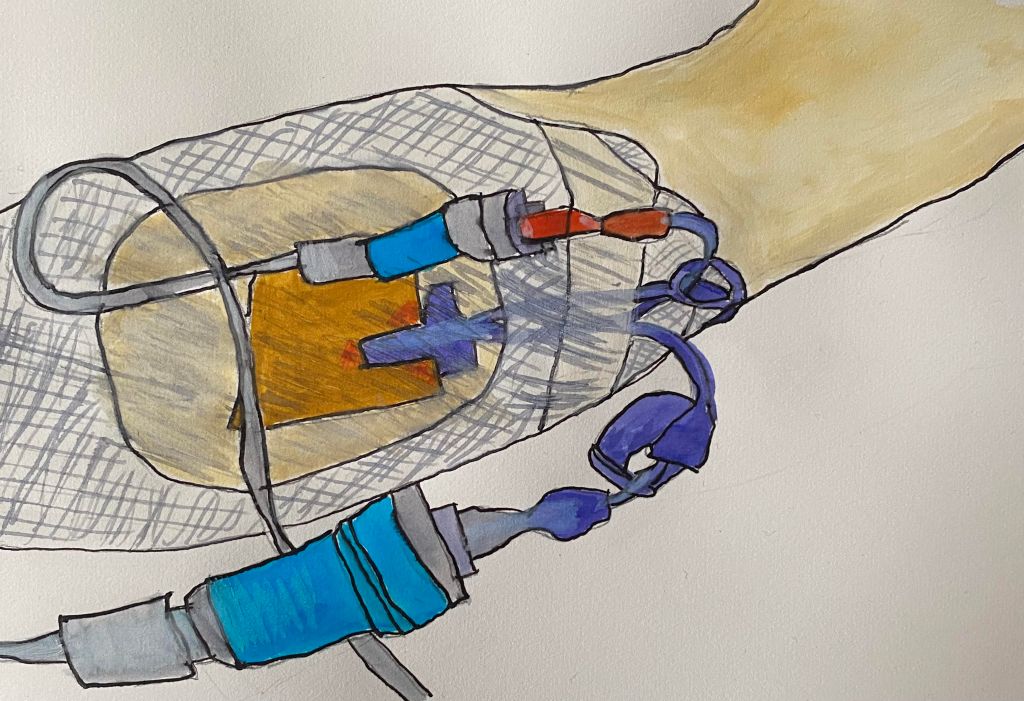
Alt Text: A small painting of mine in inks and watercolours of the part of an arm just above the elbow. There is a ‘Picc Line’ inserted into the skin and a large plaster (partly transparent so tiny amounts of bleeding can be seen) is holding the cannula in place. Various tubes trail from the cannula.

“Look, I know we’ve discussed some pretty mind-bending things here but when you read about me on paper, it’s always worse than what actually happens in reality. I bet you that I come round ok, I don’t need a ventilator & it’ll all go completely fine.” 

This is how I ended my video call with the Consultant Anaesthetist, my Breast Cancer Nurse & the Access Officer at Charing Cross Hospital. It was my usual upbeat tone, trying to make it ok for everyone else as well as remaining positive for myself. We’d had a tough hour together. At the start of July 2020, the surgeon said it was safe enough to bring me into hospital for my lumpectomy, so the Consultant Anaesthetist was discussing how she was going to make the surgery as safe as possible. Placing a patient who has conditions like mine under general anaesthetic is a tricky business. On advice from my consultant at the Royal Brompton Hospital, a ventilator was prepared, & I had a bed waiting in ICU (Intensive Care Unit) for me as part of the after care.

During the video call, the Consultant Anaesthetist explained that for every 30 minutes to an hour that she was to keep me sedated, it would take a year off my life, so we were all keen to keep the surgery to the standard an hour & a half for a lumpectomy. We also had to have more serious conversations about what could happen to me during surgery too, so I put my affairs in order.

I did fine during the operation; I came round in recovery about 6-6.30pm (the last time on the clock that I remembered was 3pm) & I didn’t need a ventilator. I came home the next evening (most patients return home in the same day or the next). We’d planned for a 3-week stay in total; 2-3 days or perhaps longer in ICU, & a couple of weeks on the general ward afterwards.

When we returned home that evening, my boyfriend & I dragged my luggage back into the flat, shut the door, & then I burst into tears of relief. Understandably I’d had some very dark thoughts about the whole ‘going under’ business. Some people say that the moment you drift off to sleep only to wake up high is the best part of any surgery. It isn’t for me. I’m always scared that I won’t come round again.

But you know what, I did come round, & I didn’t need a ventilator. And everyone was surprised & delighted that the procedure was relatively straightforward & that I was able to return home so quickly. When I expressed on the video call that I might not need a ventilator, I was ‘hedging my bets,’ so no one was more surprised at the outcome than me!

But in between the surgery & returning home, I had to spend a night in ICU. To say it overwhelmed me, is an understatement.

When I arrived in ICU it was 8pm. I only know that because my bed was located opposite the clock & the clockface gave me something to focus my attention on whilst I was drifting in & out of consciousness. I have no idea what happened in the time that I left recovery & arrived in ICU. I’d never seen so many nursing staff on one ward, but that could have been because the day shift staff were handing over to the night shift staff. Plus, I didn’t realise that a lot of ICU care is ‘one-to-one.’ It was incredibly noisy & busy. I could sense tension between the two nurses handing over to the nurse assigned to me for the night. I remember asking quietly if they could not please argue with each other around my bed as it was making me nervous & tearful. I think that’s when the nurses realised that I was more alert than I appeared & they all apologised. I was kind of mentally alert but physically weak. This state of being always scares me because I can’t make a quick get-away. In ICU, an escape was even more unlikely with the Picc Line & other medical paraphernalia that I was hooked up to. Being honest, I was nervous because I couldn’t control the circumstances that I was in. I use the term ‘alert’ very loosely because there were periods of brain fogginess, caused by medication & sheer exhaustion. In these circumstances, I become very afraid of losing the ability to self-advocate. In ICU, all I had was a very weak voice.

All my disabled friends have the same fear about losing the power to self-advocate in hospital. This fear is now acute since the pandemic & the DNR (‘Do Not Resuscitate’) orders came about.

I wasn’t prepared for the sights & sounds of ICU. Throughout the night, the ward became calmer & less full of patients. I’m not sure why & I’m not going to speculate on this. Sounds become even more intense at night when you’re trying to get to sleep. I’m also at my most anxious in the wee small hours. I was awake for most of the night; I think I managed about an hour between 6 & 7.30am; I was exhausted, but I was on ‘hyper-alert.’ 

At about 4 or 5am, my nurse appeared with a blood-thinning injection. I freaked & blurted out that I had a needle phobia. She proceeded to say that it was only a small needle & showed it to me. Trust me, that’s not the thing to do when someone has a needle phobia! I explained that I wasn’t prepared for another needle & that on the operating table, the majority of the needles had been put in whilst I was asleep because of my phobia. My nurse felt really bad when I started panicking & in turn, I felt sorry for her because she went to get the consultant & asked him to administer the injection instead! He had to talk both me & her around – me into having the injection & her into giving it to me. He stayed by my side & distracted me whilst the needle went in.

The consultant then said that he’d noticed that I hadn’t slept – was it too noisy, were the lights to bright? Because my ability to process what entered my head before it came out of my mouth had disappeared due to heavy medication, I told him straight up that I was scared to sleep in case I stopped breathing, which was likely, because I was sleeping on my back. Over a year later I still cringe at myself for saying that. The consultant gently reminded me that that’s why I was here; that if I had an issue with my breathing, I was in exactly the right place for something to be done about it, so I could just may be try to sleep? He also said that my oxygen levels had remained very stable after the operation & that he didn’t foresee an issue with my breathing anyway. But I wasn’t to be persuaded, forever the control freak. Like I said earlier in the blog, I think I got an hour or so of sleep just before breakfast.

During my stay, I worked out from snippets of conversations drifting over closed curtains that the lady next to me had collapsed into a coma after a long-haul flight. She’d had no previous history of fainting or epilepsy before. Staff were communicating with desperately worried relatives, half-way across the globe. Her assigned nurse attended to her all night, adjusting various drips & machines, trying everything to elicit some sort of response. This nurse took only a short break in 12 hours. I heard her say to the manager that she wanted to try everything she could to get a response from her as well as preparing all the machines & drips for the day staff, so they didn’t have so much to do. I was humbled by her dedication & determination.

My assigned nurse was equally as kind. She helped me phone my boyfriend to let him know that I was ok – unfortunately, I wasn’t in a fit state until midnight to say a few words to him, but that late call was crucial. He only recently confessed that he knew I’d survive the early-stage cancer, but he was terrified that my lungs would give out & I wouldn’t make it through the operation. My nurse also chit-chatted to me on & off which helped distract me from what she knew I was hearing around me, & she helped me wash in the morning before she handed over to the day nurses.

The act of distraction was important. In the early hours of the morning, the patient next to me suddenly let out a long, primal scream which started in a low octave & finished in a high one. I’d never heard any human or animal scream like that in my life & it absolutely terrified me. And then she was silent once again. When I was moved to a general ward in the morning, she was the only patient left in ICU.

There was another guy over the far side from the ward who I assumed staff were trying to wake from a coma or help him come off a ventilator because they frequently played him music & were periodically calling his name, saying it was time to wake up.

The ward slowly emptied throughout the night. I think about those patients that I was with in ICU every day & wonder if they’re ok. I would really, really like to know if they’re ok. I’m just going to tell myself that they are ok, that they’re much better now & they’re having a great life. The memories of ICU float around in my head, especially at night. Occasionally I have nightmares about it. I think I probably have to live with this trauma my whole life.

All too soon morning came, & my surgeon appeared with a physio. He was delighted that I was awake & he said I looked remarkably well. He asked me to raise my right arm (which was affected by surgery because of the lymph node removal). I did that with ease so he said that I could go home later that day. The physio intervened to say that she needed to see me do some arm exercises at first & I did those with ease. The only task left was for me to practise transferring from bed to chair & vice versa. I did this a little later on the general ward and to the horror of the physio, I did the transfers without my brakes on (I rarely use my brakes!)  All the exercises hurt like hell but I was desperate to leave the hospital as soon as I could.

I had to move to a general ward for a few hours because no-one can be sent home straight from ICU. After tea & toast, & various tubes & lines being removed, I was on my way back to a general ward. Several ICU staff spoke with me & one expressed how nice it was to have a conversation with an ICU patient because it was so rare that anyone was awake. I asked if it ever played on their minds what happened to the patients once they had moved on from ICU. I confessed that it was playing on mine. They took what I said seriously & urged me to get support in processing what I’d heard during the night. They answered my question honestly; they said very occasionally they heard follow ups on their patients from other departments, but mostly they didn’t get to know outcomes, & they were trained to try & move on emotionally.

I’m trying with CBT (Cognitive Behavioural Therapy) techniques to move on from my night at the ICU too.

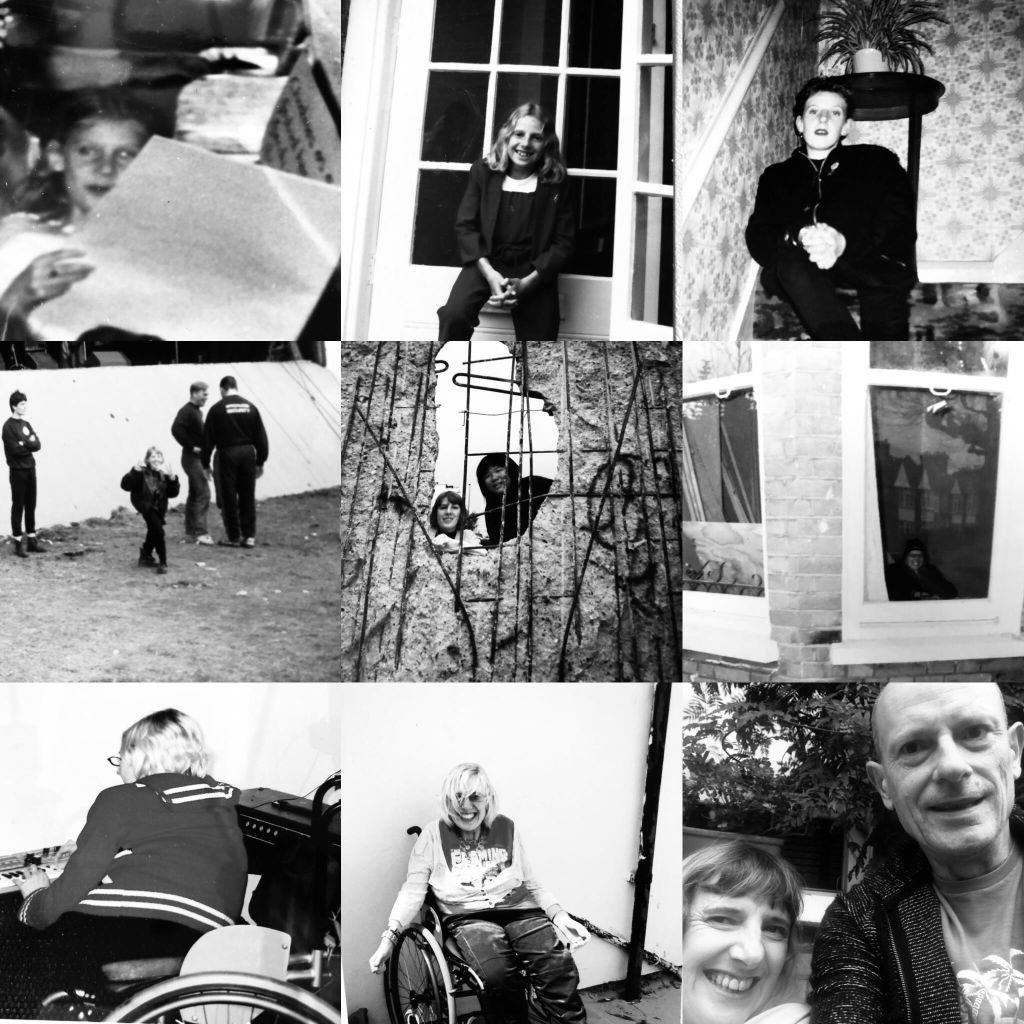
9 Photos, 9 Lives.

Alt text: 9 black and white photos that are thumbnail versions of the images that illustrate this blog

It’s been just over year since my Breast Cancer surgery, and I’m in a period of reflection. I’ve often joked that I have more than 9 lives. Then I had an idea. Why don’t I attempt to tell my story using 9 photos?

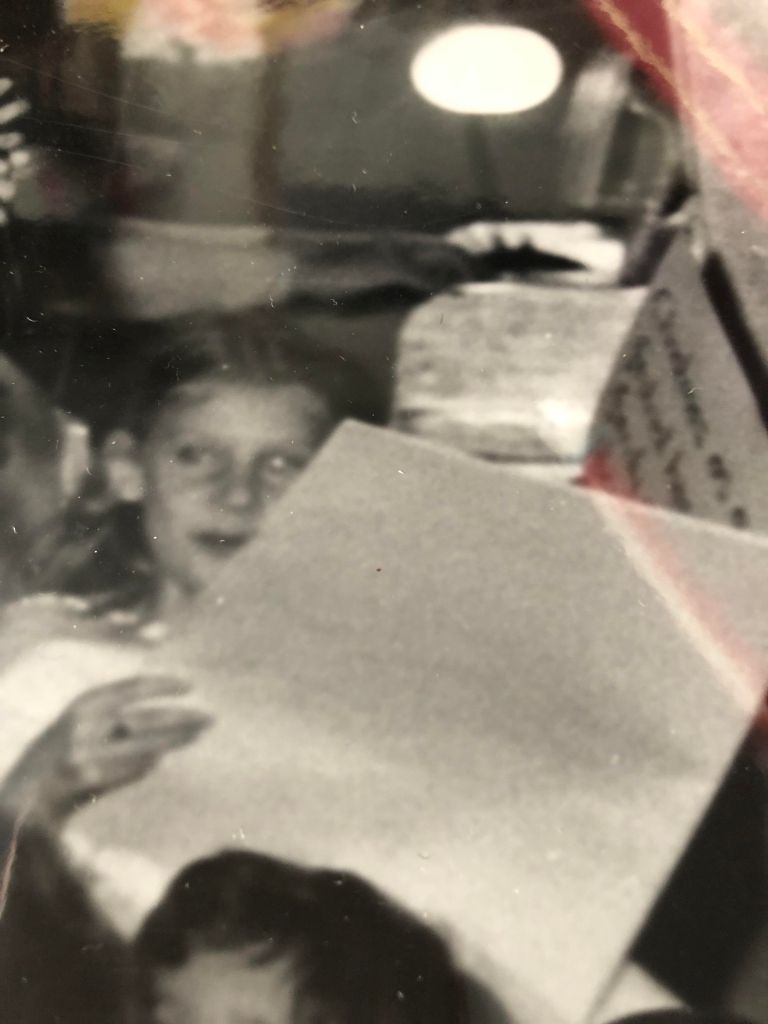
Alt Text: A grainy, out of focus, black and white photo of a little girl with her hair in bunches. She looks up from a large, white book which is open

Photo 1: Whilst this isn’t the greatest of shots, it gives a good indication of my future.

Here I’m narrating in one of the school plays. I was cast as ‘The Narrator’ many times over. Some of the ‘purists’ amongst the Disability Arts scene may scoff and say that I should have been given an acting part. Perhaps, but this was the 1970’s mainstream education’s approach to ‘integration’. “What do we do with the disabled kiddy? She’s good at reading. Great! Stick on her stage to tell the story. Bingo. We’ve found her a part that makes both her and us look great to ILEA (replaced by the Department of Education in later years).”

At 3, I was thrust into an experiment that gave disabled kids the opportunity to attend mainstream schools. There was no rulebook. Everyone involved – parents, kids, and teachers – got no support. We made it up as we went along. But the lack of guidance played to my advantage.

‘The Narrator’ held great responsibility. I had to hold my ‘shit’ together for the play; move the story forward, keep the action flowing. Once in position, I sat up on high to one side, the only character onstage for the entire duration of the play. All eyes fixed on me. I projected my voice, annunciating clearly, and everyone listened, gazing up at me.

Essex people love to chat. I love to chat. I love to hold court. I love to be interviewed.  I love to be asked to take the lead.  “Will you do the honours, Suzanne?”  “Me, oh go on then!”

And it all began in primary school.

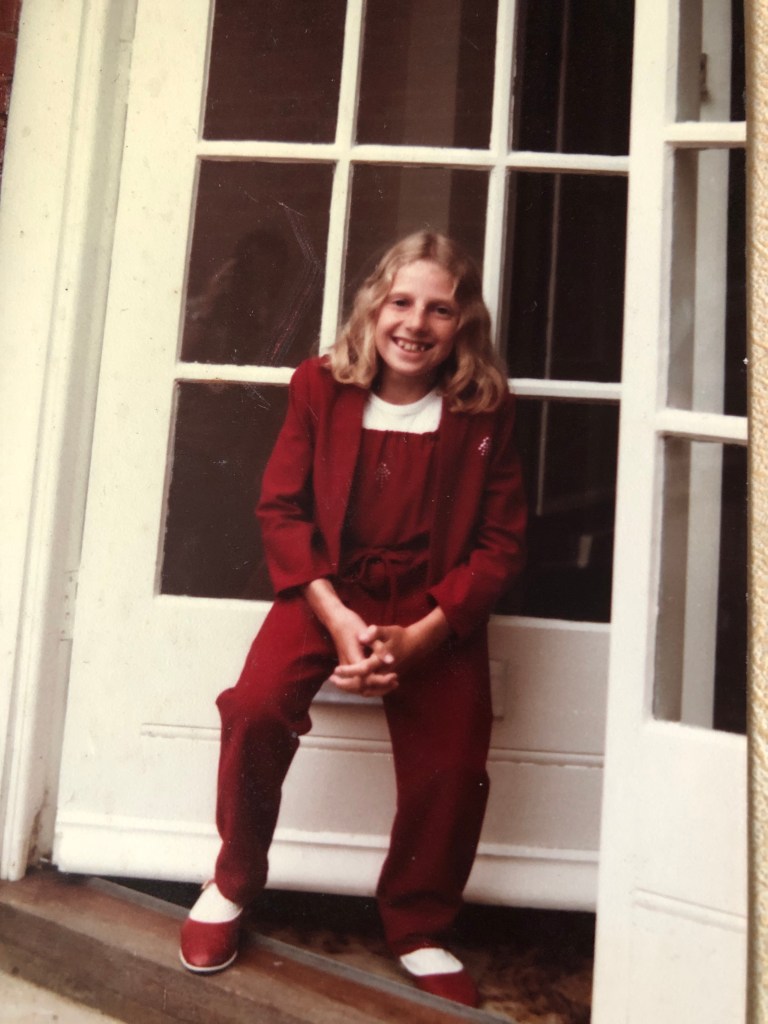
Alt text:  A girl wearing a red trouser suit and jacket, stands in an open doorway. She’s smiling.

Photo 2: It’s all about the outfits. This trait is from Mum. As kids, my sister and I were impeccably turned out. We had new outfits each Christmas, each birthday, each holiday. Mum understood all about the art of fashion and imagery, and how they could be manipulated to create different identities. Exploring my identity through clothes has been a constant in my life.

Here I’m on holiday in North Devon. I’m about 8 or 9 years old. This outfit is really special; Mum chose it for me to wear to my birthday party, but I needed to have several fittings at the shop to get it right. The shop staff were really kind, friendly and supportive which was good as I was a bit hesitant about trying on clothes in fitting rooms.

I’m so happy that I found a photo of me wearing this. It was my first bespoke garment and I felt very grown up wearing it.


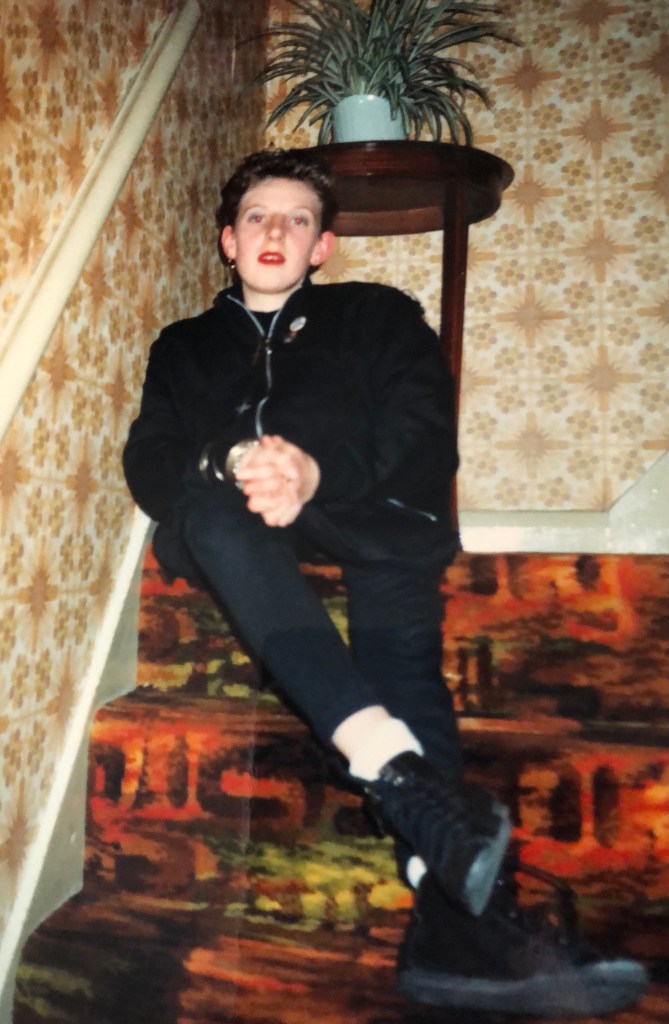
Alt text: A teenage girl with short, spiky hair sits at the top of the stairs in a house. She is looking sternly into the camera.

Photo 3: Wooaaah! THIS is a photo! I’m 16 years old, and I’m in my best friend’s house. He took the photo. He had just spiked up my hair.

I’m now a dedicated goth. Out goes the long blond hair and brightly coloured clothes. In comes misery with a matching existentialist wardrobe.

This photo was taken just before we took the train from Essex to Wembley Arena, London, to see what is still my (and his) favourite band – The Cure. I wore the same shade of red lipstick, blue eyeshadow and black eyeliner as Robert Smith.  I no longer wore my orthopaedic shoes, because they were ugly as shit, and I was ashamed to be seen in them. (In fact, my friends and I used to throw them around the playground and smash them against brick walls so that they became too broken to wear).

London was having an increasing impact on my life. At least twice a month, I was jumping on the train and heading to Hanley Street where all the independent record shops were, losing myself amongst the racks of vinyl.

It wasn’t the only place that I became lost in. I’d discovered booze a couple of years back. With I.D. for pubs and events not being invented yet (hurrah!), I’d worked out that it was easy for me to buy pints and spirits at the bar. I’d nonchalantly wander up and order. Then the bar person would become flustered, but decide that it would be rude to ask how old I was because I was disabled, and so he’d just reply “Coming up Madam.” “Smashing” I’d say.

It was all too easy. In years to come I’d pay a heavy price with alcohol. Some of you will remember the wild nights, the antics, the bad behaviour, the ‘crying wolf,’ the tear-stained traumas, well good for you if you do, because I don’t want to and they’re not for this blog. I’ve largely stopped drinking alcohol for my own sanity. Apparently, they don’t mix well with chronic pain relief or cancer medication which is great for me. I even did the whole ‘going teetotal’ thing for 3 years. I’m long past needing to be the drunkest person at the party.

Back to the time in the photo. This was my first Cure gig, and it kicked off a life-long love affair. I was, and I still am, completely obsessed with their music and with Robert Smith. Because of The Cure, I fell in love with France and French people (The Cure were way more famous in France before the UK. When I first went to France at 14 on an exchange trip, The Cure were huge like a boy band). I went on to visit Paris several more times before opting to study French and German at Goldsmiths’ College, London. Camus was my chosen special subject. I lived in Toulouse for 6 months.

People say never meet your heroes – that’s a pile of crap. I’ve met Robert Smith twice and he’s a funny, calm, gentle, down-to-earth, soul. The Cure are the best band live. You get a real intense show and if you go to several nights of a tour, the set will be completely different because The Cure have the largest back catalogue known.

A few months after this photo was taken, I experienced the most traumatic event of my life; Mum died. In a community where I’d once felt safe, everything and everyone around me now felt totally alien. Over one summer, life sucked me up, battered me around and spat me back out just in time for 6th Form. Two years later, I left for sunny New Cross, London.


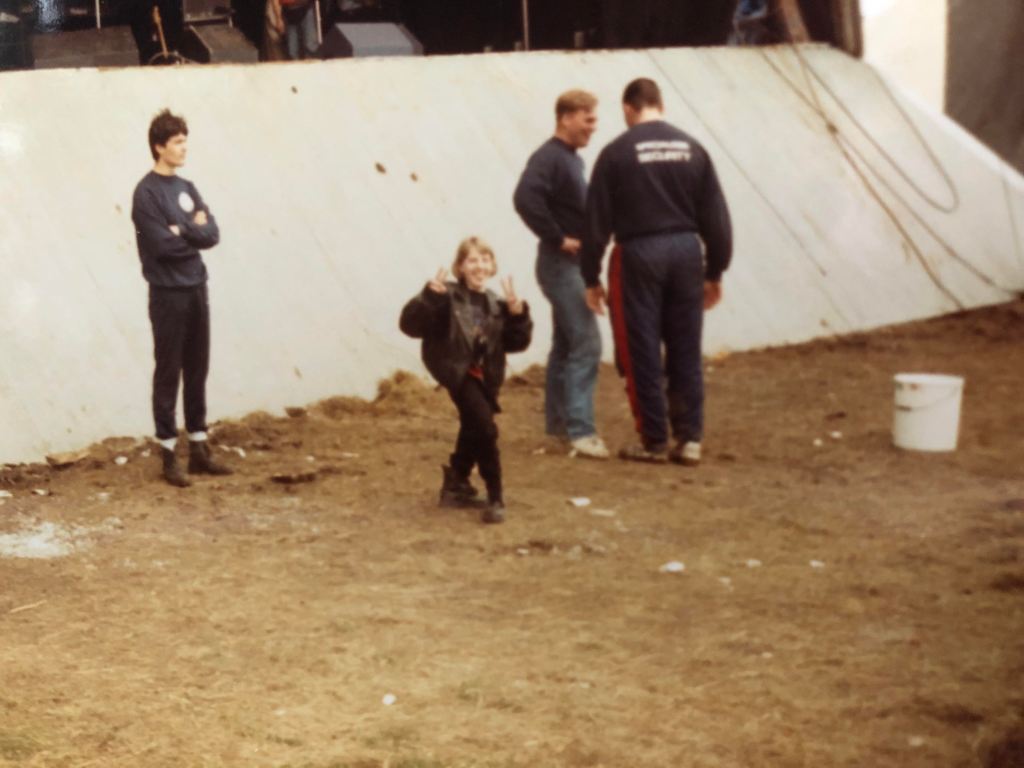
Alt text: A woman in her late teens stands in the pit in front of a large stage at a festival. She’s smiling and making peace signs with her hands. It’s really muddy. There are 3 security men talking, or looking on, close by.

Photo 4: I’m 19 here. I was standing in the pit of the Pyramid stage, Glastonbury Festival. This was the first time that I was pulled out of the crowd as my little legs were killing me. Later on, I managed to get back to the front again during De La Soul’s set because security assumed that I was a kid (I’m 4’3, I stopped growing when I was about 11!) and they were helping all the kids get a better view!

Of course, I was meant to leave the pit immediately after the first time that I was pulled out, but instead I went wandering around backstage on a ‘mission.’  The ‘mission’ was trying to find Robert Smith as The Cure were headlining that night. I had hoped that he was going to take pity on me and let me watch his set from stage-side. 

I wouldn’t have been in this situation had it not been for a lack of viewing platforms for disabled people. During The Cure’s set, I had to get rescued from the front again, but this time it was far more serious. The festival’s management had vastly underestimated how big the crowd would be and there were several big surges. Because I was so small, I was being flung against the security barrier and I got my neck trapped on the top of it. Luckily, the guy standing next to me just happened to look down at the moment of impact. He grabbed me and passed me over the barrier to the security who by now, had a steady stream of fans coming over the barriers.

This incident is the stuff of folklore at ‘Attitude is Everything,’ the charity which I founded in 2000 to make music and live events accessible by connecting disabled people and the industries together. As I was gasping for air that night, I thought that there must be a better way for disabled people to access live music and I set about creating a plan to make this happen.

Now the access is much better at live events, and crowd safety measures have really improved. And to top it all, Glastonbury was the first large camping festival to get ‘Attitude is Everything’s’ Gold Standard Charter of Best Practice Award. Hurrah!

This photo is the spark that lit ‘Attitude is Everything’s’ flame all those years ago.


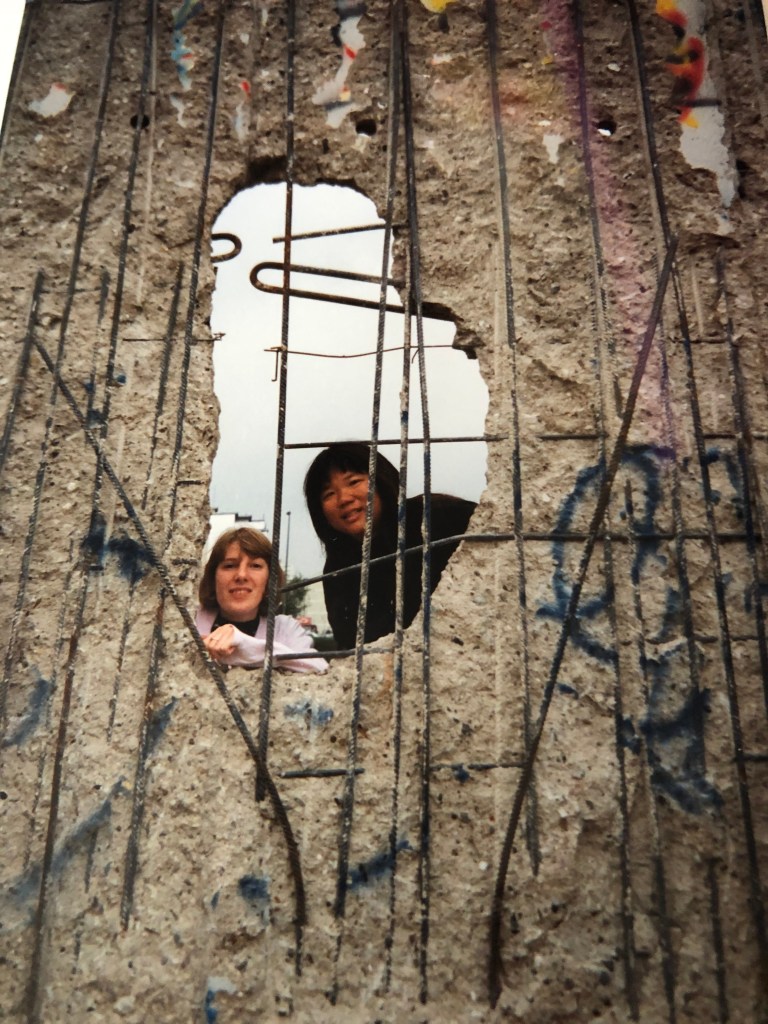
Alt text: 2 women are looking through a whole in a large wall.  The metal structures that previously held it up, are exposed.  The wall is graffited.

Photo 5: This is the Berlin Wall, or rather, was. This photo was taken a few months after the wall came down and the reunification of Germany was underway. I’d travelled there with hammers and a chisel in my luggage (yes, honestly! That would never be allowed now!) with the purpose of helping to chip away the wall. The woman standing with me (pictured) helped me knock off a small piece of the wall. Now it takes pride of place in my kitchen. 

I spent the afternoon with this lady. I think she said she was Canadian. I met her at the wall. She was standing quietly, in deep reflection. She stood out from the others there, who were largely loud, brash Americans, filming themselves making hideous, inappropriate speeeches as if they’d negotiated the Reunification themselves. 

Berlin was so amazing during this period. It was buzzing with a new identity, fresh ideas, new-found freedom; the energy was breath-taking.

Stupidly, I gave in to Goldsmiths’ (I studied here from 1989 to 1993 – hello Blur, Placebo, The Kills and Damien Hirst!) insistence that it was far better for me to stay at campus-based universities and I ended up in Marburg. The ‘Powers That Be’ at the college decided that I needed a ‘careful eye’ to be kept on me, what with my ‘additional needs’. Such a load of bollocks because I did what I liked anyway. I ended up having the best and wildest year of my life from 1991 to 1992.

Marburg is a university town not far from Frankfurt (thank god for ‘Langer Samstag’ where each month, I had a whole Saturday to escape to a city). Marburg was very pretty and I made lots of great friends, and we partied like mad. But outside of all this, it was just dull. 

I’d been spoilt the 6 months previously because I’d been living in Toulouse. OMG I can’t even EXPLAIN how amazing this beautiful city was with its bars, churches, medieval walls, indie club ‘Subway’ and just so many music-loving people. I really let rip in this town. I didn’t even have to be in lectures at ‘Mirail’ that much, so I spent my days walking the length of La Garonne (I lived in an HLM that overlooked this magnificant river) into town and trying out my French on every pretty boy that I came across. 

I was in a flat share with a wonderful lady called Simone. She cracked me up. She worked in the English department of the university but literally didn’t speak a word of English. She promised me that after trying many times, all she could manage was ‘hello’. I adored her. She was about the same age as Mum. Realising that I was a bit of a lost soul, she took me under her wing, providing a gentle steer when needed. She was deeply socialist, political, well-read and a good judge of character. She introduced me to all her wonderful friends and we’d stay up late into the wee hours, drinking – and they’d be correcting my French, of course.

When I got the call from my tutor to say that it was time for me to switch to Germany, I cried the whole day. I was heartbroken at leaving Simone, my surrogate mum. I’ve never had as strong a friendship with another older woman since. I didn’t expect to, I actually didn’t want to. Simone is one of those magical friends in my life who knows what to say and do when I struggle. We’re still in touch now – she’s in her late 70’s.


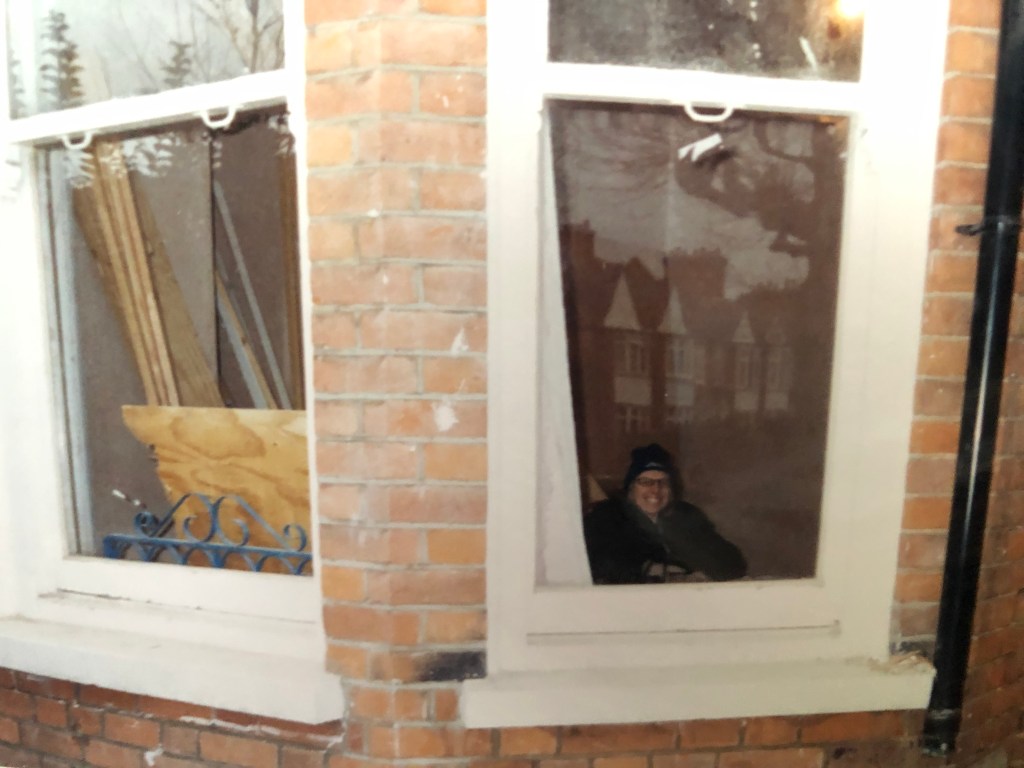
Alt text: A young woman wearing a woolley hat and glasses, looks out of the bay window of a red-brick Victorian house. The debris inside the house shows that it’s still being renovated. The young woman is grinning.

Photo 6: Fast-forward to 2002 and I’ve managed to hold down 3 ‘proper’ jobs, one of which later turns into a 21-year career at ‘Attitude is Everything’. I’m freelancing, playwriting, flirting with a bit of acting, protesting against disability discrimination, becoming a huge supporter of disabled artists, I’ve got it all going on.

In this photo I’m looking out of the window of my new flat in North Kensington. I’d become a full-time wheelchair user. After living in sub-standard London housing for many years, I’d earnt enough points to get to the top of the housing list. My reward – a one-bedroomed, accessible, garden flat in Kensington and Chelsea. Ma, I’m going up West!

I’d done my penance in housing. After leaving Goldsmiths’, I moved into a single room in Deptford Housing Co-Op. I couldn’t return to Essex. The rent was £25 per week and the social paid £23 of it. But I literally got what I paid for. The house was meant to be for 5 single people and there were 20 people in ours, including 5 members of one family who shared just a tiny room. It was an appalling way to treat people in need. I’m talking early 90’s when I lived in Deptford but Social Housing still desperately under-invested.

My first job took me to the Portobello area. Seeing my dreadful living conditions, one of my new colleagues offered me a room in her flat in Shepherds Bush for £30 a week, so I took it. Unfortunately, after a few months and a serious infection after an operation on my foot which exacerbated the problem that it was supposed to solve, it was clear that I needed wheelchair accommodation. The housing department took on my case. Well, actually they didn’t, they tried to get me to move back to Essex. However, I’d been undertaking my own research and writing directly to Housing Associations, and I’d found a place in Earl’s Court – a bed-sit in an old people’s home. Yep – and old people’s homes are still the only places that you’re likely to find accessible housing in the UK. Luckily one floor of this sheltered housing was allocated to “Young People”. The fun times could continue.

The flats had a really crap stair-lift on the front of the building, and it broke down all the time. As I was using a wheelchair more and more, I had to rely on this piece of shit. Frequently I was stuck in the building and having to call my boss about how I couldn’t come to work yet again (thank god I worked for a Disability Arts organisation who understood my predicament), or stuck outside the building, which wasn’t great because the only option was to call the Fire Brigade to get a ‘carry-in’, or rely on all the unsavoury characters that lurked about after hours to help me up the stairs. (I shouldn’t be so ungratefui to these characters, they helped me so many times).

As ‘per,’ us “Young People” partied for our lives because if we stayed in our bed-sits for too long, the walls crashed in on us and we’d have gone insane. I was content spending most of my time with my mates in the pub until my access needs became greater, as it eventually it did with all my disabled neighbours. Aging is often a faster proccess when you have impairments. All of us were slowly being allocated housing that would better meet our needs. I was the last one to be re-housed and as no more “Young People” had been moved in to replace us, I was increasingly isolated, crawling the walls of the bed-sit.

After 7 years of “Bed-Sit Land” (Marc Almond used to live a few streets away from me in Earl’s Court, and he’d certainly got the measure of bed-sits), I was offered my first proper London home. When I first viewed it in October 2001, it was pouring with rain. The house didn’t have any stud walls or ceilings, so I could see right up into the roof. The garden was filled with rubble and mud. But I got calming vibes from this place. It felt extraordinarily comforting. My Social Worker, my Housing Officer, my O.T. and the Council’s O.T. all had accompanied me for this momentous occasion. After checking that I could manage the steep ramp alone and I could move with ease inside, they offered it to me there and then. I bawled my eyes out because I was so happy and the assembled builders clapped. Picture ‘D.I.Y. S.O.S’.

Great housing changes a disabled person’s life. For the first time since I was 16 years old, I had security and independence. I could cook a meal without burning myself, I could sit down to have a shower, I could come and leave the flat as I pleased because it was all on one level, I could sunbathe in my own garden. And I could invite ALL of my friends over.


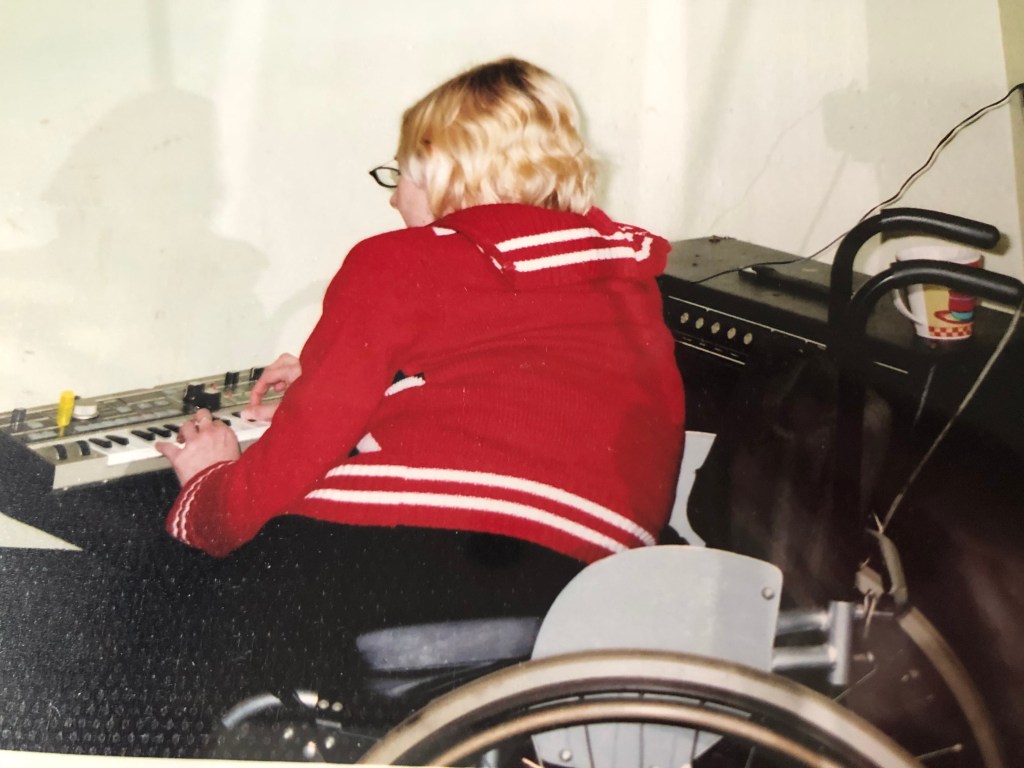
Alt text: A woman sitting in a wheelchair has her back to the camera and she is leaning over an electronic keyboard to play. She is in a rehearsal studio.

Photo 7: Ah, one of many bands. I think this photo was taken in Bush Studios and I’d be in my early 30’s. I was playing in a band called “They Walk Among Us” (I know it should be ‘amongst us’ but we didn’t want to get sued by the shop which bore a similar name – the shop was located in Kingston or Staines; I don’t quite recall). I was in a ‘sort of’ inter-band, ‘on-off,’ ‘is it or isn’t it a relationship’ ‘thing,’ and as we all know, this never goes well in bands, so I left without playing any gigs with them. Then I joined an all-female punk band which couldn’t have been any more diverse in age, background and disability. It was brilliant and I definitely thought that I had found my band soulmates with my quirky Korg complete with Vocoder, and lyrics. Except I had to leave again because the drummer criticised my lyrics.

With me, it’s always been about the lyrics. Fair enough, you don’t like my playing, you might get annoyed with me if I get knackered at rehearsal, I can take it, but if you say one bad word about my lyrics, that’s me out. I don’t let anyone touch my lyrics. NOT ONE WORD can be changed.

But at the same time as playing with the punk band, I was in another band, ‘Besta Vista Social Club.’ It couldn’t have been any more different. We played Cuban, Latino, Reggae, traditional songs from Africa, Salsa and “Who Let the Dogs Out”. You might arrive at rehearsal in a bad mood but you left feeling a million dollars, such was the beauty of the music and the strengths of the relationships in ‘Besta Vista’. The band was made up of mostly disabled people and led by Neville Murray (‘Jah Wobble and the Invaders of the Lost Heart,’ ‘Klub Mundi’), a great disabled musician and mentor – another wonderful friend who gently guided me back when I went off the rails. I played in this band for 6 years. At its height, we had 30 members. Because the Congas were too big for me, Neville taught me how to play all the small percussion instruments; the Klaves, A-Gogo, Tambourine, etc. 5,000 people came to see us in Trafalgar Square for ‘Liberty Festival’. I played it like I was on the Pyramid stage.

Neville sadly passed a couple of months ago. I’ll miss him forever. To remember him, a few of us came to together to play a few of the old tunes in my back garden this summer. We hadn’t played for 14 years but once we started playing the old tunes, it was like we’d never been away from one another. The spirit of Neville was there, saying “no, you’re behind the beat” or “thank you” if he was satisfied that you had mastered your part.


Alt text: A woman in her mid-30’s sits in her wheelchair with her arms outstretched by her sides. She’s laughing. She’s pressed against a white wall. She is fully clothed, but she’s covered from head to toe in sand.

Photo 8: I’ve been to hundreds of festivals.  Reading is my favourite because it was my first. But there’s something really special about going to a festival on a holiday campsite and staying in little chalets by the seaside. It seemed so quintessentially British, but OH so very debauched when the party arrived. Labels would host their own parties from their chalets. I’ve lost count of how many times I went to ‘All Tomorrow’s Parties’ Festival but at one stage they upgraded from Pontins, Camber Sands, to Butlins, Minehead. Just one very surreal night was watching Iggy Pop stage-dive into the crowd, in a large ballroom with swirly carpet (now soaked and sticky with beer), complete with a huge silver disco ball spinning above. And then The Melvins came on afterwards at 3 in the morning with the redcoats doing the Conga (I may have made that last bit up 😉)

It was so much more than the music at ‘’All Tomorrow’s Parties,’ it was the books, the bespoke merchandise, the artists milling about and easily accessible to the fans, the curators such as Vincent Gallo and Sean Lennon. I watched Yoko Ono, PJ Harvey, and discovered ‘Bat for Lashes’ there.

This photo was taken at the Camber Sands venue by my then PA, Katherine, outside our chalet. We’d taken a break from the music to walk on the beach. Camber Sands is known to be windy, but this day was exceptional – we got sand-blasted at 90 mph! When we returned to the chalet, we’d brought the entire contents of the beach with us. I had sand everywhere, hence my laughter.

Good times, no GREAT times.


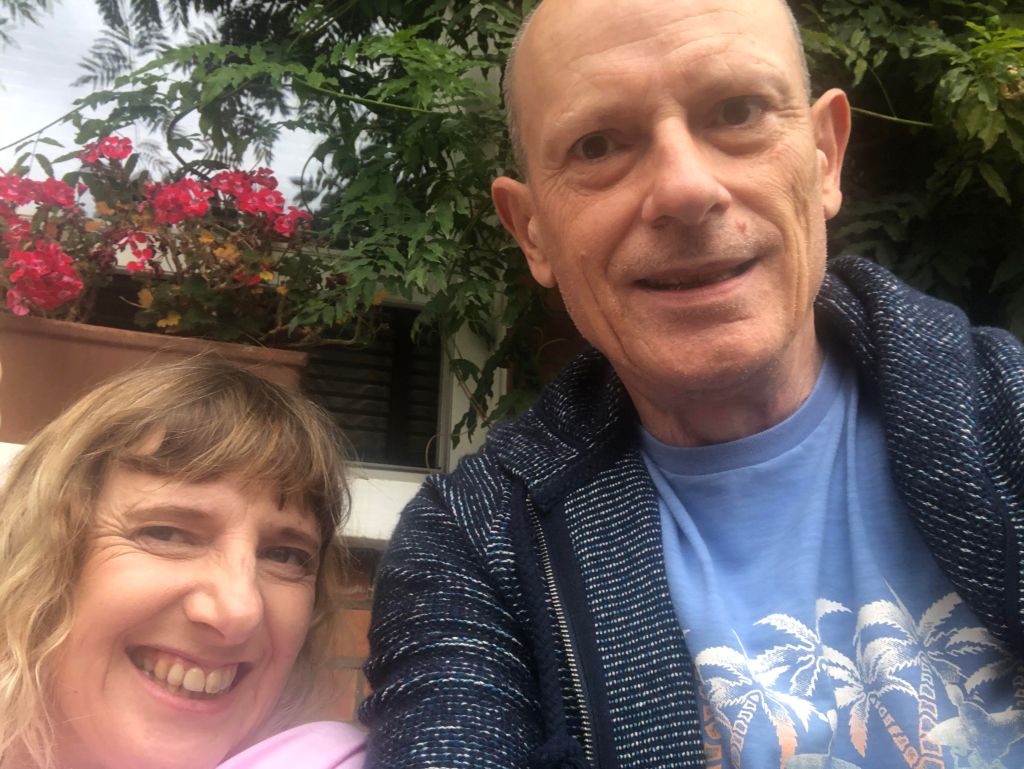
Alt text: A man and a woman are sitting together outside. This is a selfie. They are both smiling.

Photo 9: With my gentle, sweet-hearted French ‘copain’ Stephane (oh, those pretty French boys!) We’re seated on a bench in our front garden. We’re smiling because we’re celebrating the end of my Radiotherapy. I’ve insisted that we drink champagne in the pouring rain, whilst listening to my favourite tunes from over the decades.

Within our smiles, there’s relief. We’ve both survived my life-saving operation that was delayed for 4 months and my 5 days of partial therapy. By February 2021, we would find out via a mammogram that I was cancer-free, but that we’d be facing me having 10 years further treatment.

“I never realised how much I wanted to live until I thought I was going to die,” Tracey Emin.

Beam me up

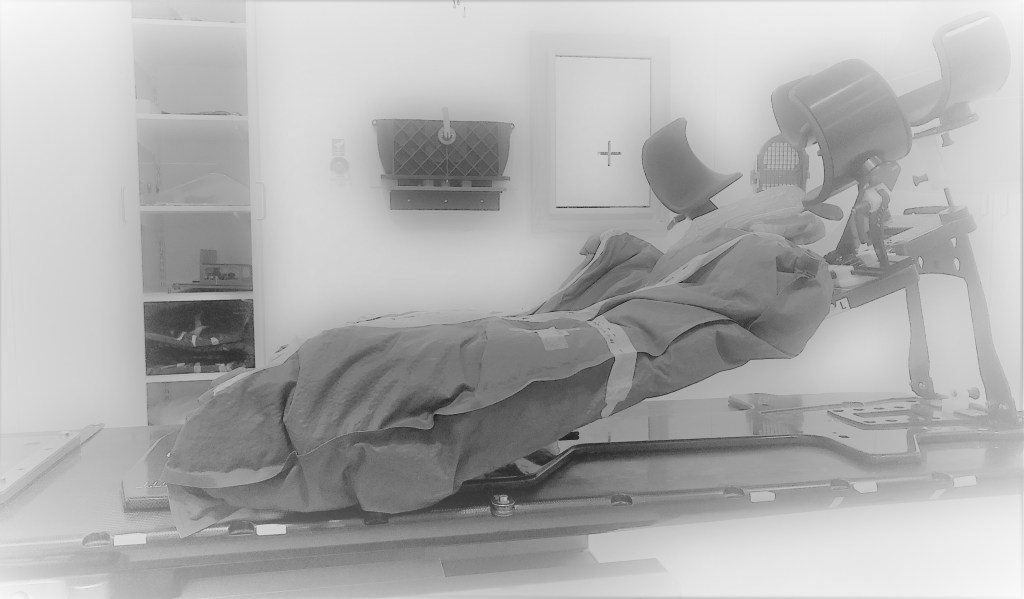
Alt text: An edited black & white image of a hospital room containing radiotherapy equipment – the table, arm cuffs & a special piece of equipment – similar to a weatherproof sailing bag, moulded to my shape – which held me in position for the treatment. 

Beam me up:

6 weeks after having breast cancer surgery (a lumpectomy), I received 5 days of partial radiotherapy.  Apparently, the success rate of this treatment is quite high & its use is on the increase.  I was glad to have this option because, 9 months later, there is no evidence that this treatment has adversely affected my lungs.

The most difficult aspect of the radiotherapy for me was coping with the equipment.  Before embarking upon the treatment, the breast cancer team did a couple of checks – one was whether I could raise both arms easily (I could) & the other was whether I could get on & off the treatment table independently.  This was slightly trickier, but because I use my right leg to do quick standing transfers in & out of my wheelchair, I managed it in quick time (it surprises people when wheelchair users can stand & do a quick transfer.  I know not every wheelchair user can do this, but I’m always amused by people’s reactions at my speedy manoeuvres in & out of my chair).

However, when I went for my preparation & assessment day, I discovered that the radiotherapy table is far higher that the consultation table & it doesn’t really move up & down.  For scale, I’m a little over 1m tall so the table was the same level as my head!  When I first saw the table, I exclaimed: “Blimey, I wasn’t expecting it to be this high, I’m not sure I’m going to manage this!”  The whole set-up looked really foreboding.  The equipment honestly looked like it belonged in some kind of sex dungeon.  For the radiation beams to be aimed, you need to be topless, so once I’d placed my arms above my head into the cuffs, I felt really exposed, submissive & vulnerable.  (I bet a man designed this equipment – no woman would ever design something that leaves patients in an undignified position!)  One of the nurses expressed that the equipment should be painted pink so that it would be more appealing.  I replied with “yeah, may-be” but apart from the gender-stereotyping issue, I’m not sure any colour would improve its “torture chamber” look. 

A large step was brought into the room, so I clambered onto that & after 3 failed attempts, I managed to heave myself up on the table, supported by my Personal Assistant & two team members.  So bloody painful 6 weeks after surgery to my breast & armpit!

The next hurdle was making sure that I didn’t slip down & off the table.  This really wasn’t easy.  The surface of it is metal & the table itself is actually very narrow.  Not only was I sliding down it, but I was also sliding off it because of my wonky balance!  To stop patients sliding, there is a metal bar drilled into the table (you can just see it to the left-hand side of the image), but my legs are different lengths & my left foot is paralysed so I have no grip.  I tried to grip the sides of the table, but then the radiotherapy team told me that I had to raise my arms & fix them into cuffs, so that they could administer the treatment to my chest & ribs. Because of the nature of the treatment, there is little room for adjustment to the equipment.  

We all had to improvise on the spot of how to get around this issue.  I had to get off the table again which involved pivoting & slowly lowering myself down onto the step (my poor arm!)  Then one of the team said that with some patients, they use what I can only describe as a “suction bag” – you’re settled into the bag on the table & placed in position for the treatment.  Then all the air is suctioned out of the bag which moulds it to your shape & enables you to stay in position.  You can see the bag & how it’s mould to my shape in the image – it’s similar to a weatherproof sailing bag.  It really is such a clever device & without it, I couldn’t have gone ahead with the treatment.  The bag was marked up with my name & each time I had treatment, my bag was placed in position & I clambered into it, settling in for the ride.

Once I’d mastered staying on the table, I had to have 3 dots tattooed onto my body – these are like ‘place-markers’ where the radiation beams are directed towards.  I had one towards the bottom of my sternum, & one each side on each side of my ribs.  They are permanent.  One of my friends said that each time she sees them in the mirror, it reminds her of how grateful she is to be alive. I wholeheartedly agree with her. 

Getting the right sites for the tattoos involves precision measuring with rulers, photographs & the radiotherapy machine being placed in several different positions.  Co-ordinates were called out & numbers punched into the computer.  I felt like a ship about to set sail.

Of course, tattoos involve needles – not great with my needle phobia & the procedure did sting because my sternum & ribs protrude.  I cried when the needles went in because I’m petrified each time I’m jabbed.

The radiotherapy team had been warned in advance about my phobia, so I had one nurse tattooing me and two others looking after me.  They put the radio on to distract me & the team sang a bit to the songs which was really sweet.  Then we started a conversation about when you mishear lyrics & sing the wrong ones out loud, but unfortunately some of the examples that the nurses started to give (“I thought Prince was singing When Doves Die!”) made me laugh which wasn’t great for the person tattooing because she needed me to be still!  However, all of this did set me up well with the team as I knew they’d be a laugh in the most daunting of situations.  They reminded me to make a playlist to listen to during the procedures.  Suddenly I felt a whole lot better about what lay ahead.  

The radiotherapy treatment began a couple of days later.  This time, a little set of steps with a handrail was put in place so I could get onto the table.  It reminded me of the physio sessions at Great Ormond Street & Tadworth Hospitals – as a little kid I was obsessed with scrambling up & down the steps, so much so I’d run back to the steps when the physio put me on other equipment! 

Two days into the treatment, one of the nurses piped up that they had a wheelchair hoist in the department.  I laughed & said: “Well it’s too late now, I’ve taught myself how to jump on & off the table!”  If I have one small wee criticism, it’s that they should have known about this hoist & offered it to me at the assessment.  I did ask if there was one & told that there wasn’t one.

I clambered carefully up the steps & launched myself into the suction bag – by now, this wasn’t so comfortable, because it had set rock solid.  I dutifully raised my arms into position.  I hadn’t brought the right equipment to play my playlists (typically I couldn’t figure out how to connect to the hospital’s equipment because I’m a technophobe!), so some 80’s pop was playing which makes me anxious at the best of times!

A friend of a friend advised me to visualise a sunflower opening as the radiation beams were being administered.  This lady had survived stage 4 cancer & was convinced that her visualisation had helped.  I tried the same visualisation & as my “sunflower” was opening, I felt that I could breathe again & that the cancer was flying out of me.  It was a wonderful sensation.

This experience is quite rare, but it can happen to patients; on the first & the last radiotherapy sessions, I felt the beams going in.  I put it down to my particular neuropathic sensitivities & pain receptors.  It felt like a burning sensation going into my ribs.  I wouldn’t say that it hurt & it lasted a few moments, just very peculiar.

By the 2nd session, I’d managed to figure out how to connect my Spotify list to the hospital’s Spotify.  The team allowed me to spend some time ‘being DJ’ to get it all right, so I had my bare boobs cupped in one hand & the other was setting the playlist up on their computer (oh dear, that really does sound dodgy!)  I heard laughter from the team & I realised that the title of the playlist had come up on their computer at the control station – “Radiotherapy Playlist – To be played whilst my Devil’s Dumplings are being lasered”.  I didn’t think the strapline would be seen, but the team loved it, explaining that their dark sense of humour was what kept them going in their profession.

Most of the radiotherapy session is taken up by the team positioning you on the table for the beams to be directed at the tattoo markers.  And once you’re in position, you must keep really still which is hard when you spasm.  Despite thinking that I’d chosen chilled music, I still had trouble keeping still when listening (listening to music has always been a ‘whole body’ experience for me).  Plus, I’d included Hefner’s “The Greedy Ugly People” which includes these lyrics:

“Love don’t stop no wars, don’t stop no cancer…”

I honestly forgot those lyrics were in that song.  Again, the radiotherapy team laughed.

The radiotherapy team were very respectful of my body & very mindful of the physical pain that I’m in due to my impairment.  They never forced me into positions that I couldn’t manage (sometimes this happens when I’m having x-rays & it angers me when radiotherapists pull you into painful positions to get their image, so I was touched at how much care this team took).  A couple of times I was able to get into position myself, but most of the time, I couldn’t due to the precision needed for the beams; in fact, it’s so precise that sometimes the team were moving the skin on my back & breasts by mere millimetres to get it right.  When they saw that the face masks were too big for me & the corners were poking me in the eyes, they’d move the mask down.  Only once did they have to interrupt the treatment to move me into a different position.  I was in awe of how it all worked.

Each time, I had 3 beams.  The machine moves around you & hoovers over each tattoo, & then there’s clicking noise & a beep when the laser beams into you.  It felt very ‘Star Trek’.  It took me a couple of sessions to get used to the movement of the machine.  I wasn’t fearful, it was just disconcerting.  But as soon as the beams stopped, the machine moved away, my music stopped, the room lights switched back on & the radiotherapists were helping me back off the table.  Bam.

I had 5 sessions that lasted 15-20 minutes each session.  At the end of the final session, my boyfriend came in & I gave him a big hug.  The team gave us some time for each other.  Before I left, I turned to face the table one more time, acknowledging just how physically hard that experience was for me.

Once I got outside, the team head had gathered as many of the department that he could & they gave me a huge clap.  They had respect for me because they knew how hard it was for me endure those sessions. And  I had respect for them for being so careful.

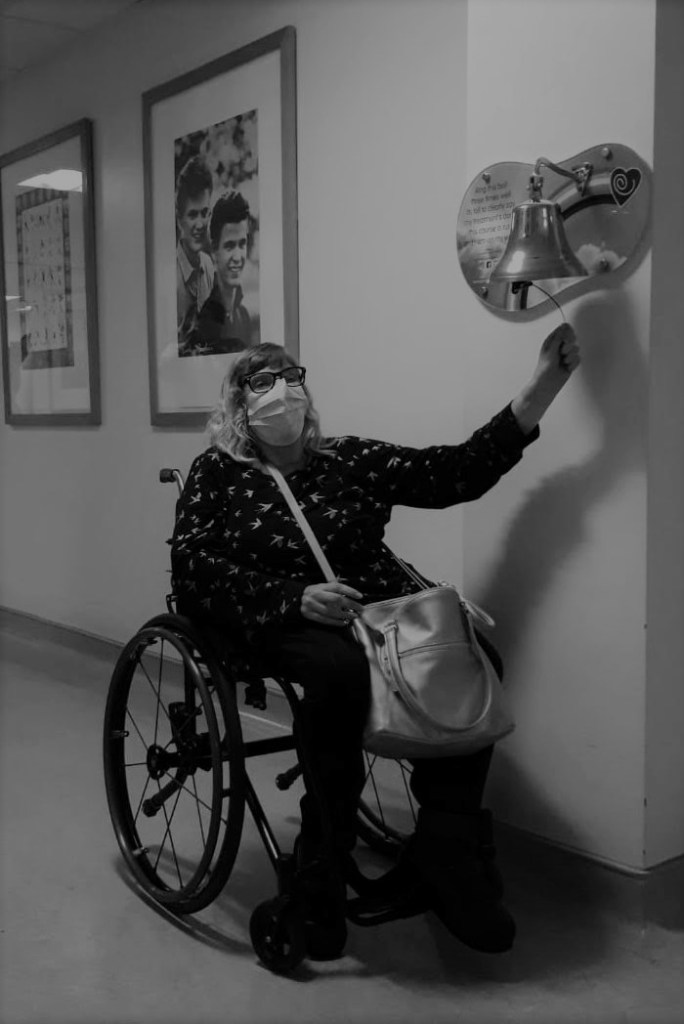
The team head led me towards the bell – many hospitals have this & the patient rings it when they’ve finished their treatment, or when they’re going onto their next stage.  There was a brief scramble for a sanitising wipe because I insisted on cleaning the rope beforehand (COVID-19 prevention!)

I rang the bell – with a little bit of assistance from a passing patient who had the strength to ring it louder than me.  Everyone cheered & clapped, including the patients in the waiting room.  I’d cheered a few times for other patients; now it was my turn to get the cheers.

*Thanks to the Radiotherapy Team for giving me permission to take the photographs included in this blog*

Alt text: An edited black & white photo of me in a hospital corridor, sitting in my wheelchair, wearing a mask & ringing a large bell.

Cancer Bends Your Mind

Alt Text: I’m a white woman with blond hair tied up in bunches, & blue eyes, but with no make-up, sitting in the back garden as it’s turning dusk.  I’m wearing a black sleeveless dress & I’m sitting underneath a large blue umbrella.  I’m smiling whilst taking a selfie head-shot.  I’ve positioned the camera so that a book appears on the white garden table behind me.  In the background are plants, a wooden greenhouse, other white garden furniture, & garden lights lit up & strung up against the brick walls. 

Cancer bends your mind.

It’s mind-bending having cancer.  I spend a lot of time pushing away intrusive and negative thoughts.  And this is doubly difficult because I already fret about aspects of my existing disability worsening through age.  Now I’m winding myself up about how the next set of treatments (letrozole & zoladex) will erode my bones even faster & what it could do to other major organs & my fragile circulatory system.  To me, living with a cancer diagnosis is as much a mental health struggle as a physical one.

Often, unwanted thoughts appear when I least expect it.  For instance, whilst I was waiting for my operation date last summer, I was sunning myself in the back garden, listening intently to my playlist & trying to avoid getting splashed by my neighbours’ boys who were having a massive water fight next door.  Just a regular afternoon in #Lockdown.  Then this thought popped into my head “what if it’s my last summer?”  And then it was followed by an onslaught of negative thoughts, “what if I never hear the birds tweeting, or the boys screaming with laughter or if I never catch up with my upstairs neighbour as she’s hanging out of her kitchen window.  What if I won’t be able to see my buds develop into flowers, or my veg go from the plot to the table?”

Then came the horrible realisation that this was a reality for my mum because she died in July 1987.  The wave of terror that went through me left me unable to breathe. 

It’s hard to convey what exactly happened next – my brain suddenly just flipped out on me.  Basically, it abruptly ‘shut down’ these dark thoughts & there I was back in the moment once again.  Just me, sunbathing, listening to the kids, etc. 

My brain reacted in a similar way to how my body reacted when I was waiting for my operation & I was on drug therapy to prevent any spread.  My body appeared to ‘shut down’ & I became really tired, & then the medication took over as it coursed through my veins & bones.  I guess my brain also ‘shut down’ in order to support me to cope with having to fight against the cancer taking over.  It seemed to be concentrated on keeping my focus to remaining positive.  Multiple people & multiple articles tell you that remaining positive helps & believe me it does help.  On the whole, I’m an optimistic person but when your bones are grinding & you have a big hole in your right boob, even the most positive person is tested!

I guess also that my mind felt that it had already been bent enough for that afternoon!

Negative thoughts have a knack of appearing during times when I need to be the most resilient & practical; all my CBT (Cognitive Behaviour Therapy) techniques fly out of the window & my brain turns to mush.    

I might have had the best day ever, but suddenly this thought pops up; “what if this isn’t the last that I’ve seen of cancer?”  I think I’d feel more confident if my oncologist hadn’t expressed that I wasn’t getting quite enough treatment just using tamoxifen & changed me over to zoladex injections & letrozole to try & stave off any local or recurrent breast cancer.  And you’ll know from previous blogs the sheer terror that I feel every time anyone refers to my lymph nodes because of what happened to my mum. 

“What if it comes back more aggressively next time?”  This is another recurrent theme.  I read blogs & talk with other people who live with a cancer diagnosis & they’re far healthier than me & by that I mean no impairments or previous health issues.  Now some are nearing the end of their lives.  I’m baffled by how I’ve got through everything so far.  I can’t get my head around it.

I’m going through a lot with this new treatment.  I need to spend more time at the hospital.  This means that I come into contact with more patients & their various stages of cancer which frightens the shit out of me because it reminds me of my own mortality & what could happen (sorry if that comes across as insensitive & uncaring, it isn’t meant to, I’m just giving an honest reaction & it triggers such a lot of bad memories for me because of past experiences that I’ve seen close family members endure). 

I’m confronted two times per month with my needle phobia & the sight of blood.  I need blood tests before each treatment & then two days later, the zoladex injection into my stomach.  Because I have a circulatory disease, my veins are deep-set so it’s always a struggle getting blood from me, involving several attempts.  If it’s done in the crease of my arm, then it rarely hurts, but I just end up winding myself up & I conjure up all sorts of things that could happen days before I’m due to have treatment.  It didn’t help last time that I had a particularly cruel nurse who was very insensitive about my phobia but after I gave feedback to the hospital trust, it’s being dealt with at a senior level (being fair on the Hospital Trust, to be treated badly by one of the staff is a very rare experience).  Despite all the support being offered in the continuation of my treatment, I’m still reluctant to return to the Chemotherapy Unit because of the many “what if’s?”

I’m constantly knackered & confused by the new injections & drug medication because it’s accelerating the menopause – oestrogen is being reduced in my body because my cancer feeds off it.  I’m currently in the headspace where can’t see a time when that tiredness & confusion will change for the better – I know it will, but it took me 9 months to get used to the side effects of tamoxifen.  I know I have to be in it for the long haul, but I feel so frustrated by it.  I need rest in between working, writing, creating my artwork &, well, simply day-to-day activities.  Resting gives me time on my hands.  And then the thoughts creep in because I haven’t got the energy to keep myself occupied.

In fairness, I’ve always been of an anxious disposition.  I’m on a constant state of ‘high-alert.’  I’ve always over-analysed my experiences.  I always over-plan.  I rarely leave anything to chance.   

In many ways, me getting cancer isn’t a good scenario because:

  1. It makes me uber anxious.
  2. The cancer really isn’t something I can control (or actually anyone can control!)

Unwanted thoughts really piss me off; I mean, they really ruin my day.  They annoy me.  I hate anything that gets in my way & stops me in my tracks.  If we go back to the moment in the garden, I just wanted to have a lovely, relaxing afternoon, not to end up so terrified that I couldn’t breathe.  It’s such a waste of energy trying to push these bad thoughts away.

I believe #Lockdown has made everything to do with cancer harder to deal with.  Because I’m in the process of reintroducing myself into the world which I find quite daunting, naturally, I worry about re-starting.  Also, there’s the added anxiety over what my new level of physicality might be as I’ve not had the chance to test my right arm’s power (arms can be affected according to the degree of breast cancer surgery & the impact on the body, it varies from person to person). 

As with all these things, the anticipation of what might happen is much worse than what actually does happen & I know that venturing back into the world will help me a great deal.  About a month ago, I went back to the office for a couple of hours to collect some equipment, but I also grabbed the opportunity to catch up with two colleagues, one of whom is new to the team.  I had convinced myself that I’d cry through being overwhelmed by the occasion & I was a little daunted too because I was travelling without someone supporting me.  But I did it & it was ok because the cab driver was lovely.  Once I’d negotiated with the builders to remove some scaffolding poles that might block our office entrance (so nice to have a familiar interaction as an everyday disabled person, lol!), & played around with the door entry system until I had to buzz my colleague to let me in, it seemed like old times!  I was overjoyed to see my two colleagues & we immediately started chatting.  Not a tear in sight from me, just lots & lots of laughter.

Next week, I’m planning to go to my first birthday party in a friend’s garden.  I’m going to be seeing a lot of mates that I haven’t seen for the longest time!  I’ve had my two COVID-19 vaccines & now my 2-week wait period is over.  I should have 95% immunity.  I’m hoping that a bit of chatting ‘shit’, singing & dancing will banish those negative thoughts, even if it is just for one afternoon.

Finally, I’m going to return to the photo that I’ve included with this blog.  I took this ‘selfie’ at dusk in the summer #Lockdown.  It was the perfect evening & it was still hot outside.  I could hear distant laughter drifting over from the gardens around me.  I had been talking with my upstairs neighbour who had adopted her customary position of leaning out of her kitchen window.  My notebooks & current reading material were scattered on the table in front of me.  I was living in the moment & I was at peace.  My mind was settled. 

I look forward to many more of these moments in time.

Self-Esteem

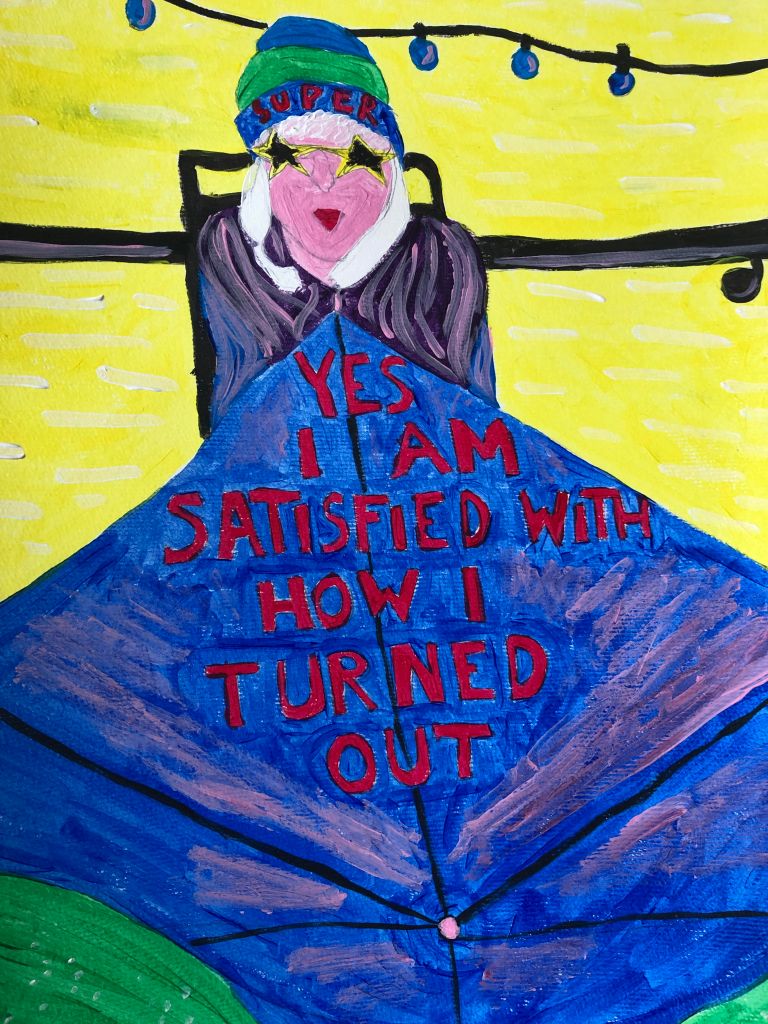
Alt text: A self-portrait in brightly coloured acrylics, in a cartoon-style.  My face is pink, and I’ve got ruby-red lips, forming into a pout.  I have white hair.  I’m wearing sunglasses with yellow, star-shaped frames, & a blue and green woolly hat with the word ‘Super’ in red across it.  I’m wearing a purple, pink & blue cape.  I’m sitting in a black wheelchair but only the top half of my frame is depicted because I’m holding a large, opened blue umbrella that hides my lower frame.  Upon the umbrella in red capitals is the slogan “Yes I am satisfied with how I turned out.”  I’m painted against a yellow, white & green background, with a black handrail and blue garden lights.

Self-Esteem:

My self-esteem has really been affected by my cancer diagnosis.  I’ve found it particularly difficult to manage my emotions & #Lockdown hasn’t helped at all because I haven’t been able to talk it all out face-to-face with friends.  I’m also paranoid that my sole topic of conversation is cancer because it’s dominating my thoughts & there’s not much else currently going on in my life.

The first time that I felt any low self-esteem associated with cancer was during an early discussion with an oncologist (who isn’t my present oncologist).  It was a bit of a fraught time – it was the start of the pandemic; my operation had just been cancelled & we were discussing what medication would be appropriate whilst I was waiting for surgery.  I found the discussion hard because it was over the telephone.  It quickly became evident that the consultant knew very little about my disability or the medications that I was already taking. 

Out of nowhere she dropped this bomb into the conversation: as it was going to be too hard to give me radiotherapy, I should expect to have a mastectomy, & that would be a whole lot easier for me in the long run.  I was shell-shocked.  At that time, all any of us knew was that I had one tiny lump and I’d been told that a lumpectomy would be appropriate.  I was also advised that all further treatment would be planned out after the operation, but it would probably be radiotherapy. 

Over the years I’ve found that people are often fond of making assumptions and decisions about what’ll be best for me in the long run, without having a conversation with me first.  I’ve learnt that you sooner you put people straight, the better.  Trying to keep my anger in check, but failing miserably, my tirade went something along these lines:

“I might be disabled, but I’m disabled enough thanks…

Just because I’m disabled, doesn’t mean that I don’t take pride in my appearance & I’m as vain as hell…

I’ve got large breasts; going around with one missing will just look ridiculous & make me look really ugly…

I won’t be able to balance properly in my wheelchair, I already struggle to keep upright…

There is no way I’m going to let you do this for just one tiny lump…

I’m not going to be lopsided, it’s too obvious…”

The conversation with oncologist ended shortly after.

I was so mad; I love my boobs – I mean who doesn’t, right?  They’ve been my best asset since I was 11.

I was dead set on having a reconstruction.  I subsequently found out this was going to be difficult for me; the operation would be complex & the methods open to me were limited.  Bringing me in & out of repeated surgeries isn’t great for me (dodgy lungs).  As the consultant anaesthetist said a few weeks later, “Ideally, I wouldn’t put you under a GA (general anaesthetic) at all, but we have to do it because we have to save your life.  I’m confident of finding a way to make you safe whilst you’re under the GA & after surgery.”

The ideal and safest way for me to have had a reconstruction was to have it at the same time as the surgery, but this would have added more time to the operation.  For every hour that I’m under a GA, it shortens my lifespan by a year. The team were fighting to keep to the standard operation time for this surgery of an hour and a half (which they subsequently did).  Due to COVID-19 restrictions, Charing Cross had designated reconstructions to be ‘elective surgeries’, so they weren’t being offered at the same time as surgery, in fact, it was looking like a 1 – 2 year wait for one. 

Feeling pretty humiliated by now, I started researching how to get that part of the treatment done privately.  However, when I told the NHS team what I was planning, they said that I wouldn’t have to go private.  It was easier working with the consultant anaesthetist because she was a lot more patient & empathetic. She took the time to properly explain why the procedures were complex; Surgery time would be lengthened to 3 hours if we added a reconstruction; difficulties with implants might last into the years, possibly involving repeated surgeries. But most importantly she understood where I was coming from.  We were both relatively young & she said that like all young women, including herself, the thought of losing a breast is traumatic, especially if you’re not expecting to.  She said whether I was disabled or not, it was irrelevant to her because she was going to explore all the available options that she had.  That confidence & reassurance was so important for me to hear.

We agreed that considering my issues with balance and what I’d said about not wanting to look lop-sided, the team would perform a double mastectomy.  Two teams of surgeons would work on each side of my body to keep the operation to an hour & a half (normally one breast is done at each time, thus doubling the time of the surgery).

It wasn’t the greatest outcome & I knew it would drastically change my appearance. But it was a matter of saving my life as well as keeping my dignity.  I began to think about having an elaborate tattoo on my new flat chest & perhaps embark upon a crazy art installation where I was photographed with different things in place of my boobs.  I have some peer mentors from Breast Cancer Care Now. I contacted them because I wanted to find out about their lived experience of these surgeries & changes to their body, but as positive as they were, the prospect of being flat-chested made me feel so low.  When I asked my boyfriend what he thought about it, he said he’d rather have me alive above anything else, which halted me in my tracks – of course, what was I thinking, I’m hanging onto my boob which could actually kill me! But despite the life-threatening situation, this feeling of not wanting to lose my boob wouldn’t go away.

When I was in my early 20’s, I had a disastrous operation on my foot.  The wound got infected & the infection spread quickly.  The surgeon suggested an amputation on the grounds that my foot was causing me a lot of trouble and the best thing to do was to just get rid of it.  But I refused.  Ok, my foot didn’t work properly & it did cause me a lot of issues, but I loved my foot with its miniature toes, even if no one else could see its beauty.  And besides, that foot is mine.  In the end, I kept my foot & it eventually it healed well.  Once I had the chance to explain to my cancer team that I’d had the same strong reaction to possibly losing a boob as I did to when I was facing a foot amputation, they better understood me.

During this time, I was still working, & I had to make an announcement that our 20th anniversary party was cancelled due to the pandemic.  My colleague chose a lovely photo of me to illustrate the piece.  It was summer, I was on the viewing platform at a festival, I looked so happy, I didn’t have a care in the word.  I burst into tears when I saw the photo go online.  I believed that I was never going to look like that again, in fact, I was going to look bloody awful.

I stopped looking at photos for a while.

Literally two days before the operation, there was a breakthrough.  The lead oncologist returned from leave & insisted that partial radiotherapy could be successful for me – Breast Cancer treatment is increasing its use of partial radiotherapy & the success rate is high. Importantly, if we went down this route, then I could have a lumpectomy.  I agreed & we reverted to our original plan of lumpectomy followed by radiotherapy & drug therapy. There was no more talk of double mastectomy.  My boobs had a ‘stay of execution.’

Then “Alien Boob” came long.  After the operation, my boob swelled to double the size!  Believe me, it had a life of its own & I really wasn’t sure where it was going to end at one point.  It had physical impacts; I struggled to sleep on my front because it was painful, my breathing was restricted & my boob became so heavy that I couldn’t push myself in my wheelchair.  It was a nightmare!

I had the opportunity to see a couple of friends in the garden between surgery & radiotherapy which was lovely.  Photographs were taken & well, you could definitely see “Alien Boob!”  

I had another period of not looking at photographs.

The medical term for “Alien Boob” is seroma, which is a build-up of fluid after surgery.  I had my boob drained twice which was painless & such a relief to have done.

Other physical aspects of my appearance were changing. I lost a lot of weight in a short space of time after surgery & changed my diet to include more fresh ingredients, fruit but the weight came back on after Christmas & Easter.  It’s a nightmare to lose weight when you’re restricted in exercise.  I was warned that my hair might start thinning & my skin would wrinkle & appear sallow.  I’ve cut down how much I wash & brush my hair but it still falls out.  My elaborate rings appear dull against my sallow skin.  I know I’m 50, I’m not going to reverse the aging process & wouldn’t want to. Then again, I don’t want to speed up the aging process either, but I’m beginning to worry about just how old I’m going to look in a few years’ time!

I would have rather aged serenely and gradually, but I’m quickly turning into an old bag!

I don’t even know what I can actually physically do anymore.  Because I haven’t been able to get out & do physical activity, I’m still unable to judge how affected my right arm is by the surgery.  Consequently, this leaves me anxious about what my new level of physical ability might be.  It’s not really helpful for me to start being anxious about what I can achieve in the future, so I distract myself with listening to the radio & making art.

I realise that all this self-image ‘stuff’ is largely in my head & the perpetual downward spiral is only driven by me.  Now I’m trying to clamber out of it & forge my way back into the world.  

However, I’d argue that my low self-esteem isn’t just being driven by me.  I think some of it can directly be attributed to where we’re currently at with society’s perception of disabled people.  2/3 of disabled people have died in the pandemic & this is happening in plain sight with no one doing anything about it.  I’ve been told that I’m “clinically extremely vulnerable” & the only solution to keeping me safe is for me to stay at home (which is crap advice as I caught COVID-19 twice even whilst shielding for over a year – I mean what was the point of that?!)  I know all too well the DNR (Do Not Resuscitate) orders & who wouldn’t be first in the queue for a ventilator.  All of this makes me question how valuable my life really is to others.

My low self-esteem comes from my poor mental health too.  The treatment is forcing the Menopause on me at an accelerated pace & this is mentally as well as physically hard.  I have pretty much all the menopause symptoms, lucky me, so I feel I can’t escape the impending doom.

#Lockdown & the fear of catching COVID-19 again has definitely hampered my recovery because I can’t just get on with the rest of my life & get back to any kind of normality.  An important part of any recovery is reconnecting with people that you love, in person, as well as having routines. 

I’m struggling to find my place in the world.   Because I haven’t spoken in lengthy sentences for so long, & I’ve only used my profile and voice in limited ways over the past year, it takes some getting used to.  I’ve noticed that I have nagging doubts about whether I can be coherent, that just loads of words & emotions will come tumbling out in a jumbled-up mess & I’ll only pause for breath when I feel I’ve finished absolutely everything that I’ve got to say.

Sometimes I’m just really, really quiet.  It’s because I believe that my only topic of conversation is cancer & I’m going on too much about it, & that it’s over now & everyone’s bored of listening to me talk about it, including me.  I’ve stayed in for so long, that I’ve literally run out of other things to talk about – “So what have you been up to – er literally nothing!”

I also get tired really easily & extreme fatigue comes on very quickly.  I have fallen asleep mid-sentence on the sofa a few times.  That doesn’t make me feel great.  I really don’t want my loved ones to see me like this.

I’ve had physical & mental setbacks in my life before.  I became a wheelchair user at 25 but I embraced it & adjusted to life relatively quickly.  I’ve always had varying degrees of anxiety & taken rest & sought treatment when required.  In terms of incidents directly affecting my self-esteem, well I guess the big ones are the times when I’ve been dumped!  Like most people, I’ve always felt really bad & convinced myself that I’ll never find anyone to love me, but I’ve got over it in time. 

But nothing has impacted on my self-esteem like cancer has. 

Who the bloody hell am I?  I never thought I’d be asking this at 50.  It’s such a strange & upsetting place to be. 

Along the road to fighting to get back to myself, once again, art has saved the day. 

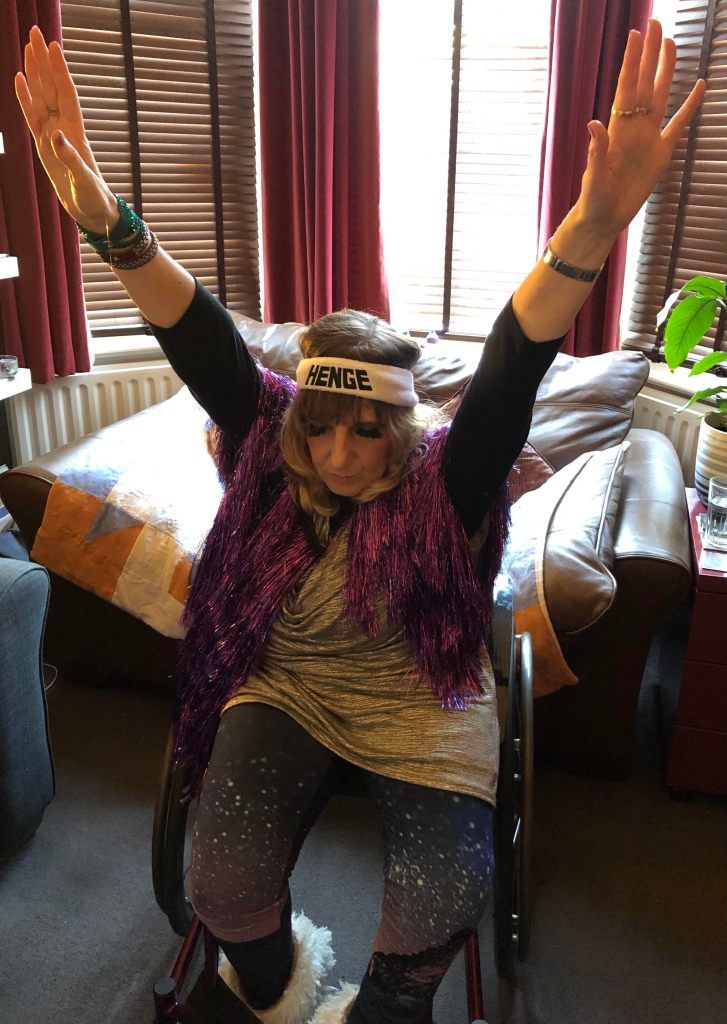
A couple of weeks ago, 64 Million Artists set us an art challenge to boost our self-esteem.  We had to create a piece completing the phrase “Yes I Am…”  Suddenly it came to me – I can’t stay in this spiral of feeling bad about myself, I don’t want to be like this, I’m beating myself up for no reason & I’m being too harsh on myself.  Then the phrase “Yes I am satisfied with how I turned out” came into my head, together with selfie photo of when I dressed up as a disabled superhero.  A few days later I turned the photo & the phrase into the painting that you see at the top of the blog.  It was my first try at painting with acrylics. 

It made me laugh a lot whilst I was painting it.  Of course, there’s no way I can let myself go into this downward spiral.  If I’m not happy with myself, then where does it end?  I’m well aware of the people that look at me & think “ah, shame” or “yep, she’s spent time at the back of the class with raffia,” so what the hell am I doing adding to all those negative voices by being self-critical? 

This painting has very little to do with me having a huge ego, but it does have everything to do with self-preservation. 

Self-preservation, the only way to get yourself through life.  Stay safe, kids!

The All-Clear

Alt text: A coloured photo selfie of me – a white woman with blond hair, wearing black-rimmed glasses, a Perspex protective visor with a white, plastic headband, a face mask designed in the colours & shapes of the ‘Day of the Dead,’ a long, pink scarf and a black puffa jacket with white-coloured hearts on it. I’m on a cobbled towpath & behind me is a long, brightly coloured boat called the ‘May Green.’  It’s covered in bright, metallic flowers & painted in vibrant rainbow colours.  The boat is a restaurant with a lower deck (indoors) & an upper deck (outdoors).

The All-Clear:

A whole year ago today (on the 10th March 2020), I was diagnosed with early-stage breast cancer.  Now I’m sitting here (on the 10th March 2021), having just received the news that my annual mammogram was “normal.”  As a disabled person, I’d usually recoil at the word “normal”, but for once, I’m overwhelmed with joy that I’m normal!  The rush of relief that I got when I read the confirmation letter was extraordinary.

I’m so proud of myself for getting through the first year of treatment.  I’m so glad that I was surrounded by amazing family, friends, my personal care assistants & my colleagues – when I say surrounded, it’s been by virtual means, but believe me when I say the love just flowed out of the phone & laptop screens.  Their laughter & positivity kept me going.  I’m also so happy that I live with my boyfriend; he’s more commonly known as ‘Im Indoors.’  He’s funny, creative, gentle, selfless & exceptionally kind; riding the #Lockdown by my side whatever it’s thrown at the two of us.

I can’t actually believe that I got through the first year of treatment with an all-clear.  I was facing many hurdles & complications both in surgery & treatment because of my impairment – there was the question mark about whether I’m receiving enough treatment to keep recurrent breast cancer at bay (this still hangs over me & I may be changing treatments as soon as this spring).  Then all the hurdles & complications because of the impact of COVID-19 on the healthcare system – my surgery was delayed for 4 months, the cancer only being kept at bay by tamoxifen, which thankfully has worked.  On top of that, I caught COVID-19 twice, despite shielding for a year.  But I still got through my first year.

I definitely have more than 9 lives.

Having spent years in hospitals & with GP’s, you’d think I’d be used to waiting by now, but in general, I’m a very impatient person.  I’ve done more than my fair share of waiting over the past year – waiting for appointments; on hold to speak with my nurse; waiting to see if the #Lockdown shielding restrictions will be extended; waiting on a lull in COVID-19 hospital admissions so I could have my life-saving surgery.

However, there is a particular type of waiting when it comes to any scans related to cancer.  I think that most cancer patients would agree that you’re only as good as your last scan result.  This type of waiting is anxiety-inducing to the point of gut-wrenching, nauseous turmoil, where your mind races & flips you into several different reality-bending scenarios at once.  Your body shakes (at the appointment where I was first diagnosed, I had to fold my legs away from my wheelchair because they were rattling so audibly against it sides).  At best, you try to crack some jokes, most of them go unheard (perhaps those jokes were in my head & not said aloud?), at worst your tears are silent as you wait in shock.  Safe to say that it’s a horrific experience.

But those seemingly never-ending waits make the relief of getting the all-clear all so sweeter.

I’m unable to work out which of the recent waiting experiences I had was the worst.  It’s probably waiting for the CT scans & the bone scans from last July.  At my surgery, a small cancer was discovered in one of my lymph nodes & that immediately triggers the other scans to see if the cancer has spread anywhere else.  Face-to-face with my oncologist with the results, I almost blurted out “hey, may be don’t tell me, don’t ruin my life, let me go on in blissful ignorance until I die one day.” Interestingly, she started off by explaining the treatments & then remembered to say, “oh your scans were clear by the way!” It’s not a criticism of her, just interesting that she appeared to think that I wouldn’t be worried by the results being of any other outcome than a positive one.

Or the other wait which sticks in my mind on the operating table.  Most of my friends, both disabled & non, think that counting down until you pass out from the anaesthetic is a great feeling.  I don’t.  I positively hate this.  It’s mainly because I’ve got dodgy lungs & as this was the longest operation (90 minutes) that I’d had in years, I was hanging onto keeping awake for as long as I could.  Typical me, I came round completely fine a few hours later, no breathing equipment needed.

But back to the happiness because I am delirious with happiness!  The “normal” (normal, me, normal, who’d have thought!) scan results came in the middle of what I’ll look back on as one of the best weeks of my entire life.  I got my first COVID-19 jab (I noted that they’d called upon the army to administer the vaccinations, we’re obviously a rowdy lot in North Ken(sington) so I’m on the first rung to freedom.  I returned to the charity that I founded (Attitude is Everything) – albeit still working remotely, but very glad to be in the thick of conversations around supporting the recovery of live music & disabled people coming back to it, & not having endless discussions centred on cancer. 

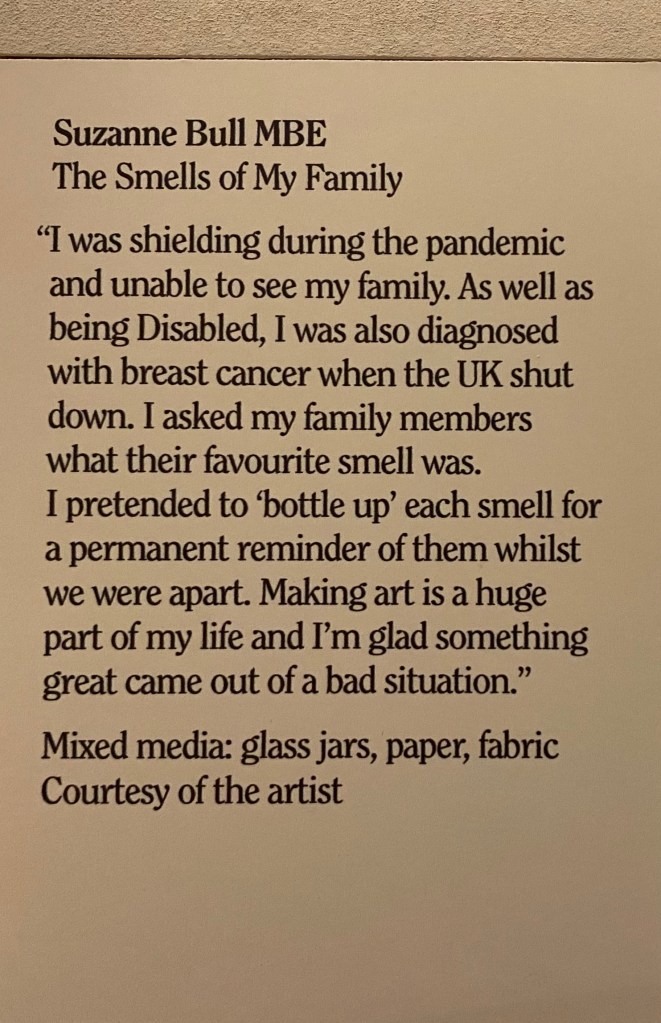
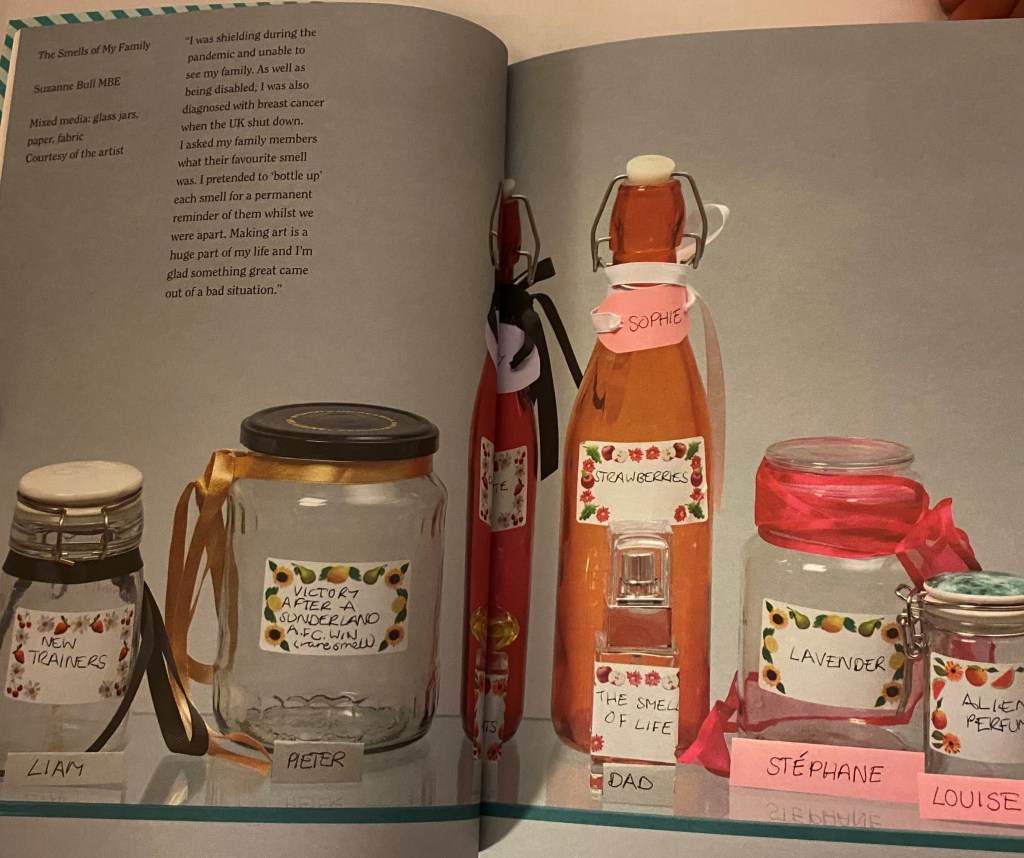
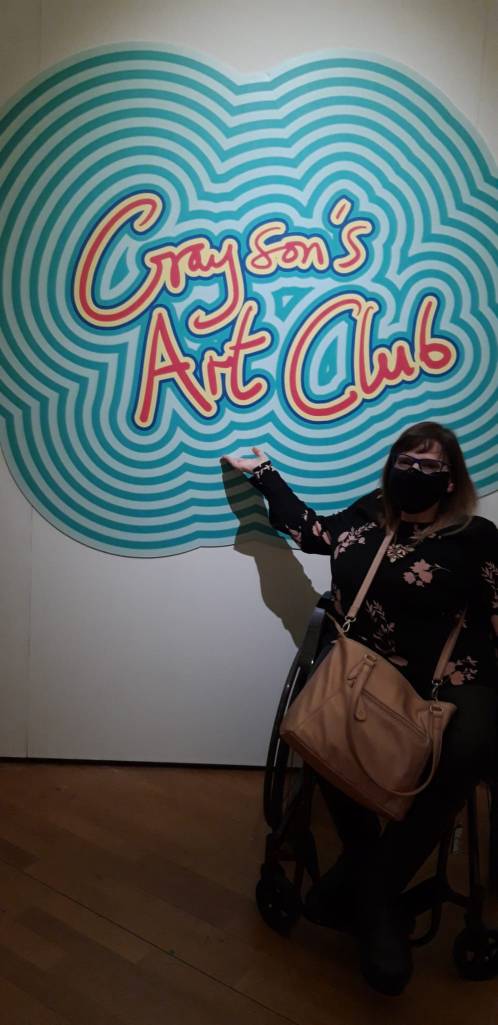
But best of all, I appeared on the first episode of the new series of Grayson’s Art Club with my conceptual art piece “The Smells of my Family.”

I’d watched the first series & it had really calmed me down, helping me make sense of my collapsing world.  I loved all the narratives about the artwork & the artists that Grayson brought together.  Interestingly, I’ve observed that there are quite a few disabled people and those with long term health conditions featured on the show.  Where funders have poured money into schemes and programmes to support disabled artists, here’s Grayson just being inclusive by nature & thus supporting the work of disabled artists on a show which goes out to millions, which I think is fabulous. 

At the same time as watching the first series, I did a few themes until I got sick through surgery & treatment, but I continued to think about creating work.  Then through the challenges of 64 Million Artists & my Art Therapy sessions, I started making art.  Anyway, these new adventures in art led me to submitting a piece for the ‘Family’ theme to Grayson’s Art Club.  Basically, triggered by an idea from 64 Million Artists, I expanded the piece that I’d made about bottling up all the smells of my favourite person (‘Im Indoors’), to bottling up the smells of all my family members.  I hadn’t seen most of my family for over a year, unless it was through a phone screen.  I needed to connect with them on a deeper level & often smells are a great way of evoking powerful memories (although, ironically, my smell still hasn’t come back after my latest spell of COVID).  I messaged them, saying I was doing an art project & I needed to know what their favourite smells were.  I had to chase them a few times (they’ve never taken me seriously as an artist, huh! 😉 & my sister Lou forgot so she just made a calculated guess for what my nieces and nephew would say. Being the piss-taker that she is, she put Lynx deodorant for my 13-year-old nephew!  My brother Liam & ‘Im Indoors’ both chose lavender (must be the favourite smell of star sign Leo’s) so I made Liam choose something else – he chose the smell of trainers having worked in a sports shop as his Saturday job.  My brother Pieter choose the smell of Sunderland AFC winning which we’d all agree, including him, is a rare smell & marked as such on the label. 

It was my dad’s choice that was my favourite & it’s very poignant for these times – he texted me to say, “I’ve thought a lot about all the usual, but decided that my current favourite smell is the smell of life.” 

So, I labelled up different sized & coloured jars & bottles with all the pretend smells & the actual names of my family, provided a short written piece & accompanying film to describe my work & why I’d made it, & pressed the submission button.

About a week (may-be it was less?) later, a got a call from a researcher, Adam, who is part of the Grayson’s Art Club team & we got talking about my artwork & me – in fact, he was so relaxed &  encouraging towards me, I think I gave him my whole life story (sorry Adam, I’m from Essex, we do love a natter!)

A few days after speaking with Adam, I was on the Zoom with Grayson himself, discussing my artwork & all about the circumstances leading to the creation of it.  Grayson was as lovely, funny, friendly & kind as you’d all imagine him to be, & more.  About a minute in, I became really nervous, but he was so relaxed, which calmed me, & then I just chatted away.  We had a much longer conversation than was edited into the programme & I want to relay just how empathetic & compassionate he was when I told him about being disabled & having cancer.  I really, really appreciated this.

I waited a few days to see if I was going to make the edit, & I was excited to hear that I did, & then I waited for the programme to go out, without telling anyone except three people who were either at home with me when the call came in or needed to know (my new line manager in case she thought I was going to bring our charity into disrepute!) It was so much fun surprising everyone!

I’m giving away a spoiler now for those who haven’t seen it, but at the end, Grayson asks me if I’d let him have my work for his exhibition.  I was thrilled. 

Not only has Grayson given me the opportunity to be in an art exhibition, but he’s also helped me turn a mind bendingly awful situation, into a positive one, for which I’ll be externally grateful.

Alt text: A coloured photo of my conceptual artwork submitted to grayson’s art club.  Different sized & coloured bottles & jars are laid out on an A3 art pad, labelled in black capital letters with their pretend smells & the names of each family member.  some of the jars & bottles are decorated with ribbons.  The backdrop is a white ventian blind which remains closed.

3.7

Alt text: an image created with watercolours of white circles painted onto a reddish-pink background.  The circles are in 4 different sizes & form a random pattern.  They represent my thought-processes as I was struggling to decide what to do for the best – literally, I was ‘going round in circles.’

3.7

Trigger warning: contains details about the side effects of cancer treatments & my emotions about the difficult decisions that I was faced with.

Before surgery, I’d agreed to a plan of a lumpectomy & partial (targeted) radiotherapy with the cancer team at Charing Cross, but of course, the plan can change once the surgeon can see exactly what’s going on during the operation.

My operation was delayed from March to July because of COVID-19 but I started tamoxifen (tablets) to halt the spread of cancer.  During surgery, the original lump that was found in my routine mammogram had shrunk, but a new little one had grown beside it.  Cancer was also found in one of my lymph nodes which made me feel sick with worry. Finding this shouldn’t have had quite such an impact on me because its presence was suspected during the biopsy, but because I’m pretty certain that my mum died of secondary breast cancer because it spread via her lymph nodes, my heart was filled with terror.  (30+ years ago, no one knew that removing nodes as part of breast cancer surgery may prevent the cancer spreading). 

Cancer in the lymph node triggered a CT scan & a bone scan; both my scans, thankfully, were clear, meaning the cancer hadn’t spread.

Due to the new growth in my breast, the cancer team wanted to try & confirm what was happening as well as finding the appropriate treatment for me – in short, whether I would benefit from having chemotherapy. 

In order to determine the best plan of action, the cancer team sent my lymph node to the US for testing (because the system that they needed isn’t available yet in the UK).  Yep, my little lymph node was flown halfway across the world to Salt Lake City for testing on the ‘Myriad’ system at the University of Utah (it’s an ‘EndoPredict’ system)!  I was amazed that they even considered doing this for me when they were dealing with a backlog of cancer surgery caused by the pandemic.  My breast cancer nurse even apologised that the result would take 2 weeks to come back!

My ‘EndoPredict’ score came back as 3.7.  Because a score of 3.3+ would usually advise that a patient has chemotherapy, that 0.4 ‘tip over’ meant that my oncologist had to discuss both the benefits as well as the side effects of treatment with me.  It became clear very early into the conversation that I already had many of the side effects that chemotherapy causes due to my impairment.  As she went down the list of side effects, I simply replied “yep, I have that already.”  I watched as her eyebrows raised further & further until she finally said, “you know, I think I’m going to talk all of this over with other colleagues & we’ll talk again in a couple of days.”

The team & I were left to mull over my quality of life versus preventing the cancer from returning.  The ‘EndoPredict’ also showed that I had 11% chance of “distant” cancer recurrence over 10 years (the term used for incurable cancer).  If I had chemotherapy, then this percentage reduces to 5%.  If you flip the figures around then without chemo, I already have an 89% of it not returning which are pretty good odds.

I’m fully aware that I could decide whether to have this life-saving treatment & so I hope my blog doesn’t come across as insensitive.  I know many people, including my mum & my sister, that had no choice at all – they had to have chemo.  What I’m trying to achieve with this blog is conveying some sort of sense of how difficult it was to make up my mind about it, & also the feeling that if I didn’t make the “right” decision, then if the cancer returned, it would all be my fault.  The side effects of the treatment & the number of needles that I would need to have (I have a needle phobia) truly terrified me, but then I got this bizarre notion into my head that I was being pathetic; that I was basing my judgements just on my phobia & fear of pain; that somehow people would think less of me because I’d’ wimped out’ & taken an easier option (I know, weird, right? But my cancer diagnosis has warped my brain).  

Believe me, it’s a hell of a lot to carry.

I had a video call with my sister.  She looked at me in all seriousness & said, “All I’m saying is, I wasn’t disabled until I had chemo.  You’re already disabled, think what impact it’s going to have on you, & if you don’t have to have it, don’t.”

A 6% benefit, that was all.

In the end, I did what I always do when faced with a dilemma, & I wrote out a list of ‘Pros & Cons.’  I was struggling to find ‘Pros’ when my oncologist rang back with a decision.  First, she asked me if I’d made a decision.  I said that I just couldn’t decide & I asked her what she thought.  She said that the team had come to the conclusion that just for a 6% benefit, it wasn’t worth risking my quality of life.  She said it with some nervousness as she knew how hellbent I was on getting all the life-saving treatment I could.  I cried with relief & then admitted that I was hoping that it would be that very decision.

Here’s the list of Pros and Cons – written in July 2020:

PROS

  • Once I’ve had it, there is only 5% chance of the cancer returning.
  • On paper, when you read about all my medical issues and impairments, I appear very incapable and disabled, but I’m actually more resilient in real life.  I came through surgery ok without a ventilator; blood gases normal and only one-night stay in hospital which wasn’t predicted.
  • I’ve never had a career-break, and this could well give me ‘head-space’ that I really need.
  • I’m well-supported at home and I’ve got some savings to tide me over (I haven’t got them now because like everyone else, I’ve been ordering random crap off the internet!)
  • I know I’d be well-supported and well-regarded by the team at Charing Cross.
  • I’d have peace of mind that every treatment was explored to prevent recurrence.
  • I’m struggling to find any more PROS.

CONS

  • All of the side effects – including bone-thinning, compromised lungs, numbness in my left foot but sometimes in my hands in the cold, chronic joint & neuropathic pain – I already have, and how much more will I be compromised?
  • It’s still a pandemic with no end / vaccine in sight and I’m high risk-COVID.  To lower my immune system, which is already compromised, is a gamble.  If I caught COVID-19, I probably wouldn’t survive (in hindsight, I had COVID-19 twice & wasn’t hospitalised or needed any treatment other than paracetamol.  Vaccines were approved in the latter part of 2020).
  • 6 months treatment is a long time to be isolating at home.  I’d miss a lot of my friends’ 50th birthday celebrations as well as my own (in the end, this didn’t matter because a new #Lockdown started in November 2020, so everyone largely missed out – thank god for ‘Zoom!’)
  • I’m never comfortable in hospital because I find them to be inaccessible and the nurses are too busy to assist me (not their fault!)
  • I’d want to negotiate PA (Personal Assistant) support to be accompanied whilst in hospital, but because of COVID-19, this might be tricky.
  • I’d be so, so tired.  I’m already wiped out by tamoxifen.
  • Being away from both my jobs and physically changing (loss of hair, etc.), I’m afraid of losing my identity and status.
  • I’m scared of making some of my impairments worse that it could ruin my quality of life, and I might not be able to work, go out, etc.
  • The margin is so small – 3.3 is low risk.  I’m only 3.7.
  • 89% chance of the cancer not returning is quite high.

Avoiding the guillotine.

As part of my recovery from breast cancer, I started a series of images that featured a guillotine, specifically from the French Revolution (I’m a French language student, no coincidence!)  I had this strong image in my head from the early days of diagnosis and it’s an image that’s grown stronger over time. 

Living with a cancer diagnosis feels like, for me, that there’s always something hanging over me.  Some days I can push this feeling more to the background.  Other days it’s right in the forefront of everything I feel.  Wherever it is on my spectrum of feelings, it’s always there like a soundtrack to my life.  Currently I struggle to control it when it dominates my every day thinking.  After speaking with others who were a little further along the survival journey than me, including my sister, feeling this every day might not go away for another 1 to 2 years. 

And it might not entirely disappear.

When I first presented my pictures to my art therapy group, one of the members said that she could relate to these images because she’d often felt like cancer was an axe hanging over her head. 

The idea to create a series of images with a common theme came from another member of our group.  She had created beautiful images on a theme of a female ballet dancer – in one image, the ballet dancer was wearing angel wings.

As soon as I saw her images, it all clicked into place how I needed to progress with my theme – strong images of a guillotine placed in various scenarios came into my mind.  I also knew that the depictions could get quite dark, although interestingly, all my creations on this theme to date have been hopeful and positive.

I have created 3 images so far (4 if you count a Christmas-themed one that I did of Santa’s reindeer pulling the guillotine behind it, but perhaps I’ll release this one for Christmas 2021!)  I’m not sure if I’ll create anymore guillotine images, or if I do, how many there will be in the end, or if their themes will be darker.  It seems to me that this is a theme to be produced over time and the images need to be created as and when I visualise them.

Image description: A photograph of an A5 sized water-colour pad, portrait orientation.  The background is painted in a dark blue water-colour paint with thick brush strokes.  An image of a cartoon black and white guillotine from the French Revolution has been printed out from a template that I found online, and glued down into the page.  The guillotine is “wearing” a cape – draped and glued into place over the guillotine are purple, yellow, and blue-coloured fake feathers.  Holding the feathers together is a pink pom-pom.  A red rubber band holds the page in place across the bottom of the picture.

The first guillotine-themed image that I created was from thinking about how much I missed dressing up to go out; so instead of doing this, the only way to express myself was to dress the guillotine up in party clothes.  In the past, whenever I’ve faced challenges, I’ve always tried to party them away; hence I’m hiding my fears (depicted by the guillotine) in party-wear (the feathered cape).  I deliberately chose vibrant, rainbow colours for the cape to give the maximum contrast to the black and white guillotine.

Image description: A photograph of an A5 sized water-colour pad, landscape orientation, placed on an orange tablemat.  The background colour is mixed blue and white water-colours, painted in thick brush strokes, to create a lightly clouded sky.  The same black and white, cartoon image of the guillotine is glued so it appears like it is floating in the middle of the page.  I used 3 different lengths of white cord from blinds which I attached to the guillotine to make them look like ropes.  Attached to the ropes are flying geese which I cut out from a Christmas card.  The guillotine also has its own cartoon rope, and I attached a robin to it, also cut out from a Christmas card.  I’ve created the image to look like the guillotine is being pulled up and away into the sky by the birds.  A red rubber band holds the page in place across the bottom of the picture.

It took me a while to get this image right, mainly because the blind cord wouldn’t stick down upon the painted page!  This image was created from my thoughts about how I just wanted someone or something to come and make all of the cancer go away; that the cancer would somehow float away from me by its own accord.  This is how I was feeling over the summer, waiting for a surgery date.  Hence the birds in a light blue and white sky, (my dreams) taking matters into their own hands and gently pulling the guillotine (the cancer) away from me.

Image description: A photograph of an A5 sized water-colour pad, portrait orientation.  The background colour is a vibrant green watercolour, painted in thick brush strokes.  The same black and white cartoon image of a guillotine is glued onto the page.  I’ve cut out a photograph of an outline of myself and glued it beneath the guillotine.  Because my arms are stretched upwards, my eyes are closed and I’m shouting, it appears that I’m lifting the guillotine high above my head.  I’ve used this same photograph in my first blog.  It’s a picture of me taken at Latitude Festival where I’m totally lost in the music.  I’m a white woman in a wheelchair (wheelchair not shown in the picture), wearing a black puffa jacket and black leather gloves, a woolly pink and green hat with pink tassels, purple reading glasses, a pink woolly scarf, and a small white cross-body shoulder bag.  A red rubber band holds the page in place across the bottom of the picture.

I think this could be my favourite image yet.  I think my face shows how dead set I am at pushing all of this cancer stuff (depicted by the guillotine) far away from me, but it’s heavy and difficult to push, and how it’s taking all my strength.  However, I think you can see pure joy in my face as I’m pushing upwards; in holding up the guillotine and how ready I am to throw it away.  I guess this relates to the feeling I had when I finished my radiotherapy, and I was allowed to “ring the bell” (many people get to do this when they finish different parts of the treatment) in the hospital.  I was ecstatic that day and I came home, then drank a whole bottle of champagne whilst sitting in my front garden in the pouring rain. 

Festivals are in my blood – rain has never put me off doing anything!

Completing the 64 Million Artists’ January Challenge – my first week

1st – 8th January 2021.

@64M_Artists

#TheJanuaryChallenge

http://www.64millionartists.com

One of the hardest things about recovery from cancer surgery & subsequent treatment, is that you’re never quite sure what your new level of fitness is going to be, & how long it might take for you to start feeling a little bit human again.  I’ve been so used to work-related tasks and goals, that I genuinely didn’t have a clue how to occupy my time whilst I on extended sick leave.  I was scared of doing anything too physical in case it stressed my body out, but at the same time, I didn’t want to sit and watch tv all day. 

As part of my recovery, I was offered a (virtual) Expressive Art course (posh word for Art Therapy) & I thought it would be fun to do.  This activity took my focus away from anything cancer related.  I’ve been pre-occupied with such unhelpful intrusive thoughts & anxiety about the cancer returning.  (Studies have shown that this is quite common for those people who have just finished treatment, & this can be a daily recurrence for 1 or two years).  By making stuff, it just re-programmes my mind so that I can immerse myself in an imaginative world.  It lowers my heart pace.  I breathe deeper; slowly lengthening the time I can concentrate.

Over the past few months, I’ve surprised myself in how creative I’ve been.  Obviously, we’re not talking ‘high art’ here, but the course has really sparked my imagination.  I’ve also started to write again as well & I’m even thinking about making little films.  This is all creative stuff that I used to do before my career went in a different direction, namely supporting live music.

January is normally a busy month for me because it’s my birthday month & the birthday month of some of my oldest & closest friends (big up the Capricorns!)  Many of them, like me, are turning 50.  The current circumstances we’re in has forced us physically apart, but we’ve still been virtually connected in zoom parties & such like.  However, I could sense that despite the frivolity & the online cocktail parties, January was going to be a long, dark month, so I was delighted when the 64 Million Artists’ January Challenge came along.  Signing up means you get a challenge each day for the entire month of January.  The tasks are picked from the public’s suggestions & then set by three artists – Tourette’s Hero (Jess Thom), Lemn Sissay & Yomi Adegoke.  I’m doing Jess’ challenges because I know & admire her.  (Well nearly all of them, there was one that I couldn’t do because I couldn’t put music on a little film I’d made, so I had to switch artists for a day!)  The emails drop about 7am each day & I’m genuinely excited for the anticipation of what the task will be.

It’s not just art-based; some of the tasks you can write stories & poems, draw cartoons, or make films.  The best thing about the creative challenges is that it allows you to just be really silly – for example, my favourite task was dressing up as a Superhero & turning one of my impairments into a superpower. Jess basically turned Tourette’s into a Superhero character & I love this idea that what others might perceive as a weakness about you, the perspective can be changed so it becomes your greatest strength.  I have an affinity with Jess’ idea.  When I was a little kid, my friends decided to name me “Super Sue” & I’m not sure which of the adults around me did this, but they made me a red cape with red & gold letters spelling out the words “Super Sue” on the back. 

I also loved the ‘Little Pocket of Hope’ task which I made the day after my 50th.  That task is dedicated to all my wonderful friends who took part & made it the perfect #Lockdown birthday.

I’ve been brave enough to publicly share my creations on Twitter & this has worked out well for me – thankfully!  I hardly use twitter because I feel quite negative towards any kind of trolling & I’m really shy about sharing any creative work; in general, I hardly ever show my creations to anyone.  I’ve been frankly chuffed by the positive feedback & the few retweets that I’ve had.  I’m banking on the fact that sharing my 64 Million Artists’ creations & sharing my blog site will help me overcome my anxieties about being judged.

Anyway, I’ve posted my first weeks’ worth of tasks below.  I hope you enjoy them.  Aside from the film which I haven’t posted on my blog, each photo has an image description underneath.

Day 1:

This task was all about ‘Conversations with a Lamp Post.’  It was New Year’s Day & although I wasn’t drinking, I did feel rough!  The task was all about what conversations you might have with inanimate objects.  I filmed whilst I was still in bed.   I chose my reusable drinking straw as my object & our conversations were based on how the straw had served me well during the times when I’m ill & can’t reach my drink, & how using it to drink cocktails as well as during ill times wasn’t necessarily related (honest!)

Day 2:

This task was about ‘Hidden Faces.’  A face appeared from a slice of my birthday cake & said “I can’t believe you made it to 50!” 

Image description: Pieces of chocolate sponge marble cake with chocolate buttercream icing is arranged on a wooden chopping board into the shape of a face.  There are two pieces of buttercream icing shaped into eyebrows, two eyes are shaped from the plain part of the sponge cake, & the nose and mouth are shaped from pieces of the chocolate part of the sponge.

Day 3:

‘Little Pocket of Hope’ – My one has a message of hope that is about always being there for my friends & placed in the pocket for them is a red velvet heart (to squeeze when you need comfort), a Robin (one visits me in the garden to cheer me up), a peppermint tea bag (everyone needs a calming cup of tea), a little notebook (to write down all your happy times & revisit them when you need cheering up) & a fountain pen (to write with).

Image description: A circle made out of two pieces of white card glued together is placed upon a black carpet.  One circle is folded in half to form the pocket.  Inside the pocket are the following items: a peppermint tea bag in a lime green coloured packet with “Jarv is…Beyond The Pale…Peppermint Jungle Herbal Tea” written on it in white writing.  Next to it is a Robin cut out from a Christmas card.  Tucked behind the Robin is a gold & yellow-coloured fountain pen with white flowers on it.  Next to the Robin is a red-coloured velvet heart with gold beads on it & a gold thread – it’s a Christmas Tree decoration.  Tucket behind the heart is a light green coloured notebook with a gold design of a thistle & the word “notes.”  Written on the lower half of the pocket in black felt tip pen are in capital letters “A circle is round and never ends, and that’s how long I’ll be your friend.”  There is a palm of a hand printed in the middle, made from a pre-made bespoke printing block.

Day 4:

My disability superpower is my old bones telling me it will rain a day before it actually does, so if I point my umbrella at you on a sunny day, you’d better take action & grab your umbrella to prepare for the following day!

Image description: A white woman with bleached blond hair & ruby red lipstick, sitting in a black electric wheelchair, is in her back garden.  She has her back against a brick wall & there are a few plants in plant pots around her as well as little bulb garden lights.  She is wearing a white, orange, and navy-blue coloured woollen bobble hat with the word “super” knitted in white & pink, orange-rimmed sunglasses shaped into two stars & a cape made from purple & blue tinsel.  She is pointing a large, royal blue umbrella out in front of her, which hides her legs. 

Day 5:

‘Thinking Inside the Box’ – ‘The Mini Jam Jar Beach Scene.’

Image description: a mini glass jam jar on a painted white shelf against a black background. Inside the jar is some light golden-brown sugar for sand. Stuck in the sand is a pink cocktail umbrella which is the parasol. Lying on top of the sand is a piece of pink ribbon which is the beach towel. This is all resting against a backdrop of white foam, green-blue sea & blue sky with white clouds & a yellow sun, painted in water colours.

Day 6:

‘Find the Rainbow’ from items around you.

Image description: an old teddy bear wearing a knitted red suit, a black & white handkerchief as a scarf & various badges with slogans, a yellow gel pen, a pink plastic hairbrush with black bristles, a green bracelet with green stones, small purple ceramic plant pot, an orange-coloured lip & cheek colour in a tube, a blue necklace shaped in the words ‘European’ with a small gold star & a silver chain.

Day 7:

‘Light as A Feather’ – here’s my little homemade bird, stopping for a rest & a drink.

Image description: A little homemade bird stops to drink from a pool which is made from light blue card & covered with fake blue & green feathers. Two small pink fluffy pom-poms form the head & body of a little bird. It’s wings & tail feather are made from fake feathers which are bright blue in colour. Its beak is made from a small piece of yellow card, cut into the shape of a diamond.

Day 8:

‘The Actual’ is about the frustrations of online shopping, expressed in a poem.

Image description: A white A4 sized pad lays on a background of rose brown piano. The poem’s words are written with a black felt tip pen as follows –

THE ACTUAL

“I wait, in anticipation, in fear, in anguish

The app isn’t working, the website has crashed

Hopes of a homemade cheese & potato pie fading; ##As the ‘Orange Circle of Doom’ keeps rotating.

Since when did booking an online shop

Become as stressful as securing a Glastonbury ticket

Why do I care so much about my brand of toilet roll

And whether, within the order, my favourite crisps will be with it?

I might be on the Extremely Clinical Vulnerable List

But my letter came too late

I suspect I wasn’t the only one unable to register

After the cut-off date.

So here I am, with all the other poor buggers, 8,000th in the online queue

Craving the day when I can return to the shop

And exchange some friendly banter with the security guard

Please, someone, make this s**t stop!